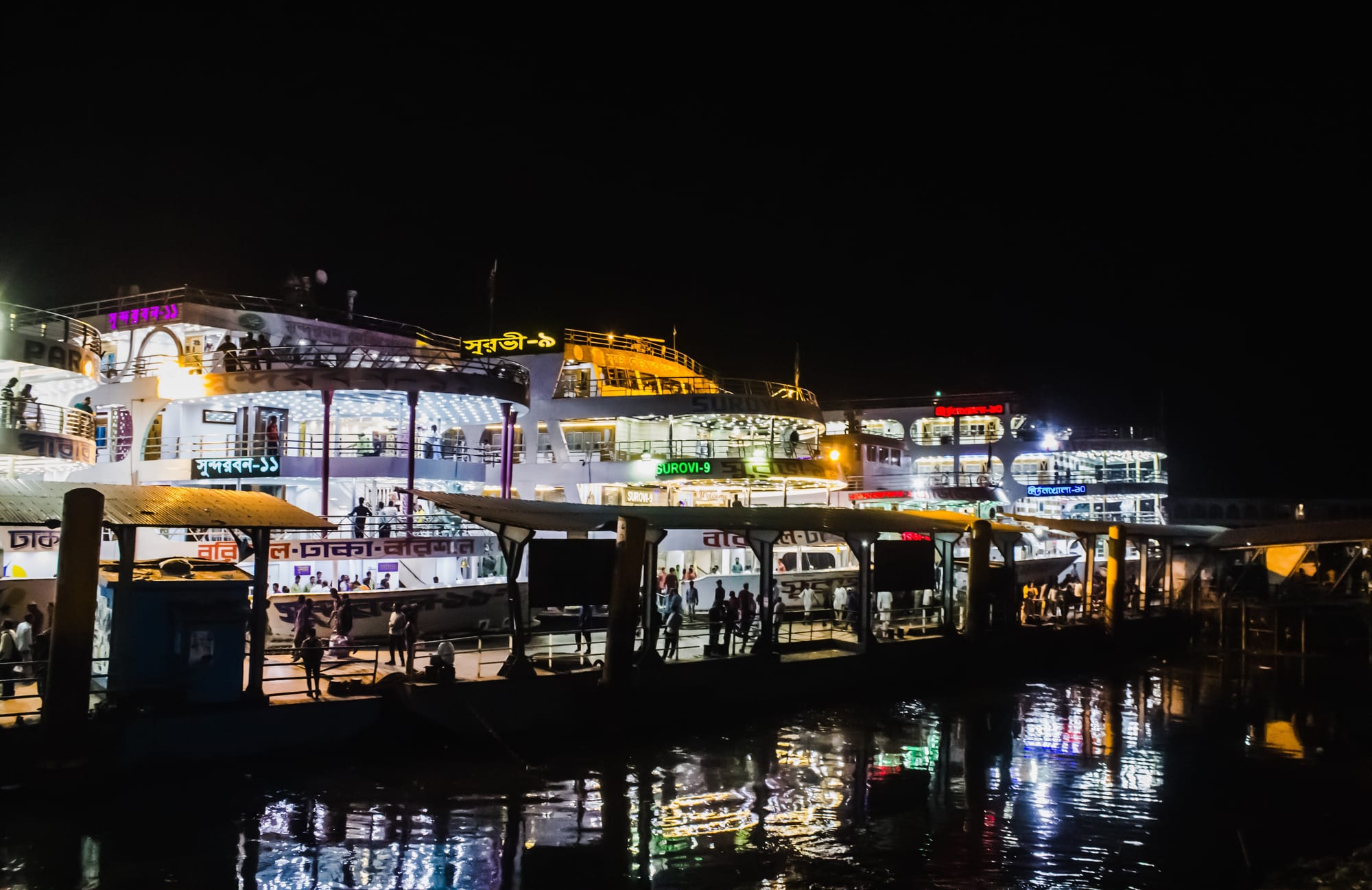
Brightly lit multi-deck passenger launches moored at a jetty at night, their lights reflected in dark river water

Dhaka & Central Bangladesh, Bangladesh

Dhaka

Passenger launches lit up at night at the Sadarghat terminal on the Buriganga River in Dhaka. (Md Shaifuzzaman Ayon / Wikimedia Commons · CC BY-SA 4.0)

The capital of Bangladesh, on the north bank of the Buriganga River in the middle of the delta. A Mughal provincial capital famous for its muslin, then a colonial district town, it became the capital of East Pakistan and in 1971 of an independent country. It is now one of the most densely populated cities on earth, with a Mughal old city, a river port and a ring of garment factories.

Neighbourhoods

  • Old Dhaka
    • Historic district
    • Best for food
    • First-time visitors

    The Mughal and Nawabi city along the Buriganga, a dense grid of lanes, courtyards and workshops holding Lalbagh Fort, Ahsan Manzil, the Star Mosque and the river port at Sadarghat. Its long-settled families speak their own Dhakaiya form of Bengali, and the area is known across the country for its food.

    Open in Maps
  • Ramna and Shahbagh
    • Museums
    • Parks
    • Arts and culture

    The civic and intellectual quarter laid out under the British, where the University of Dhaka, Curzon Hall, the Bangladesh National Museum, the Shaheed Minar and the greenery of Ramna Park stand close together. Bookshops, tea stalls and political gatherings all belong to these few blocks.

    Open in Maps
  • Gulshan
    • Hotels
    • Restaurants
    • Quiet and residential

    A planned district of the northern city built around two lakes, home to most embassies, international offices and the larger hotels. Streets are wider and calmer than elsewhere, and the restaurants and supermarkets are the most expensive in Bangladesh.

    Open in Maps
  • Banani
    • Restaurants
    • Nightlife
    • Hotels

    Immediately north of Gulshan and similar in character, with a denser run of restaurants, cafés and offices along its numbered roads. Many visitors stay here or in Gulshan and travel south into the older city by metro or car.

    Open in Maps
  • Dhanmondi
    • Local life
    • Cafés
    • Parks

    A residential area west of the centre built around Dhanmondi Lake, with a lakeside walking path, schools, clinics and a long-standing student and middle-class culture of cafés and music schools. It is associated with the political history of the 1970s.

    Open in Maps
  • Motijheel
    • Business district
    • Close to public transport

    The old commercial centre south-east of Ramna, full of banks, insurance offices and the national mosque nearby. It is the southern terminus of the metro line and is busy on weekdays and quiet at weekends.

    Open in Maps
  • Uttara
    • Close to the airport
    • Quiet and residential

    A planned suburb in the far north laid out in numbered sectors, close to Hazrat Shahjalal International Airport and the northern end of the metro. It is convenient for early flights and for travel out of the city, but far from the historic quarters.

    Open in Maps
  • Mirpur
    • Local life
    • Sport
    • Shopping

    A large working- and middle-class district in the north-west, with the national cricket stadium at Shere Bangla, the botanical garden and the zoo, and markets selling clothing from the garment trade.

    Open in Maps

Things to do

Old Dhaka landmarks

  • Lalbagh Fortlandmark

    An unfinished Mughal fort begun in 1678, whose walled garden holds the tomb of Pari Bibi, a mosque and the governor's hall.

    Open in Maps
  • Ahsan Manzillandmark

    The pink riverside palace of the Nawabs of Dhaka, built in the 19th century and now a museum of their household and the city's late colonial era.

    Open in Maps
  • Star Mosquelandmark

    A small mosque in Armanitola whose walls and domes are covered in china-clay mosaic worked into stars, flowers and landscapes.

    Open in Maps
  • Armenian Church, Dhakalandmark

    A church of 1781 with a walled graveyard in Armanitola, the surviving trace of the Armenian merchants who traded in Bengal.

    Open in Maps
  • Dhakeshwari Templelandmark

    The national Hindu temple of Bangladesh, whose name is linked to the origin of the city's own, and the focus of Durga Puja in Dhaka.

    Open in Maps
  • Hussaini Dalanlandmark

    A Shia imambara from the Mughal period beside a tank, the centre of the city's Muharram observances.

    Open in Maps
  • Rose Garden Palacelandmark

    A late 19th-century mansion in Tikatuli with a colonnaded front, remembered as a meeting place in the political history of East Bengal.

    Open in Maps

Modern Dhaka landmarks

  • Jatiya Sangsad Bhabanlandmark

    Louis Kahn's parliament building at Sher-e-Bangla Nagar, completed in 1982 — a geometry of concrete and marble set in an artificial lake.

    Open in Maps
  • Curzon Halllandmark

    A red-brick hall mixing Mughal and European forms, begun in 1904 and finished in 1908, now part of the University of Dhaka's science faculty.

    Open in Maps
  • Shaheed Minarlandmark

    The monument to the students killed in 1952 while demanding recognition of Bengali, where crowds lay flowers each 21 February.

    Open in Maps
  • Baitul Mukarramlandmark

    The national mosque, a cube-shaped building near Motijheel completed in 1968, with room for more than forty thousand worshippers.

    Open in Maps

Museums

  • Bangladesh National Museummuseum

    The country's main museum at Shahbagh, covering natural history, Bengal sculpture and terracotta, folk art and the independence struggle.

    Open in Maps
  • Liberation War Museummuseum

    A museum in Agargaon devoted to the 1971 war, built on donated personal belongings, photographs and documents.

    Open in Maps
  • Bangabhabanlandmark

    The presidential residence in Ramna, a colonial-era house in large gardens, seen from outside rather than visited.

    Open in Maps

The river, parks and lakes

  • Sadarghattransit hub

    Dhaka's river port, where multi-deck launches load for the southern delta and small rowing boats ferry people across the Buriganga.

    Open in Maps
  • Ramna Parkpark

    A large park of old trees and a lake in the middle of the city, where Pahela Baishakh begins with singing at dawn.

    Open in Maps
  • Hatirjheelpark

    A reclaimed lake and waterway east of Gulshan, ringed by walkways, bridges and a loop road, busy in the evenings.

    Open in Maps
  • Bahadur Shah Parkpark

    A small square in Old Dhaka with a memorial column, laid out on ground tied to the events of 1857.

    Open in Maps

Markets and street life

  • Chawk Bazaarmarket

    The old wholesale market of Dhaka, trading in everything from plastics to perfume, and famous for its vast evening iftar stalls in Ramadan.

    Open in Maps
  • Shankhari Bazarneighborhood

    A narrow Hindu street of tall, thin old houses where conch-shell bangle makers still work at their traditional craft.

    Open in Maps
  • New Marketmarket

    A covered shopping complex of the 1950s near Dhaka University, with hundreds of small shops for cloth, books and household goods.

    Open in Maps

Short trips from the city

  • Jatiyo Sriti Shoudholandmark

    The national martyrs' memorial at Savar, north-west of the city — seven concrete planes of different heights rising over mass graves from 1971.

    Open in Maps
  • Panam Citylandmark

    At Sonargaon east of Dhaka, a single abandoned street of decaying 19th-century merchants' mansions.

    Open in Maps
  • Baliati Palacelandmark

    A zamindar complex in Manikganj district west of Dhaka, with rows of columned facades around inner courtyards.

    Open in Maps

Seasonal events

  • Ekushey Book FairFebruary

    A month-long book fair run by the Bangla Academy, held in the month of the language movement and central to Bengali publishing.

  • Language Martyrs' Day21 February

    Crowds walk barefoot to the Shaheed Minar with flowers to remember the students shot in 1952; UNESCO marks the same date worldwide.

  • Pahela Baishakhmid-April

    The Bengali new year, which begins with songs under the banyan tree at Ramna Park and a masked procession from the university's fine arts faculty.

  • ShakrainJanuary

    A kite festival at the end of the month of Poush, when the rooftops of Old Dhaka fill with kite-flyers and, after dark, fireworks.

  • Bishwa IjtemaJanuary or February

    One of the largest Muslim gatherings in the world, held on the bank of the Turag at Tongi on the northern edge of the city.

  • Dhaka International Film FestivalJanuary

    A festival of Bangladeshi and international films shown at cinemas and cultural centres around the city.

Eat and drink

Long-standing places and food districts in Dhaka. Hours, ratings and directions come from your maps app, always current.

Dhaka classics

  • Haji Biryanirestaurant

    One of Old Dhaka's oldest eating places, begun as a roadside stall in 1939, serving goat biryani in the city's own style with borhani to drink.

    Open in Maps
  • Beauty Boardingrestaurant

    A courtyard eating house in Old Dhaka long known as a gathering place for Bengali writers, poets and artists, serving plain Bengali rice-and-fish meals.

    Open in Maps

Food districts and markets

  • Old Dhaka's biryani streetsneighborhood

    The lanes around Nazira Bazar, Nawabpur and Chawk Bazaar hold the city's kacchi biryani, morog polao and tehari shops, along with bakarkhani bakers and sellers of the yoghurt drink borhani.

    Open in Maps
  • Chawkbazar iftar marketmarket

    Through Ramadan the old market becomes an open-air fair of fried and grilled iftar food, kebabs, haleem and syrup-soaked sweets sold from late afternoon.

    Open in Maps
  • Gulshan and Banani restaurantsneighborhood

    The northern districts hold most of the city's international cooking — Thai, Chinese, Indian, Middle Eastern and Italian — alongside coffee shops and modern Bangladeshi kitchens.

    Open in Maps
  • Sweet shopsneighborhood

    Bengali sweet shops across the city sell roshogolla, chomchom, sandesh and mishti doi, the thick sweetened yoghurt set in clay pots.

    Open in Maps

Experience Dhaka

History

Dhaka grew where the Buriganga gave access to the whole delta. Settlements existed here under the Bengal sultans, but the decisive moment came in 1610, when the Mughals made it the provincial capital of Bengal and renamed it Jahangirnagar. For about a century it was one of the richest cities of the empire, exporting the fine cotton muslin woven in the villages around it and trading with Armenian, Portuguese, Dutch, French and English merchants. Lalbagh Fort was begun in 1678 and never finished, and the tomb inside it holds the daughter of the governor Shaista Khan.

When the Mughal capital of Bengal moved to Murshidabad early in the 18th century, Dhaka declined sharply, and the collapse of the muslin trade under British rule left it a provincial town. Two things revived it: the wealth and public works of the Nawab family at Ahsan Manzil, and the short-lived province of Eastern Bengal and Assam between 1905 and 1911, which briefly made Dhaka a capital again and left Curzon Hall behind. The University of Dhaka opened in 1921.

After partition in 1947 Dhaka became the capital of East Pakistan, and its streets carried the defining events of the national story: the shooting of students demanding recognition of Bengali on 21 February 1952, Sheikh Mujibur Rahman's speech at the Racecourse on 7 March 1971, the army crackdown of 25 March, and the Pakistani surrender on the same ground on 16 December. Since independence the city has grown enormously, pulled by government, trade and the garment industry, and in July and August 2024 it was the centre of the student-led uprising that ended Sheikh Hasina's government. An interim government under Muhammad Yunus followed, and after the 2026 general election the Bangladesh Nationalist Party returned to power.

Culture & Customs

Old Dhaka has an identity of its own within the capital. Its long-settled families speak Dhakaiya, a local form of Bengali carrying Urdu words, and are known for their banter, their neighbourhood loyalties and above all their food. In January the rooftops fill with kite-flyers for Shakrain at the end of the month of Poush; in Ramadan the lanes around Chawk Bazaar turn into an evening market of iftar dishes; and the Hindu street of Shankhari Bazar still has conch-shell workers and keeps Durga Puja around the Dhakeshwari temple.

The newer city is a capital of publishing, theatre, music and argument. The Bangla Academy's Ekushey Book Fair fills February, the month in which crowds walk barefoot to the Shaheed Minar to remember the language martyrs — a day UNESCO adopted as International Mother Language Day. Pahela Baishakh in April opens with the singers of Chhayanaut under a banyan tree in Ramna Park and a large procession of masks and papier-mâché animals from the university's fine arts faculty. Shahbagh, the junction between the university, the museum and the hospital, is where the city gathers to protest.

Cricket is followed intensely, and a Bangladesh match empties the streets and fills the tea stalls. Rickshaw art — painted panels of film stars, flowers and landscapes on the backs of cycle-rickshaws — is a recognised folk craft of the city and has been listed by UNESCO as intangible cultural heritage. Manners are warm and formal: elders are addressed with respect, guests are fed generously, and dress in public is modest by habit rather than rule.

Daily Life

Around ten million people live within the city's two corporations and more than twenty million in the wider metropolitan area, which makes central Dhaka one of the most densely populated places in the world. Growth is fed by migration from the countryside, much of it into the garment belts of Gazipur, Savar and Narayanganj around the edges, where hundreds of thousands of workers, mostly women, fill the roads at shift changes. Government, banking, universities, hospitals and a large technology and outsourcing sector are concentrated in the city itself.

The day is organised around traffic. People leave early, work long hours, eat lunch at their desks or from a roadside stall, and reach home late; a journey of a few kilometres can take an hour. The metro and the elevated expressway have shortened some routes, but congestion, monsoon flooding, winter air pollution among the worst measured anywhere, a shortage of affordable housing and the polluted water of the Buriganga remain the city's daily problems.

Neighbourhood life is strong all the same. Tea stalls serve as meeting points, small shops stay open late, and each mahalla has its mosque, market and cricket pitch of sorts. The wealthy live in Gulshan, Baridhara and Dhanmondi; the middle class in Mirpur, Uttara and Mohammadpur; and much of the workforce in dense low-rise settlements between them. At the two Eids the city empties as millions travel home to their villages, and for a few days its streets are quiet enough to walk.

Food

Old Dhaka is the country's most famous kitchen, and biryani is its emblem. Kacchi biryani — raw marinated mutton layered under rice with potato and cooked slowly in a sealed pot — is the dish of weddings and celebrations, served with borhani, a thin, salty spiced yoghurt drink with mint. Alongside it come morog polao, a chicken pilaf, and tehari, a yellow rice dish with cubes of beef. Bakarkhani, a thick, dry, layered flatbread from the Mughal kitchen, is eaten with morning tea, and grilled kebabs and chaap are sold from pavement griddles after dark.

The everyday food is delta food: rice, dal, vegetable bhaji and fish curry, with hilsa the most prized fish of all, and a plate of bhorta — mashes of aubergine, potato, dried fish or lentils with mustard oil, chilli and onion — accompanying almost any meal. Khichuri, rice and lentils cooked together, is what Dhaka eats when it rains. In winter, roadside stalls sell pitha, rice cakes steamed with date-palm jaggery and coconut.

Ramadan reshapes the food year: the Chawkbazar market sells haleem, jilapi, fried snacks and a famous mixed platter, and families break the fast with dates, chickpeas and puffed rice. Sweets are taken seriously — roshogolla, chomchom, sandesh and mishti doi, the sweetened yoghurt set in clay pots. Tea comes milky and sweet from stalls on every corner, and the northern districts add coffee shops and the widest choice of foreign cooking in Bangladesh.

Planning tools

Budget

Dhaka is the most expensive city in Bangladesh, and almost all of that is the hotel bill: Gulshan and Banani are priced for business travellers, while guesthouses elsewhere are very cheap. Food, rickshaws, the metro and museum entry cost little. A car with driver for a day out of the city, or repeated ride-hailing across town in traffic, is the other real expense.

Daily Budget Midrange
USD 55–120 (Gulshan or Banani hotel, restaurant meals, car with driver for day trips)
Daily Budget Shoestring
USD 20–35 (guesthouse, Old Dhaka street food, rickshaws, buses and the metro)

Staying near a metro station or in the part of the city to be seen next saves hours; many of the best things to do, from the old lanes to the riverbank, cost nothing.

Best Time to Visit

November to February is the comfortable season, dry and mild, though December and January mornings bring heavy fog and the worst of the winter smog. March to May is very hot before the rains. The monsoon from June to October waterlogs streets. The city is at its liveliest at Pahela Baishakh in April and on Ramadan evenings, and empties at the two Eids, when millions travel home to their villages.

Suggested Number of Days

Two or three days covers the old city and the museum and parliament quarter without fighting the traffic too hard. Four or five allow day trips east and north-west of the city. Traffic, not distance, decides how much fits into a day.

First Visit
2–3 days
With Surroundings
4–5 days

Transportation

Cycle-rickshaws are the way to move within a neighbourhood, and CNG auto-rickshaws or ride-hailing apps between them. The elevated metro runs north to south from Uttara through the middle of the city towards Motijheel and is by far the quickest way along that corridor. Buses are cheap, crowded and hard to use without Bengali. An elevated expressway crosses the city from the airport southwards.

Agree the fare before setting off in a rickshaw or CNG, or use an app; allow far more time than the distance suggests at rush hour.

Airport & Station Connections

Hazrat Shahjalal International Airport at Kurmitola, about 17 kilometres north of the centre, is the country's main gateway, with flights from the Gulf, South and South-East Asia and Europe and domestic services to Chattogram, Cox's Bazar and Sylhet. Intercity trains use Kamalapur station and the airport station. Long-distance buses leave from terminals on the edges of the city, and passenger launches use Sadarghat.

Walkability

Walking is how Old Dhaka is best seen — its lanes are too narrow for cars and full of interest — and Ramna, Shahbagh and the university area are pleasant on foot. Elsewhere the city is hard going: pavements are broken or occupied, crossings are rare, traffic is heavy and the heat and air quality tire people quickly. Distances between districts are long, and most residents combine short walks with rickshaws.

Safety

Violent crime against visitors is uncommon and foreigners are usually met with curiosity and hospitality. The everyday hazard is road traffic. Pickpocketing is common at Sadarghat, the railway stations and in crowded markets. As the political centre of the country, Dhaka sees demonstrations and strikes that can shut down transport and turn violent.

Keep away from rallies and large political crowds, watch bags at Sadarghat and in markets, cross roads with great care, and follow local news during periods of political tension. Check current official travel advice before travelling.

Climate

Hot and humid for most of the year, with the built-up city adding a few degrees. The pre-monsoon months are the hottest, the monsoon from June to October brings heavy rain and waterlogged streets, and the short winter is dry, mild and often hazy with fog and smog.

Summer
hot and humid, about 30–36°C before the monsoon, then heavy rain and flooded streets from June to October
Winter
dry and mild, about 12–26°C, with dense morning fog and poor air quality

Local Customs

Bangladesh is a mostly Muslim country and Dhaka dresses modestly: covered shoulders and knees for everyone, and a scarf for women entering mosques, where visitors should also remove their shoes and avoid prayer times. Greetings are with a nod or a handshake between men; many women prefer not to shake hands. Eating is done with the right hand. Hospitality is warm and invitations are frequent.

Ask before photographing people, and not at all at military sites or the airport; tipping is modest and not expected in small eating houses; alcohol is restricted, sold mainly in licensed hotel bars and clubs rather than ordinary restaurants.

Common Payment Methods

The currency is the Bangladeshi taka. Cards work in hotels, international restaurants and larger shops in Gulshan, Banani and Dhanmondi, but almost everything else — rickshaws, street food, markets, small hotels — is cash. ATMs are widespread in the northern districts and around Motijheel. Mobile money is used everywhere by residents, and small notes are worth keeping for fares and stalls.