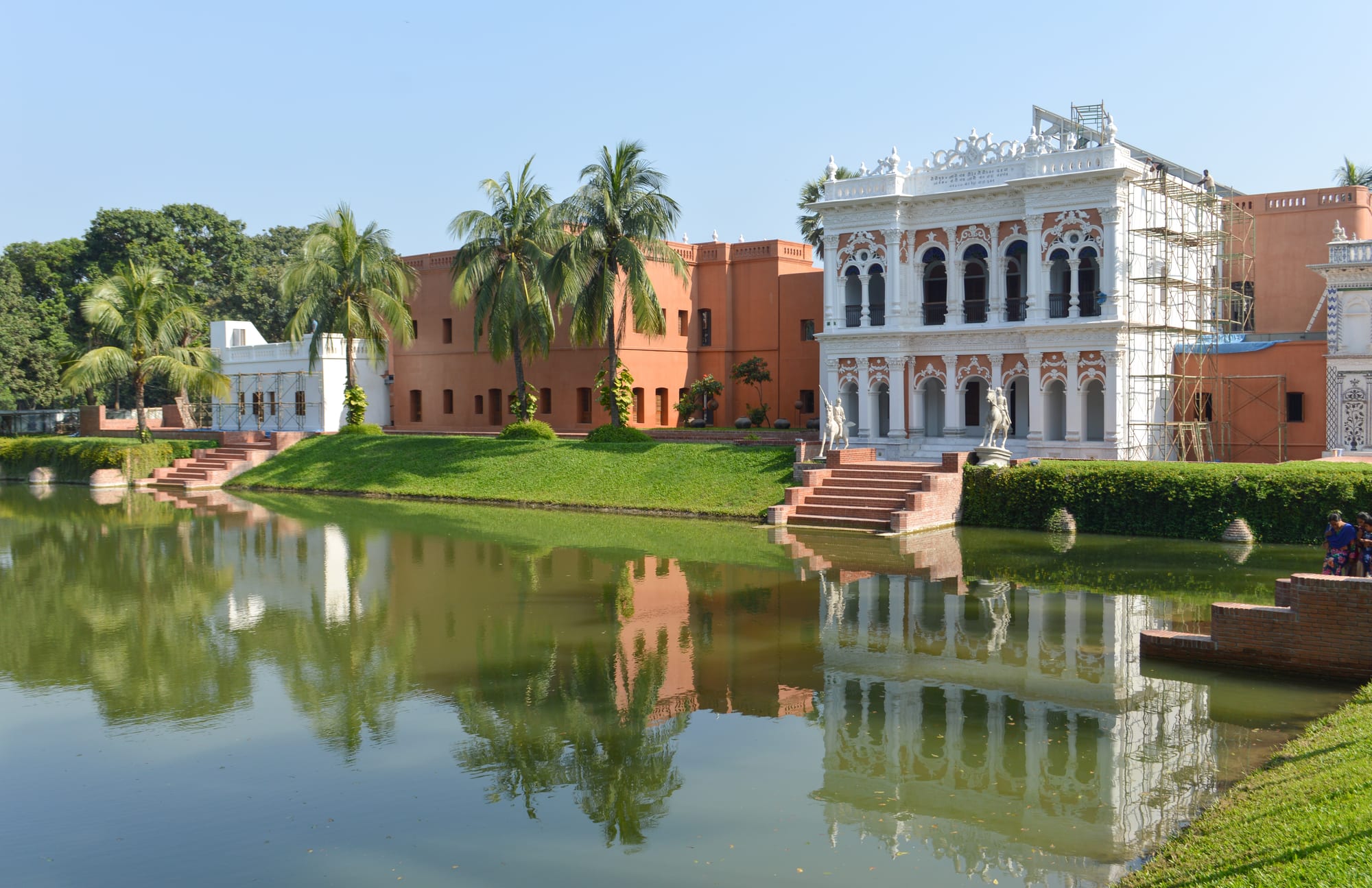
A white ornamented mansion and red brick buildings reflected in a still green pond behind palms and a lawn

Dhaka & Central Bangladesh, Bangladesh

Sonargaon

The folk art and craft museum buildings reflected in their pond at Sonargaon. (Francisco Anzola / Wikimedia Commons · CC BY 2.0)

A historic town and upazila in Narayanganj district, about 25 kilometres east of Dhaka between the Meghna and Shitalakshya rivers. Once a capital of eastern Bengal under the sultans and the base of the chieftain Isa Khan, it declined into farmland and factories. Its abandoned merchants' street at Panam Nagar and a folk art museum in an old mansion draw visitors from the capital.

Neighbourhoods

  • Panam Nagar
    • Historic district
    • Photography

    A single straight street of two- and three-storey merchants' houses, built in the late 19th and early 20th centuries and left empty after the riots of 1964. Plaster falls from stuccoed facades, ponds lie behind the rows, and the lane is fenced and ticketed as a protected site.

    Open in Maps
  • Mograpara
    • Local life
    • Transport

    The administrative centre of the upazila, on the Dhaka–Chattogram highway, where buses stop and the bazaar, banks and offices are. Most arrivals from the capital change here for a rickshaw or auto to the historic sites a few kilometres north.

    Open in Maps
  • Baidyer Bazar and the riverside
    • Quiet and residential
    • Local life

    The older riverside part of the upazila towards the Meghna, a landscape of villages, ponds, brickfields and boat landings. It gives a sense of the waterway that made Sonargaon a trading town in the first place.

    Open in Maps

Things to do

The historic town

  • Panam Citylandmark

    Fifty-two decaying merchants' mansions facing one another along a single abandoned street about 600 metres long, declared an archaeological site in the 2000s and the reason most visitors come.

    Open in Maps
  • Sonargaon folk art museummuseum

    A folk art and crafts museum established by the painter Zainul Abedin and the Bangladesh Folk Arts and Crafts Foundation, with weaving, pottery, masks, boats and metalwork displayed in grounds around a pond, beside the restored Bara Sardar Bari mansion.

    Open in Maps
  • Goaldi Mosquelandmark

    A single-domed brick mosque of 1519 in a village north of Panam, one of the few sultanate-era buildings left in the area, with terracotta and stone ornament.

    Open in Maps

Around Sonargaon

  • Sonakanda Fortlandmark

    A Mughal river fort at Bandar across the Shitalakshya, built to guard the water approach to Dhaka against Arakanese and Portuguese raiders.

    Open in Maps
  • Hajiganj Fortlandmark

    Another of the Mughal forts on the Shitalakshya at Narayanganj, a walled enclosure with bastions above the riverbank.

    Open in Maps
  • Langalbandhattraction

    A bathing place on the old Brahmaputra channel west of Sonargaon, where large numbers of Hindu pilgrims gather each spring.

    Open in Maps

Seasonal events

  • Folk art and crafts fairspring, around the Bengali new year

    The museum grounds hold a crafts fair with weavers, potters and metalworkers from around the country, along with folk music and puppetry.

  • Pahela Baishakhmid-April

    The Bengali new year brings fairs, sweets and processions to the bazaars of the upazila as it does across the country.

  • Ashtami bathing at LangalbandhMarch or April

    Hindu pilgrims come in very large numbers to bathe in the river at Langalbandh on Ashtami, a few kilometres west of Sonargaon.

Eat and drink

Long-standing places and food districts in Sonargaon. Hours, ratings and directions come from your maps app, always current.

Eating in Sonargaon

  • Mograpara bazaarmarket

    The upazila's market, with rice-and-curry eating houses, tea stalls, fruit sellers and sweet shops selling roshogolla and mishti doi in clay pots.

    Open in Maps
  • Dhaka–Chattogram highway restaurantsneighborhood

    The highway through the upazila is lined with large restaurants built for bus and lorry traffic, serving biryani, beef and chicken dishes, fish curry and rice to travellers.

    Open in Maps
  • Riverside fishneighborhood

    The Meghna and Shitalakshya supply hilsa in season along with rui, catla and smaller river fish, sold at village markets and cooked simply with mustard, turmeric and chilli.

    Open in Maps

Experience Sonargaon

History

Sonargaon — the name means golden village — was the leading town of eastern Bengal for several centuries. Its rise came under the Deva kings and then under Muslim rule from 1338, when Fakhruddin Mubarak Shah made it the seat of an independent sultanate. Ghiyasuddin Azam Shah, who ruled around the end of that century, is buried at Mograpara, and Bengali tradition remembers his exchange of verses with the Persian poet Hafez. Ibn Battuta reached Sonargaon by river in the 1340s and sailed from it towards Java.

In the late 16th century the area was the base of Isa Khan, the best known of the Bara Bhuiyan chieftains who resisted Mughal expansion into Bengal. After the Mughals prevailed, the capital moved to Dhaka in 1610 and Sonargaon's political importance ended, though it remained a centre of the muslin trade; the finest Bengal muslins were woven in villages nearby and sold to merchants who came upriver.

Panam Nagar belongs to a later chapter. The street of mansions was built mostly between the 1860s and the early 20th century by Hindu cloth merchants who prospered under British rule, each house facing the lane with a pond and garden behind. Their owners left in stages after partition in 1947 and finally after the riots of 1964, and the street has stood empty ever since. It is now a protected site, its buildings propped and slowly decaying, and the area around it has become part of the industrial belt spreading east from Dhaka.

Culture & Customs

For all its ruins, Sonargaon is a working rural upazila, and its culture is that of the villages of central Bengal: mosques and madrasas, Friday prayers that empty the bazaar, weddings with loud music and long feasts, and a Hindu minority whose Durga Puja pandals go up in autumn. The Langalbandh bathing on the old Brahmaputra channel nearby is one of the largest Hindu gatherings in Bangladesh and has been observed for centuries.

Craft gives the place its modern identity. The folk art museum, founded on the initiative of the painter Zainul Abedin, was set up to collect and keep alive Bengali village crafts — jamdani and other weaving, nakshi kantha embroidered quilts, terracotta, brass, masks, puppets and model boats — and its grounds hold a crafts fair in spring with makers from across the country. Weaving is still a living trade in the wider district, and the jamdani looms of Rupganj a short distance north-west produce the figured muslin that UNESCO lists as intangible cultural heritage.

Sonargaon also carries a strong sense of being a place that history left. School groups, students of architecture and photographers come out from Dhaka to walk the empty street, and a debate over how far the mansions should be restored, stabilised or left as ruins has run for decades. Local people are used to visitors, and hospitality is straightforward: tea first, questions after.

Daily Life

The people of the upazila are spread over Mograpara, Baidyer Bazar and dozens of villages rather than gathered in one town. The Dhaka–Chattogram highway runs through the middle of it and shapes the economy: garment and textile factories, brickfields, small workshops and transport businesses line the road and the approaches to the river crossings, and many residents commute to Narayanganj or into Dhaka itself.

Away from the highway the pattern is older. Rice is grown in the fields between the two rivers, with vegetables and mustard in winter, and fish comes from ponds as well as from the Meghna. Handloom weaving survives in some villages, and remittances from relatives working in the Gulf and Malaysia pay for the brightly painted concrete houses that are replacing tin and bamboo. Land near the highway has become valuable, and its sale to industry is a constant subject of local argument.

The day starts early, with the bazaar busiest in the morning and again at dusk. Tea stalls are the meeting places, boys play cricket on any dry patch of ground, and in the monsoon children travel to school along lanes edged with standing water. The familiar problems of the belt around Dhaka are here too: air and water pollution from brick kilns and dyeing works, traffic on a highway never built for its present volume, and the steady loss of farmland to factory sheds.

Food

The food is the plain river-and-field cooking of central Bengal, and the fish is what distinguishes it. Hilsa from the Meghna is the prize — fried in mustard oil, cooked in a mustard-seed sauce, or steamed in banana leaf — and rui, catla, boal and small fish from the ponds are curried with turmeric, chilli and onion. Rice comes with dal, vegetable bhaji and a plate of bhorta, the mashes of aubergine, potato, dried fish or lentil worked with mustard oil, green chilli and raw onion that are eaten with almost every meal.

The highway restaurants serve the food travellers expect between Dhaka and Chattogram: biryani and tehari, beef bhuna, chicken curry, dal and rice, taken quickly and washed down with sweet milky tea. In the bazaar the same dishes appear in smaller eating houses, along with parathas and eggs in the morning and singara and piyaju — fried pastries and lentil fritters — in the afternoon.

Sweets are made in shops on the main road and at every bazaar: roshogolla, chomchom, sandesh, and mishti doi set in unglazed clay pots. In winter, stalls sell pitha, the steamed and fried rice cakes made with date-palm jaggery and coconut, and the sap itself is drawn from palms in the villages and drunk fresh in the early morning. Ramadan brings the usual evening spread of haleem, jilapi and fried snacks to the bazaar stalls.

Planning tools

Budget

Sonargaon is cheap. Site entry fees are small, food at the bazaar and the highway restaurants costs very little, and local transport is by shared auto or rickshaw. The main expense is the journey from Dhaka: a hired car with driver for the day costs far more than everything else combined, though buses on the highway are inexpensive. There is a resort hotel in the upazila, but most visitors stay in the capital.

Daily Budget Midrange
USD 55–120 (Gulshan or Banani hotel in Dhaka, restaurant meals, car with driver for the day)
Daily Budget Shoestring
USD 15–30 (simple guesthouse or a day trip by bus, bazaar meals, rickshaws and shared autos)

Visiting as a day trip from Dhaka is the usual approach; carry small notes, as the sites and rickshaws take cash only.

Best Time to Visit

November to February, when the weather is dry and mild and walking Panam's street and the museum grounds is comfortable. Spring brings the crafts fair and the Langalbandh bathing. The pre-monsoon months are very hot, and from June to October heavy rain makes village lanes muddy, though the ponds and fields are at their greenest. Fridays and holidays bring large crowds from the capital.

Suggested Number of Days

Half a day covers the main historic sites, and a full day allows a slower look with lunch and time in the bazaar. Adding the river forts and villages of Narayanganj makes it worth staying longer. Traffic on the road from Dhaka is what usually decides the length of a visit.

First Visit
half a day to 1 day
With Surroundings
1–2 days

Transportation

Buses on the Dhaka–Chattogram highway stop at Mograpara, and from there battery-powered autos, CNG auto-rickshaws and cycle-rickshaws run the few kilometres to the museum and Panam Nagar. Many visitors come by hired car from Dhaka, which allows several sites to be linked in one trip. Within the upazila distances are short and roads are narrow.

Agree the fare with a rickshaw or auto driver in advance, and keep a driver waiting if coming by car, as return transport can be slow to find.

Airport & Station Connections

Sonargaon lies about 25 kilometres east of central Dhaka on the Dhaka–Chattogram highway, usually an hour to two hours by road depending on traffic. Buses towards Chattogram, Cumilla and Narayanganj pass the turning at Mograpara. The nearest airport is Hazrat Shahjalal International in Dhaka, and there is no passenger railway station in the upazila.

Walkability

The historic core is walkable: Panam Nagar's street is a few hundred metres long and closed to traffic, and the museum grounds are laid out for walking. Between the sites, however, are a couple of kilometres of village road with no pavement and some highway traffic, so most people use a rickshaw. Paths can be muddy after rain.

Safety

Sonargaon is calm and crime against visitors is rare. The everyday hazards are traffic on the Dhaka–Chattogram highway, which is heavy and fast, and the fabric of Panam Nagar itself: the empty houses are unstable, with collapsing floors and loose brickwork. Ponds and river banks have no railings.

Stay outside roped-off or visibly unsafe buildings at Panam Nagar, take care crossing the highway, and expect curiosity rather than trouble from local people. Check current official travel advice before travelling.

Climate

The same delta climate as Dhaka but a little clearer, being out of the city. The monsoon from June to October brings heavy rain and high rivers; winter is dry and mild with thick morning fog; and the weeks before the rains are the hottest of the year.

Summer
hot and humid, about 30–36°C before the monsoon, with heavy rain from June to October
Winter
dry and mild, about 12–26°C, with dense fog on winter mornings

Local Customs

This is a conservative rural area, and modest dress — covered shoulders and knees, a scarf for women at mosques and shrines — is expected. Shoes come off at mosques and at the door of a house. Visitors, especially foreigners, attract friendly attention and questions, and invitations to tea are common.

Ask before photographing people, particularly women; do not climb on the ruins for pictures; and greet shopkeepers and site staff before starting a conversation.

Common Payment Methods

The currency is the Bangladeshi taka, and Sonargaon runs on cash. Entry tickets, rickshaws, stalls and small restaurants do not take cards. ATMs are at Mograpara and in Narayanganj town, but it is easier to bring taka in small notes from Dhaka. Mobile money is used by residents rather than visitors.