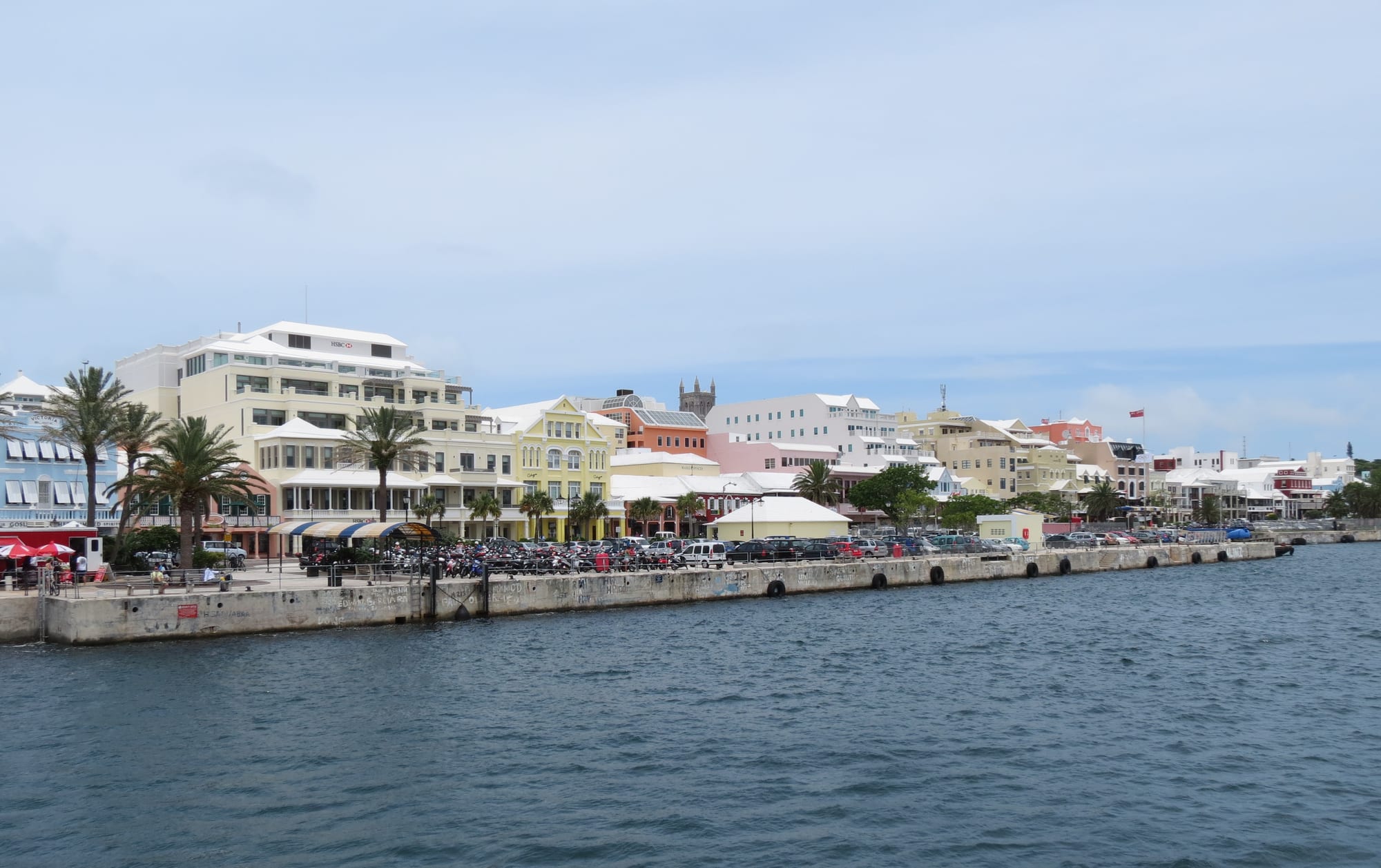
Pastel buildings, palm trees and parked scooters along a harbour wall in Hamilton, with a church tower behind

Bermuda

Hamilton

Buildings along the harbour in Hamilton. (Jeff Bellinger / Wikimedia Commons · CC BY-SA 3.0)

Bermuda's capital, a small harbour city on the north shore of Hamilton Harbour in Pembroke Parish. Laid out in the 1790s and made the seat of government in 1815, it grew into the islands' port, parliament town and a global reinsurance centre — a few blocks of pastel shopfronts, offices and two cathedrals facing the ferries and cruise ships along Front Street.

Neighbourhoods

  • Front Street and the harbourfront
    • First-time visitors
    • Shopping
    • Close to public transport

    The street along the harbour edge, lined with shops, pubs and restaurants in low pastel buildings. Cruise ships berth alongside it, and taxis wait at its stands.

    Open in Maps
  • Church Street and the civic centre
    • Historic district
    • Museums

    The blocks just uphill from the water, around the Anglican cathedral, City Hall and Sessions House, home of the parliament. Offices of international insurers fill much of the area on weekdays, and Victoria Park and Par-la-Ville Park offer shade between them.

    Open in Maps
  • Pembroke Parish and Spanish Point
    • Quiet and residential
    • Local life

    The most densely populated parish in Bermuda, which surrounds the city and has a coastline along the North Shore and Hamilton Harbour. At its north-western tip the headland of Spanish Point looks out over the entrance to the Great Sound.

    Open in Maps
  • Paget, across the harbour
    • Beaches
    • Gardens
    • Quiet and residential

    The parish on the south side of Hamilton Harbour, linked to the city by ferry and by road. It holds the Botanical Gardens, Bermuda College and a stretch of the south shore with Elbow Beach.

    Open in Maps

Things to do

Famous landmarks

  • Cathedral of the Most Holy Trinitylandmark

    The Anglican cathedral on Church Street, built between 1886 and 1905 to replace a church destroyed by arson in 1884; city rules have long kept new buildings from obscuring it.

    Open in Maps
  • St. Theresa's Cathedrallandmark

    The Roman Catholic cathedral of Bermuda, one of the city's two cathedrals and the seat of the island's Catholic bishop.

    Open in Maps
  • Front Streetneighborhood

    The harbourside main street of shops, pubs and restaurants where cruise ships tie up and the ferries come and go.

    Open in Maps
  • Sessions Houselandmark

    The building on Church Street where Bermuda's House of Assembly, one of the world's oldest legislatures, sits.

    Open in Maps
  • Fort Hamiltonlandmark

    An old fort on the high ground overlooking the city, part of the islands' long military heritage.

    Open in Maps

Museums and galleries

  • Bermuda National Gallerymuseum

    The contemporary art museum that holds Bermuda's national art collection, inside City Hall and Arts Centre on Church Street.

    Open in Maps
  • Bermuda Historical Society Museummuseum

    A small museum at Par-la-Ville on Queen Street covering the islands' history, particularly the colonial period.

    Open in Maps
  • Ocean Discovery Centremuseum

    The Bermuda Underwater Exploration Institute's museum just outside the city, about the ocean and the Bermuda Triangle.

    Open in Maps
  • Masterworks Museum of Bermuda Artmuseum

    A non-profit museum and cultural centre across the harbour in Paget, dedicated to art connected with the island.

    Open in Maps

Parks and the waterfront

  • Victoria Parkpark

    The city's first public park, filling a whole block, with flower gardens, endemic plants and a bandstand installed in 1889 for Queen Victoria's Golden Jubilee and used for free concerts.

    Open in Maps
  • Par-la-Ville Parkpark

    A garden park off Queen Street, beside the building that holds the national library and the historical society museum.

    Open in Maps
  • Barr's Bay Parkpark

    One of the city's smaller parks, alongside Par-la-Ville Park and Albuoy's Point Park.

    Open in Maps
  • Royal Bermuda Yacht Club at Albuoy's Pointlandmark

    A private yacht club founded in 1844 and based at Albuoy's Point since 1933; the small park on the point beside it looks over the harbour's moorings.

    Open in Maps
  • Spanish Pointpark

    A headland about 3 km north-west of the city at the entrance to the Great Sound, reached through Black Watch Pass, a cut in the coral cliff opened in 1934.

    Open in Maps

Gardens and beaches nearby

  • Bermuda Botanical Gardenspark

    Some 36 acres of flowers, shrubs and trees in Paget, a short drive from the city, including Camden, the official residence of the Premier.

    Open in Maps
  • Elbow Beachbeach

    One of the most popular beaches on the main island, a long stretch of pink sand on the south shore of Paget, partly private with public access to the rest.

    Open in Maps
  • Horseshoe Baybeach

    A well-known beach on the south shore in Southampton, famous for sand tinted pink by tiny red foraminifera.

    Open in Maps
  • Bermuda Aquarium, Museum and Zooattraction

    An aquarium, natural history museum and zoo at Flatts Village, established by the government in 1926 and focused on the species of oceanic islands.

    Open in Maps

Seasonal events

  • Bermuda Daythe fourth Friday in May

    A public holiday marked by a parade through Hamilton and a road race into the city, with residents staking out spots along the pavements to watch; traditionally the start of the swimming season.

  • Gombey troupes at ChristmasChristmas and public holidays

    Masked, costumed dancers and drummers of the Gombey tradition, which blends African, Caribbean and British influences, perform in the streets on holidays.

Eat and drink

Long-standing places and food districts in Hamilton. Hours, ratings and directions come from your maps app, always current.

Hamilton classics

  • Fish chowderrestaurant

    Bermuda's national dish, a dark fish chowder seasoned at the table with black rum and sherry-pepper sauce, served in many of the city's restaurants.

    Open in Maps
  • Dark 'n' Stormy and rum swizzlerestaurant

    The two drinks most closely tied to the islands — black rum topped with ginger beer, and a rum punch — poured in the pubs and bars along the harbour.

    Open in Maps

Pubs and food streets

  • Hog Penny Pubrestaurant

    A pub-style restaurant on Burnaby Hill, just off Front Street.

    Open in Maps
  • Flanagan's Irish Bar and Restaurantrestaurant

    A pub on Front Street with a main bar and a sports bar.

    Open in Maps
  • Front Streetneighborhood

    Hamilton has the largest concentration of restaurants on the islands, many of them on or just off the harbourfront.

    Open in Maps

Experience Hamilton

History

Hamilton is a planned city, and a young one by Bermudian standards. In 1790 the colonial government set aside 145 acres on the north shore of the harbour in Pembroke Parish as the site of a future seat of government; the town was incorporated in 1793 and named after Henry Hamilton, governor from 1786 to 1793. In 1815 the capital moved here from St. George's, and Hamilton has been the political centre of Bermuda ever since, with Government House to the north, the Royal Navy's Admiralty House to the west and the army's headquarters at Prospect Camp to the east.

The Town of Hamilton became a city in 1897. Its first Trinity Church, completed in 1869, was destroyed by arson in 1884, and the stone church that replaced it was built between 1886 and 1905 and consecrated as the Anglican cathedral in 1911; a Roman Catholic cathedral, St. Theresa's, followed later. During the Second World War the Royal Navy named one of the destroyers it received from the United States HMS Hamilton in the city's honour, and in 1975 Queen Elizabeth II and Prince Philip visited City Hall.

Hamilton has long been Bermuda's main port as well as its seat of government. Today the city is chiefly a business district, and although a long-standing rule bars any building from obscuring the cathedral, buildings as high as ten storeys have been planned, and some begun, in the twenty-first century.

Culture & Customs

Hamilton is the stage for Bermuda's public life. On Bermuda Day, the fourth Friday in May, a parade winds through the city and a road race finishes here, and families stake out their places along the pavements, sometimes overnight. The day is traditionally the first of the year for swimming and for wearing Bermuda shorts to the office — although the shorts, with knee socks, jacket and tie, are now accepted business dress far more widely. Gombey troupes, masked and costumed dancers with drums and whistles in a tradition that blends African, Caribbean and British influences, take to the streets on holidays.

The harbour is central to the city's identity. The Royal Bermuda Yacht Club, founded in 1844 and permitted to call itself "Royal" in 1846, has stood at Albuoy's Point since 1933 and co-hosts the Bermuda Race with the Cruising Club of America. The King Edward VII Gold Cup, first sailed as a match race in Bermuda in 1937, is still raced here as the Argo Gold Cup, the highlight of the city's sporting calendar.

Victoria Park's bandstand, brought from Scotland and installed in 1889, is used for free concerts. Among the city's notable people was Johnny Barnes, who stood at the foot of the Lane roundabout every workday morning, waving to the passing traffic. The city's motto, "Sparsa collegit", says that Hamilton has gathered together the scattered.

Daily Life

The City of Hamilton proper had a permanent population of 854 in 2016, which makes it one of the smallest capitals in the world; most Bermudians live in the surrounding parishes rather than in the city itself. Each weekday, though, the population swells: in 2010 some 13,340 people, about 40 per cent of Bermuda's workforce, worked in Hamilton.

Almost all of Bermuda's international business is done within the city limits. Reinsurers, insurers and other international companies have offices here, and several international firms are registered in Hamilton. Hamilton has been ranked as having the highest cost of living of any city in the world.

The rhythm of the day follows office hours and the ferries. Commuters arrive by bus and boat in the morning and leave by the same routes in the evening. Almost every bus route on the islands begins and ends at the city's terminal. Cruise-ship days bring crowds of visitors to the shops along the harbour.

Food

Hamilton has the largest concentration of restaurants on the islands, from waterfront dining rooms to pub-style places along Front Street and the lanes behind it. A Bermudian law keeps out most multinational fast-food chains. The headquarters of the MarketPlace, Bermuda's grocery chain, is in its Hamilton store, the largest supermarket on the islands.

The dish visitors meet first is Bermuda fish chowder, dark with fish and seasoned at the table with black rum and sherry-pepper sauce. The traditional Sunday breakfast is salt codfish with boiled potatoes, egg, onion and banana, and codfish cakes, local wahoo and rockfish, and spiny lobster in season from September to March appear on many menus.

The Dark 'n' Stormy, black rum topped with ginger beer, and the rum swizzle, a rum punch, are the drinks most closely tied to Bermuda. Several of the city's restaurants, such as the Hog Penny off Front Street, are in the style of an English pub.

Planning tools

Budget

Hamilton is one of the most expensive places in the world to stay and eat, as almost everything on the islands is imported. Guesthouses and self-catering rooms in Pembroke cost less than the larger hotels, and the parks, cathedrals, harbour views and several museums cost little or nothing. Buses and ferries keep the cost of getting around down.

Daily Budget Midrange
USD 400–800 (hotel or small resort, restaurant meals, drinks, scooter or minicar hire)
Daily Budget Shoestring
USD 180–260 (guesthouse, self-catering and takeaways, buses and ferries)

Visit between roughly November and March for lower room rates, use a multi-day transport pass for the buses and ferries, and buy groceries for some meals.

Best Time to Visit

May to October is the beach season, and Bermuda Day in late May opens the summer. April and November are milder and cheaper. Winter is quiet and mild, good for walking the city, but too cool for most people to swim, and Atlantic hurricanes are a risk from August to October.

Suggested Number of Days

The city itself is small and can be seen in a day or two. Most visitors use it as a base for the whole island, and a stay of four to six days allows for the beaches and both ends of Bermuda. Ferry and bus connections make Hamilton the easiest place to start from.

First Visit
1–2 days
With Surroundings
4–6 days

Transportation

Visitors cannot traditionally drive cars on Bermuda, so they use buses, ferries, taxis, hired scooters or small two-seat electric minicars. All but one bus route start from the bus terminal in Hamilton, and pink and blue poles mark stops for buses heading into and out of the city. SeaExpress ferries cross the harbour to Paget and Warwick and run across the Great Sound to Somerset and the Royal Naval Dockyard. Taxis wait on Front Street. Driving is on the left.

Buy a multi-day transport pass valid on both buses and ferries; if hiring a scooter, ride slowly and always wear the helmet.

Airport & Station Connections

L.F. Wade International Airport is about 11 km north-east of the city in the East End, with flights from the United States, Canada and the United Kingdom; taxis run into Hamilton. Some cruise ships berth on Front Street in the heart of the city, while others dock at the Royal Naval Dockyard and send passengers to Hamilton by ferry or bus.

Walkability

Everything in the city centre is within easy walking distance: Front Street, the cathedrals, the parks and the museums sit within a few blocks of each other. Beyond the centre, most people take a bus, ferry or taxi.

Safety

Bermuda is generally very safe for visitors, with low levels of crime affecting tourists. The main risks are road accidents on hired scooters, sunburn, and hurricanes in late summer.

Ride scooters cautiously and always with the helmet, swim at guarded beaches and heed current warnings, and watch the forecast during hurricane season. Check current official travel advice before travelling.

Climate

Humid subtropical, moderated by the Atlantic and the nearby Gulf Stream, with no true dry season. Atlantic hurricanes are a risk from August to October.

Summer
June–September, hot and humid — across the island daytime highs are around 84°F
Winter
December–March, mild and often windy — across the island temperatures run about 61–68°F, and it never freezes

Local Customs

Manners are fairly formal. It is good manners to say "good morning", "good afternoon" or "good evening" when greeting anyone, from a shop assistant to the Premier, and again when leaving. Bermuda shorts worn with knee socks, a jacket and a tie are accepted business dress in the city. Society is generally conservative and church-going.

Greet people before asking for anything, keep beachwear for the beach, and dress modestly in the cathedrals.

Common Payment Methods

The Bermudian dollar is pegged one-to-one to the US dollar, and US dollars are accepted at par everywhere. Cards are accepted almost everywhere, and ATMs in the city dispense Bermudian dollars.