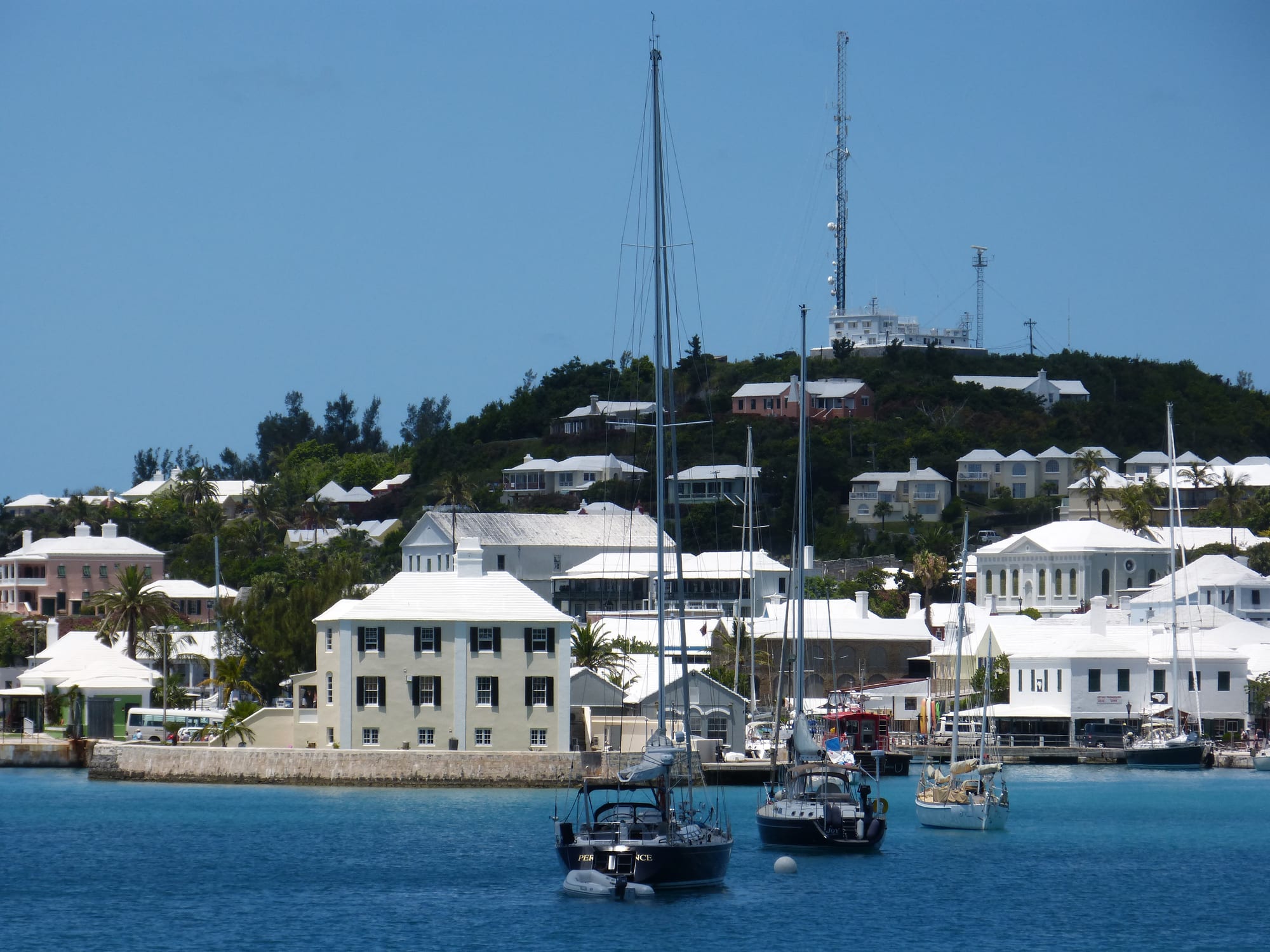
Sailing boats moored off St. George's waterfront, with white-roofed houses climbing a green hill to Fort George

Bermuda

St. George's

Ordnance Island and the waterfront of St. George's, with Fort George on the hill above. (Seán Pòl Ó Creachmhaoil / Wikimedia Commons · CC BY-SA 4.0)

The first permanent English settlement on Bermuda, founded in 1612 on the north side of St. George's Harbour at the islands' eastern end. Capital until 1815, the town keeps its old lanes, square, stone church and surrounding forts — together listed by UNESCO as a World Heritage Site in 2000.

Neighbourhoods

  • King's Square and the waterfront
    • First-time visitors
    • Historic district
    • Best for food

    The old town square by the harbour, with the Town Hall and, across a short bridge, Ordnance Island and its replica of the Deliverance. Water Street runs along the shore past museums, shops, pubs and restaurants.

    Open in Maps
  • The old town lanes
    • Historic district
    • Walking

    The streets and alleys rising behind the square, with names such as Featherbed Alley, Old Maid's Lane and Needle and Thread Alley. St. Peter's Church, the State House, the Old Rectory and the ruin of the Unfinished Church are all within a few minutes of each other.

    Open in Maps
  • The north shore of St. George's Island
    • Beaches
    • Forts

    The coast north and east of the town, a walk away over the hill, where Tobacco Bay, Achilles Bay and Fort St. Catherine look out over the reefs.

    Open in Maps
  • St. David's Island
    • Beaches
    • Quiet and residential

    The island across St. George's Harbour, enlarged during the Second World War for a United States base whose airfield is now the airport. It has Bermuda's easternmost point, a lighthouse, an old battery and quiet beaches.

    Open in Maps

Things to do

The historic town

  • St. Peter's Churchlandmark

    The oldest surviving Anglican church in continuous use outside the British Isles, and reportedly the oldest continuously used Protestant church in the New World; the oldest parts of the present building date to 1620.

    Open in Maps
  • State Houselandmark

    Built in 1620 as the first purpose-built home of Bermuda's House of Assembly, the islands' first stone building other than fortifications, and used since 1815 as a Masonic lodge.

    Open in Maps
  • Unfinished Churchlandmark

    The ruin of a church on Blockade Alley, one of the historic buildings of the World Heritage town and a popular sight in its own right.

    Open in Maps
  • Ordnance Island and the Deliveranceattraction

    A small island by a bridge from King's Square, holding a replica of the Deliverance, one of the two ships the Sea Venture survivors built, and a life-size statue of Sir George Somers by Desmond Fountain.

    Open in Maps
  • Bermuda National Trust Museummuseum

    A museum in the former Globe Hotel, built in 1699 for Governor Samuel Day and used during the American Civil War as the office of a Confederate agent.

    Open in Maps
  • Bermuda Heritage Museummuseum

    Bermuda's Black history museum, in the former Samaritan's Lodge of a society formed in the nineteenth century to help freed people after the end of slavery in 1834.

    Open in Maps
  • Tucker House Museummuseum

    The Tucker House on Water Street, one of the historic buildings named in the town's World Heritage listing, now a museum.

    Open in Maps

Forts and beaches

  • Fort St. Catherinemuseum

    A coastal artillery fort at the north-east tip of St. George's Island, rebuilt many times and garrisoned from 1612 into the twentieth century, which now houses a museum.

    Open in Maps
  • Fort Georgelandmark

    A square fort on the crest of the hill west of the town, overlooking the harbour.

    Open in Maps
  • Tobacco Baybeach

    A bay close to the town and one of Bermuda's national parks, popular for snorkelling over its reefs; in 1775 stolen gunpowder was shipped from here to the American rebels.

    Open in Maps
  • Achilles Baybeach

    A small bay beside Fort St. Catherine, within walking distance of the town.

    Open in Maps
  • Castle Islands Fortificationslandmark

    Forts on the small islands across the southern entrance of Castle Harbour, begun in 1612 and reached by boat; King's Castle is among the oldest surviving English fortifications in the New World.

    Open in Maps

Seasonal events

  • Re-enactments in King's SquareMay to September

    Actors in period dress play town criers and sentence offenders to the stocks, the pillory or the ducking stool in seventeenth-century re-enactments in the old square.

  • Cup Matchlate July or early August

    Bermuda's two-day cricket match between the Somerset and St. George's clubs, played on the Emancipation Day and Mary Prince Day holidays, the Thursday and Friday before the first Monday in August.

Eat and drink

Long-standing places and food districts in St. George's. Hours, ratings and directions come from your maps app, always current.

Around King's Square

  • The White Horserestaurant

    A pub and restaurant on King's Square by the water's edge.

    Open in Maps
  • The Wharfrestaurant

    A restaurant and bar on Water Street, on the harbour.

    Open in Maps
  • Water Street and King's Squareneighborhood

    After Hamilton, the town has the islands' largest concentration of restaurants, most of them on the waterfront and around the square.

    Open in Maps

Experience St. George's

History

St. George's began with a shipwreck. In 1609 the Sea Venture, carrying settlers to Jamestown under Admiral Sir George Somers and Sir Thomas Gates, was driven onto the reefs in a storm. The survivors built two new ships, the Deliverance and the Patience, and most sailed on to Virginia, leaving a few men behind to hold the islands. In 1612 more settlers arrived aboard the Plough, and the town was begun on the north side of St. George's Harbour. The town was first called New London.

From 1615 the Somers Isles Company ran Bermuda from here until it was dissolved in 1686. The State House was built in 1620 for the House of Assembly, and St. Peter's Church, consecrated in 1612, was rebuilt, its oldest surviving parts dating from 1620. As the islands' only true port, the town was tied to colonial America: thousands of Bermudians emigrated to Virginia and the American South. In August 1775 a group of Bermudians sympathetic to the Continental Congress stole gunpowder from the town's magazine, rolled it over the hill to Tobacco Bay and shipped it to the American rebels. During the American Civil War, St. George's was the base for blockade runners supplying the Confederacy.

The capital moved to Hamilton in 1815, and much of the old town survived. Excavations in King's Square have found the foundations of the governor's house of 1612. In 2000 the town and its surrounding forts were designated a UNESCO World Heritage Site as the Historic Town of St George and Related Fortifications.

Culture & Customs

The town lives with its past. In the summer season actors in period dress play town criers in King's Square and sentence volunteers to the stocks, the pillory and the ducking stool, and the Visitors' Service Bureau on the square runs walks through the old streets. Bermudians are particular about the town's name: in local usage it is always "St. George's", in the possessive, as with St. David's and many other Bermudian place names. Since 1996 the town has been twinned with Lyme Regis in Dorset, the birthplace of Sir George Somers.

St. Peter's Church has been in continuous use for worship for four centuries. The Bermuda Heritage Museum, in the lodge of a society founded to help formerly enslaved people after emancipation in 1834, tells the history of Black Bermudians, and the town's museums cover printing and the Confederate blockade runners.

Sport ties the town to the rest of Bermuda. The St. George's Colts football club plays at the Wellington Oval, which is also a cricket ground. Above all, St. George's is one half of Cup Match, the two-day cricket match between the Somerset and St. George's clubs played over the Emancipation Day and Mary Prince Day holidays in late July or early August.

Daily Life

St. George's Parish, which takes in the town, St. David's Island and the Tucker's Town area, had 5,659 residents in 2016, about 9 per cent of Bermuda's population. The town is the parish's centre, with its Town Hall on King's Square, a preschool and a primary school, churches, shops and the harbour.

The parish is joined to the rest of Bermuda by the Causeway, a chain of small islands linked by reclaimed land and bridges, and buses run from the town straight to Hamilton. Tourism shapes the rhythm of the day: in the summer season, cruise passengers and visitors from elsewhere on the islands fill the square and the beaches by day, and the town grows quiet in the evenings. Winters are much calmer.

The old town's status brings both care and limits. Historic buildings are looked after by bodies such as the Bermuda National Trust, which runs museums in the town, and the old lanes and buildings are part of the World Heritage Site.

Food

The town has the largest concentration of restaurants on Bermuda after Hamilton, most of them pubs and restaurants on Water Street and around King's Square by the harbour. The White Horse, a pub on the square, and The Wharf, on Water Street, are among them.

Menus follow the Bermudian kitchen. Fish chowder, the national dish, comes dark with fish and beef stock and is finished at the table with black rum and sherry-pepper sauce. Codfish cakes are a staple, and the traditional Sunday breakfast is salt cod with potatoes, hard-boiled egg, onion and banana. Local wahoo and rockfish are common, and spiny lobster appears in season, from September to March. At Christmas many families make cassava pie, and peas and rice and hoppin' John are traditional dishes too.

The drinks are the islands' own: the Dark 'n' Stormy, black rum topped with ginger beer, and the rum swizzle, a rum punch, both closely associated with Bermuda and poured in the town's waterfront bars.

Planning tools

Budget

Bermuda is one of the most expensive destinations in the world, and the old town is no exception for meals and rooms. The town itself costs little to enjoy: the lanes, the square, St. Peter's Church, the forts' grounds and the beaches are free or cheap, and buses and ferries keep travel costs down.

Daily Budget Midrange
USD 400–800 (hotel or small resort, restaurant meals, drinks, scooter or minicar hire)
Daily Budget Shoestring
USD 180–260 (guesthouse, self-catering and takeaways, buses and ferries)

Use a multi-day transport pass for the bus from Hamilton and the ferry from the Dockyard, and visit between roughly November and March for lower room rates.

Best Time to Visit

May to September brings the swimming season and the costumed re-enactments in King's Square, and Cup Match falls in late July or early August. April and November are pleasant and cheaper. Winter is quiet and mild, good for walking the town and the forts, and the hurricane risk runs from August to October.

Suggested Number of Days

The town is small and most visitors see it in a day from elsewhere on Bermuda. An overnight stay or two allows time for the beaches, the forts and St. David's at a slower pace, and the town is quieter once the day visitors leave.

First Visit
1–2 days
With Surroundings
2–3 days

Transportation

The town is compact and easily explored on foot. Buses run direct to Hamilton, and other parts of the islands are reached by changing there or by taxi. A SeaExpress ferry links St. George's with the Royal Naval Dockyard at the western end. Visitors hire scooters or small electric minicars rather than cars, and driving is on the left.

Buy a multi-day transport pass valid on both buses and ferries, and ride hired scooters slowly on the narrow, winding roads.

Airport & Station Connections

L.F. Wade International Airport is on St. David's Island in the same parish, closer to St. George's than to Hamilton, and taxis make the short trip into town. Buses come directly from Hamilton, and ferries run from the Royal Naval Dockyard. Cruise passengers arriving at the Dockyard can reach the town by ferry.

Walkability

All the sights of the old town are within easy walking distance of King's Square, along narrow lanes and alleys that climb gently from the harbour. Tobacco Bay, Achilles Bay and Fort St. Catherine can also be reached on foot, and shuttles run to the beaches.

Safety

Bermuda is generally very safe for visitors, with low levels of crime affecting tourists. The town's main risks are road accidents on scooters, sun and heat, and currents when swimming.

Ride scooters cautiously and always with the helmet, swim at guarded beaches and heed current warnings, and watch the forecast during hurricane season. Check current official travel advice before travelling.

Climate

Subtropical and humid, moderated by the Gulf Stream, with rain in every month and no true dry season. Atlantic hurricanes are a risk from August to October.

Summer
June–September, hot and humid — across the island daytime highs are around 84°F
Winter
December–March, mild and often windy — across the island temperatures run about 61–68°F, and it never freezes

Local Customs

Greetings matter: say "good morning", "good afternoon" or "good evening" to anyone, a shop assistant included, before asking for anything, and again when leaving. Society is generally conservative and church-going. Locals always say "St. George's", in the possessive, never "St. George".

Dress modestly inside St. Peter's Church, which is still in use for worship, and keep beachwear for the beach.

Common Payment Methods

The Bermudian dollar is pegged one-to-one to the US dollar, and US dollars are accepted at par. Cards are accepted almost everywhere; ATMs dispense Bermudian dollars.