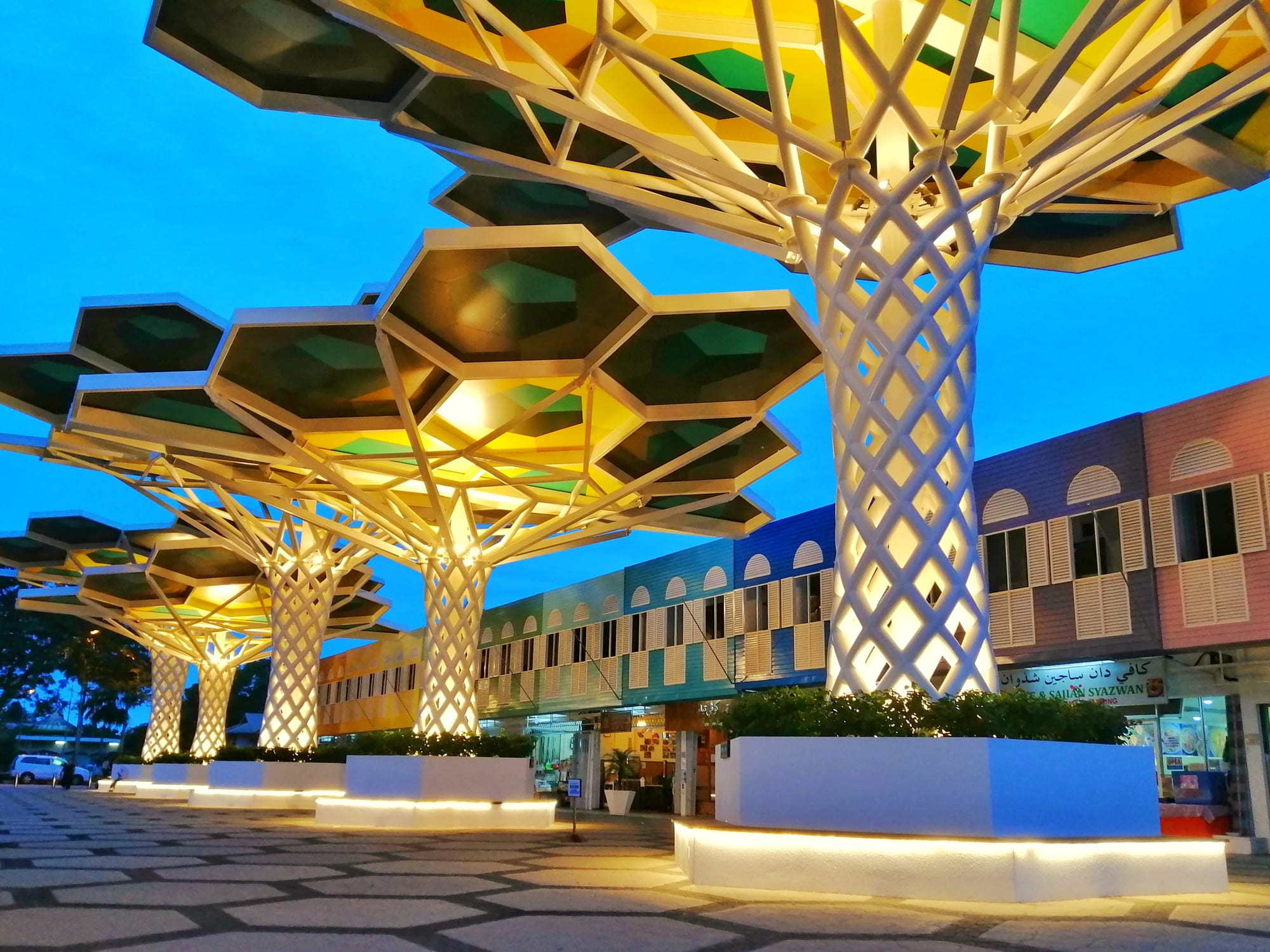
A lit pedestrian plaza in Bangar at dusk with white tree-shaped canopies of yellow and green hexagons above patterned paving and pastel shophouses

Brunei

Bangar

The pedestrian area among the shophouses in the centre of Bangar, lit at dusk. (zulfadli / Wikimedia Commons · CC BY-SA 4.0)

The small administrative town of Temburong, the eastern district of Brunei that is cut off from the rest of the country by Malaysian territory. Set on the Temburong River among forested hills, it is a quiet grid of shophouses, offices and a market that serves scattered Malay, Kedayan, Iban and Murut villages, and it is the way in to the rainforest upriver.

Neighbourhoods

  • Bangar town centre
    • First-time visitors
    • Close to the boats
    • Local life

    A few streets of shophouses, government offices, a mosque and a market on the north bank of the river, beside the old passenger jetty. Everything in town is within a ten-minute walk, and the day ends early.

    Open in Maps
  • Batang Duri
    • Rainforest
    • River trips
    • Quiet and residential

    A riverside village upstream at the end of the road, where longboats leave for the national park. Iban longhouses and small farms line the route, and the forest closes in beyond it.

    Open in Maps
  • The riverside villages
    • Local life
    • Quiet and residential

    Kampongs of Malay, Kedayan, Iban and Murut families spread along the Temburong and Labu rivers and the roads that follow them, with fruit gardens, rubber and small plantations between stretches of forest.

    Open in Maps

Things to do

Rainforest and rivers

  • Ulu Temburong National Parkpark

    Brunei's first national park, protected since 1991 — primary rainforest in the upper Temburong valley, reached by longboat from Batang Duri with licensed guides, with a canopy walkway 50 m above the forest floor and grey gibbons in the trees.

    Open in Maps
  • Temburong Riverattraction

    The river the district is named after, running from forested hills past the town to the mangroves of Brunei Bay, and the traditional route through Temburong.

    Open in Maps
  • Peradayan Forest Reservepark

    A hill forest reserve east of the town with marked trails climbing through dipterocarp forest to the rocky summits of Bukit Patoi and Bukit Peradayan.

    Open in Maps
  • Selirong Islandpark

    An island of mangrove forest in Brunei Bay at the mouth of the Temburong River, visited by boat for its mangrove park and its birdlife.

    Open in Maps

Getting there and around

  • Sultan Haji Omar Ali Saifuddien Bridgelandmark

    The 30 km road bridge over Brunei Bay and its mangroves, the longest in Southeast Asia, which links Temburong directly with the rest of the country and replaced the boats and the overland route through Malaysia.

    Open in Maps

Short trips from the town

  • Kampong Ayerneighborhood

    The stilt village on the Brunei River in the capital, centuries old and still home to thousands, reached by water taxi from the city centre.

    Open in Maps
  • Omar Ali Saifuddien Mosquelandmark

    The capital's landmark mosque, completed in 1958 with a gold dome and a lagoon holding a replica royal barge, about an hour away by road.

    Open in Maps
  • Royal Regalia Museummuseum

    In the centre of Bandar Seri Begawan, a museum of the coronation chariot, royal regalia, state gifts and the constitutional history of the sultanate.

    Open in Maps

Seasonal events

  • Ramadan and Hari Raya Aidilfitrithe ninth Islamic month and the days after it

    Daytime eating and drinking in public stop, and the market sells cooked food and kuih in the late afternoon; families across the district hold open houses once the fast ends.

  • The Sultan's birthdayJuly

    Weeks of national celebration, with district-level events, parades and gatherings held in the town.

  • National DayFebruary

    The anniversary of full independence in 1984, marked with flags, school parades and district ceremonies.

Eat and drink

Long-standing places and food districts in Bangar. Hours, ratings and directions come from your maps app, always current.

Bangar classics

  • Malay rice and river fishrestaurant

    The town's handful of restaurants and coffee shops serve rice with grilled or curried fish, chicken, vegetables and sambal, along with noodle soups and nasi katok, the cheap paper-wrapped plate of rice, fried chicken and chilli paste.

    Open in Maps
  • Ambuyatrestaurant

    The sago-starch national dish, wound onto a two-pronged bamboo fork and dipped in a sour sauce, is cooked at home across the district and served at some places in and around the town.

    Open in Maps

Markets

  • Bangar marketmarket

    The town's market sells jungle ferns and vegetables, fruit, rice cakes and kuih brought in from the surrounding villages, and is busiest in the morning.

    Open in Maps

Experience Bangar

History

Temburong has been settled far longer than its quiet appearance suggests. Malay and Kedayan families farmed and fished along the Temburong and Labu rivers, and Iban and Murut communities moved into the interior, living in longhouses and working the hills above the water. Rivers were the roads, and the district's produce — sago, fruit, rubber, timber and fish — travelled downstream to the capital by boat.

The district became separate from the rest of Brunei by accident of empire. In 1890 the Limbang valley, which lies between Temburong and the main body of the country, was annexed by Sarawak under the Brooke rajahs, cutting the sultanate in two; Brunei never accepted the loss, and the split remains. Bangar, on the river a short way inland, grew as the administrative centre of the isolated eastern district, with government offices, a school, a police post and a row of shophouses.

For most of the twentieth century the way in was by boat: a speedboat run through the mangroves from the capital, or a slow road journey through Malaysian territory with border formalities at each end. Oil money brought roads, clinics and electricity, and conservation policy set aside large areas of the interior as protected forest, with Ulu Temburong National Park — the country's first — protected from 1991 and reached only by longboat. The opening of the long bridge across Brunei Bay ended the district's isolation, putting Bangar within about an hour's drive of Bandar Seri Begawan and making day visits from the capital straightforward.

Culture & Customs

Temburong has a mixed population, and Bangar is where that mix meets. Malay and Kedayan villages sit alongside Iban and Murut — locally Lun Bawang — communities whose longhouses, festivals and languages come from a different Bornean tradition, and Chinese shopkeepers have long held part of the town's trade. The district is often described as Brunei's green corner, and people take a certain pride in living on the quiet side of the water.

Life is organised around the mosque, the school and the extended family, with the same courtesies as the rest of the country: shoes off indoors, the right hand for eating and giving, a thumb rather than a finger for pointing, and hospitality accepted rather than refused. Weddings and Hari Raya open houses draw people back from the capital, and the roads fill on holiday weekends.

Longhouse communities keep their own calendars and welcome visitors through guides or invitations rather than on the doorstep. Forest knowledge remains part of daily life — fishing the rivers, gathering ferns and fruit, reading the water levels — and much of the guiding work in the national park is done by people from these villages. Visitors are expected to dress modestly, ask before photographing anyone, and follow their host's lead.

Daily Life

Temburong is the least populated of Brunei's four districts, home to something in the order of ten thousand people, and Bangar is the only place that can be called a town. Its shophouses hold a few restaurants, general stores, a bank, a clinic and government offices; the rest of the district is villages, plantations, farms and forest reserve spread along the rivers and the roads.

Public-sector work, agriculture and small business support most households, and a growing number of people commute to the capital now that the bridge has cut the journey to about an hour. That link runs both ways: shopping, hospital appointments and secondary schooling often mean a trip out of the district, while the bridge has brought day visitors, weekend picnickers and tour groups in.

The day starts early, with the market busiest in the morning and offices opening soon after dawn; by evening the town is largely closed, and social life moves to homes and the mosque. Depopulation is the standing concern, as young people leave for work and study elsewhere, and set against it are tourism, conservation projects and the hope that easier access will keep families in the district.

Food

Eating in Temburong is home cooking and simple restaurant food rather than anything elaborate. Rice comes with river and sea fish — grilled, fried or cooked in a sour, chilli-hot broth — with chicken, jungle ferns such as paku, and sambal made from chillies, shrimp paste and lime. Nasi katok, the paper-wrapped plate of rice, fried chicken and sambal that Bruneians eat at any hour, is sold in the town as it is everywhere in the country.

Ambuyat, Brunei's national dish, belongs here as much as in the capital: sago starch from the trunk of the sago palm, stirred with hot water into a thick, sticky, almost tasteless paste, wound onto a two-pronged bamboo fork and dipped into a sour sauce, then eaten with fish, vegetables and sambal. Sago palms grow in the district's swampy ground, and older residents remember when it was everyday food rather than a speciality.

The market supplies the rest: river fish, jungle vegetables, bananas and other fruit, glutinous rice rolls wrapped in leaves, and kuih, the brightly coloured rice-flour and coconut cakes eaten with tea. There is no alcohol anywhere in the country, so meals are accompanied by sweet iced drinks, fruit juices, coconut water and strong tea, and the coffee shops serve as the town's meeting places.

Planning tools

Budget

Temburong is inexpensive apart from the forest trips, which are organised through licensed operators and are the main cost of a visit. Accommodation is limited to small guesthouses, homestays and eco-lodges upriver, and food in town is cheap. Fuel is heavily subsidised and there is no alcohol to buy.

Daily Budget Midrange
USD 90–180 (hotel, restaurants, a Temburong day tour, car hire)
Daily Budget Shoestring
USD 40–65 (guesthouse or homestay, simple restaurant meals, shared transport)

Many visitors come on a day trip from the capital rather than staying; anyone spending the night should arrange transport and any park visit before arriving, as options in town are few.

Best Time to Visit

There is no reliable dry season and rain is possible in any month, so the gaps between the two monsoons are the usual choice for the rivers and the forest. Heavy rain can raise the rivers and affect longboat trips upstream. Ramadan changes eating hours throughout the district.

Suggested Number of Days

The town itself needs only a few hours. Two or three days suit anyone staying upriver for the forest and the rivers rather than visiting from the capital. River levels and weather change how much is possible.

First Visit
1 day
With Surroundings
2–3 days

Transportation

The district is served by roads rather than public transport, and there is no bus network worth the name, so a hire car, a booked driver or an organised tour is how people get about. Longboats carry visitors upriver from Batang Duri to the national park with licensed guides. The town centre itself is walkable end to end.

Driving is on the left, roads are quiet and fuel is very cheap; arrange a return journey in advance, as taxis are not waiting in the town.

Airport & Station Connections

From Bandar Seri Begawan the usual route is the long Sultan Haji Omar Ali Saifuddien Bridge across Brunei Bay, about an hour's drive in all, which has replaced the older options of a boat through the mangroves or a road journey through Malaysian Sarawak with several border posts. The passenger boat service between the capital and the jetty at Bangar ended after the bridge opened. The nearest airport is at the capital.

Walkability

The town is small and flat and is easily covered on foot: shophouses, offices, the mosque, the market and the jetty sit within a few hundred metres of each other. Everything outside the centre — the villages, Batang Duri, the forest reserves — needs a vehicle or a boat. Heat, humidity and sudden downpours are the limits on walking.

Safety

Brunei is a very safe country for visitors, with very low crime, and the district is quieter still. The points to be aware of are legal and social rather than physical: this is a strict Islamic state that has adopted elements of sharia penal law, alcohol is banned, and public behaviour, dress, and any conduct seen as offending Islam or the monarchy are taken seriously. Same-sex relations are criminalised and discretion is essential. In the forest the practical risks are heat, leeches, slippery trails and rising rivers, which is why guides are required upriver.

Dress modestly, do not eat or drink in public during daylight in Ramadan, and avoid criticism of the Sultan. Check current official travel advice before travelling.

Climate

Equatorial: hot, humid and wet all year, with no real dry season and little variation between months. Rain often falls hard in the afternoon and clears again. Inland and upriver it rains more than on the coast, and mornings in the hills can start misty.

Summer
Hot and humid at around 32°C by day and 23°C at night, with heavy rain possible in any month
Winter
Barely different — around 31°C by day, with the north-east monsoon from December to March bringing longer wet spells

Local Customs

Temburong is rural and conservative. Modest dress covering shoulders and knees is expected, shoes come off before entering a house, a mosque or a longhouse, and the right hand is used for eating and giving. Visits to longhouses are made with a guide or an invitation, and permission is asked before entering or photographing. Friday afternoon is a closure period for prayers.

Alcohol cannot be bought or sold in the country; non-Muslim visitors may bring in a limited amount from abroad for their own private consumption, and it must be declared. Tipping is not customary, and criticism of the Sultan or of Islam is a serious matter.

Common Payment Methods

The currency is the Brunei dollar, interchangeable at par with the Singapore dollar. Cards are accepted at some shops and lodges but not everywhere, and ATMs in the district are few, so cash brought from the capital is the safer option for the market, boats and small restaurants.