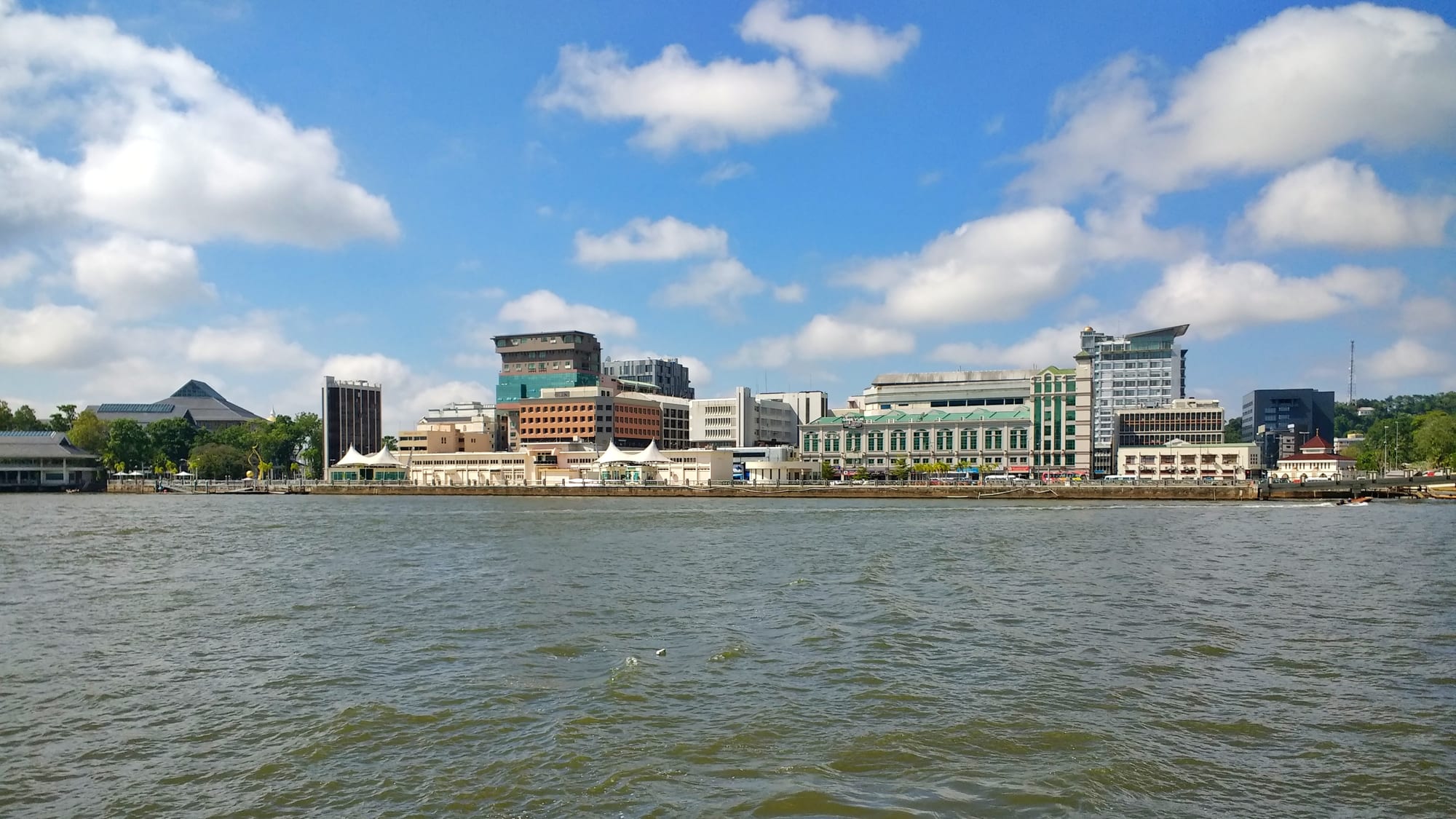
The low waterfront buildings of central Bandar Seri Begawan seen across the wide brown Brunei River under a blue sky with white clouds

Brunei

Bandar Seri Begawan

The centre of Bandar Seri Begawan seen across the Brunei River from Kampong Ayer. (Mx. Granger / Wikimedia Commons · CC0)

The capital of Brunei, on the Brunei River a little upstream from the sea. It grew from the stilt settlement of Kampong Ayer, still inhabited on the water opposite the modern centre, into a low-rise, orderly city of government offices, two very large mosques and shopping districts, funded by oil and gas and surrounded by rainforest and mangrove.

Neighbourhoods

  • Pusat Bandar (the city centre)
    • First-time visitors
    • Historic district
    • Close to public transport

    The compact core on the north bank of the river, holding the Omar Ali Saifuddien Mosque, the Royal Regalia Museum, government offices, the waterfront and most of the older shophouses. Almost everything of interest in the centre is within a short walk, and the boat jetties for Kampong Ayer are here.

    Open in Maps
  • Kampong Ayer
    • Local life
    • Photography
    • Boats

    The water village on the far bank, a settlement of houses, mosques, schools and shops raised on stilts and joined by wooden walkways. Thousands of people still live there, and water taxis cross from the centre in a few minutes.

    Open in Maps
  • Gadong
    • Best for food
    • Shopping
    • Night market

    The capital's commercial district a few kilometres north-west of the centre, with shopping malls, restaurants and the large night market. It is where much of the city eats and shops in the evening, and it is busier after dark than the old centre.

    Open in Maps
  • Kiulap
    • Shopping
    • Cafés
    • Business

    A grid of shops, banks, cafés and small restaurants next to Gadong, popular for coffee and casual eating. It has little in the way of sights but is where a good deal of everyday city life happens.

    Open in Maps
  • Jerudong
    • Beaches
    • Families
    • Resorts

    A coastal district about 13 km north-west of the centre, with the country's amusement park, a long beach on the South China Sea and a large resort complex. The drive out takes well under an hour.

    Open in Maps

Things to do

Mosques and palaces

  • Omar Ali Saifuddien Mosquelandmark

    The city's landmark mosque, completed in 1958 with a gold dome, marble and Italian stone, standing beside an artificial lagoon that holds a replica royal barge.

    Open in Maps
  • Jame' Asr Hassanil Bolkiah Mosquelandmark

    The largest mosque in Brunei, opened in 1994 for the Sultan's silver jubilee in the Kiarong area, with 29 golden domes, four minarets and extensive gardens.

    Open in Maps
  • Istana Nurul Imanlandmark

    The Sultan's official residence upriver from the centre, among the largest residential palaces in the world, seen from the road or the river except during the Hari Raya open house.

    Open in Maps

Museums

  • Royal Regalia Museummuseum

    A domed building in the centre displaying the coronation chariot, royal regalia, state gifts and the constitutional history of the sultanate.

    Open in Maps
  • Malay Technology Museummuseum

    A museum beside the river near Kota Batu explaining how houses on stilts, boats, fishing gear and metalwork were made in Brunei and among Borneo's Indigenous peoples.

    Open in Maps

The river and the water village

  • Kampong Ayerneighborhood

    Centuries of settlement on the water, with wooden houses, mosques and schools on stilts linked by walkways, reached by water taxi and served by a cultural and tourism gallery.

    Open in Maps
  • Sungai Bruneiattraction

    The river that the capital is built around; boats run up its mangrove creeks, where proboscis monkeys and crocodiles are often seen, and down towards the sea.

    Open in Maps

Parks and viewpoints

  • Tasek Lama Recreational Parkpark

    A forest park on the hill immediately behind the centre, with a small waterfall, reservoir, stepped paths and a viewpoint over the city.

    Open in Maps

Short trips from the city

  • Jerudong Parkattraction

    An amusement park opened in 1994 on the coast north-west of the capital, with rides and gardens, about 13 km from the centre.

    Open in Maps
  • The Empire Bruneiattraction

    A very large hotel and country club on the coast at Jerudong, built for a member of the royal family and opened in 2000, known for its marble lobby and sea-facing grounds.

    Open in Maps
  • Muara Beachbeach

    A long sandy beach at the port town at the mouth of the river, about 20 km north-east, used by families at weekends.

    Open in Maps
  • Ulu Temburong National Parkpark

    Protected primary rainforest in the eastern district, reached by road and longboat, with a canopy walkway high above the forest floor and gibbons in the trees.

    Open in Maps

Seasonal events

  • Ramadan and Hari Raya Aidilfitrithe ninth Islamic month and the days after it

    Daytime eating and drinking in public stop, Ramadan markets sell kuih and cooked food in the late afternoon, and the Sultan holds an open house at the palace after the fast ends.

  • The Sultan's birthdayJuly

    Several weeks of national celebration, with a parade, a public gathering and events across the districts.

  • National DayFebruary

    The anniversary of full independence in 1984, marked by a mass parade at the national stadium and flags through the capital.

  • Chinese New YearJanuary or February

    Marked by Brunei's Chinese community with temple visits, lion dances and family meals, mainly around the centre and Gadong.

Eat and drink

Long-standing places and food districts in Bandar Seri Begawan. Hours, ratings and directions come from your maps app, always current.

Bandar classics

  • Ambuyatrestaurant

    The national dish — a sticky, near-flavourless sago starch twirled onto a two-pronged bamboo fork and dipped in a sour sauce, eaten with grilled fish, vegetables and sambal at traditional restaurants in the capital.

    Open in Maps
  • Nasi katok stallsrestaurant

    A cheap plate of rice, fried chicken and sambal wrapped in paper, sold from small stalls and shophouses across the city at all hours; the name comes from knocking on the shutter to be served.

    Open in Maps

Markets and food districts

  • Gadong Night Marketmarket

    Rows of stalls grilling satay and fish, frying noodles and selling brightly coloured kuih each evening in the commercial district — one of the busiest eating places in the country.

    Open in Maps
  • Tamu Kianggehmarket

    An open-air tamu beside the Kianggeh River in the centre, trading since the 1960s and selling jungle vegetables, fruit, river fish, spices and local cakes to city households.

    Open in Maps
  • Kiulap cafés and restaurantsneighborhood

    A compact district of coffee shops, Malay and Chinese restaurants and bakeries, where much of the city meets over iced drinks in the absence of any bar scene.

    Open in Maps

Experience Bandar Seri Begawan

History

The settlement on this stretch of the Brunei River is old. Chinese and Malay records describe a trading port here, and by the fifteenth and sixteenth centuries it was the capital of a sultanate whose authority reached along the coasts of Borneo and into the present-day Philippines. Its population lived almost entirely on the water, in the stilt villages collectively called Kampong Ayer, which Antonio Pigafetta, sailing with Magellan's expedition in 1521, described as a city of thousands of houses standing in salt water.

Brunei's power shrank through the nineteenth century, as territory passed to the Brooke rajahs of Sarawak and to the British North Borneo Company, and in 1888 the remnant became a British protectorate. The town on the river — then known simply as Brunei Town — remained small and largely waterborne. A deliberate move to build on dry land began under British residents in the early twentieth century, and oil found in the west of the country from 1929 gradually paid for roads, schools and government buildings.

Japanese forces occupied Brunei from 1941 to 1945, and Allied bombing badly damaged the town before liberation. Postwar oil revenue transformed it: the Omar Ali Saifuddien Mosque was completed in 1958 as the symbol of the new capital, the centre was rebuilt in concrete, and much of Kampong Ayer's population was rehoused on land, though thousands stayed on the water. The city was renamed Bandar Seri Begawan in 1970 in honour of Sultan Omar Ali Saifuddien III, who had abdicated in favour of his son. Full independence followed in 1984, and the decades since have added ministries, mosques, malls and suburbs across the Brunei-Muara district.

Culture & Customs

The capital is the showcase of Malay Islamic Monarchy, the state philosophy that binds Malay custom, Islam and loyalty to the Sultan. Its effects are visible: the scale of the mosques, the royal ceremonies, the absence of bars and the quiet of Friday afternoons, when shops close for prayers. Religious festivals structure the year, and the Hari Raya open house at the palace, when ordinary residents queue to shake the Sultan's hand, is the city's largest annual gathering.

Courtesy is formal and unhurried. Greetings involve a light touch of the hands followed by bringing the hand to the chest, shoes are removed at the door, the right hand is used for eating and passing, and a thumb rather than a forefinger is used to point. Hospitality is expected to be accepted, and refreshments are offered to visitors as a matter of course.

About a tenth of the population is ethnic Chinese, with temples and clan associations in the older streets and a full Lunar New Year calendar, and Indigenous Bornean communities add further languages and traditions. Social life happens in homes, at restaurants and coffee shops, at the night markets and in the malls rather than in public nightlife. Visitors are expected to dress modestly, to behave discreetly, and to treat the monarchy and Islam as subjects beyond argument.

Daily Life

Around seventy thousand people live in the municipal area, and most of Brunei's roughly 460,000 residents live in the surrounding Brunei-Muara district, which makes the capital and its suburbs the centre of national life. Kampong Ayer still houses thousands on the water, with piped services, schools, clinics and mosques reached by walkway and boat, while newer housing spreads inland in low estates of detached houses.

Government is the largest employer, and the oil and gas industry that funds it operates mainly in the west of the country. Wages are supported by a welfare state of free or heavily subsidised healthcare, education and housing, and by very cheap fuel, which helps explain why almost every household drives. The long-standing worry is the economy's near-total reliance on hydrocarbons and the slow pace of diversification; many young Bruneians study abroad and return to public-sector work.

The rhythm of the day is early. Offices and schools start soon after dawn, the midday heat empties the streets, and the evening belongs to the night markets, the malls and family meals. Friday's long prayer break is the fixed point of the week, and the city is at its quietest then.

Food

Bruneian cooking is close to Malay food, with Chinese and Indonesian influence and a strong preference for rice, fish and chilli. The dish visitors are pointed towards is ambuyat: sago starch mixed with hot water into a thick, sticky, almost tasteless paste, wound onto a two-pronged bamboo fork called a chandas and dipped in a sour sauce, then eaten with grilled or fried fish, boiled jungle ferns and sambal. It is a shared, slow meal rather than a quick one.

Everyday eating is cheaper and faster. Nasi katok — rice, fried chicken and sambal wrapped in paper — is the national snack, sold from stalls and shophouses at all hours; noodle soups, satay grilled over charcoal, and kelupis and lamban, glutinous rice rolls wrapped in leaves, fill in the rest. The Gadong night market is where most of this is eaten, with rows of grills and fryers working from late afternoon.

Kuih, the brightly coloured Malay cakes made from rice flour, coconut and palm sugar, are sold everywhere, and in huge quantities in the hour before the fast breaks during Ramadan. There is no alcohol, so meals are paired with sweet iced drinks, fresh fruit juices, coconut water and strong tea; coffee shops and the cafés of Kiulap and Gadong take the place that bars occupy elsewhere.

Planning tools

Budget

Brunei is not cheap, but it is quieter and less expensive than Singapore. Hotels and imported goods are the main costs, while food-court and stall meals cost very little and fuel is heavily subsidised. There is no nightlife economy, because alcohol cannot be sold, which keeps evening spending low.

Daily Budget Midrange
USD 90–180 (hotel, restaurants, a Temburong day tour, car hire)
Daily Budget Shoestring
USD 45–70 (guesthouse, food-court meals, local buses)

A hire car or a tour is needed for the rainforest and the coast; within the capital, taxis and ride-hailing are limited, so plan transport before arriving.

Best Time to Visit

There is no reliable dry season and rain is possible in any month, so the gaps between the two monsoons are the usual choice for river trips and the rainforest. Temperatures barely change through the year. Ramadan alters daytime hours across the city, with many restaurants closed until dusk.

Suggested Number of Days

The capital itself is small and can be seen in a day or two. Three or four days allow the rainforest, the coast and the river trips as well. Rain, Friday prayer closures and Ramadan hours all affect how much fits into a day.

First Visit
1–2 days
With Surroundings
3–4 days

Transportation

The city is spread out and built for cars, and public buses are limited and stop running early in the evening. Most visitors use a hire car, a taxi booked through a hotel, or a ride-hailing app; taxis are few and rarely flagged down on the street. Water taxis cross the river to Kampong Ayer constantly, and longer boats run up the river and along the coast.

Driving is on the left, roads are good and quiet and fuel is very cheap; reaching Temburong district now uses the long Sultan Haji Omar Ali Saifuddien Bridge rather than a boat.

Airport & Station Connections

Brunei International Airport is about 8 km from the centre, roughly fifteen minutes by road, and is served mainly by Royal Brunei Airlines with connections across Southeast Asia and beyond. Buses also arrive overland from Miri and Kota Kinabalu in Malaysia, a long journey with several border posts, and boats run from Labuan to the ferry terminal at Muara.

Walkability

The centre is small enough to walk: the mosque, the Regalia Museum, the waterfront and the shophouses are within a few hundred metres of each other, and the boat jetties are in the middle of it. Beyond that the city thins out into road junctions and car parks, and Gadong, Kiulap and the airport all need transport. Heat, humidity and sudden downpours shorten walks.

Safety

Brunei is a very safe country for visitors, with very low crime, and the capital is quiet at night. The points to be aware of are legal and social rather than physical: this is a strict Islamic state that has adopted elements of sharia penal law, alcohol is banned, and public behaviour, dress, and any conduct seen as offending Islam or the monarchy are taken seriously. Same-sex relations are criminalised and discretion is essential.

Dress modestly, do not eat or drink in public during daylight in Ramadan, and avoid criticism of the Sultan. Check current official travel advice before travelling.

Climate

Equatorial: hot, humid and wet all year, with no real dry season and very little variation between months. Heavy downpours come in the afternoon and clear quickly. The north-east monsoon blows from December to March and the south-easterly one from about June to October.

Summer
Hot and humid at around 32°C by day and 24°C at night, with heavy rain possible in any month
Winter
Barely different — around 31°C by day and 23°C at night, with the north-east monsoon from December to March bringing longer spells of rain

Local Customs

Malay Islamic Monarchy is the state philosophy, and public life follows it. Modest dress covering shoulders and knees is expected, and women are given robes and headscarves at the mosques, which close to non-Muslim visitors at prayer times and on Fridays. Shoes come off indoors and at mosque entrances, the right hand is used for eating and giving, and people are pointed at with a thumb rather than a finger. Friday afternoon is a closure period for prayers.

Alcohol cannot be bought or sold in the country; non-Muslim visitors may bring in a limited amount from abroad for their own private consumption, and it must be declared. Tipping is not customary, and criticism of the Sultan or of Islam is a serious matter.

Common Payment Methods

The currency is the Brunei dollar, interchangeable at par with the Singapore dollar, which also circulates freely. Cards are accepted in hotels, malls and restaurants, and ATMs are common in the centre, Gadong and Kiulap. Cash is needed for markets, stalls, water taxis and buses.