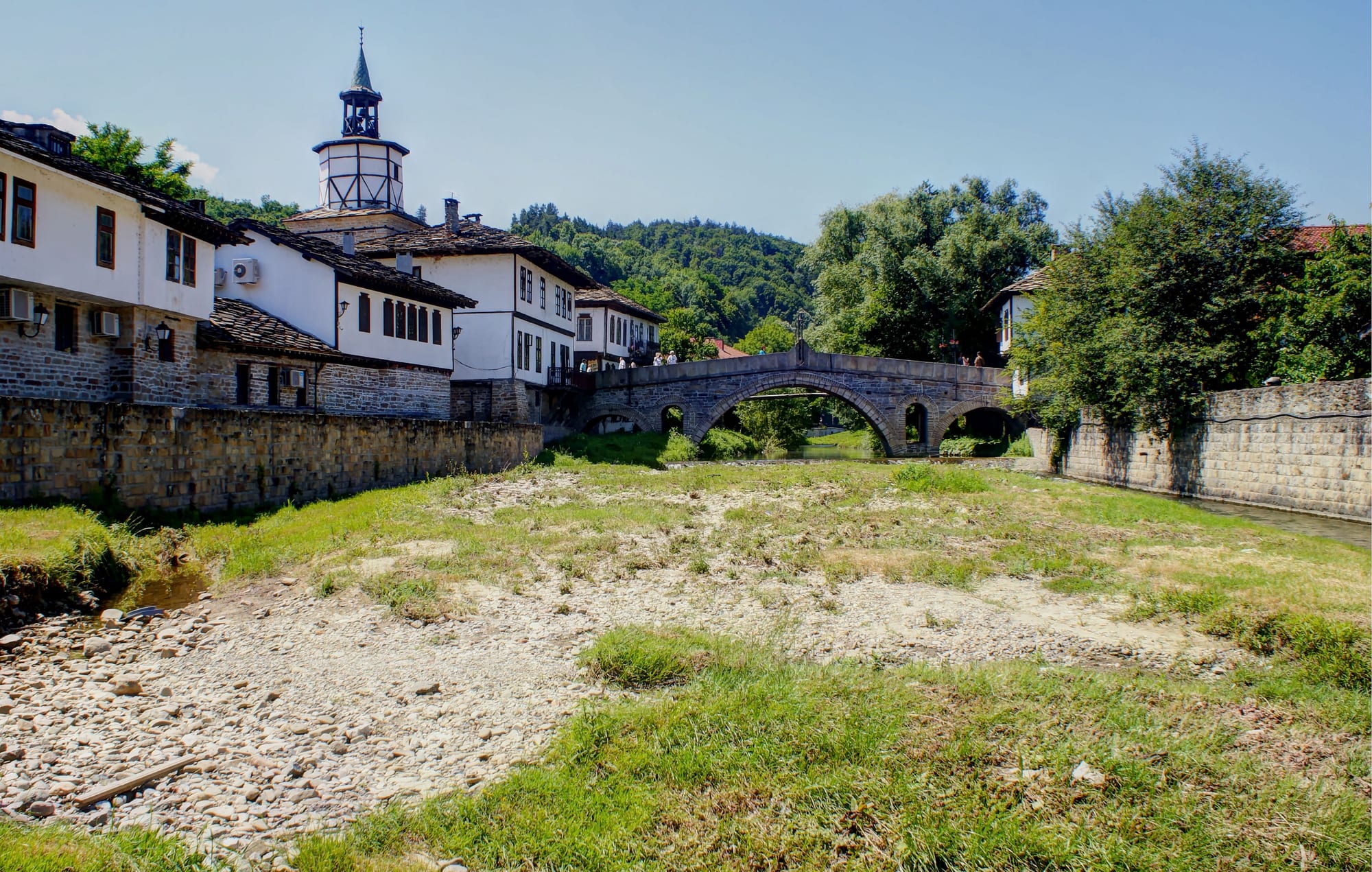
A stone arched bridge over a shallow riverbed, with white Revival houses and a timber-topped clock tower behind

Veliko Tarnovo & the North, Bulgaria

Tryavna

The old humpback bridge in the centre of Tryavna. (Gitanes232 / Wikimedia Commons · CC0)

A small town in the valley of the Tryavna river on the northern slopes of the Balkan range, east of Gabrovo. Crafts flourished here during the National Revival, and its school of woodcarving and icon painting is the oldest of the Revival-era art schools. Today its stone-roofed houses, clock tower and old bridge make it a quiet museum town.

Neighbourhoods

  • The old town around Kapitan Dyado Nikola Square
    • First-time visitors
    • Historic district
    • Museums

    The heart of Tryavna, a square framed by the 1814 clock tower, the old school building and Revival-era houses with wooden bay windows and stone-slab roofs. Most of the museum houses, galleries and craft shops are on the square or the lanes leading off it.

    Open in Maps
  • Slaveykov Street and the riverside
    • Best for food
    • Quiet evenings

    The older residential lanes along and above the Tryavna river, where preserved Revival-era houses and several traditional taverns stand. The old public bath beside the river now holds a museum of Asian and African art.

    Open in Maps
  • The edges of town
    • Quiet and residential
    • Walks

    Newer streets, guesthouses and villas climb the wooded slopes around the old centre. They are quieter and greener than the square, and the forests of the Balkan range begin within a short walk.

    Open in Maps

Things to do

The old town

  • Clock tower and Kapitan Dyado Nikola Squarelandmark

    The clock tower of 1814, whose clock was installed the following year and still works, stands on the square at the centre of the old town.

    Open in Maps
  • The old humpback bridgelandmark

    An arched stone bridge over the river just behind the clock tower, built in 1844–45 and, with the tower, one of the symbols of the town.

    Open in Maps
  • St Archangel Michael Churchlandmark

    A church in the town centre whose woodcarved iconostasis and bishop's throne are counted among the masterpieces of the Tryavna school of woodcarving.

    Open in Maps

Museum houses

  • Daskalov Housemuseum

    A merchant family's house built in 1804–08, now a museum of woodcarving and icon painting, famous for two carved ceiling suns made by rival masters who worked for six months without seeing each other's work.

    Open in Maps
  • Museum of Icon Painting and Woodcarvingmuseum

    A collection of more than 160 original icons by the town's families of icon painters, from the 17th to the 19th century.

    Open in Maps
  • Slaveykov Housemuseum

    The museum-house of the writers Petko and Pencho Slaveykov, father and son, in the old part of the town, with an exhibition of their work.

    Open in Maps
  • Angel Kanchev Housemuseum

    The family house of the revolutionary Angel Kanchev, with documents and household objects on his life and the town's part in the struggle against Ottoman rule.

    Open in Maps
  • Museum of Asian and African Artmuseum

    An unexpected collection housed in the town's old public bath on the riverside.

    Open in Maps

Short trips from the town

  • Bozhentsiattraction

    A hillside village and architectural reserve of two-storey Revival houses with stone roofs, where new buildings must match the old style.

    Open in Maps
  • Etar Architectural-Ethnographic Complexmuseum

    An open-air museum near Gabrovo, opened in 1964, where craftsmen work in reconstructed houses and water-powered workshops of the Revival period.

    Open in Maps
  • Dryanovo Monasterylandmark

    A working Orthodox monastery founded in the 12th century in the valley of the Andaka river, inside Bulgarka Nature Park.

    Open in Maps
  • Bulgarka Nature Parkpark

    A nature park of about 22,000 hectares on the northern slopes of the Balkan range between Gabrovo and Kazanlak, with forests, trails and many historic sites.

    Open in Maps

Eat and drink

Long-standing places and food districts in Tryavna. Hours, ratings and directions come from your maps app, always current.

Tryavna classics

  • Taverns of the old townneighborhood

    Restaurants around the square and on Slaveykov Street serve traditional Bulgarian food, some of them inside preserved Revival-era houses.

    Open in Maps
  • Cafés around the squarecafe

    Coffee shops in the centre double as places for a beer or a glass of rakia, which most cafés and restaurants in town serve.

    Open in Maps

Experience Tryavna

History

People lived in the Tryavna valley in Thracian times, but the town appears in documents only from the 12th century. In 1190 a battle near Tryavna proved crucial in re-establishing Bulgarian independence from Byzantium, and St Archangel Michael Church in the centre is said to have been built after Tsar Asen's victory over the Byzantine emperor Isaac II. After the Ottoman conquest the settlers here were charged with guarding the passes over the mountains, and in return they enjoyed privileges; only Bulgarians lived in the town.

The craftsmen of Tryavna turned woodcarving and icon painting into their main livelihood. From the middle of the 17th century the town gave its name to the Tryavna school, the oldest of the artistic schools of the Revival, founded by the painter Vitan Karchov, and its masters carved iconostases and painted icons for churches far beyond the town. The houses of the Revival period have a design of their own: irregular stone ground floors for workshops and shops, timber upper floors with bay windows, and roofs of stone slabs. The clock tower went up on the main square in 1814, the Daskalov family's house was finished in 1808, and one of the first secular schools in Bulgaria was opened on the same square.

The town produced figures of the national movement, including the revolutionary Angel Kanchev and the poet Pencho Slaveykov, both born here. Today it draws visitors with around 140 cultural monuments, museums and exhibitions.

Culture & Customs

Tryavna's identity rests on its craft. The school of woodcarvers and icon painters is remembered in almost every building of the old town, and its most famous story is the contest in the Daskalov House, where two masters, Dimitar Oshanetsa and Ivan Bochukovetsa, carved a sun into the ceilings of the two largest rooms for six months without being allowed to see each other's work. The tradition is still taught: the National High School for Applied Arts, the Tryavna School, trains young woodcarvers and icon painters, and many workshops and galleries in town sell their work.

Literature is the other source of local pride. The writers Petko Slaveykov and his son Pencho are remembered in a museum-house in the old quarter; the Swedish scholar Alfred Jensen proposed Pencho for the Nobel Prize, but he died before the nomination could be considered. The house of Angel Kanchev, a comrade of Vasil Levski, recalls the town's part in the struggle against Ottoman rule.

The town keeps close ties abroad: it has been twinned with Brienz in Switzerland since 1994 and joined the Douzelage association of European towns in 2011. Sport is on a small scale, with a football club and basketball club and the Tryavna Ultra race.

Daily Life

About 6,800 people lived in Tryavna at the end of 2025, well down from nearly 10,000 in 2009. The town is the centre of a municipality of the same name and has a weekly newspaper, Tryavnenska Sedmitsa.

The economy combines a long-established textile industry with tourism. Visitors come for the old town and museums, and the town has guesthouses, private lodgings, villas, restaurants and taverns to serve them, along with shops selling woodcarving, jewellery and other crafts. The town's art school, where successors of the old icon painters and woodcarvers learn their crafts, keeps the tradition alive.

Life follows the ordinary pattern of a Bulgarian small town: an early start, a sit-down lunch, coffee on the square, and evenings out on the main streets in warm weather. Gabrovo, the larger city about 20 km to the west, is linked to Tryavna by buses about ten times a day on weekdays. In winter the town is quiet, and nearby slopes draw skiers when snow falls in the mountains.

Food

Tryavna eats like the rest of the Balkan foothills, and its taverns serve traditional Bulgarian food, some of it in restored houses of the Revival period. A mushroom soup, Tryavnenska gabena chorba, is listed as one of the town's own dishes. Banitsa, a baked pastry of layered filo and filling, is a breakfast staple; shopska salad is a common salad of chopped cucumbers, onions, peppers and tomatoes with white cheese; and lyutenitsa is a purée of tomatoes, red peppers and carrots, often served on bread.

From the grill come kebapche, cumin-seasoned minced meat shaped into a stick, and meshana skara, a mixed plate of kebapche, kyufte and other grilled meats. Cold cuts include pastarma, a spicy beef sausage.

Rakia is the everyday spirit, and in winter it is served hot as greyana rakia. Beer and rakia are available in almost every café and restaurant, and there are few places that serve only alcohol. Local craftsmen also make wooden toys and carved souvenirs, sold in the shops of the old town.

Planning tools

Budget

Tryavna is inexpensive, like the rest of northern Bulgaria. Rooms are mostly in small family-run guesthouses and private lodgings, meals in taverns cost little, and the museums charge modest entry fees. Prices rise a little at summer weekends, when visitors arrive from the bigger cities.

Daily Budget Midrange
USD 70–120 (boutique guesthouse, restaurant dinners, museum tickets, a hire car for the villages)
Daily Budget Shoestring
USD 35–50 (guesthouse room, tavern meals, buses and trains)

Most of the town's sights are close together and cheap to visit; a car makes it easy to add Bozhentsi, Etar and the monasteries.

Best Time to Visit

May, June, September and early October, when the foothills are green and the town is quiet. July and August are hot. Winters are cold and snowy, which suits the ski area at Uzana in the mountains nearby, though some museums keep shorter hours.

Suggested Number of Days

The town itself is small and can be seen in a day or two. Allow three or four to take in the neighbouring villages, monasteries and nature park, more for anyone walking or cycling in the mountains rather than driving.

First Visit
1–2 days
With Surroundings
3–4 days

Transportation

The old town is small enough to cover on foot. Tryavna has a small local bus network, taxis and minibuses, and buses run to Gabrovo several times a day on weekdays, less often at weekends. A hire car is the easiest way to reach the villages, monasteries and trailheads of the Balkan range.

Mountain roads around the town can be slow and, in winter, snowy; check conditions before driving over the Balkan passes.

Airport & Station Connections

Tryavna lies about 20 km east of Gabrovo and about 226 km from Sofia. It has a railway station on a north–south line, with trains from the junction at Gorna Oryahovitsa, near Veliko Tarnovo, where connections from Sofia are made; a few trains continue south to Stara Zagora. A daily bus runs to Sofia. International visitors usually fly into Sofia and continue by train, bus or car.

Walkability

Very good. The square, the bridge, the museum houses and the taverns are all within a few minutes of one another, though some lanes are steep and cobbled. Good shoes help, particularly when the stones are wet or icy.

Safety

Bulgaria is a safe country for visitors, with low levels of violent crime. Tryavna is a small and quiet town. The practical risks are slippery cobbles in the old streets, unlit roads in the countryside after dark and heavy snow on the mountain roads in winter.

Wear good shoes for the cobbled lanes and check road conditions before crossing the Balkan range in winter. Check current official travel advice before travelling.

Climate

Continental, shaped by the town's position on the northern slopes of the Balkan range and its distance from the Black Sea. Summers are warm, winters cold and snowy, and spring is short, falling mainly in April.

Summer
warm, with average daytime highs of about 27°C
Winter
cold and snowy, with average daytime highs of about 4°C

Local Customs

Tips are not added to bills; leaving 5–10 per cent in restaurants is usual if the service was good. Bulgarians often shake the head for 'yes' and nod for 'no', which can cause confusion. Tryavna is proud of its craft heritage, and many shops sell work by local woodcarvers and icon painters. Churches are working places of worship.

Dress modestly and speak quietly in churches, and ask before photographing inside them or in craft workshops.

Common Payment Methods

The currency is the euro (EUR). Bulgaria adopted the euro on 1 January 2026, replacing the lev, and the euro has been the sole currency since 1 February 2026. Cards are accepted in most restaurants and guesthouses, but cash is useful for small shops and craft stalls, and there are ATMs in the centre.