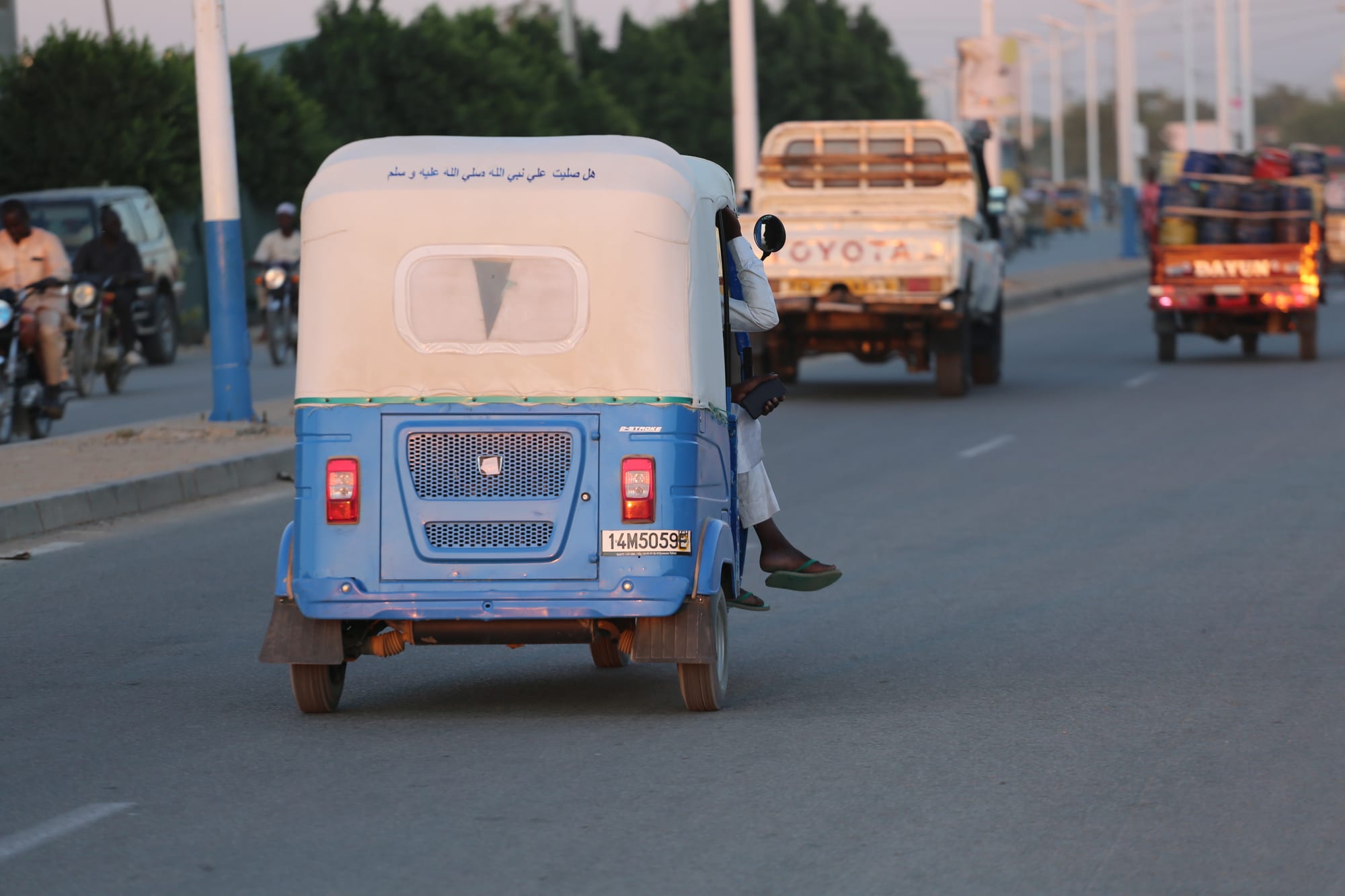
A blue and white motorised rickshaw and loaded pick-up trucks on a wide paved road at dusk in Abéché

Abéché, Zakouma & the East, Chad

Abéché

Traffic on one of Abéché's main roads in eastern Chad. (Abakar B / Wikimedia Commons · CC BY-SA 4.0)

The largest town of eastern Chad and the former capital of the Ouaddaï sultanate, set in dry country about 750 kilometres north-east of N'Djamena by road. Sand-coloured streets, mud-brick mosques and the remains of the sultans' palace recall a caravan city that traded north across the Sahara; today it is a university and market town and a base for humanitarian work. This page is written to explain the city, not to encourage travel.

Neighbourhoods

  • The old town
    • Historic district
    • First-time visitors

    The oldest quarter, laid out around the sultans' palace and the main mosque, with narrow sandy lanes between low mud-brick and banco houses and compound walls. It is where Abéché's history as a sultanate capital is still legible in the buildings.

    Open in Maps
  • The souk quarter
    • Markets
    • Local life

    The commercial heart, a dense grid of stalls, workshops and small shops trading livestock, grain, cloth, leatherwork and goods carried in from Sudan and Libya. Tailors, cobblers and metalworkers work in the open along the lanes.

    Open in Maps
  • The administrative quarter
    • Quiet and residential
    • Practicalities

    The wider, more ordered streets laid out under French administration and since expanded, holding the provincial offices, the hospital, the better guesthouses and the compounds of aid organisations. Traffic here runs out towards the airport.

    Open in Maps
  • The university quarter
    • Students
    • Quiet and residential

    The newer outskirts around Abéché's university and secondary schools, which bring students from across the east. Housing is low and spread out, with sandy open ground between blocks and small shops serving the student trade.

    Open in Maps

Things to do

The old town

  • The sultans' palacelandmark

    The remains of the residence of the sultans of Ouaddaï, built after the capital moved here in the 19th century and still the focus of the old quarter.

    Open in Maps
  • The grand mosquelandmark

    The Grand Mosque on the Place de l'Indépendance, built in the nineteenth century and one of the oldest and most important mosques in Chad.

    Open in Maps
  • The old quarter's lanesneighborhood

    Sandy streets of walled compounds and flat-roofed houses between the palace and the mosque, the surviving fabric of the caravan-era town.

    Open in Maps

Markets

  • Abéché soukmarket

    The town's large market and the country's principal camel market, also trading cattle, millet and sorghum, vegetables, spices, cloth, pottery and craftwork, with tailors and cobblers working along its lanes.

    Open in Maps

Short trips from the town

  • Ouaralandmark

    The ruined first capital of the Ouaddaï sultanate, deserted after its wells dried up, where a palace, a mosque and a city wall still stand between the hills; the site was added to Chad's UNESCO World Heritage tentative list in 2005.

    Open in Maps

Seasonal events

  • Eid al-Fitrvaries with the lunar calendar

    The feast that ends Ramadan, the town's biggest social occasion, marked by prayers, new clothes, visiting and shared meals.

  • Eid al-Adhavaries with the lunar calendar

    The feast of sacrifice, when livestock trading in the souk reaches its peak and families slaughter and share a sheep or goat.

  • Ramadanvaries with the lunar calendar

    A month of daytime fasting that reshapes the whole rhythm of the town, with markets busiest in the late afternoon and evening.

Eat and drink

Long-standing places and food districts in Abéché. Hours, ratings and directions come from your maps app, always current.

Abéché classics

  • Esh with saucerestaurant

    The eastern staple — a stiff millet or sorghum porridge eaten by hand from a shared bowl with an okra, dried-meat or vegetable sauce, served in small eating houses around the market.

    Open in Maps
  • Grilled meat stallsrestaurant

    Mutton and beef grilled over charcoal and served with bread and onion, the standard evening food of the market streets.

    Open in Maps

Markets and tea

  • The souk food stallsmarket

    Grain, dried okra, dates, honey and gum arabic sold alongside cooked food, with kisra, a thin fermented sorghum flatbread, eaten with stews.

    Open in Maps
  • Tea placescafe

    Small shaded stands where strong sweet tea is poured in rounds, the everyday social ritual across the east.

    Open in Maps

Experience Abéché

History

Abéché grew up as a capital of the sultanate of Ouaddaï, a Muslim state founded in the 17th century whose first seat was at Ouara, north of the present town. During the 19th century the sultans moved their capital here from Ouara, whose wells had dried up, to a site with better water in the Ouaddaï hills, and built palaces, mosques and Quranic schools. The new capital sat at the southern end of a caravan route that ran across the Sahara to Kufra and Benghazi, and it grew rich on the trade in ivory, salt, cloth and slaves moving north and on goods coming south. By the late 19th century it was among the larger towns of the central Sahel, walled, densely built and known for its scholars.

French troops invaded the sultanate in 1909, took Abéché and forced the sultan to give up his throne, though resistance across Ouaddaï continued for years afterwards. On 15 November 1917 French troops killed more than 75 notables and religious figures in the town, among them some 20 Quranic teachers, in what is remembered as the coupe-coupe massacre. The town was then the largest in Chad, with some 28,000 people, but trade across the desert declined and epidemics cut the population to about 6,000 by 1919. The sultanate itself was restored under French orders in 1935. Under colonial rule Abéché became an administrative centre for a region in which France invested very little.

Since independence in 1960 the town has been shaped by events beyond the border. It served as a garrison and administrative base through the rebellions and civil wars of the later 20th century, and from the mid-2000s it became the logistical hub for the aid operation serving refugees from Darfur, a role that expanded again after war resumed in Sudan in 2023. The Adam Barka University of Abéché and the Lycée Franco-Arabe are here, and the sultan of Ouaddaï retains a traditional role in the town.

Culture & Customs

Abéché is overwhelmingly Muslim and has long been a centre of Islamic learning in Chad, with Quranic schools and a scholarly reputation that once drew students from across the region. That inheritance shapes daily manners: unhurried greetings, careful hospitality, modest dress, and a clear separation between the ways men and women use public space. The two Eids and Ramadan are the great fixed points of the year, marked by prayer, visiting, new clothes and shared meat.

The town is a meeting place of peoples. The Maba, whose language was the state language of the sultanate, are long established in Ouaddaï, alongside other communities, Arab herding families, Zaghawa and Tama traders from further north, and, more recently, people displaced from across the Sudan border. Chadian Arabic links them all; French is the language of offices and the university. Many families have relatives on the Sudanese side, and the cultural world of Abéché has always reached east towards Darfur as much as west towards N'Djamena.

The sultanate remains part of local identity. The sultan of Ouaddaï holds a traditional authority recognised alongside the state, and weddings, naming ceremonies and religious festivals are marked with drumming and, on the largest occasions, horsemen. Craft traditions are strong and visible — leatherwork, saddlery, silverwork, tailoring and embroidery are practised in workshops open to the street in the market quarter.

Daily Life

Something over 76,000 people were counted in Abéché in 2012, which makes it one of Chad's larger towns and the centre of the east. Its economy rests on trade: livestock, millet and sorghum, dates from the northern oases, gum arabic tapped from acacia trees, and manufactured goods carried in from Sudan and Libya. The university, the hospital, the provincial administration and the large presence of humanitarian organisations make the town a source of salaried work that is rare in the region.

Housing runs outwards from the old quarter in low compounds of mud-brick and concrete, with newer districts spreading over sandy ground towards the university and the airport road. The day begins early, slows through the worst of the afternoon heat and revives at dusk, when the market streets fill and tea stands do their best business. Water, electricity and fuel supply are all intermittent.

The dominant issue is the refugee emergency in the surrounding province. Camps and settlements established for Darfuris in the 2000s have been joined since 2023 by much larger new ones along the border, and Abéché is the hub through which the response is organised. That brings vehicles, flights and money into the town while straining water, housing and food prices for everyone living here.

Food

Abéché eats in the Sahelian and Sudanese way. The staple is esh, the Chadian Arabic name for the stiff millet or sorghum porridge known further west as boule, eaten by hand from a shared bowl and dipped into a sauce. The sauces are of okra, fresh or dried and slippery in texture, of dried tomato and onion, or of charmout, strips of beef or mutton dried in the sun and then pounded. Kisra, a thin fermented sorghum flatbread, is served with stews and is more common here than in the south.

Milk is central to the diet of the herding families who trade in the town: fresh or soured cow's and camel's milk, and butter clarified for cooking. Meat is the food of guests and festivals, grilled over charcoal and served plainly with bread and raw onion; mutton and goat are usual, beef at bigger occasions. Baobab leaves and dried okra thicken sauces through the dry months, and dates arrive by truck from the Borkou oases in the north.

Drinks are non-alcoholic. Strong sweet tea, sometimes with mint or spices and poured in several rounds, is offered to every visitor. Karkanji, made from dried hibiscus flowers, is drunk cold and sweet, and a tart drink is made from baobab fruit pulp. Market stalls sell peanuts, dried fish, honey and gum arabic alongside the grain.

Planning tools

Budget

Abéché is a humanitarian hub rather than a tourist town, and that sets its prices: the few decent guesthouses are expensive for what they are and are often full of aid staff, while market food and tea cost very little. The real expenses are vehicles, fuel, permits and the flight or long road journey from N'Djamena. Payment is in cash.

Daily Budget Midrange
USD 150–300 (a guesthouse room, market meals and a hired vehicle with a driver, before flights from N'Djamena)
Daily Budget Shoestring
USD 40–80 (a basic room, market meals, tea and shared local transport — practical only for those already working in the region)

Arrange rooms, vehicles and permits before arriving; nothing here is bookable on the spot and costs are set locally.

Best Time to Visit

November to February, when days are warm rather than punishing and the nights are cool. March to May is extremely hot before the rains, and the rainy season from roughly June to September turns wadis and tracks around the town to mud.

Suggested Number of Days

The old quarter and the market can be seen in a day or two. Three or four allows for the Ouaddaï hills and the ruins north of town, and journeys here are slow, so travel days should be counted separately.

First Visit
1–2 days
With Surroundings
3–4 days

Transportation

Abéché is compact enough to cross on foot, and motorised rickshaws and motorcycle taxis handle short trips within the town. Beyond it, everything is done by 4x4 or by shared pick-up along sandy tracks and partly paved roads, and journeys are measured in hours or days rather than minutes.

Agree a price for any rickshaw or vehicle before setting off, and treat road travel outside the town as something arranged through local contacts rather than improvised.

Airport & Station Connections

Abéché has an airport on the edge of town, which connects it with N'Djamena and Faya-Largeau; a flight takes a couple of hours against a road journey of a long day or more over roughly 750 kilometres, partly paved and partly track. Most arrivals are by air or by chartered or shared vehicle.

Walkability

The old quarter, the mosque and the souk are within walking distance of one another on flat, sandy ground, and this is the natural way to see the centre. There are few pavements, shade is scarce and the outer quarters and the airport road are too spread out to walk comfortably in the heat.

Safety

Abéché lies in the east, the part of Chad most affected by the war across the Sudan border, and the province has taken in very large numbers of refugees since 2023. Armed groups, weapons trafficking and banditry affect the frontier zone and the roads, and most governments advise against travel to the region.

Globeway covers Chad so it can be understood. Keep well away from the Sudan border and the camp areas unless working with a humanitarian organisation, travel only with local arrangements, and visit Zakouma only through the park or a specialist operator. Check current official travel advice before travelling.

Climate

Sahelian and semi-arid. A short rainy season falls in the northern summer, the rest of the year is dry and dusty, and the months before the rains are the hottest of all. Nights cool sharply in winter.

Summer
the rains, roughly June to September, with storms, tall grass and around 25–35°C
Winter
dry, dusty and warm by day at about 30–35°C from December to February, with cool nights

Local Customs

Abéché is a conservative Muslim town with a tradition of religious scholarship. Modest dress is expected of everyone, with shoulders and knees covered, and men and women often socialise separately. Greetings are unhurried and matter; tea offered by a host is accepted and drunk in several rounds. Alcohol is not part of public life here.

Ask before photographing people, and do not photograph soldiers, checkpoints, official buildings or refugee camps; tipping is not customary, though a small payment for a service is normal.

Common Payment Methods

The currency is the Central African CFA franc, pegged to the euro. Abéché runs on cash: euros change most easily, cards are of almost no use, and any bank or ATM should be treated as unreliable. Enough cash for the whole stay should be carried from N'Djamena.