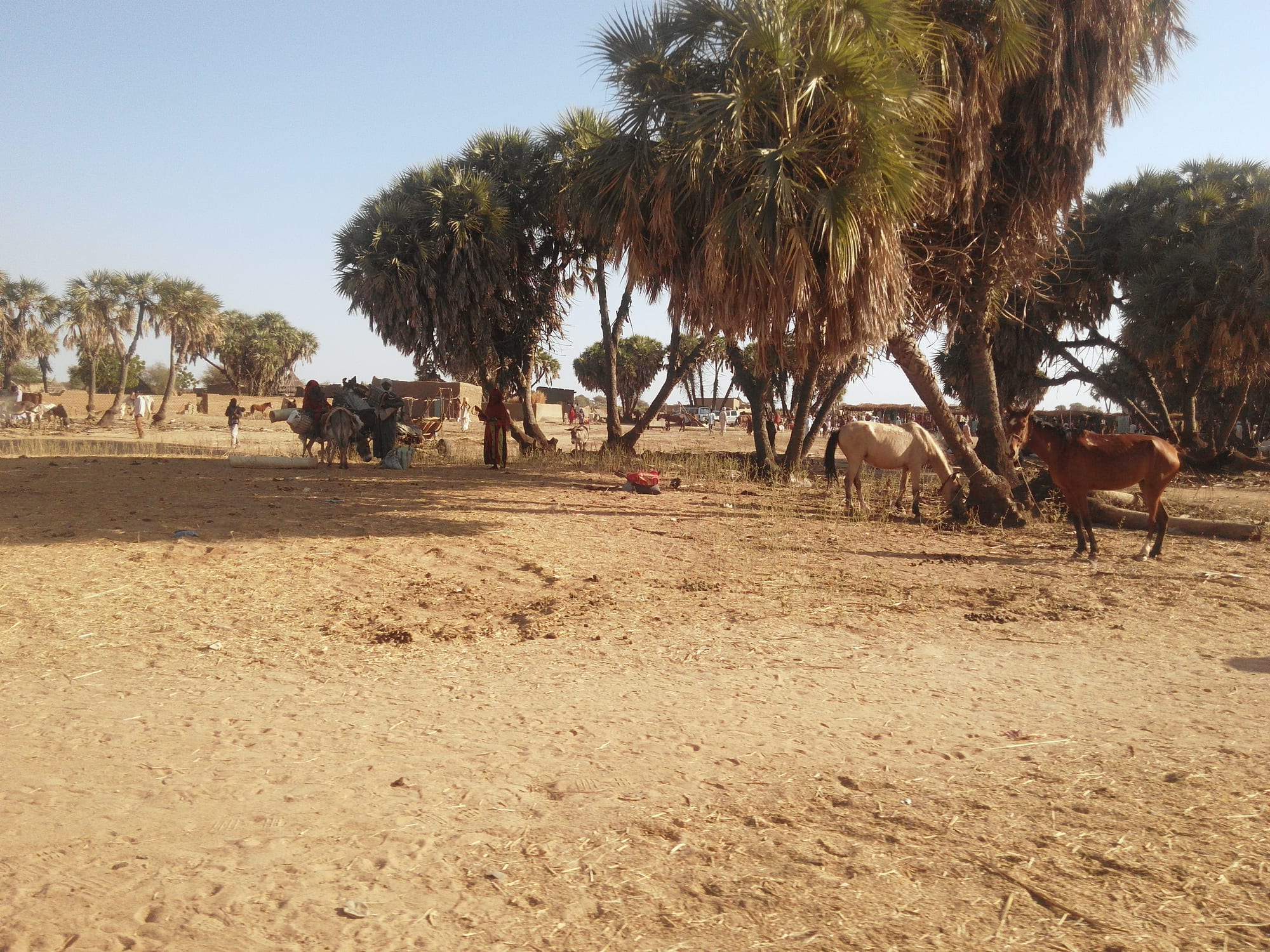
Horses and donkeys standing under doum palms on open sandy ground beside low mud-brick buildings

Abéché, Zakouma & the East, Chad

Am Timan

Market ground under doum palms at Am Timan in the Salamat region of Chad. (Chrisrosenk / Wikimedia Commons · CC BY-SA 4.0)

The main town of Salamat in south-eastern Chad, spread over sandy ground beside the seasonal Bahr Azoum, which continues below the town as the Bahr Salamat, among doum palms and mud-brick compounds. It is a market and administrative centre for a region of herders and millet farmers, and the usual road approach to Zakouma National Park and its elephant herds. This page is written to explain the town, not to encourage travel.

Neighbourhoods

  • The market quarter
    • Markets
    • Local life

    The centre of the town, where open ground under doum palms fills with livestock, grain sellers, cloth and household goods, and where the tailors, butchers and tea stands are concentrated. Animals brought in for sale are tethered at its edges.

    Open in Maps
  • The administrative quarter
    • Practicalities
    • Quiet and residential

    Wider streets around the provincial offices, the town hall, the hospital and the compounds of aid organisations, laid out in the colonial period and extended since. The few places offering rooms to outsiders are here or nearby.

    Open in Maps
  • The riverside quarters
    • Local life
    • Quiet and residential

    Compounds of mud-brick and straw spreading towards the Bahr Azoum, where gardens are worked in the riverbed as the water falls. In the rains these edges of town are the first to flood and the hardest to reach.

    Open in Maps

Things to do

In the town

  • Am Timan marketmarket

    The weekly gathering that gives the town its purpose, trading cattle, sheep, goats, millet, sorghum, dried fish and cloth under the palms.

    Open in Maps
  • The Bahr Azoum riverbedattraction

    The seasonal watercourse beside the town, known here as the Bahr Azoum and downstream as the Bahr Salamat, a broad sandy bed for much of the year that fills with the rains and is planted with gardens as it dries; wells are dug into the bed as the dry season goes on.

    Open in Maps
  • The old quartersneighborhood

    Lanes of walled mud-brick compounds and straw-roofed houses shaded by doum palms, the everyday fabric of a Sahelian market town.

    Open in Maps

Short trips from the town

  • Zakouma National Parkpark

    Chad's oldest and best-known national park, declared in 1963, where an elephant population that fell from thousands to about 450 has stabilised and begun to breed again under strict protection, alongside buffalo, Kordofan giraffe, kudu, hartebeest, lions and large dry-season gatherings of birds.

    Open in Maps
  • Bahr Salamat Faunal Reservepark

    The reserve of some 20,600 square kilometres that surrounds Zakouma National Park, designated in 1964 and managed with the park by African Parks since 2017, a buffer of savannah, woodland and seasonal floodplain grazed by herders.

    Open in Maps

Seasonal events

  • Eid al-Fitrvaries with the lunar calendar

    The feast ending Ramadan, the town's largest social occasion, with prayers, visiting and shared meals.

  • Eid al-Adhavaries with the lunar calendar

    The feast of sacrifice, the busiest moment of the year for the livestock trade in the market.

  • The transhumancedry season, roughly December to May

    Herding families move south with cattle and camels as the pastures dry, passing through the Salamat plains and filling the market before returning north with the rains.

Eat and drink

Long-standing places and food districts in Am Timan. Hours, ratings and directions come from your maps app, always current.

Am Timan classics

  • Boule with saucerestaurant

    The staple stiff millet or sorghum porridge, eaten by hand from a shared bowl with okra, dried meat or vegetable sauce in small eating houses near the market.

    Open in Maps
  • Grilled meat and river fishrestaurant

    Mutton and goat grilled over charcoal, and fish from the Bahr Azoum and the Salamat floodplain, fresh in the rains and dried or smoked the rest of the year.

    Open in Maps

The market

  • Am Timan market stallsmarket

    Millet and sorghum, dried okra and baobab leaf, peanuts, honey, dried fish and hibiscus flowers sold alongside cooked food.

    Open in Maps
  • Tea standscafe

    Shaded stands pouring strong sweet tea in rounds, the ordinary meeting places of the town through the heat of the day.

    Open in Maps

Experience Am Timan

History

Am Timan grew where the Bahr Azoum comes down from the east and spreads into the Salamat floodplain, a place with water, grazing and a crossing point on the routes between the Ouaddaï sultanate to the north-east and the Baguirmi lands to the west. The plains around it were a frontier country of Arab herding groups and settled farming villages, and were raided for slaves by the stronger states on either side through the 18th and 19th centuries — a history that left the region thinly populated and its communities mixed.

French forces reached the Salamat in the first years of the 20th century, as part of the slow conquest of what became Chad, and Am Timan was made the administrative seat of the district. Colonial rule brought little beyond a small garrison, an administration and a hunting reputation: the game country west of the town became Zakouma National Park by presidential decree in 1963, the first and oldest national park in the country. A cotton plantation and processing plant outside the town were destroyed in the fighting of the later twentieth century.

Since independence the town's story has been the region's. Rebellion and civil war in the later 20th century reached Salamat as they reached most of the country, and the park lost most of its elephants to heavy poaching in the 2000s. Management of Zakouma passed to African Parks in 2010 in partnership with the government, and intensive anti-poaching work allowed the herd, down to some 450 animals, to stabilise and start breeding again. Am Timan, as the nearest town of any size, became the road gateway to that recovery, and remains the administrative and market centre of a province where most people live from cattle and millet.

Culture & Customs

Salamat is a meeting ground of peoples. Arab herding groups, who speak Chadian Arabic as a first language, share the province with settled farming communities including the Runga, Sara-related groups from further west and families drawn in by trade, and its southern edge shades into Chad's Christian and traditional south. The town itself is predominantly Muslim, and the mosque, the Quranic school and the two Eids give the year its shape.

The culture of the province is pastoral above all. Cattle and camels are wealth, status and inheritance, and the long seasonal movement of herds — south towards the rivers as the pastures dry, north again with the rains — sets the calendar for whole families. Wedding and naming ceremonies are the great occasions, marked with drumming, praise singing and, in the countryside, displays of horsemanship; horses are still kept and valued here.

Hospitality is a firm obligation rather than a courtesy: a visitor is offered tea poured in rounds and a bowl of food whatever the household has. Manners are formal and unhurried, elders are greeted first, and food is taken with the right hand from a shared dish. Dress is modest for everyone, and women in the town usually cover their hair. Relations between herders and farmers over crops, water and grazing routes are the region's most sensitive everyday subject.

Daily Life

Upwards of 50,000 people live in Am Timan, which makes it one of the larger towns of south-eastern Chad and the administrative centre of Salamat. Its economy is farming and livestock: millet, sorghum and sesame grown in the rains, gardens of vegetables worked in the drying riverbed, and cattle, sheep and goats brought in for the market. Fish from the floodplain, honey and gum arabic add cash income, and the provincial offices, the hospital, the schools and a handful of aid organisations provide most of the salaried work.

Houses are compounds of mud-brick, banco and straw behind low walls, with doum palms for shade and open sandy ground between the quarters. The day starts before the heat, empties in the early afternoon and comes back to life at dusk around the market and the tea stands. Water comes from wells and pumps, electricity is limited and intermittent, and most cooking is done on wood or charcoal.

The seasons dominate everything. In the rains the plains flood, tracks close, the town can be cut off for weeks and malaria rises; in the dry months the herds move through, the riverbed gardens are planted, and traders and vehicles move freely again. Drought years, crop failure and competition for grazing are the recurring pressures, and the presence of Zakouma to the west, with its rangers and its visitors, is one of the few outside sources of work and money.

Food

Am Timan eats the Sahelian staples. The centre of every meal is boule, the stiff millet or sorghum porridge known in Chadian Arabic as esh, eaten by hand from a shared bowl and dipped into sauce. Sauces are of okra, fresh in the rains and dried and powdered the rest of the year, of baobab leaf, of dried tomato and onion, or of charmout, sun-dried strips of beef or mutton pounded into the pot. Daraba, a mix of vegetables with peanut, is common where the south's influence is felt.

Being on a floodplain gives the town more fish than most of Chad. Catches from the Bahr Azoum and the seasonal pools are eaten fresh in the rains and smoked or dried for the dry season, when they are broken into sauces. Meat is grilled over charcoal for guests and festivals, milk — fresh, soured or clarified into cooking butter — is central to the herding families, and dates come up from the market traders who bring them south from the oases.

Drinks are non-alcoholic in the town: strong sweet tea poured in several rounds, karkanji made from dried hibiscus flowers, and a tart drink from baobab fruit pulp. Peanuts, sesame and honey are sold by the measure in the market, and bread and fried dough appear wherever there is a town oven.

Planning tools

Budget

The town itself is inexpensive — market food, tea and a very basic room cost little — but almost nobody comes for the town. Visits are built around Zakouma, which is sold as a package with lodge or camp accommodation, meals, game drives and park fees, and that sets the real cost. Vehicles, fuel and the journey from N'Djamena dominate everything else. Cash only.

Daily Budget Midrange
USD 350–700 (Zakouma lodge package with meals, game drives and park fees, before the flight from N'Djamena)
Daily Budget Shoestring
USD 40–80 (a basic room, market meals, tea and shared local transport in the town itself)

Arrange a Zakouma visit well ahead through the park or a specialist operator; transfers, permits and payment are settled before arrival.

Best Time to Visit

The dry season, roughly December to May, is when Zakouma is visited, and the wildlife viewing is best from February to April, when animals gather at the last water. The rains from about June to September flood the Salamat plains and make the roads around the town impassable.

Suggested Number of Days

The town is a stop rather than a stay, and a day covers it. Most visitors allow four to six days in the area so that the park is worth the effort of reaching it; the length depends mainly on how travel in and out is arranged.

First Visit
1 day
With Surroundings
4–6 days

Transportation

The town is small enough to walk, with motorcycle taxis and carts for loads and longer errands. Beyond it there is no public transport worth the name: movement is by 4x4, by shared pick-up along sandy tracks, and by donkey or horse in the surrounding villages. Tracks that are easy in the dry season disappear under water in the rains.

Treat every road journey here as weather-dependent and arrange vehicles through local contacts or the park rather than on arrival.

Airport & Station Connections

Am Timan lies roughly 600 kilometres east and south of N'Djamena by road, a long day or more of driving on a route that is partly paved and partly track. Visits to Zakouma are usually flown in from the capital and arranged through the park, while the town itself is reached overland by hired vehicle or shared pick-up. Am Timan has a sand airstrip, upgraded by the French Foreign Legion in 1971 for military transports.

Walkability

Everything in Am Timan is within walking distance on flat, sandy ground — the market, the offices and the riverbed are a few minutes apart. There are few paved surfaces or pavements, shade is limited to the palms and the compound walls, and walking is done early or late rather than in the middle of the day.

Safety

Salamat is quieter than the provinces along the Sudan border, but the wider east is affected by armed groups, weapons trafficking and banditry, and robbery occurs on the region's roads. Disputes between farmers and herders over land and water can turn violent in the dry season. Most governments advise against travel to the region.

Globeway covers Chad so it can be understood. Keep well away from the Sudan border and the camp areas unless working with a humanitarian organisation, travel only with local arrangements, and visit Zakouma only through the park or a specialist operator. Check current official travel advice before travelling.

Climate

Sahelian, and wetter than most of Chad. A long hot dry season is broken by summer rains that turn the plains around the town into floodplain and tall grass. The months before the rains are the hottest of the year.

Summer
rainy season roughly June to September, around 25–35°C, with flooded wadis, tall grass and closed tracks
Winter
dry, warm and dusty by day at about 30–35°C from December to February, with cool nights

Local Customs

Salamat is largely Muslim, and the town is conservative and rural in manner. Modest dress covering shoulders and knees is expected, greetings are unhurried, and tea offered by a host is drunk in several rounds. Men and women largely socialise apart. Livestock is wealth, and questions about a family's animals are polite rather than intrusive.

Ask before photographing people or herds, avoid photographing soldiers, checkpoints and official buildings, and expect a small payment rather than a tip to be the normal thanks for a service.

Common Payment Methods

The currency is the Central African CFA franc, pegged to the euro. Am Timan is a cash town: cards are not usable, banking is minimal and any ATM should be treated as unreliable. Enough CFA francs, and euros to change, should be carried in from N'Djamena, along with small notes for the market.