💰 Budget
Nobody travels here independently, so the budget is the expedition budget. The Ennedi is visited on organised 4x4 trips of one to two weeks carrying their own fuel, water, food and camping kit, with guides, permits and often an escort, and the daily figure reflects all of that rather than anything bought in Fada. In the town itself, lodging is very basic and money buys little beyond tea, bread and supplies.
- Daily Budget Midrange
- USD 350–700 per day on an organised Ennedi and Ounianga expedition, before international flights
- Daily Budget Shoestring
- USD 30–60 (very basic lodging and market food in the town — not a practical way to see the Ennedi)
Choose a specialist Sahara operator with recent experience in the Ennedi; permits, escorts, fuel and water are part of their service, not something to organise on arrival.
📅 Best Time to Visit
November to February is the only sensible window, with mild days and cold nights. By March and April the heat becomes severe, and from May to September desert travel around Fada is dangerous and rarely attempted.
⏳ Suggested Number of Days
The town itself is an hour's walk. Time here is really time on the plateau, and expeditions usually run one to two weeks because the distances between the gueltas, arches and rock-art sites are large and the driving is slow. Getting in and out adds several days.
- First Visit
- 1 day
- With Surroundings
- 7–12 days
🚆 Transportation
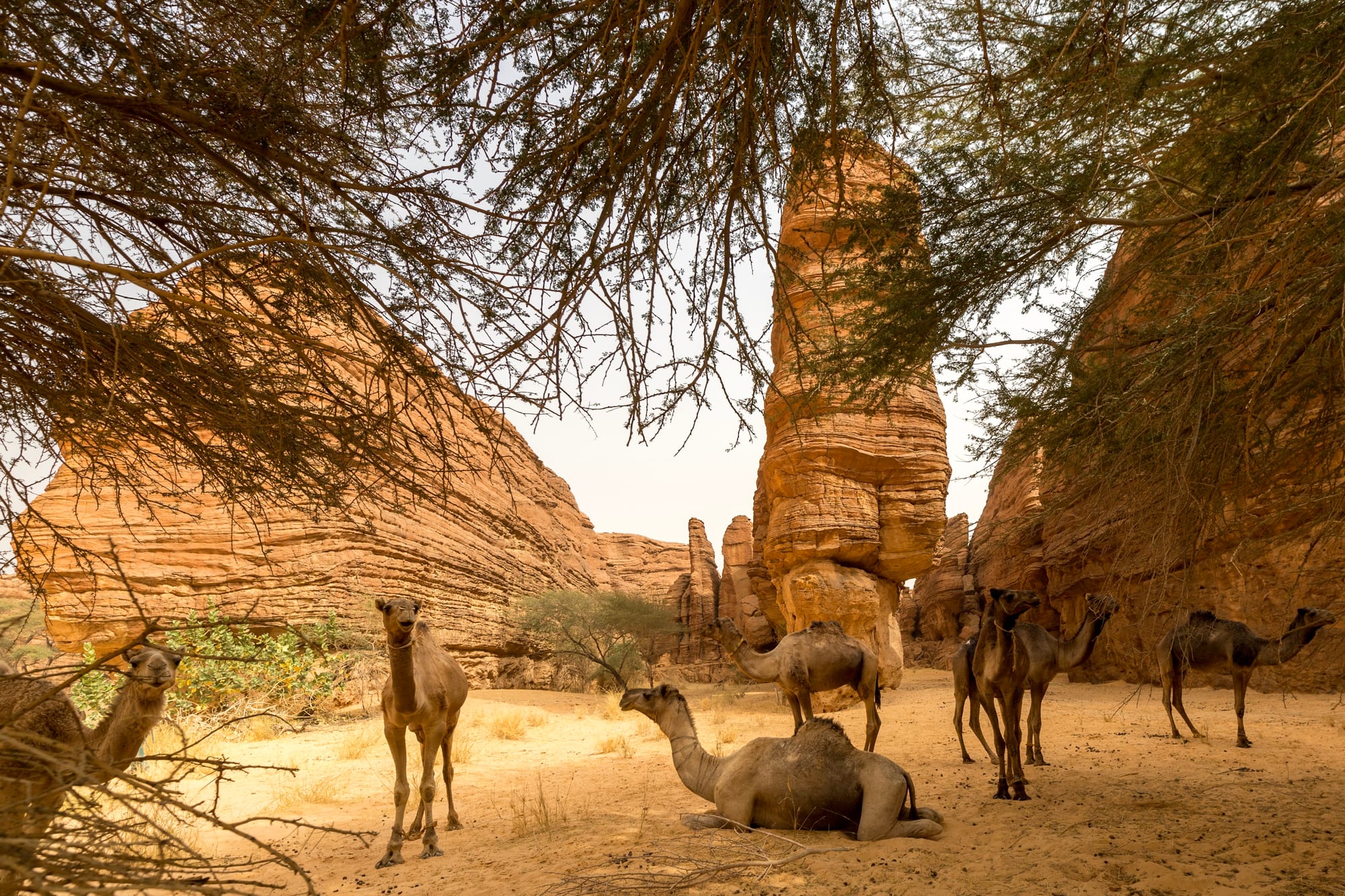
Fada is small enough to cross on foot, and beyond it there are no roads in any ordinary sense — only sand and rock tracks crossed by 4x4, with camels still used by herding families. Vehicles travel in convoy, carrying fuel and water, and a driver-guide who knows the plateau is essential.
Never travel out from the town in a single vehicle; distances between water and fuel are enormous and there is no roadside help of any kind.
🛬 Airport & Station Connections
Fada lies deep in the north-east, several days' driving from N'Djamena across more than 1,000 kilometres of desert and Sahel. Most expeditions fly to an airstrip — Fada has an airport of its own, and there is another at Amdjarass, east of the Ennedi — and continue by 4x4, or drive the whole way as part of the trip. There is no ordinary public transport to rely on.
🚶 Walkability
The town is entirely walkable: the administration, the market and the palm gardens are a few minutes apart on flat sand. Beyond the gardens there is nothing to walk to, and walking on the plateau is done from a vehicle at the start of a canyon or a guelta, with a guide and water.
🛡️ Safety
The Ennedi is visited by a small number of organised expeditions each dry season, but the far north as a whole carries serious risks: banditry, landmines left by past wars, armed groups and smuggling along the Libyan border, and sheer isolation, with no medical help within a day's travel. Most governments advise against travel to the region.
Globeway covers Chad so it can be understood. Do not visit the Lake Chad area or the Tibesti; travel to the Ennedi and Ounianga only with a specialist operator holding current permits and security arrangements. Check current official travel advice before travelling.
🌦️ Climate
Hyper-arid Sahara with a slight Sahelian influence. Rain is rare and unreliable, falling in a few summer storms if at all; the difference between day and night temperatures is extreme, and dust and sandstorms are common in spring.
- Summer
- extreme heat, often above 45°C, with occasional brief storms and no practical travel
- Winter
- clear and pleasant by day, around 25–30°C, with cold nights that can approach freezing
🤝 Local Customs
This is Toubou and Muslim country, and manners are those of the desert: greetings are long, hospitality is an obligation, and tea poured in three rounds is offered to every guest. Dress is modest and protective, with men often wearing long turbans against sun and sand. Water at wells and gueltas belongs to the herders who use it, and camps are made at a distance from it.
Ask before photographing people, herds or watering places, do not photograph soldiers or checkpoints, and carry out everything brought in — there is no waste disposal in the desert.
💳 Common Payment Methods
The currency is the Central African CFA franc, pegged to the euro. Fada is entirely a cash town with no banking or card facilities of any use to a visitor; all money for an expedition is carried from N'Djamena, in CFA francs and euros, with small notes for the market.