💰 Budget
There is no tourism here and no tourist pricing; there is also very little to buy. Lodging is basic and improvised, market food and tea cost little, and everything imported is expensive because it has been trucked a thousand kilometres across the desert. Any real budget is the cost of an organised expedition, with vehicles, fuel, water, permits and guides.
- Daily Budget Midrange
- USD 350–700 per day on an organised Ennedi and Ounianga expedition, before international flights
- Daily Budget Shoestring
- USD 30–60 (a very basic room, market meals and tea in the town itself)
Everything — rooms, vehicles, fuel and permits — is arranged in advance through an operator or local contacts; nothing can be improvised on arrival.
📅 Best Time to Visit
November to February, when days are mild and nights cold. From March the heat builds quickly, average daytime highs in Borkou stay above 39°C from April to September, and spring brings dust and sandstorms blown off the desert floor.
⏳ Suggested Number of Days
The oasis can be seen in a day. Most people here are passing through on a longer desert journey and stop only to rest, refuel and resupply, so the number depends on the expedition's route rather than on the town.
- First Visit
- 1 day
- With Surroundings
- 2–3 days
🚆 Transportation
The town is crossed on foot or by pick-up, and distances within the oasis are short. Beyond it there is nothing but sand and rock tracks, driven by 4x4 in convoy with fuel and water carried; camels are still worked by herding families. Trucks from the south are the supply line and travel in groups.
Never leave the oasis in a single vehicle or without a driver who knows the route; there is no fuel, water or help between the desert settlements.
🛬 Airport & Station Connections
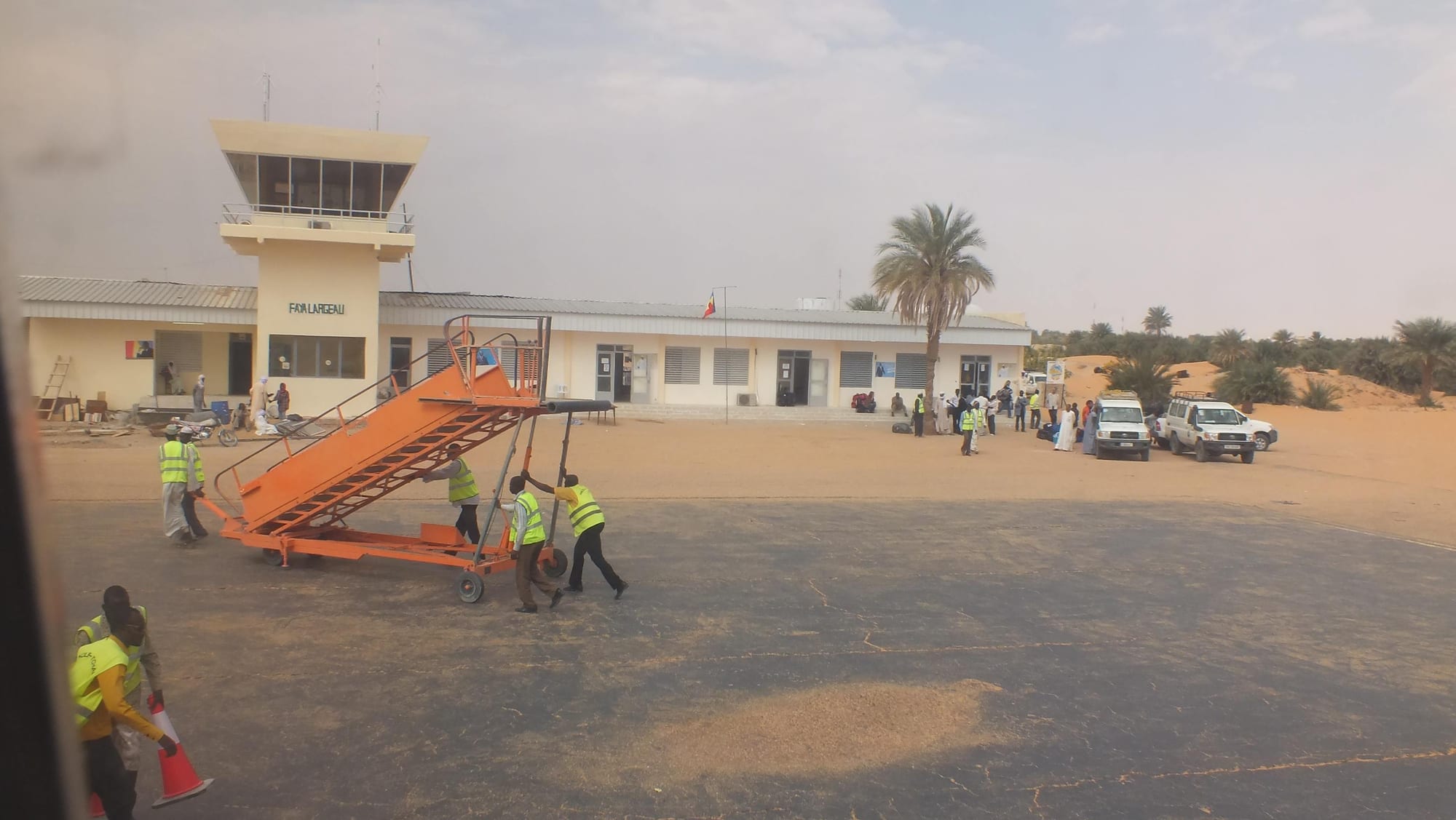
Faya-Largeau has an airport with a paved runway of 2,800 metres, used almost exclusively by military aircraft, so flying in is not a matter of buying a ticket. The alternative is a drive of roughly 1,000 kilometres north from the capital across Sahel and then open desert, taking several days in convoy. There is no railway and no scheduled bus.
🚶 Walkability
The centre, the market and the nearest palm groves are easily walked on flat sand, and the groves are the pleasant place to do it. The town is spread out towards the airstrip, shade is scarce away from the palms, and walking is done early or late rather than through the middle of the day.
🛡️ Safety
Borkou is calmer than the Tibesti to the north-west, but the far north carries serious risks: armed groups and smuggling along the Libyan border, clashes connected with gold mining, banditry, landmines left by past wars, and isolation so complete that medical help is a flight away. Most governments advise against travel to the region.
Globeway covers Chad so it can be understood. Do not visit the Lake Chad area or the Tibesti; travel to the Ennedi and Ounianga only with a specialist operator holding current permits and security arrangements. Check current official travel advice before travelling.
🌦️ Climate
Hyper-arid Sahara. Rainfall averages under 12 millimetres a year, falling between June and September if at all, and some years bring none; sunshine is among the highest recorded anywhere, at around 3,800 hours a year, and the daily swing between afternoon heat and night cold is large. Dust and sandstorms are frequent, especially in spring.
- Summer
- extreme heat, with average highs above 39°C from April to September and a peak around 42°C in June, hot nights and blowing sand
- Winter
- clear and pleasant by day at around 25–30°C, with cold nights that can approach freezing
🤝 Local Customs
Borkou is Toubou and Muslim, and desert manners apply. Greetings are long and come before any business, hospitality is an obligation on the host, and tea is served in three rounds and accepted. Dress is modest and covering for everyone; men commonly wear long turbans. Wells and gardens belong to families, and permission is asked before entering or drawing water.
Ask before photographing people or herds, never photograph soldiers, checkpoints, the airport or military installations, and expect to explain any travel plans at checkpoints.
💳 Common Payment Methods
The currency is the Central African CFA franc, pegged to the euro. The town works entirely on cash, with no usable card facilities and no reliable bank or ATM for visitors. CFA francs and euros are carried in from N'Djamena, with plenty of small notes for the market and for fuel.