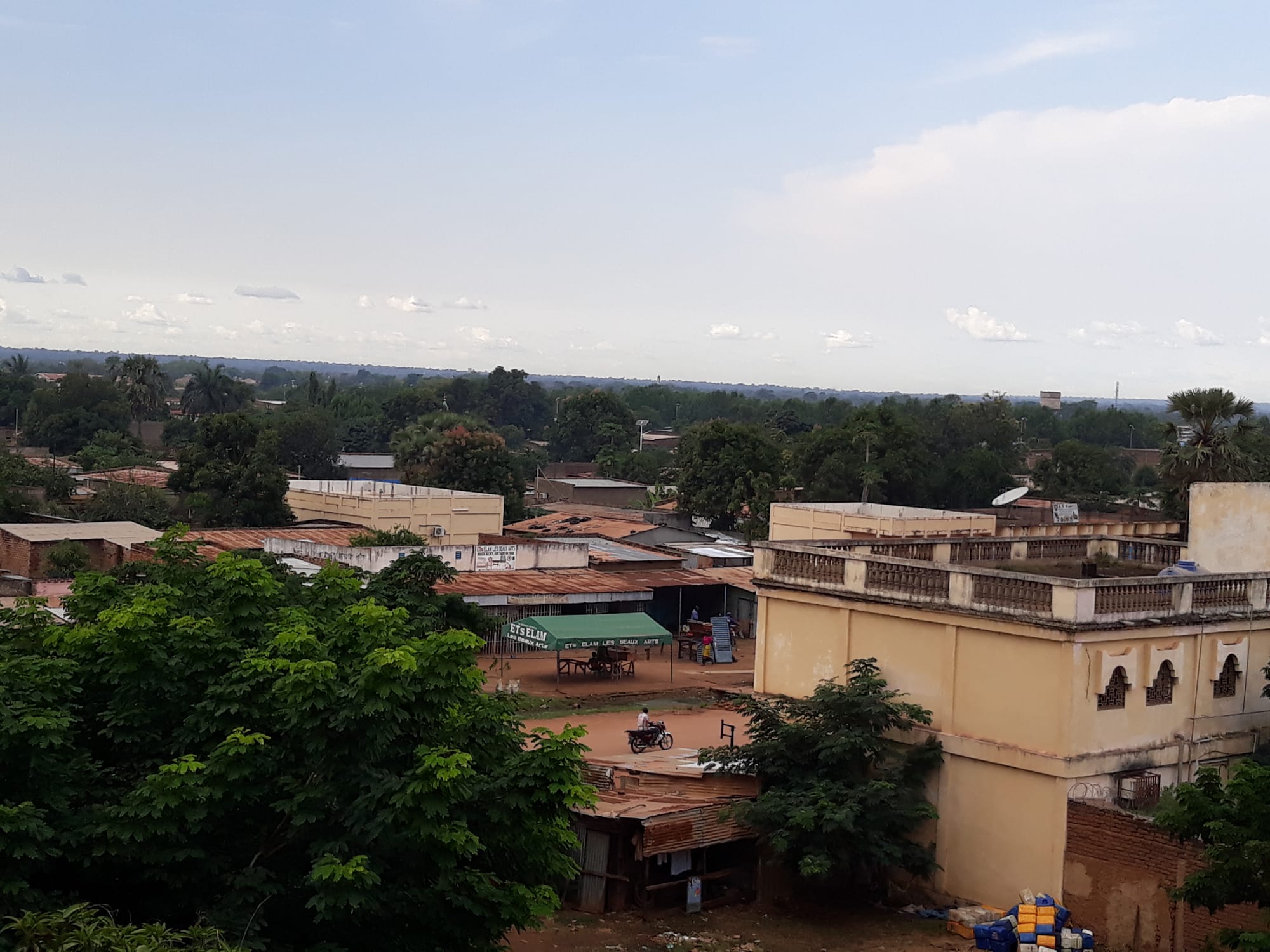
View from above over Moundou's low buildings, rusted tin roofs and green trees

Moundou, Sarh & the South, Chad

Moundou

A view over the low roofs and trees of Moundou, the largest city in southern Chad. (Korom10 / Wikimedia Commons · CC BY-SA 4.0)

Chad's second-largest city and the capital of Logone Occidental, on the Mbéré river in the green farming country of the south-west, some 475 kilometres from N'Djamena. It is the main city of the Ngambaye, an industrial and trading centre built on cotton and on the brewery that makes the country's best-known beer. This page is written to explain the city, not to encourage travel.

Neighbourhoods

  • Centre-ville
    • First-time visitors
    • Markets
    • Administration

    The commercial and administrative core, with the main market, banks, offices and most of the city's lodging within a few streets. It is busy by day with traders, motorbike taxis and lorries carrying cotton and goods.

    Open in Maps
  • Dombao
    • Churches
    • Quiet and residential

    A residential district associated with the Catholic diocese, where the newer cathedral was built. Compounds, schools and mission buildings stand among mango trees, and the atmosphere is calmer than the centre.

    Open in Maps
  • The riverside quarters
    • Local life
    • Fishing and farming

    Neighbourhoods spreading towards the Mbéré, where the banks are used for fishing, washing and dry-season gardens. Low compounds and market gardens run down to the water, and parts flood in the rainy season.

    Open in Maps
  • The industrial edge
    • Industry and trade
    • Transport links

    The outskirts along the roads to N'Djamena and Doba, where the brewery, cotton ginneries, depots and workshops stand. It is a working district rather than a place to stay, but it explains the city's economy.

    Open in Maps

Things to do

Landmarks

  • Sacred Heart Cathedrallandmark

    The seat of the Catholic diocese of Moundou, dedicated to the Sacred Heart; a newer cathedral was begun in the Dombao district in 1999.

    Open in Maps
  • The Gala breweryattraction

    The brewery on the edge of the city that produces Gala, the lager sold across Chad, and one of the country's main manufacturers.

    Open in Maps

Markets and the river

  • Moundou central marketmarket

    The city's main market, trading grain, groundnuts, shea butter, fish, cloth and imported goods for the whole of Logone Occidental.

    Open in Maps
  • The Mbéré riverbankattraction

    The banks of the Mbéré, a tributary of the western Logone, below the city, used by fishermen, washers and dry-season gardeners.

    Open in Maps
  • Moundou Airporttransit hub

    The city's airport, with a single asphalt runway of about 1,800 metres a few kilometres from the centre.

    Open in Maps

Short trips from the city

  • Dobaattraction

    The town at the heart of the oil basin whose fields have been pumped since 2003 for export by pipeline through Cameroon.

    Open in Maps
  • Kéloattraction

    A market town in Tandjilé on the road north, surrounded by sorghum, groundnut and cotton fields.

    Open in Maps

Seasonal events

  • Christmas and EasterDecember and spring

    The biggest days of the year in a largely Christian city, with long services, choirs and family gatherings across the parishes.

  • Dry-season festivals and wrestlingdry season, roughly December to April

    Dances, drumming and wrestling matches are held in the city and surrounding villages once the harvest is in and travel is easy.

  • Independence DayAugust

    Chad's national day, marked with official ceremonies and parades in the regional capital.

Eat and drink

Long-standing places and food districts in Moundou. Hours, ratings and directions come from your maps app, always current.

Moundou classics

  • River fish and grillsrestaurant

    Fresh fish from the Mbéré and the Logone, grilled or fried, and charcoal-grilled goat and mutton served with boule or chips are the staples of the city's eating places.

    Open in Maps
  • Gala beerrestaurant

    The lager brewed in the city is drunk across Chad and is a point of local pride; bars and roadside terraces serve it cold when the power holds.

    Open in Maps

Markets and food districts

  • Moundou central marketmarket

    Sorghum, millet, cassava, groundnuts, sesame, shea butter, dried fish and seasonal mangoes and guavas are sold from stalls and mats.

    Open in Maps
  • Street kitchens in the centreneighborhood

    Small kitchens and stands around the market serve rice with sauce, groundnut stews, brochettes, fried dough and sweet tea through the day.

    Open in Maps

Experience Moundou

History

Moundou grew in the country of the Ngambaye, one of the Sara peoples of the southern plains, who lived in scattered farming villages organised by lineage rather than under a king. The region lay beyond the Saharan trade routes but within reach of the slave raids of the Muslim sultanates to the north, which depopulated districts of the south in the nineteenth century and left a distrust that still colours the way southerners speak about the north.

The French created the post of Moundou on 8 November 1923, in the middle of a zone that was still resisting colonial rule, and moved the chief town of the Middle Logone district there in 1927. A cotton ginning factory was installed in 1926, and from the late 1920s the colonial administration imposed compulsory cotton growing on southern farmers, with harsh penalties for those who resisted, and Moundou became the place where the crop was collected, ginned and shipped north. Missions and schools arrived with the administration, so that by independence in 1960 the south supplied much of the country's educated class. The Logone breweries grew into one of the country's main manufacturers, and their Gala lager became the best-known consumer product made in Chad.

Independence did not spare the city. The south was the base of resistance after northern forces took N'Djamena in 1979 and 1980, and fighting between government troops and southern rebels in the early 1980s reached the region, with lasting consequences for the city and its hinterland. Cotton has been through repeated crises since, and from 2003 the oil fields around Doba to the east brought a new industry, jobs and traffic to a city that remains, after the capital, the largest in Chad.

Culture & Customs

Moundou is the main city of the Ngambaye, and their language is what is spoken in the market, on building sites and at home, with French kept for offices, schools and paperwork; Chadian Arabic matters less here than almost anywhere else in the country. Southerners often define themselves against the north, and the city has a reputation for plain speaking and for political independence.

Christianity dominates. Catholic and Protestant churches are full on Sunday, choirs rehearse through the week, and the diocese runs schools, clinics and missions across the region, while ancestral practices continue alongside church membership in many families. Muslim traders have their own quarters and mosques, and the mix is generally peaceable. The yondo, the Sara initiation in which young men spend a period in the bush with their elders, remains important in the villages around and is not explained to outsiders.

Music and dance run through funerals, weddings and harvests — drums, balafons and massed singing — and the dry season brings wrestling, which draws crowds from the surrounding villages. Football is followed closely. Hospitality is straightforward and generous: guests are greeted at length, fed, and offered bili-bili, the home-brewed millet beer that is shared from a calabash, or a bottle of the beer the city itself makes.

Daily Life

Moundou's population is usually put at something close to 140,000, and the city keeps growing; it remains Chad's second-largest and the commercial capital of the south. Cotton is the old backbone — ginneries, an oil mill and the trade that the crop supports — and the brewery is the best-known employer, while the oil fields around Doba have added contractors, transport work and money that circulates in the city's shops and bars.

Most households combine a wage or a trade with farming: sorghum, millet, cassava, groundnuts and sesame on plots outside the city, and cotton for cash. Women dominate the market and the brewing of millet beer. Neighbourhoods are low compounds of mud brick or concrete behind walls, with schools, small churches and workshops between them, and services thin at the edges, where the city keeps spreading.

The day starts at first light, slows in the worst heat and picks up again in the evening, when the market empties and the terraces fill. Power cuts, the price of fuel and food, flooded streets in the rainy season, and the recurring troubles of the cotton sector are the practical concerns; so are the clashes between farmers and herders in the surrounding provinces, which are followed closely in the city.

Food

Moundou eats the food of the Sara south. The staple is boule, a stiff porridge of millet, sorghum or cassava, taken by hand and dipped in a sauce built on okra, called gombo, sorrel and other leaves, groundnut paste, sesame, or dried fish. Shea butter, pressed from the nuts of wild trees, is a common cooking fat, and cassava appears more here than in the Sahel to the north.

Fish from the Mbéré and the Logone is grilled or fried fresh and sold smoked in the market; goat, mutton and chicken are grilled over charcoal in the evening and eaten with bread, raw onion and chilli. Rice with sauce and groundnut stew are the usual midday meals in the street kitchens around the market. Mangoes, guavas and citrus grow around the city and are sold by the basket in season, with roasted groundnuts and sesame bars as everyday snacks.

The city is known nationally for what it drinks. Gala, the lager brewed in Moundou, is found in bars across Chad, and bili-bili, the cloudy home-brewed millet beer, is sold by women brewers from their compounds and drunk from calabashes. Sweet tea is the everyday drink, and karkanji, a red infusion of dried hibiscus flowers spiced with ginger, clove and cinnamon, is taken cold.

Planning tools

Budget

Moundou is cheaper than N'Djamena, although the oil economy in the region keeps the better rooms dearer than the town's size suggests. Accommodation means simple hotels and mission guesthouses; market food and street kitchens cost little. The main expense for visitors is a hired vehicle and driver, needed for anything beyond the centre.

Daily Budget Midrange
USD 100–260 (the better hotels in Moundou or Sarh, restaurant meals, a car and driver)
Daily Budget Shoestring
USD 35–60 (basic hotel or mission guesthouse, market food, buses between towns)

Bring enough cash from N'Djamena; banks exist in the city but cash machines cannot be relied on.

Best Time to Visit

November to February, when the rains have stopped, the tracks have dried and the heat is bearable. March and April are the hottest months, and from June to September heavy storms flood roads and make travel around the region slow, though the countryside is at its greenest.

Suggested Number of Days

Moundou is a working city rather than a sightseeing one, and a day or two covers it. Three or four make sense for anyone taking in the Logone valleys and the towns around, where the long drives set the pace.

First Visit
1–2 days
With Surroundings
3–4 days

Transportation

Motorbike taxis are the everyday way of getting around, with shared taxis and pick-ups on the longer routes. Buses and bush taxis link the city with N'Djamena, Kélo, Doba and Sarh, leaving when full. Streets in the centre are partly paved and the rest are red earth that turns to mud in the rains, so a 4x4 is useful in the wet season.

Agree fares before setting off, travel between towns by day only, and allow extra time in the rains when river crossings can close.

Airport & Station Connections

Most visitors arrive by road from N'Djamena, a long day's drive of some 475 kilometres south, on a route that is paved in stretches and potholed in others, with checkpoints along the way. Buses run the route daily. Moundou Airport has a single paved runway, though air services are limited, and the Cameroon border lies a few hours to the west.

Walkability

The centre is flat and compact enough to walk between the market, the offices and the cathedral, best in the early morning or late afternoon. Beyond it the city spreads out along wide earth roads with little shade and no pavements, and motorbike taxis are how most people cover the distance. Streets are unlit after dark.

Safety

The south avoids the jihadist violence of the Lake Chad area, but it has its own problems: deadly clashes between farmers and herders in the surrounding provinces, highway banditry and kidnapping for ransom on rural roads, and occasional protests and strikes in the city. Most governments advise against all or all-but-essential travel to the country.

Globeway covers Chad so it can be understood. Travel only by day with a local driver, avoid demonstrations, and do not photograph officials, soldiers or government buildings. Check current official travel advice before travelling.

Climate

Sudanian and among the wettest parts of Chad, with a long rainy season from about May to October and a dry season when the Harmattan brings dust and haze. It is hot all year, and the peak heat comes in March and April before the rains break.

Summer
rainy season May to October, humid at 25–33°C, with heavy storms and flooded roads
Winter
dry and hazy, 30–35°C by day and around 15–20°C at night from December to February

Local Customs

This is Ngambaye country and part of the wider Sara south: Christianity, Catholic and Protestant, is the majority faith, often alongside ancestral practices, and there are Muslim quarters and mosques in the trading districts. Ngambaye is the language of the street, with French for official business. The yondo initiation is part of village identity and is not discussed with outsiders.

Greet people properly before asking anything, use the right hand for eating and giving, dress modestly, and ask before taking photographs of people, churches or markets.

Common Payment Methods

The currency is the Central African CFA franc, pegged to the euro. Cash runs the city: cards are effectively unusable, the few cash machines are unreliable, and money is best brought from N'Djamena. Small notes are needed for motorbike taxis, markets and street food.