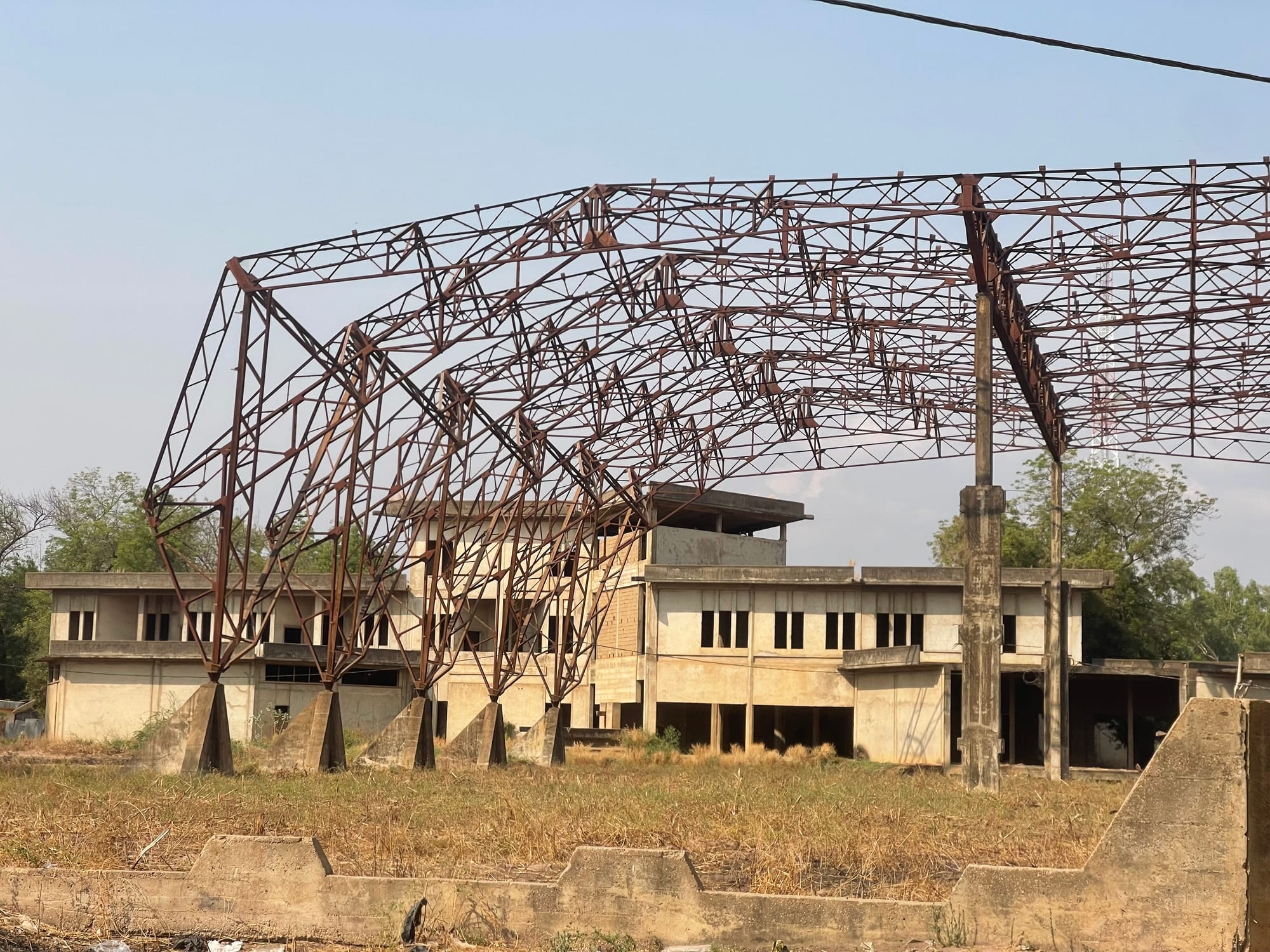
A long abandoned concrete building in Sarh behind a rusting steel roof frame, with dry grass in the foreground under a hazy sky

Moundou, Sarh & the South, Chad

Sarh

A derelict building in Sarh known locally as the house of François Tombalbaye, Chad's first president. (Mahmoud Sabir97 / Wikimedia Commons · CC0)

The capital of Moyen-Chari and Chad's third-largest city, on the Chari river in the south-east, founded by the French as Fort-Archambault and renamed Sarh in 1972. It is a leafy town of wide colonial-era avenues living on cotton, sugar, fishing and trade, with Manda National Park on the river nearby. This page is written to explain the city, not to encourage travel.

Neighbourhoods

  • The colonial centre
    • First-time visitors
    • Historic district
    • Administration

    The old Fort-Archambault core near the river, laid out with wide avenues shaded by mango and flame trees. Administrative buildings, the cathedral, banks and the town's lodgings stand within a few blocks of the central market.

    Open in Maps
  • The market quarter
    • Markets
    • Local life

    The streets around the large open market, the busiest part of town, where grain, fish, cloth and imported goods are traded and motorbike taxis wait. Small kitchens and tea stalls cluster along the edges.

    Open in Maps
  • The riverside
    • Views
    • Fishing life
    • Quiet and residential

    Compounds and gardens running down to the Chari, where canoes are pulled up, nets are dried and fish is smoked. The bank is the coolest part of town in the late afternoon and floods in the rainy season.

    Open in Maps
  • The outskirts and the university quarter
    • Students
    • Quiet and residential

    Newer districts spreading along the roads out of town, with schools, the university and low compounds among fields. Services are thinner here, and the countryside begins within a few kilometres.

    Open in Maps

Things to do

In the town

  • The Chari riverbankattraction

    The river below the town, where fishermen work from dugout canoes and the catch is smoked and sold along the bank.

    Open in Maps
  • Sarh central marketmarket

    A large open market trading sorghum, groundnuts, sesame, smoked fish, fruit, cloth and imported goods for the whole of Moyen-Chari.

    Open in Maps

Landmarks and transport

  • The cathedrallandmark

    The Roman Catholic cathedral, seat of the diocese of Sarh, one of the main landmarks of the old colonial centre.

    Open in Maps
  • The Grand Mosquelandmark

    The Grande Mosquée de Sarh, the principal mosque of the town and, with the cathedral, one of its two main religious landmarks.

    Open in Maps
  • Sarh National Museummuseum

    The town's museum, one of the few formal sights in Sarh alongside the cathedral and the mosque.

    Open in Maps
  • Sarh Airporttransit hub

    The town's small airport, about two kilometres north-west of the centre, with a single 1,800-metre runway and no international facilities.

    Open in Maps

Short trips from the city

  • Manda National Parkpark

    A park of more than 113,000 hectares bounded by the Chari, a faunal reserve from 1953 and a national park since 1965, with savannah woodland, birdlife recognised as an Important Bird Area, and large mammals that are mostly seen in the dry season.

    Open in Maps
  • Koumraattraction

    The capital of Mandoul region and one of Chad's larger towns, a market centre among millet fields and shea trees on the main road west.

    Open in Maps

Seasonal events

  • Christmas and EasterDecember and spring

    The largest occasions of the year in a mainly Christian city, marked by long services, choirs and family meals.

  • Dry-season festivals and wrestlingdry season, roughly December to April

    Dances, drumming and wrestling matches are held in the town and the villages around once the harvest is in.

  • Independence DayAugust

    Chad's national day, marked with ceremonies and parades in the regional capital.

Eat and drink

Long-standing places and food districts in Sarh. Hours, ratings and directions come from your maps app, always current.

Sarh classics

  • Chari river fishrestaurant

    Fish from the Chari, grilled fresh over charcoal or sold smoked and dried, is what the town is known for across southern Chad.

    Open in Maps
  • Boule and saucerestaurant

    Stiff millet, sorghum or cassava porridge eaten by hand with okra, sesame, groundnut or fish sauce is the everyday meal in local kitchens.

    Open in Maps

Markets and food streets

  • Sarh central marketmarket

    Grain, groundnuts, sesame, shea butter, smoked fish and seasonal mangoes and guavas are sold from stalls, with cooked food at the edges.

    Open in Maps
  • Street kitchens and tea stallsneighborhood

    Stands around the market and along the main avenues serve rice with sauce, brochettes, fried dough and sweet tea through the day.

    Open in Maps

Experience Sarh

History

Sarh began as a French military post on the Chari, founded in 1897 during the conquest of the region and named Fort-Archambault. The site lay in the country of the Sar, one of the Sara peoples, who farmed the plains between the Chari and its tributaries in villages organised by lineage and initiation society rather than under kings, and who had suffered heavily from the slave raids launched out of the Muslim sultanates to the north.

Under French Equatorial Africa the post became an administrative and garrison town with wide avenues, a hospital, missions and schools. From the late 1920s the colonial administration forced southern farmers to grow cotton, and Fort-Archambault became one of the collecting and ginning centres of the crop that paid for the colony; a sugar complex was later built at Banda, some 25 kilometres from the town. Missions spread Christianity and produced much of the educated class that staffed the state at independence in 1960, including Chad's first president, François Tombalbaye, who came from this part of the south.

Tombalbaye's campaign of cultural authenticity in the early 1970s renamed French-era towns, and Fort-Archambault became Sarh in 1972, three years before he was killed in a coup. The town was drawn into the violence that followed the northern capture of N'Djamena in 1979 and 1980, when the south became the base of resistance and fighting in the early 1980s left lasting scars. Since then Sarh has remained the administrative and trading centre of Moyen-Chari, living on cotton, sugar, fishing and government.

Culture & Customs

This is Sara country: the city is named after the Sara, who make up roughly a third of Chad's population and form its largest ethnic group, and Sar is spoken alongside French; Sara communities extend across Moyen-Chari, the Logone regions and part of Tandjilé. Chadian Arabic is heard among traders but counts for less here than in the north, and the city's identity is southern, agricultural and Christian.

Churches shape the week. Catholic and Protestant congregations fill on Sundays, choirs are practised and competitive, and the diocese runs schools and clinics across the region, while ancestral practices continue quietly alongside church life. The yondo, the Sara initiation in which young men spend a period in the bush learning from their elders, remains a cornerstone of identity in the villages around and is not explained to outsiders; traditional chiefs still arbitrate disputes over land.

Music and dance belong to funerals, weddings and harvests, with drums, balafons and massed singing, and the dry season brings wrestling matches that draw villages against each other. Football is followed closely, and the university gives the town a student population. Manners are those of the south: greetings that run through family and health before anything else, the right hand for eating and giving, and a calabash of millet beer offered to guests. Southerners speak frankly about the long imbalance of power with the north.

Daily Life

Sarh is the third-largest city in Chad, after N'Djamena and Moundou, and the administrative centre of Moyen-Chari, though it remains a provincial town where most households have a foot in farming. Sorghum, millet, cassava, groundnuts and sesame are grown for the family and cotton for cash, and fishing on the Chari supports a trade in smoked and dried fish that reaches markets across the country. The sugar complex at Banda, some 25 kilometres away, cotton ginning, government offices and the university are the main sources of wages.

The centre keeps the shape the French gave it — wide avenues, old trees, low public buildings — while newer quarters spread outwards in compounds of mud brick and concrete. Electricity and piped water are limited and interruptions routine; cooking is on wood or charcoal, and water is often drawn from wells and boreholes.

The day begins early, pauses through the worst heat and resumes in the evening, when the market empties and the riverbank and terraces fill. The pressures people name are the price of food and fuel, the state of the roads, flooding when the Chari rises, the recurring crises of the cotton sector, and the insecurity to the south, which has brought refugees from the Central African Republic into camps in the region.

Food

Sarh eats the food of the Sara south, with the river giving it a particular character. Boule, the stiff porridge of millet, sorghum or cassava, is taken by hand with a sauce of okra, called gombo, sorrel and other leaves, sesame, groundnut paste, or fish. Shea butter, pressed from the nuts of wild trees, is the usual cooking fat, and dried fish flavours much of what is cooked.

Fish from the Chari is the town's speciality: perch and catfish grilled fresh over charcoal, or smoked and dried on racks along the bank for sale in markets far away. Goat, mutton and chicken are grilled in the evening and eaten with bread, raw onion and chilli, while rice with sauce and groundnut stew are the usual midday meals in the street kitchens near the market. Mangoes, guavas and citrus grow around the town and are sold by the basket in season; roasted groundnuts and sesame bars are the standard snacks.

To drink, bili-bili, the cloudy home-brewed millet beer, is sold by women brewers from their compounds and shared from calabashes, and bottled Gala lager from Moundou is found in the bars. Sweet tea is drunk throughout the day, along with karkanji, a red infusion of dried hibiscus flowers spiced with ginger, clove and cinnamon, sweetened with sugar from the complex nearby.

Planning tools

Budget

Sarh is inexpensive by Chadian standards, with simple hotels and mission guesthouses rather than anything international, and market food and street kitchens costing very little. The real expense is transport: the long drive from N'Djamena, and a hired vehicle and driver for the park and the countryside, where there is no other way to travel.

Daily Budget Midrange
USD 100–260 (the better hotels in Moundou or Sarh, restaurant meals, a car and driver)
Daily Budget Shoestring
USD 35–60 (basic hotel or mission guesthouse, market food, buses between towns)

Bring cash from N'Djamena in CFA francs; banks exist in the town but cash machines cannot be relied on.

Best Time to Visit

November to February, when the rains are over, the tracks have dried out and the heat is manageable; wildlife around Manda gathers near the Chari as the country dries. March and April are the hottest months, and from June to September many of the roads around the town are impassable.

Suggested Number of Days

A day or two covers the town itself at an unhurried pace. Three or four allow for the river, the park and the villages nearby, and for the long drives that any visit to this part of Chad involves.

First Visit
1–2 days
With Surroundings
3–4 days

Transportation

Motorbike taxis are the normal way of getting about town, with shared taxis, pick-ups and buses on the routes to Koumra, Moundou and N'Djamena, leaving when they are full. Streets are partly paved in the centre and red earth elsewhere. Anything off the main roads, including the park, needs a 4x4 and local arrangements.

Agree fares in advance, travel between towns by day only, and allow extra time in the rains when tracks and river crossings can close.

Airport & Station Connections

Most visitors come by road from N'Djamena, a long day's drive of roughly 560 kilometres to the south-east, with checkpoints and rough stretches along the way; buses and bush taxis run the route. Moundou is a further long drive west. Sarh Airport lies just outside the town, but it is not an international airport and air services are limited. The Central African Republic border lies to the south and is best avoided.

Walkability

The colonial centre is flat, shaded in places by old trees, and small enough to walk between the market, the cathedral and the river, best done early or late because of the heat. Beyond the centre the town spreads along wide earth roads with no pavements and no street lighting, and motorbike taxis are how residents cover the distance.

Safety

Moyen-Chari avoids the jihadist violence of the Lake Chad area, but the south has its own problems: deadly clashes between farmers and herders, highway banditry and kidnapping for ransom, and armed groups crossing from the Central African Republic, whose conflict has driven many refugees into camps on the Chadian side. Most governments advise against all or all-but-essential travel to the country.

Globeway covers Chad so it can be understood. Stay well away from the Central African Republic border, travel only by day with a local driver, and do not photograph officials or security posts. Check current official travel advice before travelling.

Climate

Sudanian and among the wetter parts of Chad, with a long rainy season from about May to October, when the Chari runs high, and a dry season of dust, haze and burnt grass. It is hot all year, with the worst heat in March and April.

Summer
rainy season May to October, humid at 25–33°C, with heavy storms and flooded tracks
Winter
dry and hazy, 30–35°C by day and around 15–20°C at night from December to February

Local Customs

Sarh lies in Sara country, and Sar is widely spoken alongside French, with Chadian Arabic heard in the market. Christianity, Catholic and Protestant, is the majority faith, often held alongside ancestral practice, and there are Muslim quarters with their own mosques. The yondo initiation remains important in the villages and is not discussed with outsiders. Sharing millet beer is a normal gesture of welcome.

Greet people at length before asking anything, use the right hand for eating and giving, dress modestly, and ask before photographing people, markets or ceremonies.

Common Payment Methods

The currency is the Central African CFA franc, pegged to the euro. The town runs on cash: cards are effectively unusable, cash machines are unreliable, and money is best carried in from N'Djamena, with small notes for motorbike taxis, markets and guides.