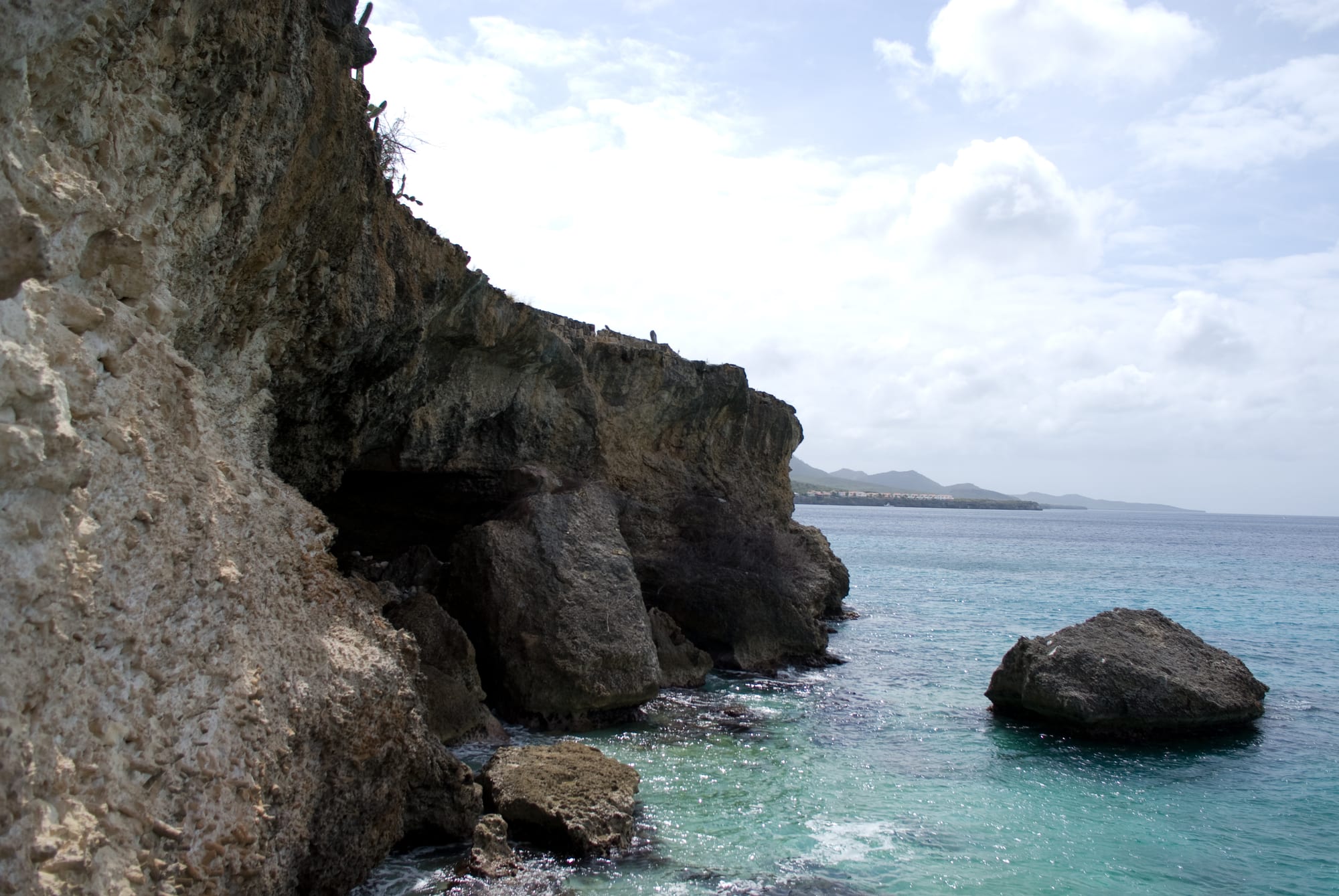
Weathered coral limestone cliffs dropping into clear turquoise sea, with a boulder offshore and low hills on the horizon

Curaçao

Westpunt

Coral cliffs on the coast at Westpunt, Curaçao. (Charles Hoffman from New York, United States / Wikimedia Commons · CC BY-SA 2.0)

A small village at the western tip of Curaçao, founded in the 1860s by newly freed slaves around a Catholic church, about 35 km from Willemstad. Long isolated and still quiet, it is now known for small coral-sand beaches below limestone cliffs, some of the island's best diving, a fishing beach, and the national parks of Christoffel and Shete Boka nearby.

Neighbourhoods

  • Sabana Westpunt
    • Quiet and residential
    • Local life

    The village itself, grown up around the Catholic church finished in 1853 and settled in the 1860s by newly freed slaves. It is small and quiet, with no supermarket of its own, and holiday homes owned by European Dutch and Willemstad families stand among the older houses.

    Open in Maps
  • The western beaches
    • Beaches
    • Diving and snorkelling

    The coves around the island's westernmost point — Playa Kalki, Playa Forti and Playa Grandi — set below cliffs of white coral rock. Most of the accommodation here caters to scuba divers, with a dive centre on the beach at Playa Kalki.

    Open in Maps
  • Kenepa and the Knip beaches
    • Beaches
    • History

    South of the village toward Lagún, the old Kenepa plantation with its landhuis, and the sandy bays of Grote Knip and Kleine Knip, popular starting points for snorkelling.

    Open in Maps

Things to do

Beaches

  • Playa Kalkibeach

    A beach also known as Alice in Wonderland for its mushroom-shaped coral formations, named after the Papiamentu word for white coral rock, with reefs for beginners and experienced divers and a dive centre on the sand.

    Open in Maps
  • Playa Fortibeach

    A sand-and-pebble beach with a snack bar and a restaurant, known for the spot beside the restaurant where people jump from the cliff into the sea.

    Open in Maps
  • Grote Knipbeach

    Also called Playa Abou, a public beach between Westpunt and Lagún that opens onto a small lagoon between high rocks, used as a starting point for snorkelling on the nearby reef.

    Open in Maps
  • Kleine Knipbeach

    The smaller neighbour of Grote Knip, a little beach in a bay between rocks with few facilities, known for snorkelling in clear, calm water.

    Open in Maps
  • Playa Jeremibeach

    A small, secluded beach just north of Lagún, partly sand and partly volcanic material, with no facilities and known for the clear water of its bay.

    Open in Maps

The coast and diving

  • Watamulaattraction

    The dive area off Cliff Villa Peninsula, where two currents meet and stir up nutrients — its name is a corruption of the Dutch for 'water mill' — with sea blowholes in the coral rock to the north-east.

    Open in Maps
  • Playa Grandimarket

    The beach north of Playa Forti where the local fishing community lands and sells its catch, from barracuda, wahoo and snapper to lobster and octopus.

    Open in Maps

Short trips from the village

  • Christoffelparkpark

    The national park around the island's highest point, with former plantations, a mine complex, eight hiking trails, rare orchids on its tall cacti, and white-tailed deer.

    Open in Maps
  • Christoffelbergtrail

    At 372 metres the highest point on Curaçao, climbed on the most demanding of Christoffelpark's trails, best attempted early in the morning; no one may start the climb after 10 am.

    Open in Maps
  • Savonet Museummuseum

    A museum in the 18th-century plantation house near the entrance to Christoffelpark, telling the history of the Savonet plantation, its owners and its slaves.

    Open in Maps
  • Shete Boka National Parkpark

    A national park founded in 1994 along more than 10 km of the rough north coast, whose inlets, or boka's, are protected nesting beaches for sea turtles — Boka Tabla, a cave where the sea rolls in, is the best known.

    Open in Maps
  • Landhuis Kenepalandmark

    The house of the Kenepa plantation, once one of the island's most prosperous and among its best-preserved landhuizen, where the slave revolt led by Tula began on 17 August 1795.

    Open in Maps

Eat and drink

Long-standing places and food districts in Westpunt. Hours, ratings and directions come from your maps app, always current.

Westpunt classics

  • Playa Grandi fish salesmarket

    The fishing community's landing beach, where the day's catch of tuna, mahi mahi, snapper, wahoo and lobster is sold.

    Open in Maps
  • Playa Fortirestaurant

    A snack bar and a restaurant on the cliff above the beach, beside the island's best-known jumping spot.

    Open in Maps
  • Restaurants of Westpuntneighborhood

    A handful of beach bars and restaurants around the western tip, many serving fresh local fish.

    Open in Maps

Experience Westpunt

History

Westpunt appears on maps of the Dutch West India Company from around 1700. In 1849 the Savonet plantation gave land to the Catholic Church for a church and a school, and the church was finished in 1853. After slavery was abolished in 1863, newly freed people settled around it in the 1860s, and the village they built is known today as Sabana Westpunt.

Near the village stands the house of the Kenepa plantation, named after the fruit of the kenepa tree, once among the most prosperous estates on the island, producing divi-divi seed pods and sheep's wool. On 17 August 1795 enslaved workers led by Tula began the Curaçao Slave Revolt there. Along the road to Willemstad, Landhuis Daniel, built around 1700, is one of the island's oldest plantation houses.

With Willemstad about 35 km away, the village remained isolated for most of its history. Its population has been falling steadily, incomes are well below the island average, and the elementary school closed in 2002. Since then holiday homes and tourist accommodation, much of it for divers, have appeared along the coast.

Culture & Customs

Westpunt is part of Bandabou, the rural west of the island, and its identity is that of a small community descended from the freed families who settled around the church. Papiamentu is the language of daily life, and the village church remains its centre. The memory of slavery is close at hand: the Kenepa plantation where Tula's revolt began lies just outside the village, and the Savonet Museum at the entrance to Christoffelpark tells the story of a plantation, its owners and its slaves.

The sea shapes local life. Fishermen land their catch at Playa Grandi, and the cliff at Playa Forti is so well known as a place to jump into the sea that it turns up in the lyrics of a song by the Curaçao group Diverse Sauzen, "Bij Playa Forti gaan we springen". Divers come for the reefs and the meeting currents off Watamula, and families from Willemstad and from the Netherlands keep holiday houses here.

Daily Life

Westpunt is a thinly populated part of Curaçao, and the number of people living here has been falling for years. There is no supermarket in the village — the nearest is about fifteen minutes' drive away — and residents depend on neighbouring Barber for supplies, with a small shop on the main road.

Work comes from fishing, from tourism — dive centres, beach bars, restaurants and holiday rentals — and from jobs elsewhere on the island, reached by car along the Weg naar Westpunt. Divers and snorkellers fill the coves, the fishing community works from Playa Grandi, and Christoffelpark and Shete Boka, the two national parks next to the area, are managed by the Carmabi Foundation.

Food

Food in Westpunt is simple and centred on the sea. The fishing community at Playa Grandi sells its daily catch, which includes barracuda, mahi mahi, blacktail and yellowtail tuna, red and queen snapper, wahoo, sailfish, amberjack, bluejack, black grouper, lobster, octopus and lionfish.

The island's home cooking is the base of most meals: stobá, a stew of goat, beef or papaya; guiambo, a slippery okra-and-seafood soup; kadushi, a soup made from cactus, a plant that also grows wild in Christoffelpark; and funchi, a cornmeal paste close to polenta, served with fish or goat. Pastechi, fried pastry turnovers filled with cheese, tuna, chicken or minced meat, are the usual snack. The beach bars and restaurants around the western tip serve fresh fish to swimmers and divers, and with no supermarket in the village, many visitors self-cater with supplies brought from Barber or Willemstad.

Planning tools

Budget

Westpunt has few shops and no supermarket, so most visitors stay in self-catering apartments or dive-oriented accommodation and bring supplies from Barber or Willemstad. A hire car is the largest cost after a room, and diving, entry to the national parks and beach facilities add to the daily bill.

Daily Budget Midrange
USD 150–320 (dive-oriented accommodation, car hire, restaurant meals, a dive or park visit)
Daily Budget Shoestring
USD 55–95 (apartment, self-catering, a snack bar meal, bus)

Stock up on groceries before driving out, and use the free public beaches as well as the managed ones.

Best Time to Visit

Any time of year. December to April is the busiest stretch across the island, while May to November is quieter and cheaper, with brief showers late in the year. Christoffelpark is best walked in the cool of the early morning in any season.

Suggested Number of Days

A day trip from Willemstad covers the beaches and the parks in outline. Divers and walkers usually stay several days, and the number rises with the amount of diving and hiking planned.

First Visit
1–2 days
With Surroundings
3–5 days

Transportation

A car is the practical way to get around: the beaches, the parks and the shops at Barber are spread along the main road, and the national parks have routes designed for driving. ABC buses run from the Otrobanda station in Willemstad to Westpunt, but departures can be an hour or two apart.

Watch for goats, donkeys and iguanas on the roads, and leave nothing in a parked car at the beaches.

Airport & Station Connections

Westpunt lies about 35 km from Willemstad along the Weg naar Westpunt, the main road across the west of the island. Most people arrive by hire car from Curaçao International Airport or the city; buses leave from the Otrobanda station in Willemstad.

Walkability

The village is small and walkable, and some beaches are close to it, but the coast is spread out along roads with little shade and the parks are a drive away. Watamula's blowholes can be reached on foot from Westpunt.

Safety

Curaçao is one of the safer Caribbean islands, with petty theft from cars, hotel rooms, and beaches the main concern, and some violent crime and drug activity in parts of Willemstad, especially Otrobanda and the areas away from the tourist centre after dark. Strong currents affect the wilder north (windward) coast, and the rough sea along the rocky shore of Shete Boka and around the northern point is not suited to swimming.

Swim from the calm south-western beaches rather than the north coast, jump from cliffs only where it is customary and the water is clear, and leave no valuables in cars. Check current official travel advice before travelling.

Climate

Hot, dry and breezy all year, cooled by the trade wind, with cacti and dry scrub on the hills. Rain is light and comes mostly in short showers late in the year, and the island lies south of the main hurricane belt.

Summer
hot, dry and windy — across the island temperatures run around 28–32°C
Winter
much the same, with brief showers from October to December and days around 28–32°C across the island

Local Customs

Westpunt is a small rural community where Papiamentu is the everyday language and the Catholic church is at the centre of village life. 'Danki' means thanks, and 'dushi' is the all-purpose word for anything good. Sea turtles nest on the protected inlets of Shete Boka, and the parks are managed for conservation.

Keep to the marked routes in the national parks and leave turtle nesting beaches undisturbed.

Common Payment Methods

The currency is the Caribbean guilder, pegged to the US dollar, which is widely accepted. Visa and Mastercard are accepted nearly everywhere on the island, but there are few shops and services in the village, and buses and petrol stations take cash.