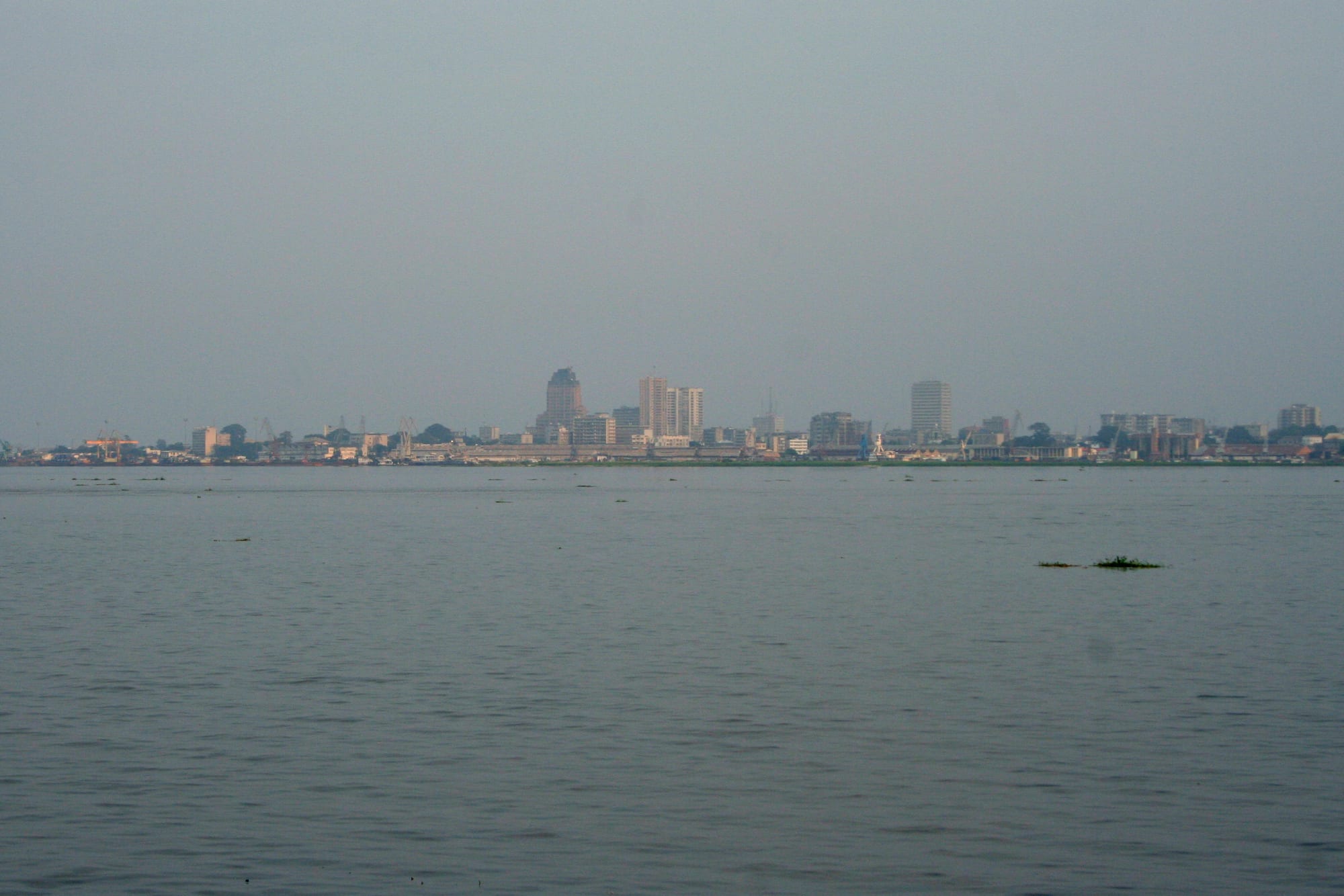
The low skyline of Kinshasa's Gombe district across the wide grey water of the Congo River under a hazy sky

Kinshasa & the West, Democratic Republic of the Congo

Kinshasa

The towers of Gombe, Kinshasa's administrative district, seen across Pool Malebo from Brazzaville. (Karin Lakeman / Wikimedia Commons · CC BY-SA 3.0)

The capital of the DR Congo, spread along the Congo River where it widens into Pool Malebo, with Brazzaville visible on the far bank. Founded as a trading station in 1881 and renamed in 1966, it has grown into one of the largest cities in Africa and the home of Congolese rumba. This page is written to explain the city, not to encourage travel.

Neighbourhoods

  • Gombe
    • First-time visitors
    • Business and embassies
    • Riverside

    The administrative and business district on the river, with the ministries, embassies, banks and most of the city's larger hotels. The Boulevard du 30 Juin runs through it, and the riverfront looks across Pool Malebo to Brazzaville. It is the most orderly and the most expensive part of the city.

    Open in Maps
  • Matonge
    • Nightlife
    • Music
    • Local life

    A dense quarter in Kalamu, south of the centre, long associated with bars, live music and the rumba scene. Streets of small shops, hair salons, tailors and open-air terraces stay busy late, and the name has travelled — a Congolese quarter of Brussels carries it too.

    Open in Maps
  • Limete
    • Industry
    • Local life

    An industrial and residential commune east of the centre, laid out on a grid, with warehouses and factories along the main road towards the airport. Its tall interchange tower with a statue of Patrice Lumumba is a landmark on the drive into town.

    Open in Maps
  • Ngaliema
    • Quiet and residential
    • Views

    The hilly western commune above the river, holding diplomatic residences, the presidential park and military camp on Mont Ngaliema and, further out, the rapids at Kinsuka where the Congo begins its descent. Streets climb steeply and the air is a little cooler than downtown.

    Open in Maps
  • Kintambo
    • Markets
    • Local life

    One of the oldest settled parts of the city, west of Gombe near the river, built around a busy market and a crowded transport junction. It mixes small workshops and shops with housing on the slope below Ngaliema.

    Open in Maps

Things to do

Famous landmarks

  • Boulevard du 30 Juinlandmark

    The wide central avenue through Gombe, named for the date of independence in 1960, lined with offices, banks and hotels.

    Open in Maps
  • Stade des Martyrsattraction

    The national stadium, built in 1993 and seating about 80,000, the largest in the country and among the largest in Africa, used for football internationals and for very large concerts and rallies.

    Open in Maps
  • Tata Raphaël Stadiumattraction

    The older stadium in Kalamu where Muhammad Ali fought George Foreman in the 1974 bout billed as the Rumble in the Jungle.

    Open in Maps
  • Palais du Peuplelandmark

    The domed parliament building, completed in 1979 with a Chinese line of credit, and the seat of the national assembly and senate.

    Open in Maps
  • University of Kinshasalandmark

    The country's oldest university, founded in 1954 as Lovanium on the Mont Amba plateau south of the centre, with a campus of long low blocks among trees.

    Open in Maps

Museums and the arts

  • National Museum of the Democratic Republic of the Congomuseum

    A museum of the country's cultural history, with three halls able to show some 12,000 objects, in a building funded by South Korea and handed over in 2019.

    Open in Maps
  • Académie des Beaux-Artsattraction

    The national fine arts school, founded in 1943 and in Kinshasa since 1949, whose sculptors and painters supply much of the public art seen around the city.

    Open in Maps

The river and green space

  • Pool Maleboattraction

    The lake-like widening of the Congo River beside the city, about 35 kilometres long, with Brazzaville on the opposite bank and sandbanks and fishing pirogues in between.

    Open in Maps
  • Lola ya Bonoboattraction

    A sanctuary on the southern edge of the city caring for orphaned bonobos in forest enclosures, the only great ape found solely in the DR Congo.

    Open in Maps
  • Livingstone Fallsattraction

    The long series of rapids and cataracts through which the Congo drops below the city, beginning downstream of Ngaliema Bay and continuing towards Matadi.

    Open in Maps

Short trips from the city

  • The Inkisi river and the Zongo fallsattraction

    The river that drops over the broad Zongo falls in Kongo Central, roughly 70 kilometres south-west of the city and a long-standing weekend escape.

    Open in Maps
  • Brazzavilleattraction

    The capital of the neighbouring Republic of the Congo, directly across Pool Malebo, reached by the ferry between the two river ports.

    Open in Maps

Eat and drink

Long-standing places and food districts in Kinshasa. Hours, ratings and directions come from your maps app, always current.

Kinshasa classics

  • Poulet à la moamberestaurant

    Chicken stewed in the thick orange pulp of palm fruit with chilli, served with rice, fufu or chikwangue and a dish of pondu — the meal most often called the national one.

    Open in Maps
  • Grilled fish and libokerestaurant

    River fish, above all capitaine, grilled whole over charcoal or steamed in a leaf parcel with onion, chilli and oil, eaten with fried plantain.

    Open in Maps
  • Ntaba and brochettesrestaurant

    Grilled goat and skewered meat from pavement braziers, the standard accompaniment to a cold beer at an open-air bar.

    Open in Maps

Markets and food districts

  • Marché Centralmarket

    The central market, a dense trading ground for cassava flour, smoked fish, palm oil, greens and almost everything else sold in the city.

    Open in Maps
  • Matongeneighborhood

    The quarter where the bars, grills and music venues are concentrated, with food sold from terraces and street stalls well into the night.

    Open in Maps
  • Gombe and the Boulevard du 30 Juinneighborhood

    The sit-down end of the city's eating, with Congolese, Lebanese, Indian and European restaurants clustered near the hotels and embassies.

    Open in Maps

Experience Kinshasa

History

Kinshasa began as two villages, Kinshasa and Kintambo, trading on the southern shore of Pool Malebo, the stretch where the Congo River widens above the first rapids. In 1881 Henry Morton Stanley, working for King Leopold II, founded a station there and named it Léopoldville. Its value was geography: goods could travel more than a thousand kilometres upriver from this point, but not past the cataracts below it, so everything had to be carried overland to the sea. The railway from Matadi, opened in 1898 at a heavy cost in workers' lives, made the town the hinge of the whole colonial economy, and in 1923 the capital moved here from Boma.

The town grew fast and unequally, with a European quarter along the river and African cités pushed inland behind a buffer strip. Riots in January 1959 shook Belgian confidence and independence followed in June 1960; the city was the stage for the crisis that unseated and then killed Patrice Lumumba. Mobutu Sese Seko renamed it Kinshasa in 1966 and made it the showcase of his rule, staging the Ali–Foreman fight and its accompanying music festival in 1974.

As the state decayed the city kept swelling. Unpaid soldiers looted Kinshasa in 1991 and again the following year, destroying much of its industry and driving out foreign business. Laurent-Désiré Kabila's forces entered the city in 1997, ending the Mobutu era, and he was assassinated here in 2001. Since then Kinshasa has grown into one of the largest cities in Africa, its expansion running far ahead of the roads, water mains and power lines meant to serve it.

Culture & Customs

Kinshasa is the capital of Congolese music. Rumba took shape here and in Brazzaville in the middle of the twentieth century, blending Cuban records with local styles, and the guitar bands of Franco and Tabu Ley Rochereau made it the dominant popular music of central Africa; later generations turned it into soukous and ndombolo. UNESCO inscribed Congolese rumba on its list of intangible cultural heritage in 2021. Live music remains a weekend fixture in the bars of Matonge and the outer communes, and a successful singer holds a status closer to that of a politician.

The city is also known for La Sape, the society of elegant dressers whose members treat tailoring as a discipline and a form of dignity, and for a strong visual art scene built around the Académie des Beaux-Arts, whose graduates paint, sculpt and teach across the country. Popular painting from Kinshasa, with its satirical scenes of city and colonial history, is collected internationally.

Daily manners are formal in ways visitors notice: long greetings, respect for age, careful dress and a preference for indirectness over blunt refusal. Lingala, quick and full of slang, is the language of the street, French that of the office. Churches shape the week — Catholic, Protestant, Kimbanguist and thousands of Pentecostal congregations meeting in halls and courtyards — and funerals and weddings draw very large gatherings.

Daily Life

Estimates put the population at about 18.5 million in 2026, which makes Kinshasa the largest city in the country by a wide margin and the largest officially French-speaking city in the world. It is also very young: a large share of residents are under twenty. The built-up area runs for tens of kilometres along the river and inland into the hills, and new neighbourhoods appear faster than services reach them.

Formal employment is scarce. Most households live from trade, transport, repair work, small workshops and remittances — the improvised economy summed up in the local phrase about fending for oneself. Gombe, with its ministries, banks and embassies, is a different world from the cités, where water comes from standpipes and electricity arrives in shifts. Flooding after heavy rain regularly destroys houses in low-lying districts near the rivers that cross the city.

The day starts before dawn with long commutes in crowded minibuses, and markets open early. Business is done before the evening rush, and the night belongs to bars, churches and music. Constant topics of conversation are the price of cassava flour and fuel, the exchange rate of the franc, school fees, and the politics of a city that decides much of the country's.

Food

The everyday plate is a starch and a sauce. Fufu, a stiff dough of cassava or maize flour, or chikwangue, fermented cassava paste steamed into a firm loaf in leaves, is eaten with the right hand alongside pondu, cassava leaves pounded and simmered with palm oil, onion and often fish. Rice and fried plantain appear beside them, and pili-pili chilli is on the table.

Poulet à la moambe — chicken in a sauce made from the pulp of palm fruit — is the dish brought out for celebrations. River fish is the other pillar: capitaine and tilapia grilled over charcoal, or cooked as liboke, wrapped in leaves with onion and chilli and steamed. Makayabu, salted fish, is soaked and stewed, and mbinzo, caterpillars fried with onion, sell in season. Ntaba, grilled goat, is the standard snack with a beer.

Eating out ranges from the ngandas, the small open-air eating houses where a plate of fish and pondu costs little, to the restaurants of Gombe, where Lebanese, Indian and European cooking is served to an expatriate and official clientele. Local lagers are drunk cold and in large bottles; palm wine and the home-distilled lotoko circulate informally; and fruit — mangoes, avocados, pineapple and the cooked purple safou — fills the markets in season.

Planning tools

Budget

Kinshasa is one of the most expensive cities in Africa for a visitor. Hotels in Gombe charge international rates, almost everything in the shops is imported, and a car with a driver is close to a necessity, which pushes daily costs well above the rest of the country. Anything significant is priced in US dollars.

Daily Budget Midrange
USD 200–400 (Gombe hotel, car and driver, restaurant meals)
Daily Budget Shoestring
USD 60–100 (simple guesthouse outside Gombe, street food, shared taxis) — hard to manage safely

Carry clean, unmarked US dollar notes along with some Congolese francs for small purchases, and arrange a driver through a hotel or a local contact rather than hailing transport in the street.

Best Time to Visit

June to September, the dry season, is the easiest stretch: little rain, milder temperatures and better road conditions towards Kongo Central, though the sky often stays grey for weeks. The rains from October to May bring heavy storms and flooding in low-lying neighbourhoods. Security and political events matter more than the season.

Suggested Number of Days

Two or three days covers the city itself, which is large and slow to move around. Four or five suit anyone adding the waterfalls and river country outside it, or the far bank. Traffic, not distance, decides how much fits into a day.

First Visit
2–3 days
With Surroundings
4–5 days

Transportation

The city sprawls for tens of kilometres along the river and traffic is heavy for most of the day. Shared minibuses and converted vans carry most residents, along with motorbike taxis, and an urban rail line runs irregularly on the old tracks. Visitors normally use a private car with a driver, arranged through a hotel or a local contact.

Allow far more time than the distance suggests, especially into and out of the centre in the morning and late afternoon, and keep windows up and doors locked in stationary traffic.

Airport & Station Connections

N'djili airport, about 20 kilometres east of the centre, is the country's main international gateway, with flights from Europe, the Gulf, Ethiopia, Kenya and West and Southern Africa, and domestic services to the provinces. The drive in takes an hour or more in traffic. The paved national road runs south-west to Matadi in roughly six to eight hours, and ferries cross Pool Malebo to Brazzaville.

Walkability

Gombe is flat and can be walked in daylight, and the riverside and the Boulevard du 30 Juin are the pleasant stretches, though pavements are uneven and often occupied by traders. Elsewhere distances are long, road crossings are difficult and walking is not the usual way to move between districts. Walking after dark is not advised anywhere in the city.

Safety

Kinshasa lies far from the conflict in the east, but it has serious street crime, including armed robbery and street gangs, and political protests can turn violent. Power cuts, flooding during the rains and road accidents are routine hazards, and malaria and cholera are present. Police and military checkpoints are common, and photographing official buildings, bridges or uniformed personnel causes trouble.

Most governments advise caution throughout the DR Congo, and travel here works best through a trusted local contact or operator; avoid demonstrations and do not walk in Kinshasa after dark. Keep copies of documents, agree transport in advance, and treat any crowd as a reason to leave the area. Check current official travel advice before travelling.

Climate

Tropical and humid, a little south of the Equator, with a long rainy season and a cooler, cloudy dry season. Temperatures vary less through the year than the rainfall does, and humidity is high throughout.

Summer
rainy season (October–May): hot and humid, roughly 25–33°C, with heavy afternoon thunderstorms
Winter
dry season (June–September): overcast and milder, roughly 18–29°C, with little rain

Local Customs

Lingala is the language of the street and French that of offices and schools; a greeting in Lingala is well received. Greetings are unhurried and elders are addressed first. Dress is careful — Kinshasa takes clothes seriously, and the sapeurs are the extreme expression of that — so scruffy clothing reads badly in offices and churches. Sunday church attendance is widespread.

Tipping is modest and appreciated rather than expected; ask before photographing people, and never photograph soldiers, police, government buildings, the airport, the port or the bridges.

Common Payment Methods

The currency is the Congolese franc, but the US dollar circulates alongside it and larger prices are usually quoted in dollars. Bring new, undamaged notes, as worn or pre-2009 bills are refused. Cards are accepted only at larger hotels and a few restaurants, cash machines are unreliable, and mobile money is widely used by residents.