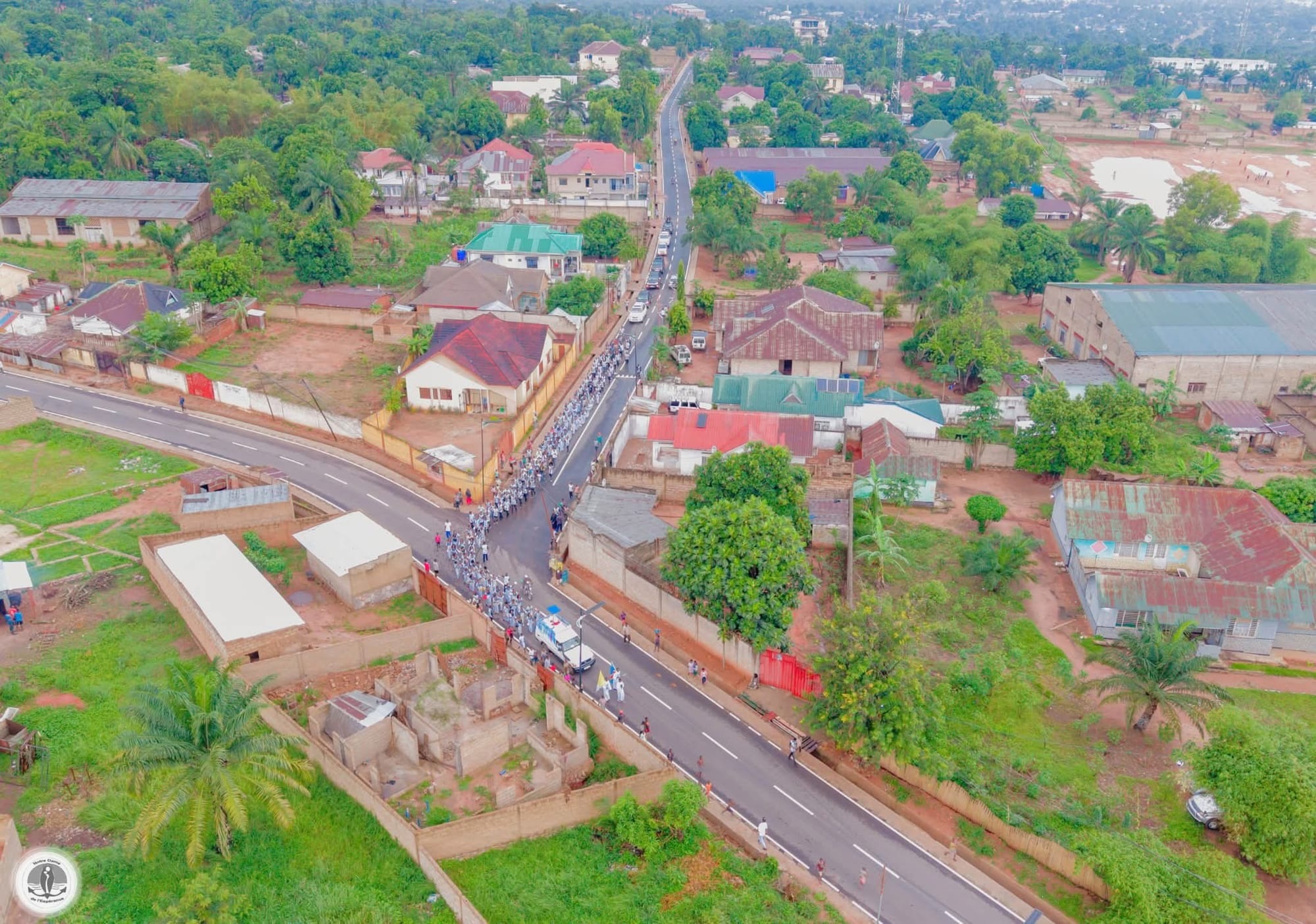
A road running through a low-rise district of tin and tile roofs, trees and red earth plots

The Kasaï, Democratic Republic of the Congo

Mbuji-Mayi

A street through a residential district of Mbuji-Mayi. (Kitangaza.1953 / Wikimedia Commons · CC0)

The capital of Kasaï-Oriental and one of the largest cities in the DR Congo, built on the diamond fields of the Mbuji-Mayi river in the southern savanna. It grew from the mining town of Bakwanga, was the seat of the short-lived South Kasai secession in 1960, and remains the commercial centre of Luba-Kasai country. This page is written to explain the city, not to encourage travel.

Neighbourhoods

  • The centre
    • First-time visitors
    • Commerce
    • Administration

    The commercial core, with the provincial administration, banks, diamond buying houses, the main market and the few hotels. Business is done along a handful of surfaced avenues, and the streets are thick with motorbike taxis.

    Open in Maps
  • Bipemba
    • Local life
    • Markets

    A large commune on the southern side of the city, residential and densely built, with street markets, schools and churches. It sits on the road towards the airport and the mining concessions.

    Open in Maps
  • Dibindi
    • Local life
    • Trade

    A busy central commune of compounds, workshops and small traders, where much of the everyday commerce of the city takes place away from the formal shops of the centre.

    Open in Maps
  • Kanshi and Muya
    • Quiet and residential
    • Local life

    The communes north and east of the centre, spreading towards the river and the outer farmland, mixing older housing with new building on the city's edge. Water and power supplies here are especially unreliable.

    Open in Maps

Things to do

Getting around and landmarks

  • Mbuji-Mayi Airporttransit hub

    The airport a few kilometres from the centre, served by the domestic flights that bring nearly every visitor to the city.

    Open in Maps

The river and the diamond country

  • The Mbuji-Mayi riverattraction

    The river that gives the city its name — Tshiluba for goat water, after the herds kept in the region — a major tributary of the Sankuru running past the diamond country the city was built on.

    Open in Maps

Short trips from the city

  • The Fwa riverattraction

    A savanna river about 50 kilometres from the city, a tributary of the Lubi, known for a community of fish found nowhere else.

    Open in Maps
  • Mwene-Dituattraction

    A railway town in Lomami province about 100 kilometres south of the city, with a station on the national line and a trade in the produce of the farming country around it.

    Open in Maps

Eat and drink

Long-standing places and food districts in Mbuji-Mayi. Hours, ratings and directions come from your maps app, always current.

Kasaï classics

  • Bidia with saucerestaurant

    The regional staple, a stiff dough of maize and cassava flour eaten with the right hand alongside greens, groundnut sauce, beans, dried fish or goat.

    Open in Maps
  • Brochettes and grilled goatrestaurant

    Skewered meat and grilled goat from charcoal braziers set up beside the bars along the main avenues in the evening.

    Open in Maps

Markets

  • Mbuji-Mayi central marketmarket

    The city's main trading ground, selling maize and cassava flour, groundnuts, dried fish, palm oil, vegetables, charcoal and goods trucked in from Kinshasa and Lubumbashi.

    Open in Maps

Experience Mbuji-Mayi

History

Diamonds were found in the gravels of the Kasaï rivers early in the twentieth century, and the deposits around the Mbuji-Mayi river proved to be among the richest sources of industrial stones in the world. A mining settlement grew at Bakwanga to work them, run by a company whose successor, the Société minière de Bakwanga, known as MIBA, became the city's reason for existing. The town was built by and for the mine: workers' camps, company installations and the tracks that carried stones and supplies.

Independence turned it into a political centre. In 1960 Albert Kalonji declared the secession of South Kasai with its capital at Bakwanga, and tens of thousands of Luba who had left the region returned or were driven there amid fighting between Luba and Lulua communities and an army offensive that killed great numbers before the state was reabsorbed in 1962. The town took the name Mbuji-Mayi at the end of 1962.

Under Mobutu the diamond trade kept the city going as the rest of the economy collapsed, and when the state currency failed the stones served in its place. The population swelled with people from across the Kasaï, and the built-up area spread far beyond anything the roads, water mains and power lines could serve. MIBA's industrial output has fallen a long way from its peak, and most stones are now dug by hand by artisanal miners and sold to licensed buying houses in town — a shift that has left the city large, busy and poorly served, and dependent on trade rather than on a single company.

Culture & Customs

Mbuji-Mayi is the great city of the Luba-Kasai, and Tshiluba is heard everywhere, with French kept for offices and classrooms and Lingala arriving with music and soldiers from the capital. Kasaïans have a national reputation for schooling, commerce and political argument, and the ties between this city and the Luba communities of Kinshasa and Lubumbashi are constant, carried by traders, students and remittances.

Customary authority runs alongside the administration. Chiefs and family elders are consulted on land, marriage and disputes, extended families share the cost of school fees and funerals, and a funeral can occupy a street for days. Respect for age is expected, greetings are lengthy, and refusals are made indirectly.

Church life is loud and central: Catholic and Protestant missions of long standing, Kimbanguist congregations and a very large number of revival churches whose choirs rehearse in courtyards through the evening. Music follows two strands — mutuashi, the Luba dance rhythm carried to national fame by the singer Tshala Muana, and the rumba and ndombolo that dominate the bars. Diamonds colour social life as well as the economy: fortunes are made and lost quickly, wealth is displayed, and the trade is discussed with a mixture of pride and suspicion.

Daily Life

Estimates of the population vary widely in the absence of a recent census: about 1,480,000 by one 2010 estimate and as many as 3,500,000 by a United Nations figure for 2008, which leaves Mbuji-Mayi generally counted the second largest city in the country after Kinshasa. The built-up area covers a great deal of ground in low compounds of brick and sheet metal, with cultivation and mining pits at its edges.

The economy turns on diamonds and on the trade that follows them: digging, sorting, buying, transport and the shops and services the money supports, along with farming on the outskirts. Formal employment is scarce, and much of the city lives on small trade and family networks. Electricity supply is poor even by Congolese standards and generators are common, water comes from standpipes and wells, and the road and rail links that bring in fuel, cement and flour are slow, which keeps prices high.

The day begins before dawn in the markets and ends early outside the bars, with motorbike taxis running all day on unpaved streets. Conversation turns on the price of maize flour and fuel, the exchange rate, school fees, the state of the mines and the fortunes of the diggers, and on the weather in a place where a heavy storm can make half the streets impassable.

Food

Bidia is the foundation of the meal: a stiff dough of maize and cassava flour, rolled in the right hand and dipped into a sauce. Pondu, cassava leaves pounded and simmered with palm oil and onion, is the standard green, and sauces are built on groundnuts, palm oil, okra, aubergine and pili-pili chilli. Beans, sweet potatoes and rice fill out the plate.

Meat matters more here than fish, which arrives dried or smoked from the rivers rather than fresh: goat and chicken for guests and celebrations, skewered meat grilled over charcoal in the evening. Caterpillars gathered in season are fried with onion and sold by the cup, a delicacy that outsiders find surprising and locals do not. Groundnuts, maize and cassava from the surrounding farmland fill the markets, along with mangoes, bananas, avocados and pineapples in season.

Eating out means small kitchens serving bidia and sauce, or the braziers set up beside bars at nightfall. Bottled lager comes in by road and rail from Kinshasa and Lubumbashi and is drunk cold and in large bottles; palm wine and home-brewed maize or sorghum beer are the traditional drinks, and a strong home-distilled spirit circulates informally. Sugary tea or instant coffee with bread or fried dough starts the day.

Planning tools

Budget

There is no visitor circuit here. Hotels are basic to mid-range, priced in US dollars and often expensive for what they offer, because diamond buyers, officials and aid workers are the main guests. Food and local transport are cheap; the flight in is the largest cost, and imported goods are dear because everything arrives by air or by a long road haul.

Daily Budget Midrange
USD 120–250 (hotel in Mbuji-Mayi, driver, meals), before flights
Daily Budget Shoestring
USD 40–80 (simple guesthouse, market food, motorbike taxis) — there is no budget travel circuit here

Bring all the US dollars needed in clean, new notes, plus Congolese francs for markets and motorbike taxis; card payments and cash machines cannot be relied on.

Best Time to Visit

June to August, the drier and cooler months, when the earth roads are passable and the sky clears. From September to May heavy afternoon storms turn tracks to mud and can cut outlying areas off for days. Local security and health conditions matter more than the season.

Suggested Number of Days

A day or two is enough for the city itself, which is vast in area but short on formal sights. Three or four suit anyone travelling out into the surrounding savanna and mining country. Flight schedules and road conditions decide the real length of a stay.

First Visit
1–2 days
With Surroundings
3–4 days

Transportation

Motorbike taxis carry most people, with shared minibuses on the main roads. Only a few avenues are surfaced; the rest are red earth, dusty in the dry season and deeply rutted in the rains. The railway from Katanga passes through Mwene-Ditu to the south-west and runs irregularly. Visitors normally hire a vehicle and driver through a hotel or a local organisation.

Agree fares before setting out, allow far more time than the distance suggests, and avoid travelling between towns after dark.

Airport & Station Connections

Mbuji-Mayi Airport, a few kilometres from the centre, handles the domestic flights that bring nearly everyone who arrives. The road west to Kananga is long and only partly improved, the road south to Mwene-Ditu links to the Katanga railway, and both journeys take far longer than the distance suggests.

Walkability

The commercial centre can be walked, with the market, the banks and the administration close together, though pavements are patchy and the sun is strong. The city spreads for many kilometres beyond it in low compounds and unpaved streets, so anything further means a motorbike taxi, and mining pits and workings make some edges of the built-up area unsafe to wander into.

Safety

Kasaï-Oriental is far from the war in the east, but diamond wealth attracts crime, and armed robbery and theft are the main risks, especially after dark and around the buying houses and diggings. The wider region has not fully recovered from the Kamuina Nsapu violence of 2016 to 2019 in the neighbouring provinces. Health services are weak, disease outbreaks recur, and mining areas are guarded and not open to casual visitors.

Most governments advise caution throughout the DR Congo; visits here should be arranged with a trusted local contact or organisation, and roads avoided after dark. Do not photograph or approach mining concessions, checkpoints or anyone in uniform, and take malaria precautions seriously. Check current official travel advice before travelling.

Climate

A hot, humid savanna climate on a plateau, a little cooler than the central basin. Rain falls from about September to May, with a shorter, drier and cooler spell from June to August when nights turn fresh.

Summer
rainy season (September–May): hot and humid, roughly 20–31°C, with heavy afternoon storms
Winter
dry season (June–August): warm days and cooler nights, roughly 16–30°C

Local Customs

Tshiluba is the everyday language, French the language of offices and schools, and a greeting in Tshiluba is noticed. Greetings are unhurried and elders addressed first; customary chiefs remain influential in land and family matters. Churches shape the week, funerals and weddings draw very large gatherings, and dress is modest and neat.

Tipping is not expected; ask before photographing people or markets, and never photograph mining sites, soldiers, police, the airport or government buildings — diamonds make people cautious about cameras.

Common Payment Methods

The Congolese franc is used for markets, transport and small purchases, while hotels, freight and anything substantial are priced in US dollars, which circulate widely in a city built on an export trade. Bring new, undamaged notes. Cards are almost never accepted, cash machines are unreliable, and mobile money is common among residents.