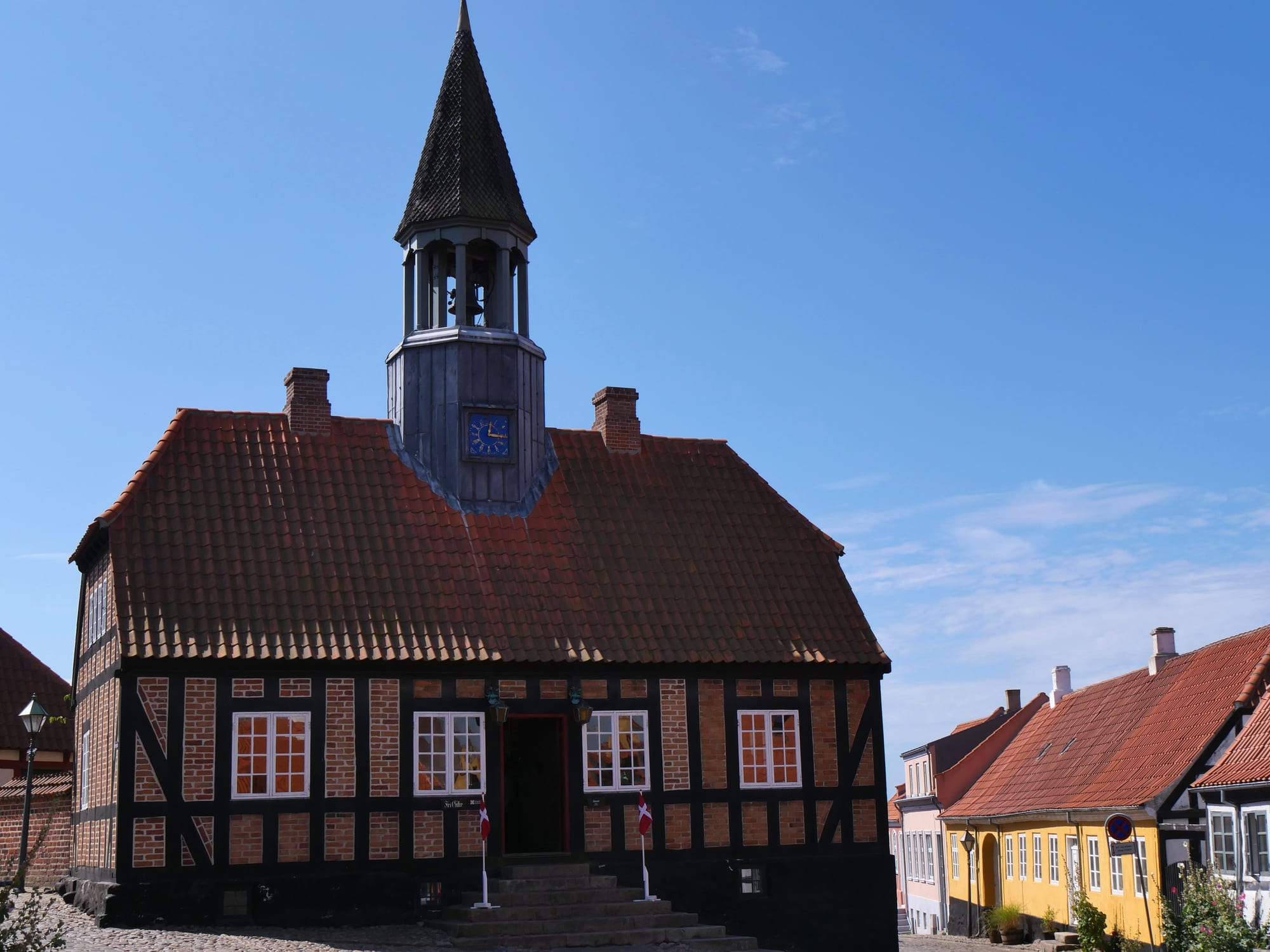
A small half-timbered red-brick town hall with a slate-clad bell tower and clock, beside yellow houses under a blue sky

Central Jutland, Denmark

Ebeltoft

The old town hall of Ebeltoft, built in 1789, at the heart of the cobbled old town. (A. Winterstein / Wikimedia Commons · CC BY-SA 4.0)

An old port town on the Djursland peninsula in eastern Jutland, a market town since 1301, whose cobbled streets and half-timbered houses survived centuries of slow decline. Today it is one of Denmark's tourist centres, with the restored frigate Jylland, a museum of contemporary glass, the hills of Mols Bjerge National Park and thousands of summer houses around it.

Neighbourhoods

  • The old town
    • First-time visitors
    • Historic district
    • Shopping

    Cobbled streets of half-timbered and stuccoed houses around the old town hall, under plans for their conservation begun in the 1960s by the town council and the National Museum. Much of the medieval street pattern survives, and the streets hold specialist shops, glass studios, cafés and restaurants.

    Open in Maps
  • The harbour front
    • Museums
    • Waterfront
    • Families

    The waterfront on the west side of the Hasnæs peninsula — Ebeltoft is the only east Jutland harbour town whose harbour faces west — where the frigate Jylland stands in dry dock and the glass museum occupies the old customs house. The converted Maltfabrikken arts and culture centre is also in the town.

    Open in Maps
  • Øer and the coast
    • Beaches
    • Summer houses
    • Quiet and residential

    South of the town lies the holiday resort of Øer, and the coast around Ebeltoft is lined with several thousand summer houses and child-friendly beaches, many of them Blue Flag beaches, busiest in June, July and August.

    Open in Maps

Things to do

Museums and landmarks

  • Frigate Jyllandmuseum

    A wooden-hulled sailing frigate with an auxiliary steam engine, built for the Danish navy in 1860, which fought at the Battle of Heligoland in 1864; the last surviving screw frigate, restored and on display in dry dock since 1994.

    Open in Maps
  • Glasmuseet Ebeltoftmuseum

    One of the world's first glass museums, devoted to contemporary glass art, founded in 1985 by the glass artists Finn Lynggaard and Tchai Munch in the former customs house, with a modern wing of 2006 and a glass-blowing studio.

    Open in Maps
  • The Old Town Halllandmark

    The small town hall of 1789, now a museum with its original dungeon, where many couples come to marry.

    Open in Maps
  • Farvergårdenmuseum

    An old dye-works preserved in its original courtyard buildings with the historic implements once used to dye cloth and yarn.

    Open in Maps

Parks and the countryside

  • Mols Bjerge National Parkpark

    A 180-square-kilometre national park inaugurated in 2009, which takes in the town and the Ice Age hills of Mols, reaching 137 metres, with heath, woods and coast for walking and cycling.

    Open in Maps
  • Ree Park – Ebeltoft Safariattraction

    A safari park near the town with more than 800 animals of 80 species from five continents, including a hilly bush savannah for its cheetahs.

    Open in Maps
  • Poskær Stenhuslandmark

    The largest round barrow in Denmark, built around 3300 BC near the village of Knebel, its burial chamber capped by an 11-tonne granite slab.

    Open in Maps
  • Kalø Castlelandmark

    The ruins of a castle around 700 years old on a peninsula within the national park.

    Open in Maps

Short trips from the town

  • Aarhusattraction

    Denmark's second city, with Den Gamle By, the ARoS art museum and a rebuilt harbour, across the bay by road.

    Open in Maps

Seasonal events

  • Ebelfestivalmid-October

    An apple festival held every year since 2004 in week 42, celebrating apples — from which the town takes its name — and Ebeltoft's history and culture.

Eat and drink

Long-standing places and food districts in Ebeltoft. Hours, ratings and directions come from your maps app, always current.

Ebeltoft classics

  • Restaurants of the old townneighborhood

    Cafés and restaurants line the cobbled streets around the old town hall, a couple of them in restored historic houses.

    Open in Maps
  • Fish restaurants at the harbourneighborhood

    Fish restaurants and cafeterias in the small harbour area.

    Open in Maps
  • Mols Bolsjerrestaurant

    A sweet shop in the old town selling a wide variety of bolsjer, Danish boiled sweets.

    Open in Maps

Experience Ebeltoft

History

Ebeltoft was probably founded around 1200, and its name, first recorded in 1301 as Æpplætofte, is thought to come from the apple tree that appears on the town's oldest seals. That year King Erik Menved granted it the privileges of a market town, and in 1317 he gave its citizens the same law as Viborg and Aarhus. A Latin school opened in 1558, but the town suffered from plague in 1619–20 and badly from the wars of the 17th century; in the war of 1657–60 the Swedes built their fortifications on a rise called Skansen, and Swedish and Danish ships fought in the bay.

Seaborne trade was the town's living, and in the later 17th century, with large merchants' houses, warehouses and shipyards and a profitable trade above all with Bergen, it outgrew its rival Grenaa; in 1672 it had 817 people. The Great Northern War cost it part of its fleet, and the decline that followed left only two ships by 1798. Through the 19th century Ebeltoft remained one of the smallest market towns in the country, and much of its medieval street pattern survives.

That stagnation preserved the town. A railway to Trustrup ran from 1901 to 1968, and in the 1960s the town council and the National Museum began planning the conservation of the old centre. The frigate Jylland was towed here in 1960 and restored by 1994, the glass museum opened in 1985 and the European Film College in 1993, and in 2015 Ebeltoft topped a list of the best-preserved medieval towns in Denmark.

Culture & Customs

The town's culture is built on its craftspeople and its visitors. Ebeltoft has the largest concentration of small studio-glass workshops in Denmark, and glass workers, potters, painters and jewellery designers have settled in and around it; the glass museum, founded by two local glass artists, shows contemporary work from around the world and runs a glass-blowing studio. The European Film College, a folk high school in the hills north of the town, brings in young filmmakers from abroad, and the international schools, the tourism and the old harbour trade are thought to explain why most people in the town are open towards foreigners.

Old customs survive as spectacle. Many couples come to marry in the old town hall of 1789, and uniformed night watchmen with lanterns set out on their evening round from its stone steps. The Maltfabrikken, a former malt factory closed in 1998 and for a time threatened with demolition, reopened in 2020 as a centre for art, culture and events, and drew up to half a million visitors in its first six months.

Each October the Ebelfestival, started in 2004 by the local Rotary Club, celebrates the apple and the town's history. The wider area has a place in Danish humour too: the people of Mols, the Molboer, are the simple folk of the Molbo stories, a 'town of fools' tradition of Danish folktales.

Daily Life

About 7,400 people lived in Ebeltoft at the start of 2026, making it the largest town in Syddjurs Municipality, and the population nearly doubles in the summer holidays. All year there are more people in the area than the official figure suggests, because of the several thousand summer houses that surround it.

Ebeltoft has lost many jobs in recent years. Several large employers of unskilled labour have closed, fishing and farming are shrinking, and the Mols-Linien ferry company moved many of its staff to the ferry port of Aarhus. Quite a few residents commute to Aarhus, about 50 km away by road, and tourism, with the general stores and supermarkets, hotels, restaurants and bars, provides much of the work in the town.

The town is generally well-to-do. Daily life follows the season: quiet winters among year-round residents, and summers when the cobbled streets, harbour and beaches fill with families from Aarhus, Copenhagen and abroad. Since 2009 the town has stood inside Mols Bjerge National Park, and walks and cycle rides in the hills are close at hand.

Food

Ebeltoft's table is the Danish one, with the sea close by. Fish restaurants and cafeterias stand around the small harbour, and herring, which features prominently in Danish cooking, comes smoked, fried, pickled or breaded; plaice, rødspætte, is served as fried, breaded fillets with lemon and remoulade. Lunch is smørrebrød, buttered dark rye bread with cold toppings, and the hot staples are frikadeller, pan-fried meatballs, and flæskesteg, roast pork with crackling.

A couple of the old town's restaurants occupy restored historic houses, and cafés on Adelgade serve coffee and old-fashioned ice-cream cones. Local specialities sold in the town's shops include apple schnapps, fitting for a town named after the apple, and bolsjer, homemade Danish boiled sweets, sold at a sweet shop in Nedergade.

Around 1900 the town had a malt factory and two breweries; the malt factory's building now houses the Maltfabrikken culture centre. Beyond the town, restaurants in the hills of Mols are known for good dining, and the apple festival each October brings the local fruit to the centre of attention.

Planning tools

Budget

Ebeltoft is a holiday town and its prices follow the season. Many visitors rent a summer house by the week, which is cheap in June and September and dear in the school holidays. Restaurants and the frigate and glass museum tickets are the main daily costs; the old town, the beaches and the national park are free.

Daily Budget Midrange
USD 210–360 (hotel or summer house, restaurant dinners, museum tickets, a hire car for Djursland)
Daily Budget Shoestring
USD 100–150 (campsite cabin or shared summer house, bakery and supermarket food, a hired bike)

Summer houses cost far less outside July and August, and tap water is excellent and free; tipping is not expected.

Best Time to Visit

June to August is the high season, when the population nearly doubles, the beaches fill and every shop and restaurant is open. May and September are quieter and still pleasant for walking in Mols Bjerge. The apple festival in mid-October is a reason for an autumn visit; winter is quiet and dark.

Suggested Number of Days

One or two days are enough for the town and its museums. Most visitors stay longer — often a week in a summer house — to add the beaches, the national park and the rest of Djursland; a car or bike makes the difference.

First Visit
1–2 days
With Surroundings
3–5 days

Transportation

The old town and the harbour are reached on foot from anywhere in the centre. Ebeltoft has had no railway since its branch line closed in 1968, so the surrounding countryside, beaches and the national park are best reached by car or bicycle; buses serve the town.

Hire a bike for the beaches and the Mols hills; summer traffic into the old town is heavy, so park on the edge and walk in.

Airport & Station Connections

Aarhus Airport at Tirstrup lies about 15 km north of the town by road, and bus 212 links it with Ebeltoft. Many visitors come by car or bus from Aarhus, which is about 50 km away by road; from Zealand, car ferries cross the Kattegat from Odden to Ebeltoft and to Aarhus.

Walkability

Very walkable. The old town, the harbour, the frigate and the glass museum all lie within a few minutes of one another, though the cobbles are uneven underfoot. Beaches and summer-house areas around the town are a bike ride rather than a walk.

Safety

Denmark is a very safe country with low levels of violent crime. Ebeltoft is a quiet small town, busy but calm in summer. The usual care is needed at the beach, and ticks are found in the grass and woods of the surrounding hills.

Swim at recognised bathing beaches, watch children near the water, and check for ticks after walks in the national park. Check current official travel advice before travelling.

Climate

Temperate and maritime, mild and changeable. Summer days are long and winter days short and grey.

Summer
mild — in nearby Aarhus August is the warmest month, with a mean temperature of about 16°C
Winter
cold and grey — in nearby Aarhus February is the coldest month, with a mean temperature of about 0°C

Local Customs

Social life is informal and egalitarian. Tipping is not expected, as service is included. The people of Mols, the 'Molboer', are cast in Danish folktales as a simple folk who act foolishly. English is widely spoken.

Respect the private gardens and doorsteps of the old town's houses when photographing, and keep cycle paths clear on foot.

Common Payment Methods

The currency is the Danish krone (DKK). Cards and mobile payment (MobilePay locally) are accepted almost everywhere, and many places no longer accept cash at all.