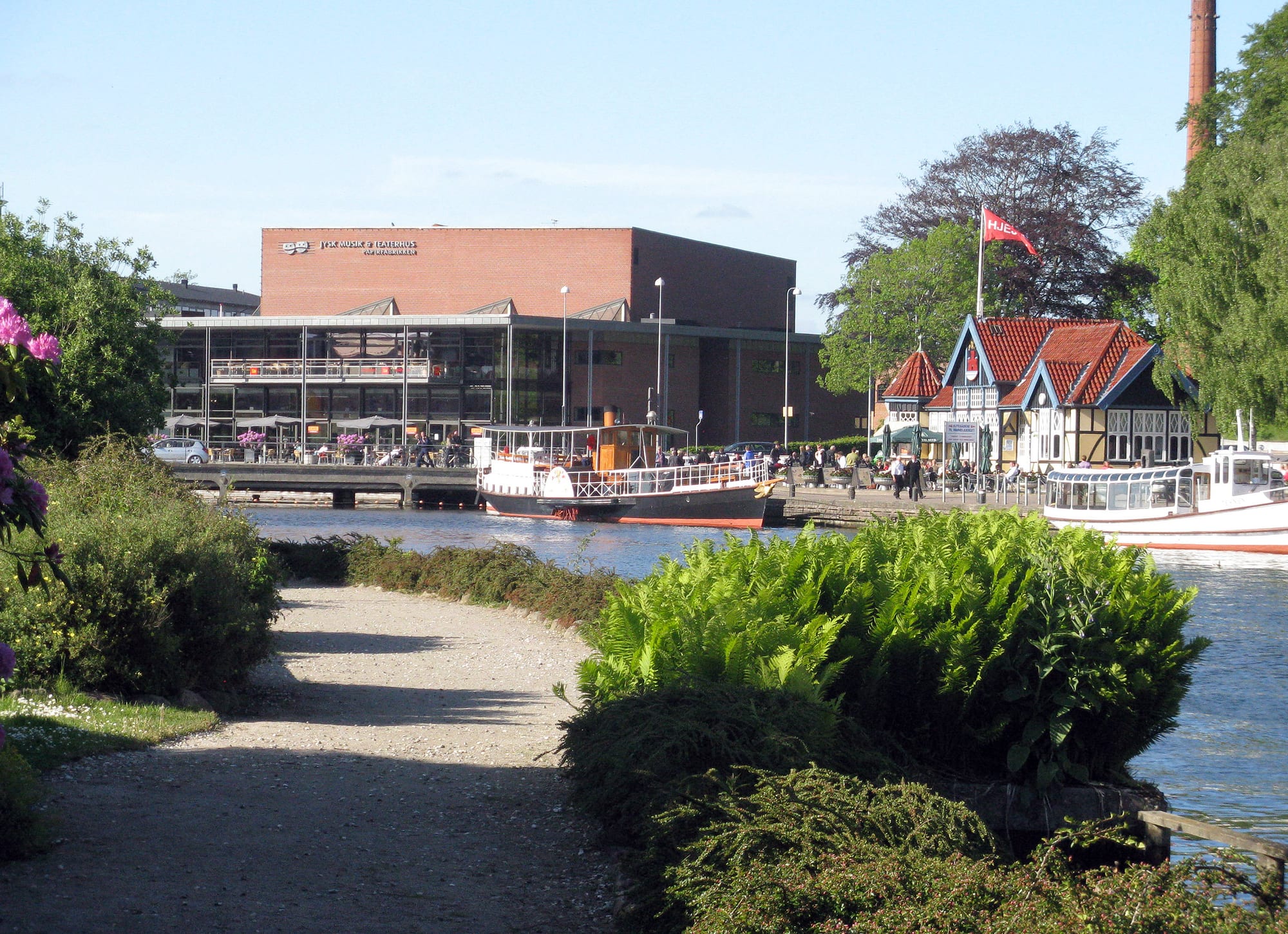
A small steamboat moored on a calm river in front of a brick concert hall and a red-roofed half-timbered kiosk

Central Jutland, Denmark

Silkeborg

Silkeborg harbour on the river, with the Hjejlen boats, the boat kiosk and the theatre and music house. (Nils Jepsen / Wikimedia Commons · CC BY-SA 3.0)

A lakeside town on the Gudenå in the middle of Jutland, founded in 1844 around a paper mill and surrounded by Denmark's largest forest district and the lakes of Søhøjlandet. It is known for the Iron Age Tollund Man, the 1861 paddle steamer Hjejlen, Asger Jorn's art museum and its claim to be the country's outdoor capital.

Neighbourhoods

  • Town centre and Torvet
    • First-time visitors
    • Shopping
    • Close to public transport

    The old square, Torvet, is the heart of the town, with two fountains and a bronze statue of the founder Michael Drewsen in front of the old town hall. It and the streets around it are pedestrianised, and the square holds the weekly market on Saturdays. The railway and bus station lie on the southern edge.

    Open in Maps
  • Papirfabrikken and the harbour
    • Arts and culture
    • Best for food
    • Waterfront

    The site of the old paper mill beside the river, closed in 2000 and rebuilt as a district of flats, a cinema, a concert hall, a paper museum, restaurants and cafés. The boat harbour opposite is where the Hjejlen boats leave for the lakes, and Museum Jorn and the Indelukket recreation area lie close to each other by the water.

    Open in Maps
  • Sejs-Svejbæk and the lakes
    • Quiet and residential
    • Lakes and forest

    South-east of the town, among the forests and lakes, the village of Sejs is known for large houses and lakeside villas at Brassø. The area is one of the most expensive in Denmark to live in and a base for walking, cycling and canoeing on the water.

    Open in Maps

Things to do

Museums

  • Museum Silkeborg and the Tollund Manmuseum

    The town's history museum in Silkeborg Manor of 1767, the oldest building in the town, where the Tollund Man and the Elling Woman, two Iron Age bog bodies found west of the town, are displayed.

    Open in Maps
  • Museum Jornmuseum

    An art museum on the Gudenå built on the collections Asger Jorn assembled, with the largest body of his work and paintings and sculpture by the CoBrA group, Max Ernst, Fernand Léger and Man Ray.

    Open in Maps
  • Silkeborg Bad and the Bunker Museummuseum

    The former municipal sanatorium beside Lake Ørnsø, the Gestapo's Danish headquarters during the occupation, now an art centre with sculptures in its park and a small museum in one of the German bunkers.

    Open in Maps

Lakes, river and forest

  • Hjejlenattraction

    The paddle steamer built in 1861 for a group of citizens led by Michael Drewsen, the world's oldest coal-fired paddle steamer still in service, which carries visitors from the town harbour to Himmelbjerget in summer.

    Open in Maps
  • Himmelbjergetviewpoint

    The 147-metre 'sky mountain' between Silkeborg and Ry, crowned by a red brick tower of 1875 and a gathering place for more than two centuries, reached by boat from the town.

    Open in Maps
  • Silkeborg Forestspark

    A merged block of public and private woodland of about 22,400 hectares south of the town, divided into north, west, east and south sections.

    Open in Maps
  • Søhøjlandetpark

    The lake highland around the town, the highest-lying part of Denmark and the one with the most lakes, linked by the Gudenå, the country's longest river.

    Open in Maps

Sport

  • JYSK Parkattraction

    The 10,000-capacity stadium of Silkeborg IF, opened in 2017 next to the JYSK Arena, home of the handball side Bjerringbro-Silkeborg.

    Open in Maps
  • Jyllands-Ringenattraction

    A motor-racing circuit at Resenbro on the edge of the town, which hosted the Danish Grand Prix for sports cars from 1968 to 1970 and now stages touring-car series.

    Open in Maps

Short trips from the town

  • Aarhusattraction

    Denmark's second city on the Kattegat coast, with Den Gamle By, the ARoS art museum and its rebuilt harbour, reached by regional train.

    Open in Maps

Seasonal events

  • Riverboat Jazz Festivallate June

    A five-day jazz festival held in the town on the last weekend of June.

  • SCC country music festivalAugust

    A country music festival held in Indelukket every year since 1986.

  • IldfestregattaAbout every three years

    A festival held since 1899 in which houses along the river are hung with coloured lamps, decorated boats fill the harbour and fireworks are fired from a raft on the lake.

Eat and drink

Long-standing places and food districts in Silkeborg. Hours, ratings and directions come from your maps app, always current.

Silkeborg classics

  • Restaurants around Torvetneighborhood

    The square and the shopping streets that radiate from it hold most of the town's restaurants and cafés, across every budget.

    Open in Maps
  • Papirfabrikkenneighborhood

    Several restaurants and cafés in the converted paper-mill buildings by the harbour, including one in the paper museum.

    Open in Maps

Markets and local drink

  • Saturday market on Torvetmarket

    The weekly market held on the town square on Saturdays.

    Open in Maps
  • Bryghuset Kragelundrestaurant

    A microbrewery near the town, opened in 2007, whose beers are all unfiltered and unpasteurised.

    Open in Maps

Experience Silkeborg

History

A castle called Silkeborg stood on an islet in Silkeborg Langsø in the 15th century, with a monastery and a farming estate nearby, but the present town is young. In 1844 the firm Drewsen og Sønner founded a paper mill where the castle had been, using the Gudenå for power, for production and for transport, and Michael Drewsen, who ran it, is regarded as the town's founder. A commission to establish a trading centre was set up in 1845, and the settlement grew from 30 people in 1844 to 556 in 1850 and 1,204 in 1855, when it gained a town council and a parish. The railway arrived in 1871, and Silkeborg became a market town only in 1900. Drewsen also led the group of citizens who commissioned the paddle steamer Hjejlen in 1861 to carry passengers on the lakes.

The bogs around the town have yielded two of the best-known finds of the European Iron Age. The Elling Woman was dug out of the Bjældskovdal bog west of the town in 1938, and in 1950 peat-cutters found the Tollund Man about 60 metres away, so well preserved that he was first taken for a recent murder victim.

During the German occupation the Gestapo turned Silkeborg Bad, the municipal sanatorium, into its Danish headquarters, and German bunkers still stand in the park. The paper mill dominated the town for a century and a half; it ran into difficulties in the 1990s, was bought by a German company in 1993 and closed in 2000, and its buildings were turned into a new district of homes, culture and restaurants.

Culture & Customs

Silkeborg calls itself Denmark's outdoor capital, and its identity is bound up with water and woods: rowing, canoeing and cycling on the lakes and through the forests, and the boat trip to Himmelbjerget, a hill that has drawn gatherings and celebrations for more than 200 years. The painter Asger Jorn of the CoBrA group enrolled at a teacher-training college in Silkeborg and returned to the town in 1951, and the collection he built up from the early 1950s until his death in 1973 became Museum Jorn, which also holds works by artists he admired, from Max Ernst to Man Ray.

The town's year is marked by music. The Riverboat Jazz Festival fills the last weekend of June, the SCC country festival has been held in Indelukket since 1986, and the Hede Rytmer rock and pop festival opens the summer. About every third year, in a tradition dating from 1899, the Ildfestregatta lights up the river with lamps and decorated boats; on three nights firework companies compete in an unofficial national championship, and the winner from three years before puts on the final show from a raft on the lake.

Football and handball are the favourite sports. Silkeborg IF, founded in 1917, won the Danish league in 1994, the Danish Cup in 2001 and the UEFA Intertoto Cup in 1996, and plays at JYSK Park. The handball side Bjerringbro-Silkeborg is shared with the town of Bjerringbro. A ski slope at nearby Gjern uses natural snow in winter and a nylon track the rest of the year, and in 2019 the town hosted the World Women's Curling Championship.

Daily Life

About 53,000 people lived in the town at the start of 2026, and about 103,000 in the wider Silkeborg Municipality, of which it is the seat. The lake country around it is among the most expensive places to live in Denmark, with large houses and lakeside villas at Brassø near the village of Sejs.

The paper mill was once the town's main business; today the headquarters of Jyske Bank, the country's third-largest bank, stand here, and the town has an unusually large number of car dealerships. The daily newspaper Midtjyllands Avis, founded in 1857 as Silkeborg Avis, is one of the oldest in the country, and it and the local radio station are based at Papirfabrikken.

The town is split east to west by Silkeborg Langsø, which flows into the Gudenå on the eastern side. A motorway completed in 2016 links it with Aarhus and Herning, and twelve town bus routes run on gas. Weekends in summer are spent on the water and in the forests, swimming from piers at lakes such as Almind Sø, and on Saturdays the square fills for the market.

Food

Silkeborg eats as the rest of Denmark does, with lunch built on smørrebrød — buttered rugbrød, a dense, dark rye bread, topped with cold meats, sliced sausage, egg or pickled herring. The hot classics are frikadeller, pan-fried meatballs of pork or of veal and pork; stegt flæsk med persillesovs, slices of fried pork belly served with potatoes and a white parsley sauce; and flæskesteg, roast pork with crackling, often eaten at Christmas with red cabbage. Breakfast on a Sunday may include wienerbrød, the pastry known abroad as a Danish.

Most of the town's restaurants are on and around Torvet and in the pedestrian streets that run off it, with more in the converted paper-mill buildings by the harbour, where the paper museum also has a café. The countryside around Silkeborg keeps the tradition of the kro, the Danish country inn held in high regard as a place to eat, including old inns near the Gudenå north of the town.

For drink, Bryghuset Kragelund, a microbrewery near the town that opened in 2007, makes unfiltered and unpasteurised beers, alongside the national beers and akvavit. The spring at Arnakkekilden in the park of Silkeborg Bad has supplied water bottled by Carlsberg for many years.

Planning tools

Budget

Silkeborg is an inland town and good value by Danish standards all year, though Denmark is still one of the most expensive countries in the world. Hotels and restaurant meals are the main costs; the forests, lakeside paths and swimming lakes are free, and the museums and boat trips charge moderate entry.

Daily Budget Midrange
USD 200–350 (mid-range hotel, restaurant dinners, museum tickets, a boat trip on the lakes)
Daily Budget Shoestring
USD 100–150 (hostel, bakery and supermarket food, town buses and a hired bike)

Tap water is excellent and free, and tipping is not expected because service is included.

Best Time to Visit

May to September, when the Hjejlen boats run to Himmelbjerget, the lakes are warm enough for swimming and canoeing, and the Riverboat Jazz Festival and summer music festivals fill the town. Winter is quiet, cold and dark, and passenger boats on the river run only in summer.

Suggested Number of Days

One or two days cover the town and its museums. Three or four allow time on the lakes and in the forests, by boat, bike or canoe, or a trip further afield. Visits in summer, when the boats run, need the most time.

First Visit
1–2 days
With Surroundings
3–4 days

Transportation

The centre is small enough to walk, and pavements and space for bicycles run everywhere. Twelve yellow town bus routes serve the centre and suburbs from the bus terminal at the railway station, and blue regional buses run to the surrounding towns. In summer the Hjejlen boats link the town with stops along the lakes, and canoes and kayaks can be hired by the dam.

Hire a bike or canoe to reach the lakes; motorways now link the town with Aarhus, Herning, Horsens, Randers and Viborg for drivers.

Airport & Station Connections

Silkeborg station, on the southern edge of the centre, is on the line between Aarhus and Herning, with trains from Aarhus every 30 minutes; from Copenhagen the usual route is by train with a change at Skanderborg. Buses also run from Aarhus. Karup Midtjylland Airport, about 40 km to the north-west, lost its scheduled route to Copenhagen in 2025.

Walkability

Very walkable. Torvet, the pedestrian streets, the station, the harbour, Papirfabrikken and Museum Jorn all lie within a short walk of one another along the river, and paths lead from the town straight into the forests and along the lakes.

Safety

Denmark is a very safe country with low levels of violent crime. Silkeborg is a quiet town and its centre is easy to walk at night. The main hazards are outdoors: ticks are common in the lake-district forests, and the lakes call for the usual care when swimming or canoeing.

Check for ticks after forest walks, swim at recognised bathing places, and wear a life jacket in a canoe or kayak. Check current official travel advice before travelling.

Climate

Temperate and maritime, mild and changeable, with rain possible in any month. Daylight is long in June and short in December.

Summer
mild — in nearby Aarhus August is the warmest month, with a mean temperature of about 16°C
Winter
cold and grey — in nearby Aarhus February is the coldest month, with a mean temperature of about 0°C

Local Customs

Social life is informal and egalitarian, and showing off is frowned on. Tipping is not expected, as service is included. Cycling is an everyday way of getting around, so cycle lanes are for bikes, not pedestrians. English is widely spoken, but a Danish greeting — 'hej' — is always welcome.

Keep out of cycle lanes on foot, and follow the signs at bathing places and in the forests.

Common Payment Methods

The currency is the Danish krone (DKK). Cards and mobile payment (MobilePay locally) are accepted almost everywhere, and many places no longer accept cash at all, so carrying cash is rarely necessary.