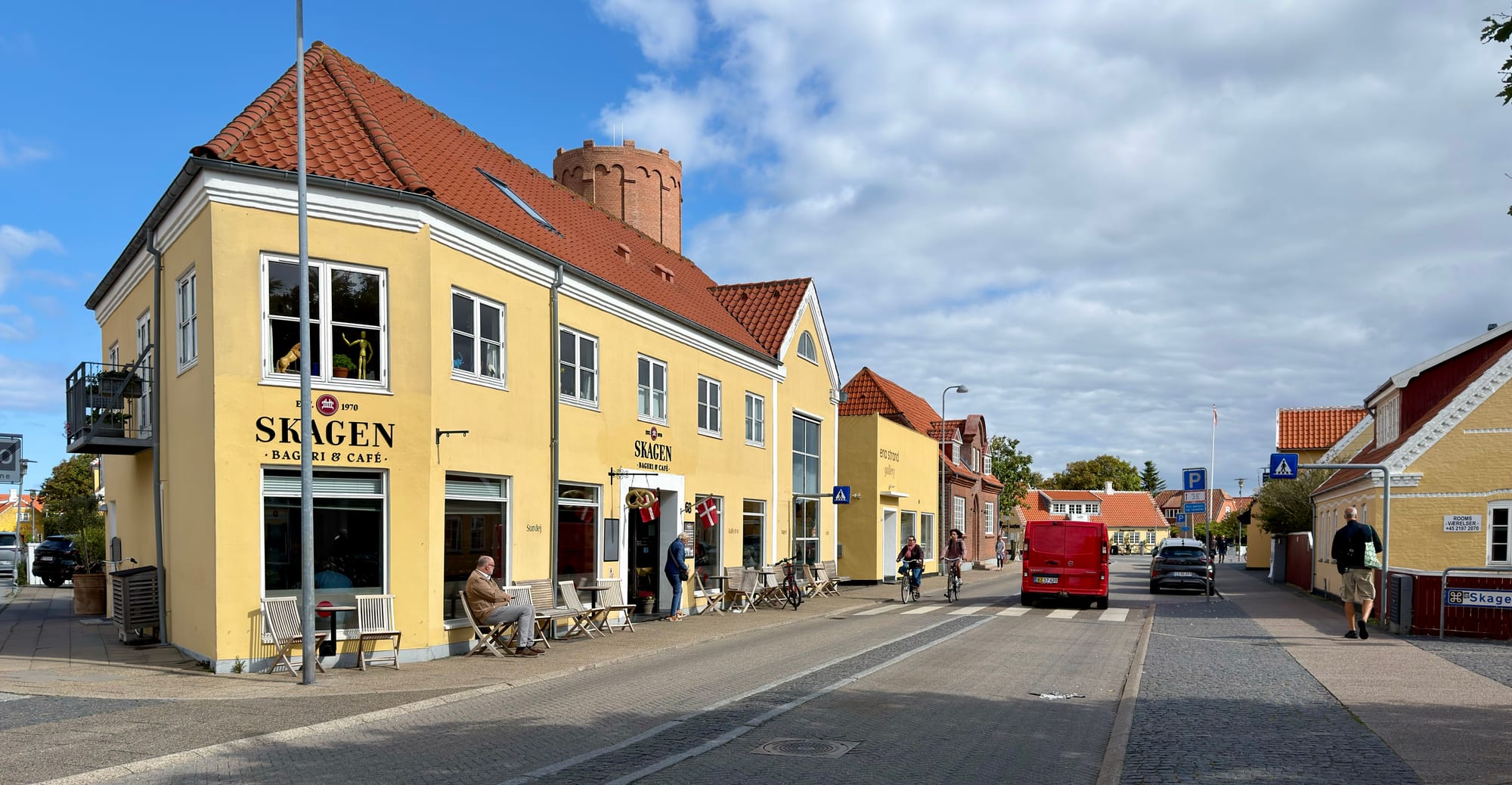
A yellow corner building with a red tiled roof and white trim on a quiet street, with a round brick water tower behind

North Jutland, Denmark

Skagen

Yellow-plastered houses with red roofs on Sankt Laurentii Vej, Skagen's main street. (Olgierd Rudak / Wikimedia Commons · CC BY-SA 4.0)

Denmark's northernmost town, on the Skagen Odde peninsula near Grenen, where the Skagerrak and the Kattegat meet. A medieval herring village battered by storms and drifting sand, it drew the Skagen Painters in the late 19th century, and today combines the country's main fishing port with yellow-painted streets, art museums and about two million visitors a year.

Neighbourhoods

  • Sankt Laurentii Vej and the centre
    • First-time visitors
    • Shopping
    • Close to public transport

    The main street away from the harbour, lined with many of the yellow-plastered, red-roofed houses designed by Ulrik Plesner between 1890 and 1930, and known for its glass and pottery shops. Skagens Museum and the Anchers' house are a short walk away.

    Open in Maps
  • The harbour
    • Best for food
    • Waterfront
    • Nightlife

    Denmark's leading fishing port, opened in 1907, where a fish auction is held at dawn and the warehouses designed by Thorvald Bindesbøll stand along the quay. In summer thousands of visitors fill the restaurants on the quay, and the marina, open in the summer months, draws sailors from Norway and Sweden.

    Open in Maps
  • Vesterby and Østerby
    • Historic district
    • Quiet and residential

    Two old districts of the town, known for little fishermen's cottages and narrow streets. Vesterby, the main village from about 1340, holds the open-air town museum among the dunes.

    Open in Maps
  • Gammel Skagen
    • Beaches
    • Sunsets
    • Summer houses

    The old fishing community of Højen on the west side of the peninsula, first settled in the 12th century and a resort since the late 19th century, with fishing cottages and beaches facing the Skagerrak. It has a permanent population of only about 30 and suffers from coastal erosion and drifting sand.

    Open in Maps

Things to do

Art and museums

  • Skagens Museummuseum

    The museum founded in 1908 in the dining room of the inn where the painters gathered, by Michael Ancher, P.S. Krøyer, Laurits Tuxen and others, with more than 1,800 works by the Skagen Painters and their circle.

    Open in Maps
  • Anchers Husmuseum

    Michael and Anna Ancher's home of 1884, with its 1913 studio and much of the original furniture, opened as a museum in 1967 and enlarged in 1989 with the neighbouring Saxild House.

    Open in Maps
  • Drachmanns Husmuseum

    The house of 1829 where the writer and marine painter Holger Drachmann lived from 1902, open as a museum since 1911 with his paintings and work by the other Skagen artists.

    Open in Maps
  • Skagen Town and Regional Museummuseum

    An open-air museum in the dunes of Vesterby with fishermen's cottages, an old life-saving station, a smithy and a Dutch windmill.

    Open in Maps

Grenen and the dunes

  • Grenenviewpoint

    The long sandbar at the northern tip of Denmark, north-east of the town, where the Skagerrak and the Kattegat meet; between Easter and late October a sand train, Sandormen, runs out from the car park.

    Open in Maps
  • Skagen Lighthouselandmark

    The Grey Lighthouse of 1858 north-east of the town, a 46-metre brick tower that replaced the White Lighthouse of 1747, the first lighthouse in Denmark built in brick.

    Open in Maps
  • Skagen Odde Nature Centremuseum

    A museum of sand, water, wind and light near the tip of the peninsula, designed by Jørn Utzon in 1989.

    Open in Maps
  • Sand-Covered Churchlandmark

    The tower of the late 14th-century church of St Lawrence, all that was left standing when drifting sand forced its closure in 1795.

    Open in Maps
  • Råbjerg Miletrail

    The largest moving dune in northern Europe, about 2 square kilometres and 40 metres high, between Skagen and Frederikshavn.

    Open in Maps

Seasonal events

  • Sankt Hans Aften23 June

    Midsummer Eve on the beach, with a blazing bonfire and song — a scene painted by P.S. Krøyer.

  • Skagen Festivalfirst weekend of July

    Denmark's oldest music festival, held since 1971 on stages around the town and the harbour, presenting folk music in its various forms, including folk rock, jazz and blues.

Eat and drink

Long-standing places and food districts in Skagen. Hours, ratings and directions come from your maps app, always current.

Skagen classics

  • Skagen Fiskerestaurantrestaurant

    A fish restaurant established in 1907 at the side of the harbour, in a town where seafood is the staple.

    Open in Maps
  • Restaurants on the harbour quayneighborhood

    Small restaurants in the old fishing houses on the quay, known for freshly cooked shrimp.

    Open in Maps

Shops and sweets

  • Food shops of the centreneighborhood

    Butchers, bakers, a cheese shop and fishmongers sit among the galleries in the town centre.

    Open in Maps
  • Bolcherietrestaurant

    A sweet shop near the harbour where visitors can watch sweets being made and taste them.

    Open in Maps

Experience Skagen

History

The name Skagen, first recorded as Skaffuen in 1284, means a narrow, high point of land. The first building, in the 12th century, stood at Højen on the west side of the peninsula; around 1340 Vesterby on the east coast became the main village, and St Lawrence's Church was built at the end of the century. In 1413 Erik of Pomerania made Skagen a market town, and for a time it was the largest community in Vendsyssel, with up to 2,000 people. The sea and the sand were constant enemies: in 1568 some 350 boats and ships were wrecked off the coast, storms in the 1590s flooded houses and drowned many, drifting sand buried 25 farms in 1595, and in 1795 the sand-choked church was closed by royal decree and all but its tower demolished.

Herring stocks declined in the 17th century, the Swedes plundered the town in 1644, and the population fell to 650 by 1781. Lighthouses rose to guard the strait — the White Lighthouse in 1747 and the Grey Lighthouse in 1858. In 1871 Holger Drachmann and the first painters arrived, followed by Michael Ancher in 1874 and P.S. Krøyer in 1882, and the colony gathered at the town's inn, where Anna Ancher, the innkeeper's daughter, had been born.

The railway from Frederikshavn arrived in 1890 and the fishing harbour opened in 1907, bringing both industry and tourists. Christian X built the summer villa Klitgaarden here in 1914, and the population more than doubled between 1930 and 1955, reaching a peak of 14,050 in 1980. Since then it has fallen steadily, and in 2007 Skagen lost its own municipality and became part of Frederikshavn.

Culture & Customs

Skagen's culture is inseparable from the painters who came each summer from the late 1870s until the turn of the century. Drawn by the scenery, the fishermen and one another's company, they painted outdoors in the manner of the French Impressionists and broke with the rigid traditions of the Danish and Swedish art academies. The group revolved around Michael Ancher and Anna Ancher, the only native of Skagen among them, and included Krøyer, Laurits Tuxen, Marie Krøyer, the Norwegian Christian Krohg and writers such as Holger Drachmann and Georg Brandes. Krøyer's Hip, Hip, Hurrah! shows them celebrating in a garden. Their museums, and galleries selling local art and reproductions, have made Skagen one of the places in Denmark with the most galleries, many of them on Trondsvej.

The town's look is distinctive: low yellow houses with red tile roofs, many designed by Ulrik Plesner, who also rebuilt the church in 1909–10 and designed the station and Skagens Museum. Glass and pottery workshops line Sankt Laurentii Vej. The composer Carl Nielsen and his sculptor wife Anne Marie Carl-Nielsen kept a house here, and her bronze lifeboatman on the square, brought to the town in 1932, honours the fishermen and rescuers of Jutland.

The calendar peaks in summer, with the midsummer bonfire on the beach and song on 23 June and the Skagen Festival, the country's oldest music festival, on the first weekend of July. From the 1960s it became fashionable for well-to-do Danes to spend their summers here, and sailors from Norway, Sweden and Denmark are now among its frequent visitors.

Daily Life

About 7,250 people lived in Skagen in January 2026, little more than half its 1980 peak; the permanent population has fallen markedly this century, while some two million visitors come each year. Since 2007 the town has been governed from Frederikshavn, with a loss of administrative jobs.

Fishing remains the base of the economy. The harbour is the largest fishing port in Denmark, with the country's main herring-processing plant and the town is home to FF Skagen, the world's top producer of fish meal and fish oil, while the Karstensens shipyard builds trawlers for Norwegian owners. The harbour also has facilities for cruise ships, and an offshore park serving the Norwegian market was set up in 2012. Skagen's skipper school, opened in 1921, is the last in Denmark and trains navigators from across Scandinavia.

Tourism is now a major source of income and employment. The old fishing village has become a miniature town of boutiques, galleries and seafood restaurants, and in summer its streets are congested with traffic. Housing estates built from the 1960s spread north towards Højen, while the oldest streets of Vesterby and Østerby keep their fishermen's cottages. Out of season the town is far quieter.

Food

Seafood is the staple of the town's restaurants, with fresh fish coming in at Denmark's main fishing port. Skagen is known for fish in general and for freshly cooked shrimp in particular, eaten on the quay at small restaurants in the old fishing houses or carried home. Skagen Fiskerestaurant has stood at the side of the harbour since 1907, and in summer thousands of visitors fill the restaurants on the quay beside the warehouses designed by Thorvald Bindesbøll.

Danish fish cookery runs through the menus. Herring, which features prominently in Danish cuisine, is served smoked, fried, pickled, breaded or charred, and pickled herring often opens a meal on dark rye bread. Plaice, rødspætte, comes as fried, breaded fillets with lemon and remoulade, and is the base of stjerneskud, the 'shooting star' — a piece of steamed white fish and a piece of fried, breaded plaice side by side on buttered toast.

The town's food shops — butchers, bakers, a cheese shop and fishmongers — sit among its galleries, and at a sweet shop near the harbour visitors can watch sweets being made. A fish auction is held at dawn in the harbour, a reminder that the restaurants are only the visible end of a working fishing town.

Planning tools

Budget

Skagen is the expensive exception in an otherwise affordable part of Denmark. In July rooms are among the dearest in the country; in spring and autumn prices fall sharply. Seafood dinners and museum tickets are the main daily costs, while Grenen, the beaches and the dunes are free.

Daily Budget Midrange
USD 230–420 (mid-range hotel, fish restaurant dinners, museum tickets, more in July)
Daily Budget Shoestring
USD 100–160 (campsite cabin or hostel, harbour-kiosk shrimp and supermarket meals, a hired bike)

In high season, stay in Frederikshavn or Aalbæk and take the local train to Skagen rather than paying Skagen's July room rates.

Best Time to Visit

June to August for the long light evenings, the beaches, the midsummer bonfire and the Skagen Festival, with July the busiest month. Spring and autumn bring migrating birds and far fewer people, and winter is quiet.

Suggested Number of Days

Two or three days are enough for the town, its museums and the tip of the peninsula. Allow longer to explore the dunes and beaches further down the coast by bike or car; summer, when everything is open, rewards more time than winter.

First Visit
2–3 days
With Surroundings
3–5 days

Transportation

The centre is compact and flat, and cycling is popular: bikes can be hired near the station, and marked cycle routes, including mountain-bike circuits, run in and around the town. A sand train covers the last stretch of sand at Grenen between Easter and late October. Road 40 links the town with Frederikshavn, and in summer the town can become congested with traffic.

Leave the car at the edge of town in July and walk or cycle in; paid parking is by the station.

Airport & Station Connections

Skagen station, the most northerly in Denmark, is the end of the Skagensbanen line from Frederikshavn, which has frequent local trains with onward connections to Aalborg and the rest of the country. Aalborg Airport has its own railway station and city buses. Frederikshavn has ferries to Gothenburg, Oslo and Læsø. By road the town is 41 km north of Frederikshavn on Road 40.

Walkability

Very walkable. The station, Sankt Laurentii Vej, the harbour, Skagens Museum and the Anchers' house all lie within a short walk of one another. Grenen and the lighthouses are a longer walk or a short ride north-east, and Gammel Skagen is a bike ride across the peninsula.

Safety

Denmark is a very safe country with low levels of violent crime. Skagen is quiet and busy rather than risky in summer. The sea is the real hazard: bathing at Grenen is forbidden because the currents where the two seas meet can be fatal.

Do not swim in the waters around Grenen, where bathing is prohibited, and swim only at recognised beaches. Check current official travel advice before travelling.

Climate

A cool maritime climate, shaped by the surrounding sea. Skagen is Denmark's sunniest town, averaging about 306 hours of sunshine in July. Winters are cold and grey.

Summer
mild and bright — Skagen gets about 306 hours of sunshine in July; in Aalborg, 108 km away by road, July and August average about 16°C
Winter
cold and grey — in Aalborg, 108 km away by road, January and February average between −3 and 2°C

Local Customs

Social life is informal and egalitarian. Tipping is not expected, as service is included. The midsummer bonfire with song on the beach is a highlight of the local year. English is widely spoken, and many visitors in summer are sailors from Norway and Sweden.

Keep to marked paths in the dunes, which are fragile, and do not photograph people's homes and gardens without asking.

Common Payment Methods

The currency is the Danish krone (DKK). Cards and mobile payment (MobilePay locally) are accepted almost everywhere and many places no longer accept cash, though a little cash can be useful for small seasonal services.