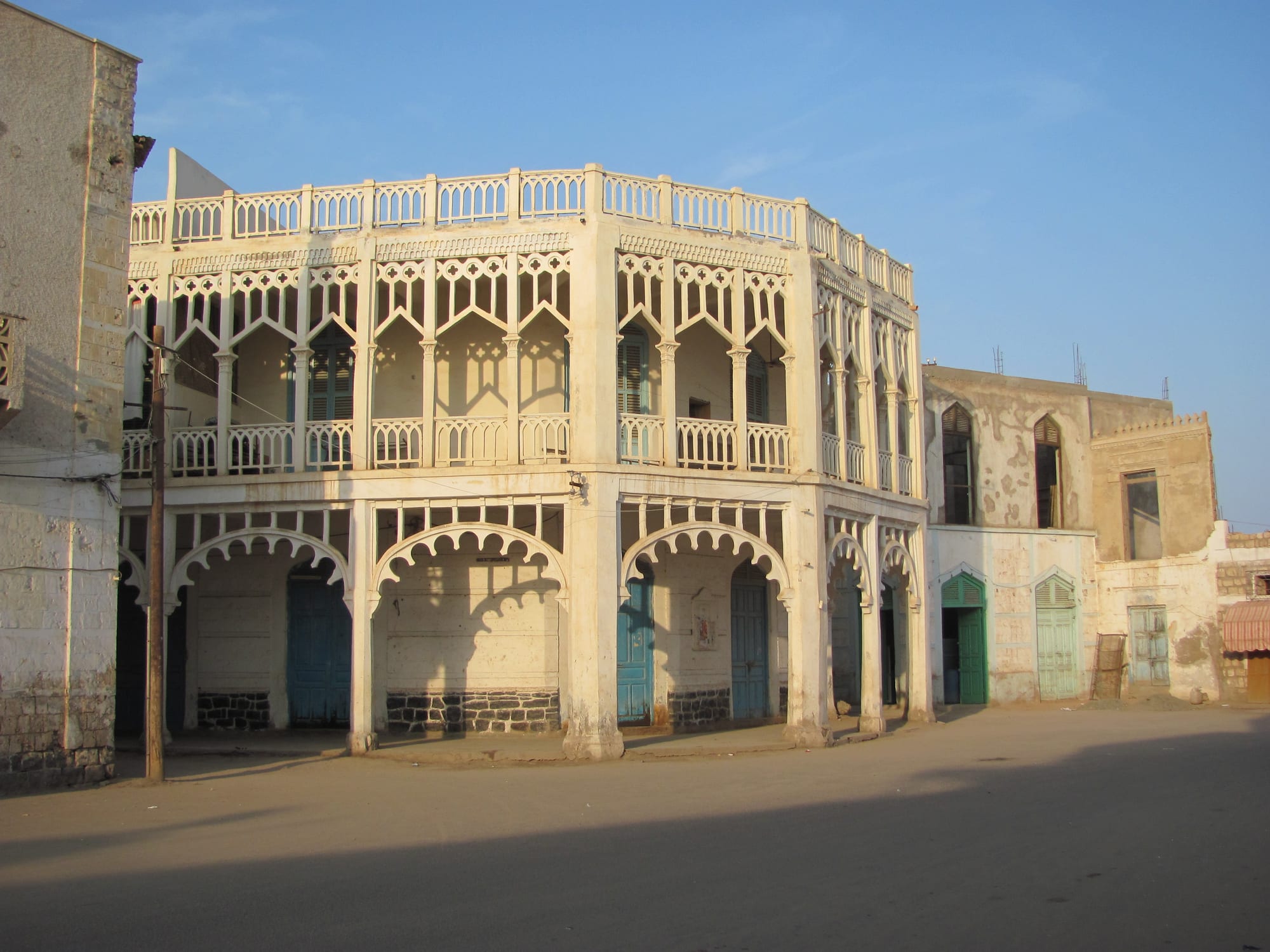
A two-storey coral-stone building with a first-floor arcade of pointed arches and a carved balustrade on an empty sandy street

Eritrea

Massawa

An arcaded coral-block building in the historic centre of Massawa. (Reinhard Dietrich / Wikimedia Commons · CC0)

Eritrea's main Red Sea port, built on two low islands joined by causeways to the mainland, with an old town of coral-block houses, arcaded balconies and Ottoman and Egyptian arches. Long a gateway between the highlands and the sea, it was heavily damaged in the independence war and only partly rebuilt. This page is written to explain the town, not to encourage travel.

Neighbourhoods

  • Massawa Island
    • First-time visitors
    • Historic district
    • Architecture

    The old town, on the island of Basé, with coral-block houses, balconies, arcades and pointed arches, along with mosques, the old market and buildings still showing war damage. Everything historic is within a few streets.

    Open in Maps
  • Taulud Island
    • Sea views
    • Quiet and residential

    The island between the old town and the mainland, reached by causeway, with the Imperial Palace, hotels and the tank memorial of War Memory Square by the causeway to the mainland.

    Open in Maps
  • The mainland town
    • Local life
    • Markets
    • Transport links

    Where most people now live and work, spreading inland from the causeway around the market, the bus station and the roads to Asmara and the salt flats. It is plainer than the islands and busier in daily life.

    Open in Maps

Things to do

The old town

  • The coral-block old townneighborhood

    Streets of houses built from blocks of Red Sea coral, with shuttered windows and arcaded upper floors in an Ottoman, Egyptian and Arabian manner, some restored and some still ruined.

    Open in Maps
  • Sheikh Hanafi Mosquelandmark

    The fifteenth-century mosque of the old town, one of its oldest buildings, standing among the lanes and coral houses of the island.

    Open in Maps
  • The Imperial Palacelandmark

    The palace on Taulud Island, built in 1872–1874 for the Egyptian governor Werner Munzinger and later Emperor Haile Selassie's winter palace.

    Open in Maps
  • The causewaysattraction

    The low causeways built under Egyptian rule in the 1870s to join the two islands to each other and to the mainland.

    Open in Maps

The sea

  • Sheikh Saeed Islandattraction

    A small island near the town, reached by the ferries that sail from the harbour.

    Open in Maps

Short trips from the town

  • Dahlak Archipelagoattraction

    A low, arid group of two larger and 124 smaller islands about 58 km east of the town, reached by ferry from the port, with coral reefs, clear water and a few historic sites.

    Open in Maps
  • Adulisattraction

    The ruins of the ancient port city of the kingdom of Aksum, about 40 km south of the town on the Gulf of Zula, first surveyed in 1840 and excavated in stages since 1906.

    Open in Maps
  • Asmaraneighborhood

    The highland capital, reached by a switchback road climbing more than 2,000 metres from the coast.

    Open in Maps
  • Eritrean Railwaytransit hub

    The narrow-gauge line built by Italy between the port and Asmara, rebuilt in the 1990s, with restored steam locomotives used for tourist charters.

    Open in Maps

Seasonal events

  • Independence DayMay

    The anniversary of independence in 1991, marked on 24 May across the country with parades and celebrations.

  • Eid al-Fitrvaries with the lunar calendar

    The festival ending Ramadan, the main celebration of the year in this largely Muslim port town.

Eat and drink

Long-standing places and food districts in Massawa. Hours, ratings and directions come from your maps app, always current.

Massawa classics

  • Grilled Red Sea fishrestaurant

    Fish from the Red Sea, grilled, fried or stewed and eaten with bread or rice, is the everyday food of the port.

    Open in Maps
  • Seafoodrestaurant

    Seafood appears on menus near the waterfront; Eritrean cooking uses more of it than Ethiopian, thanks to this coast.

    Open in Maps

Markets and cafes

  • The town marketmarket

    Fish, spices, vegetables brought down from the highlands and imported goods, traded in the early morning and again after the heat of the day.

    Open in Maps
  • Cafes on the waterfrontcafe

    Espresso in the Italian manner, tea and the three rounds of the coffee ceremony, drunk in the shade.

    Open in Maps

Experience Massawa

History

Massawa is an old port and has changed hands many times. Its islands gave a sheltered anchorage, and the trade of the highlands — ivory and hides among it — reached the Red Sea near here; the Aksumite port of Adulis lay about 40 km to the south, and Massawa seems to have emerged as a port between the eighth and tenth centuries as Adulis declined. Islam came early to this shore, and the town became a Muslim trading settlement, the link between the Red Sea coast and the Christian highlands.

The Ottomans took Massawa in 1557 and held it, directly or through local and Egyptian governors, until 1865, when it passed to Egypt. The Egyptian governor Werner Munzinger rebuilt much of the port from 1872, adding the causeways and the palace on Taulud, and the old town kept its houses of coral, shuttered windows, arcades and mosques among narrow lanes. Italy seized the port in 1885 and made Massawa the capital of its new colony of Eritrea until the administration moved up to Asmara in 1897; the railway begun here in 1887 reached Asmara in 1911.

The twentieth century was hard on the town. Its port served Italian, British and later Ethiopian interests, and during the war of independence it was fought over directly: the Eritrean offensive known as Operation Fenkil took the town in February 1990, and the shelling and aerial bombardment that followed destroyed most of the city, including numerous historic Islamic buildings. Restoration has been partial, and damaged buildings still stand between the restored ones.

Culture & Customs

Massawa is a coastal town rather than a highland one, and that shapes everything. Its population is largely Muslim, and the links across the Red Sea to Arabia are as old as the links inland: the Dahlak islands offshore were an Islamic foothold from the eighth century, and the town long answered to rulers on the far side of the sea. Tigrinya, Arabic and English are the country's working languages.

The mosque sets the week, Ramadan reshapes the year, and the two Eids are the great celebrations, with the town at its busiest after dark. Hospitality follows the same patterns as in the rest of the country — the coffee ceremony, brewed three times and served with incense — and tea is offered to anyone who declines coffee.

The Italian period left espresso, pasta and many buildings, designed with a conscious effort to keep the old town's scale and its narrow, irregular lanes, and the Ottoman and Egyptian centuries left the older buildings. Life is lived at night: in the hottest months the streets are empty by day and fill after sunset, when families walk on the causeway and the cafés put chairs on the pavement. The independence war is remembered in War Memory Square on Taulud, where three tanks stand by the entrance to the causeway as a memorial to the 1990 battle.

Daily Life

Massawa is a small town for a national port, with most residents living on the mainland rather than on the historic islands. Its population grew to about 60,000 by the mid-1980s, fell sharply in the war, and has since been reduced again by decades of sanctions and isolation, which have shrunk trade and led many people to leave.

The port is the economy: cargo for the highlands, exports of copper and zinc from the Bisha mine, imports of oil and consumer goods, and fishing boats, alongside government employment, national service postings, small trade and the salt and cement works nearby, which run at far below full capacity. Since September 2026 a crisis at the Bab al-Mandab strait has disrupted shipping through the southern Red Sea, and fuel, power and imported goods are frequently short.

The heat organises the day more strictly than in any other Eritrean town. Boats go out and the market trades at first light; by mid-morning shutters come down and the streets empty for several hours; work resumes late in the afternoon and the social evening runs long, with tea stalls, food stands and the waterfront in use until late. Air conditioning is a luxury and most people rely on shade, courtyards and the sea breeze.

Food

Massawa eats from the sea. Red Sea fish is grilled, fried in pieces or cooked in a spicy stew, and eaten with bread, rice or injera, and seafood appears on the tables near the harbour; Eritrean cooking as a whole uses more seafood than Ethiopian, thanks to this coast. Fish is also one of the meats that go into the spicy stews served with injera across the country.

The highland repertoire is here too: injera with zigni, alicha and shiro, eaten from a shared platter, along with the Italian legacy of pasta and bread. Berbere, the national spice mix, accompanies almost every dish, and trade across the water has long brought goods and tastes from Arabia.

Vegetables and grain come down from the highlands, and the market also sells spices and imported goods. Tea is offered to anyone who declines coffee, espresso survives from the Italian period, and the coffee ceremony, brewed three times and served with incense and popcorn, is performed in homes. Sowa, the home-brewed barley beer, and mies, a honey wine, are little drunk in a largely Muslim town, as Muslim Eritreans abstain from alcohol.

Planning tools

Budget

Massawa is inexpensive but has little choice. A handful of hotels on Taulud and the mainland, simple eating houses and cheap fish keep costs low; boats to the islands and a hired car with a driver are the real expenses, and everything is paid in cash.

Daily Budget Midrange
USD 70–130 (better hotel, hired car with driver, guide)
Daily Budget Shoestring
USD 30–55 (basic hotel, local eateries, shared transport)

Ferries and boats to the Dahlak islands leave from the port; the travel permit for the coast is obtained in Asmara first.

Best Time to Visit

November to February, the only comfortable months on this coast, when the heat eases below the annual mean of nearly 30°C. From April to September the heat is extreme and humid, regularly above 40°C, and outdoor activity in the middle of the day becomes dangerous.

Suggested Number of Days

The old town is small and takes half a day to a day at a slow pace. Two or three days allow for the coast and a boat trip offshore, which depend on weather, fuel and the permits already arranged in the capital.

First Visit
1 day
With Surroundings
2–3 days

Transportation

The islands and the old town are walked. Shared minibuses and taxis run between the mainland town, the causeways and the beaches, and boats leave the harbour for the offshore islands. Buses and shared cars climb to Asmara from the mainland terminal, and a hired car with a driver is the flexible option — with a permit, which all intercity travel requires.

Fuel shortages can cancel boat trips and road journeys at short notice, so allow spare time and confirm arrangements locally.

Airport & Station Connections

Most people arrive from Asmara by a switchback road that drops more than 2,000 metres from the highlands to the coast in a few hours; the Italian-built narrow-gauge railway follows the same descent for occasional excursions. There is an airport near the town with limited use, so the road is the practical route, and a travel permit is needed for it.

Walkability

The old town on Massawa Island is flat, compact and best seen on foot, and the causeway walk to Taulud gives the view back over the harbour. Heat rather than distance sets the limits: between about ten in the morning and late afternoon the streets empty and walking is uncomfortable. There is very little shade.

Safety

Everyday crime is very low and the town is quiet, but the practical risks are heat, dehydration and limited medical care, with serious cases taken to Asmara. The port is a restricted area, photography is tightly controlled, and travel here requires a permit arranged in the capital. Since September 2026 an escalation of the war in Yemen has caused a crisis at the Bab al-Mandab strait, at the southern end of the Red Sea, and shipping through the region has been disrupted.

Everyday crime is very low and visitors are rarely troubled by it, but Eritrea is a militarised one-party state with indefinite national service, no independent media, and severe restrictions on movement, photography, and speech. Never photograph the port, military sites, bridges, the airport or people in uniform, carry the travel permit at all times, and drink far more water than feels necessary. Check current official travel advice before travelling.

Climate

One of the hottest marine coastal areas in the world, with a mean temperature of nearly 30°C: hot and humid all year, with very little rain (about 185 mm a year), sea breezes in the evening and a short cooler season in the northern winter.

Summer
April to September is extreme, often above 40°C with high humidity and hot wind off the land
Winter
November to February is the bearable season, cooler than the annual mean of nearly 30°C but with warm nights

Local Customs

A largely Muslim town, more conservative than the capital. Modest dress is expected in the streets and the market, and swimwear belongs at the beach only. Shoes come off at the door of a mosque, and visitors enter only with permission. Greetings are unhurried, the right hand is used for eating and giving, and the coffee ceremony is the standard gesture of welcome.

Do not photograph the port, the causeway defences, military sites or anyone in uniform, and ask before photographing people or houses. Avoid political conversation.

Common Payment Methods

The currency is the Eritrean nakfa at a fixed official rate, and cash is the only practical means of payment; cards are unusable and ATMs do not serve foreign cards. Money is changed in Asmara before coming down, and nakfa notes may not be taken out of the country.