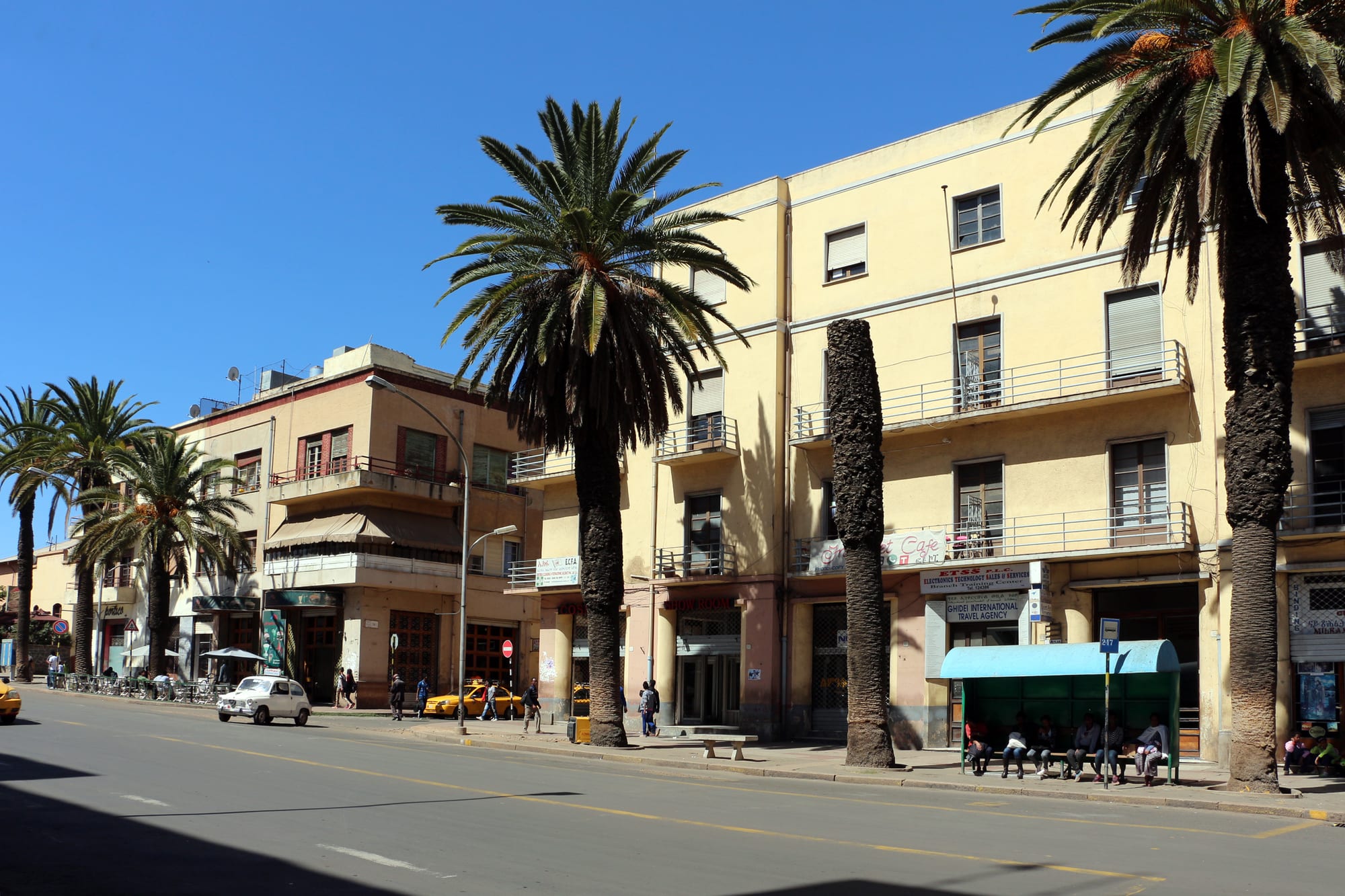
A wide palm-lined avenue of low pale 1930s buildings with balconies and arcades, under a deep blue sky

Eritrea

Asmara

Harnet Avenue in central Asmara, lined with palms and Italian-built 1930s buildings. (Sailko / Wikimedia Commons · CC BY 3.0)

Eritrea's capital, on a highland plateau at about 2,325 metres, built up by Italy from 1897 as the seat of its colony and filled in the 1930s with modernist cinemas, villas and petrol stations. The centre, listed by UNESCO in 2017, is unusually intact, and life there runs on cafés, walks and coffee. This page is written to explain the city, not to encourage travel.

Neighbourhoods

  • The city centre and Harnet Avenue
    • First-time visitors
    • Architecture
    • Cafes

    The core of the modernist city, built around a broad palm-lined avenue of arcades, cinemas, bars and government offices. Almost everything a visitor wants to see is within a few blocks, and the evening walk along the avenue is the city's main social habit.

    Open in Maps
  • The market zone
    • Markets
    • Local life

    The trading quarter laid out in the colonial period as the mixed zone around the market, with market halls, grain and spice traders and workshops. It is noisy, busy and the working heart of the city.

    Open in Maps
  • The old indigenous quarters
    • Historic district
    • Local life

    The districts that grew from the indigenous quarter of the colonial period, when the centre was reserved for Europeans, with dense low housing on narrow lanes and a strong neighbourhood life.

    Open in Maps
  • The villa quarter
    • Quiet and residential
    • Villas

    The leafier residential area laid out for Europeans south of Harnet Avenue in the colonial period, with villas and garden walls along quiet streets.

    Open in Maps

Things to do

Modernist landmarks

  • Fiat Tagliero Buildinglandmark

    A 1938 petrol station by the engineer Giuseppe Pettazzi, shaped like an aeroplane, with a central tower and a pair of 15-metre cantilevered concrete wings — the emblem of Asmara's futurist architecture.

    Open in Maps
  • Cinema Imperolandmark

    An Art Deco cinema built in 1937 and named for Mussolini's proclaimed empire, its façade lit by 45 round lights and vertical lettering, with most of its original equipment and seats.

    Open in Maps
  • Harnet Avenueattraction

    The palm-lined main street, laid out as the Corso del Re and later renamed Viale Mussolini, lined with arcades, bars and the Catholic cathedral.

    Open in Maps

Churches, mosques and museums

  • Church of Our Lady of the Rosarylandmark

    The Lombard Romanesque Catholic church of 1923, commonly called the cathedral, with a 52-metre freestanding bell tower completed in 1925 on the main avenue.

    Open in Maps
  • Enda Mariam Cathedrallandmark

    The Eritrean Orthodox Tewahedo cathedral, given its present rationalist form in 1938, its walls and twin towers built in alternating layers of brick and stone that echo Aksumite architecture.

    Open in Maps
  • Al Khulafa Al Rashiudin Mosquelandmark

    The Great Mosque, designed by Guido Ferrazza and built in the 1930s in a blend of Rationalist, Neoclassical and Islamic styles, its fluted minaret visible across the city.

    Open in Maps
  • National Museum of Eritreamuseum

    The national museum, founded in 1992, which keeps the country's historical artefacts, exhibits cultural collections from local sites and carries out archaeological excavations.

    Open in Maps
  • The tank graveyardattraction

    A scrapyard on the eastern edge of the city where tanks, vehicles and other material left over from the war were gathered from all over the country after independence.

    Open in Maps

Short trips from the city

  • Debre Bizenlandmark

    An Orthodox monastery founded in the 1350s on the summit of a 2,460-metre mountain near the town of Nefasit.

    Open in Maps
  • Kerenneighborhood

    The country's second city, at about 1,590 metres north-west of the capital, known for its market and its wartime history, including a key battle in 1941.

    Open in Maps
  • Eritrean Railwaytransit hub

    The narrow-gauge Italian-built line that drops from Asmara to the Red Sea at Massawa, rebuilt in the 1990s, with restored 1930s steam locomotives used for tourist charters.

    Open in Maps

Seasonal events

  • Independence DayMay

    The anniversary of the day in 1991 when independence fighters entered Asmara, marked on 24 May with a week of parades, concerts, carnivals and cycling races.

  • MeskelSeptember

    The Orthodox feast of the Finding of the True Cross, celebrated with bonfires, processions and church services.

  • Eid al-Fitrvaries with the lunar calendar

    The festival ending Ramadan, observed by the city's Muslim community with prayers at the main mosque and family gatherings.

Eat and drink

Long-standing places and food districts in Asmara. Hours, ratings and directions come from your maps app, always current.

Asmara classics

  • Injera with zigni and shirorestaurant

    The national plate — teff flatbread shared from a large tray and topped with stews — spicy zigni beef, alicha made without berbere, and shiro of ground chickpeas.

    Open in Maps
  • Pastarestaurant

    A lasting Italian legacy, more common here than anywhere in the region, sometimes with sauces spiced with berbere.

    Open in Maps

Cafes and bars

  • Cafes of Harnet Avenuecafe

    Espresso and cappuccino, served in practically every bar and coffee shop in the capital, the centre of the city's daily routine.

    Open in Maps
  • Coffee ceremonycafe

    Coffee brewed three times and served in three rounds, often with incense and popcorn, offered to guests at home and at festivities.

    Open in Maps

Markets

  • The central marketmarket

    Spices, berbere, teff, vegetables, honey and butter traded in the market halls and the streets around them.

    Open in Maps

Experience Asmara

History

According to local tradition, Asmara was founded when four highland villages on the plateau united to live in peace, and it existed as a settlement for over half a millennium on the trade route to Massawa. In the 1870s Ethiopia's emperor Yohannes IV made his governor Ras Alula ruler of the region, and Alula made Asmara the provincial capital; Italy took it in 1889 as it assembled the colony of Eritrea.

In 1897 the Italian governor moved the colonial capital here from Massawa, preferring the cool, dry air of the plateau to the heat of the coast. A railway was built up the escarpment, reaching the city in 1911, and a grid of avenues, villas and offices was laid out. The great transformation came in the 1930s, when Italy poured money and people into Eritrea as the base for its invasion of Ethiopia: cinemas, bars, petrol stations, apartment blocks and factories went up in rationalist, futurist and art deco styles, built by Italian architects for a population that by 1939 was more than half Italian. Eritreans were largely confined to separate quarters under colonial segregation.

British administration followed Italy's defeat, then federation with and annexation by Ethiopia. The thirty-year war of independence ended in 1991 when Eritrean fighters entered Asmara, and it became the capital of the independent state in 1993. Poverty, war and isolation meant little was demolished or rebuilt, which is why the 1930s city survives so completely; in 2017 UNESCO inscribed the centre as a World Heritage Site.

Culture & Customs

Asmara is a highland city and predominantly Tigrinya-speaking, with a long-settled Muslim population as well as Orthodox, Catholic and Protestant Christians; the Orthodox cathedral, the Catholic cathedral and the main mosque stand within a few streets of one another, which residents mention with pride.

The dominant social ritual is the coffee ceremony — green beans roasted over charcoal, ground, brewed three times and served with incense and popcorn — and its urban cousin, the macchiato drunk standing at a bar counter. The Italian legacy is not only architectural: coffee, pastries, pasta, cycling and the evening stroll along Harnet Avenue remain part of daily life.

Public life is quiet and orderly. There is no independent press, national service shapes the lives of most young adults, and political conversation in public is avoided; a large diaspora keeps in close contact with the city and sustains many households. Music and dance, above all at weddings, are the liveliest cultural forms, and cinema-going, football and long café conversations fill the rest. Manners are courteous and reserved, and visitors are treated with a formal, watchful hospitality.

Daily Life

Asmara is much the largest city in Eritrea; no recent census exists, so population figures are only estimates. It sits at about 2,325 metres, which gives it a climate unlike anywhere else in the country.

The economy is small and state-dominated. Government and national-service postings, small trade, workshops, transport and construction provide most work, and remittances from relatives abroad support a large share of households. Electricity, fuel, water and imported goods are frequently in short supply, and queues are a routine part of the week. Private business exists but within narrow limits, and many young people are absent, either in national service or abroad.

The day begins early with coffee and the walk to work or school. Offices and shops break in the middle of the day, and the late afternoon brings the passeggiata: families and friends walking the main avenue, filling café terraces and bars until the streets empty fairly early in the evening. Bicycles are common, cycling is a national enthusiasm — the Tour of Eritrea often starts here — and traffic remains light enough that the city is unusually quiet for a capital.

Food

Asmara eats injera, the wide sourdough pancake made from teff, laid on a shared platter and topped with stews: zigni, beef simmered in berbere chilli spice; alicha, cooked without berbere and milder; shiro, a purée of ground chickpeas; lentils and vegetables. Hilbet, a cream of fenugreek, lentils and fava beans, is vegan, and berbere accompanies almost everything.

The Italian inheritance is genuine rather than nostalgic. Pasta is everyday food, sometimes with sauces spiced with berbere, and panettone is served with tea or at the coffee ceremony. Espresso and cappuccino are served in practically every bar and coffee shop in the capital.

The traditional drinks are sowa, a bitter fermented barley beer brewed at home, and mies, a honey wine, drunk by Christians, while tea is offered to anyone who declines coffee and homes keep the three rounds of the coffee ceremony, served with incense and popcorn. The markets supply berbere, cumin, honey and clarified butter.

Planning tools

Budget

Asmara is inexpensive by the numbers but hard to travel in. Hotels and meals cost little, yet there is almost no tourism industry, permits are needed for travel outside the city, and fuel and hard currency are scarce. It is a cash economy in nakfa, which may not be taken out of the country.

Daily Budget Midrange
USD 70–130 (better Asmara hotel, hired car with driver, guide)
Daily Budget Shoestring
USD 30–55 (basic hotel, local eateries, shared transport within the city)

Change only what is needed; exporting nakfa is prohibited and there is little to spend it on.

Best Time to Visit

October to March, when the highland air is dry, clear and mild. The rains fall mainly in July and August, and the cold nights of December and January come as a surprise at this altitude. The coast is bearable in the same winter months.

Suggested Number of Days

Two or three days suit the compact centre, which rewards slow walking. Five to seven allow for the highlands and the coast, where the permit process and the pace of transport, rather than distance, decide how much fits in.

First Visit
2–3 days
With Surroundings
5–7 days

Transportation

The centre is walked. City buses and shared minibuses run cheaply to the outer districts, and shared taxis also run. Buses and shared cars leave for other towns, and a hired car with a driver is the practical way to go further — with the permit that all intercity travel requires.

Travel permits for destinations outside the capital are arranged in Asmara and must be carried on the road; fuel shortages can disrupt plans.

Airport & Station Connections

Asmara International Airport, on the edge of the city, has a handful of regional connections; arrival by air is how nearly all visitors come. The road down the escarpment to Massawa on the Red Sea drops more than 2,000 metres, and the old narrow-gauge railway, 118 km long, follows the same descent for tourist charters.

Walkability

One of the most walkable capitals in Africa. The centre is flat, laid out on a grid, shaded by palms and small enough to cross in twenty minutes, and the evening promenade along the main avenue is a civic habit. The altitude makes walking harder than it looks at first, and the air is thin and dry.

Safety

Everyday crime is very low and visitors are rarely troubled by it. The constraints here are political rather than criminal: movement outside the city requires permits, photography is restricted, and consular assistance is minimal. Traffic is light and the streets are calm at night by the standards of most capitals.

Everyday crime is very low and visitors are rarely troubled by it, but Eritrea is a militarised one-party state with indefinite national service, no independent media, and severe restrictions on movement, photography, and speech. Never photograph military sites, government buildings, bridges, the airport or people in uniform, carry permits for any travel outside the capital, and avoid political conversation. Check current official travel advice before travelling.

Climate

A mild highland climate at over 2,300 metres: warm days, cool to cold nights, low humidity and strong sun all year. Rain falls mainly in a summer season from about June to September, and the rest of the year is dry.

Summer
June to September is the rainy season, wettest in July and August, with mild highland temperatures of about 15–25°C
Winter
December to February is dry and sunny, mild by day at about 15–25°C and cold at night

Local Customs

Manners are formal and unhurried. Greetings involve a handshake and enquiries after family and health; a slight bow of the head shows respect to elders. Dress is conservative, and shoulders and knees are covered in churches and mosques, where shoes come off. The coffee ceremony is an invitation that is not lightly refused, and eating is done with the right hand from a shared plate of injera.

Do not photograph military sites, government buildings, the airport, bridges or anyone in uniform, and ask before photographing people. Avoid political conversation, including with people who raise it themselves.

Common Payment Methods

The currency is the Eritrean nakfa, at a fixed official rate to the US dollar, and this is a cash economy: cards are effectively unusable and ATMs do not serve foreign cards. US dollars are brought in and changed at the official rate on arrival, and nakfa notes may not be taken out of the country.