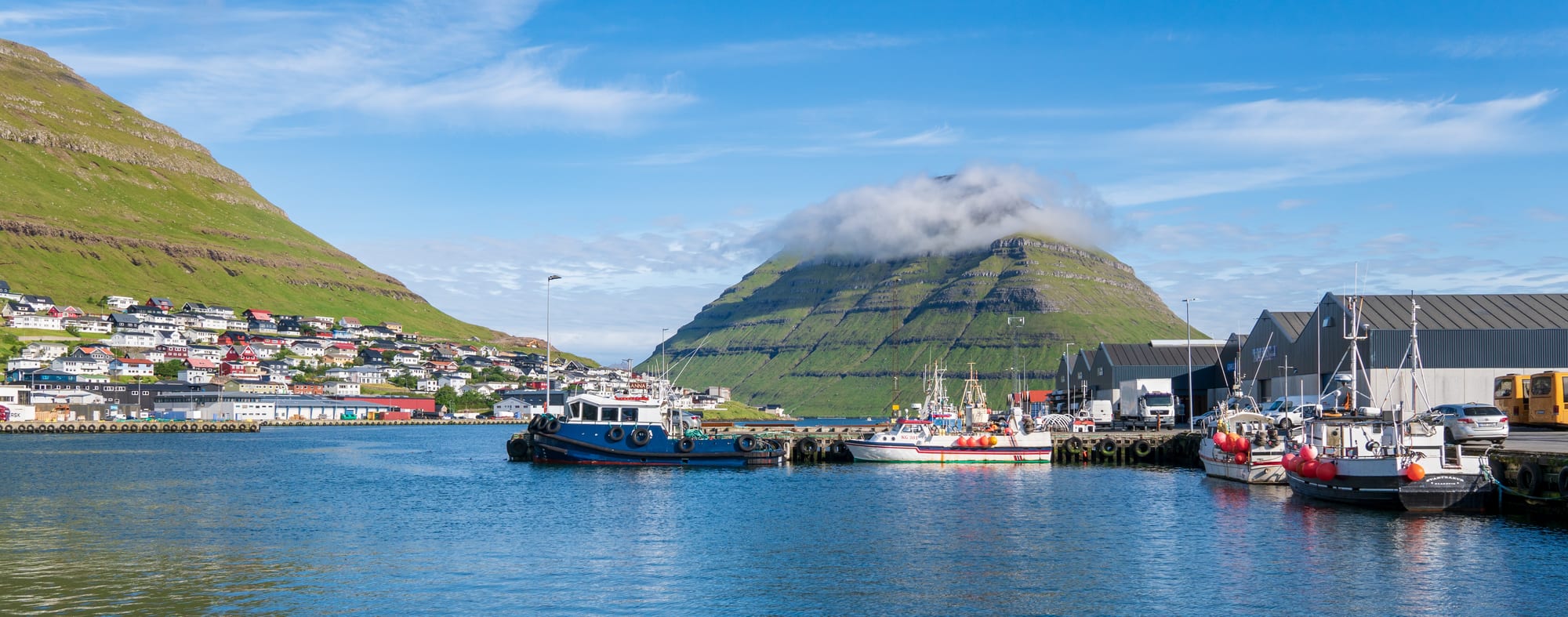
Fishing boats moored in a calm blue harbour, houses on a green slope to the left and a cloud-capped mountain across the water

Faroe Islands

Klaksvík

Fishing boats in the harbour of Klaksvík, on the island of Borðoy. (Ekrem Canli / Wikimedia Commons · CC BY-SA 4.0)

The second town of the Faroe Islands, wrapped around a deep natural harbour on Borðoy in the Northern Isles. Four fishing villages merged to form it in 1938, and a modern fishing fleet made it the commercial centre of the north. Since an undersea tunnel opened in 2006 it has been linked by road to the rest of the islands and serves as the gateway to Kalsoy and the outer isles.

Neighbourhoods

  • The harbour and town centre
    • First-time visitors
    • Close to public transport

    The streets around the head of the harbour hold the bus station, shops, cafés with views over the water, the fishing quays and the ferry berth for Kalsoy. Most of the shops lie to the south and east of the harbour.

    Open in Maps
  • The old village districts
    • Quiet and residential
    • Views

    Houses climb the slopes on both sides of the inlet in what were once the separate villages of Vágur, Myrkjanoyri, Gerðar and Uppsalir. Walking from the north end of one side of the harbour to the other is about 3 km.

    Open in Maps

Things to do

In town

  • Christianskirkjanlandmark

    A church consecrated in 1963 to the Danish architect Peter Koch's design, with an open roof modelled on Viking halls and Faroese smoke rooms, dedicated to sailors lost in the Second World War.

    Open in Maps
  • Viðarlundin úti í Grøvpark

    A small park beside the bay, laid out like a Scandinavian rural landscape — unusual in the Faroes — with views of the town and harbour.

    Open in Maps
  • Boat tours from the harbourattraction

    Tours of the fjords and sounds of the Northern Isles leave from the harbour between May and the start of October.

    Open in Maps

Walks and viewpoints

  • Klakkurtrail

    The 413-metre hill above the town, reached on a walk of about three hours there and back from the centre, with views over Klaksvík and the islands of Kunoy, Kalsoy and Eysturoy.

    Open in Maps

Short trips from the town

  • Kalsoyattraction

    The long, narrow 'man island' to the west, reached by ferry from Klaksvík to Syðradalur; its northern tip stood in for a location in the James Bond film No Time to Die.

    Open in Maps
  • Kunoyattraction

    The 'woman island' just west of Borðoy, linked to it by a causeway.

    Open in Maps
  • Viðareiðiattraction

    The northernmost settlement in the Faroe Islands, on the island of Viðoy, reached by bus from Klaksvík.

    Open in Maps

Seasonal events

  • SummarfestivalurinAugust

    The Summer Festival, a music festival held in Klaksvík every summer since 2004.

Eat and drink

Long-standing places and food districts in Klaksvík. Hours, ratings and directions come from your maps app, always current.

Klaksvík classics

  • Harbour-side caféscafe

    Cafés in the town look out over the harbour and the fjord.

    Open in Maps
  • Fish by the harbourneighborhood

    In a town built on fishing, fish and chips are served from a stand in the car park next to the harbour.

    Open in Maps

Experience Klaksvík

History

People have lived at Klaksvík since early times — the first settlement dates back to the Viking age — but for centuries the head of the harbour held only scattered farms and hamlets; in 1901 they had 545 people between them. The sheltered natural harbour on Borðoy gave a safe base for fishing and trade. In time the settlements grew into four villages, Vágur, Myrkjanoyri, Gerðar and Uppsalir, which were merged into the town of Klaksvík in 1938.

Fishing made the town the commercial and cultural centre of the Northern Isles, with an important harbour and a modern fleet. The brewery Föroya Bjór, a family firm founded in 1888, also grew up here. In 1963 the town consecrated Christianskirkjan, a church in a Norse style dedicated to the memory of sailors who lost their lives in the Second World War.

For most of its history Klaksvík was an isolated place, reached only by sea. That changed in April 2006, when the Norðoyatunnilin, an undersea tunnel under the Leirvíksfjørður, linked Borðoy by road with Eysturoy and so with the rest of the islands. The town became one of the key ports of the Faroes, and a new industrial park was laid out by the tunnel entrance.

Culture & Customs

Christianskirkjan is the town's best-known building and one of the most notable modern buildings in the islands. Designed by the Danish architect Peter Koch, it uses the open roof construction of the Viking halls, which survived in Faroese smoke-room kitchens and village churches. Its name honours the Danish king Christian X.

Every summer the town hosts Summarfestivalurin, the Summer Festival, a music festival founded in 2004 with plenty of musical events, usually held in August.

Football carries the town's name far beyond the islands. KÍ, the local club founded in 1904, is one of the most successful in the Faroes, and in August 2023 it became the first Faroese side to reach the group stage of a European competition after beating BK Häcken in the Champions League qualifying rounds. The volleyball club Mjølnir became the first Faroese volleyball team to compete in a European Cup the same year. As across the islands, Sunday is quiet and church and family life matter.

Daily Life

About 5,100 people lived in Klaksvík at the start of 2025. The town has the services of a much larger place for the whole north: supermarkets and shops, a bus station, banks, a hospital, a pharmacy and a public swimming pool.

The economy rests on the sea. The harbour is home to a fishing industry and a modern fleet, and the tunnel has turned the town into one of the key ports of the islands, with industry gathering by the tunnel entrance. Föroya Bjór brews beer and soft drinks here, and the town is the hub for the Northern Isles, with ferries to Kalsoy and helicopters to Svínoy and Fugloy.

Life is lived around the harbour and on the steep slopes on either side of it. A frequent bus connects the town with Tórshavn, and since 2014 a town bus has linked the outlying districts with the centre. Most shops serve local people rather than visitors.

Food

Klaksvík eats as the rest of the Faroes does, from a tradition built on lamb and fish and on old methods of preservation. Skerpikjøt, well-aged, wind-dried mutton, is the most popular treat, dried in a slatted shed, the hjallur, beside many homes; ræst kjøt is semi-dried mutton and ræstur fiskur matured fish. Tvøst og spik, pilot-whale meat and blubber, comes from the grindadráp, the traditional drive hunt of pilot whales, which is defended locally as essential to Faroese culture and criticised abroad.

Fresh fish from the North Atlantic is eaten all year, which suits a town whose harbour is full of fishing boats, and there is fish and chips by the quay. Popular tastes have moved closer to the European norm in recent decades, with more vegetables on the table.

The town's own contribution is beer. Föroya Bjór, founded in Klaksvík in 1888 and one of the oldest companies in the islands, has been the only Faroese producer of beer and soft drinks since 2007, and has exported to Iceland since 2009. Since a change in the law in 2011, Faroese breweries may brew strong beer, though stronger drinks are still sold only through the government shops and licensed venues.

Planning tools

Budget

Klaksvík is as expensive as the rest of the Faroes. Tunnel tolls, the ferry to Kalsoy and boat tours are the main extras; walks such as Klakkur cost nothing, and supermarkets keep food costs down.

Daily Budget Midrange
USD 250–460 (hotel or guesthouse, restaurant meals, car hire, tunnel tolls, a boat trip)
Daily Budget Shoestring
USD 100–160 (guesthouse or B&B, supermarket food, buses)

The town is small enough to walk; save the budget for the ferry and a boat tour.

Best Time to Visit

May to the start of October is the season for boat tours from the harbour, and August brings the Summer Festival. The weather is unpredictable and rain is common all year; in nearby Tórshavn summer highs barely pass 13°C and winter days hover around 6°C.

Suggested Number of Days

The town itself needs about a day. Two or three days allow time for the neighbouring islands and boat trips, more if wind or fog hold up ferries and helicopters.

First Visit
1 day
With Surroundings
2–3 days

Transportation

The town is small enough to walk, and a town bus has linked the outlying districts with the centre since 2014; taxis are also available. Ferries sail to Syðradalur on Kalsoy several times a day on a fairly complex schedule, and helicopters serve the remote islands of Svínoy and Fugloy. Buses run to Fuglafjørður, Kunoy and Viðareiði.

Check the Kalsoy ferry timetable carefully before setting out, as departures vary through the week.

Airport & Station Connections

Since 2006 the Norðoyatunnilin, a 6.2 km undersea road tunnel from Leirvík on Eysturoy, has linked Klaksvík with the rest of the islands; it is tolled. A frequent bus service runs to Tórshavn, and the airport on Vágar is reached by road through the tunnels.

Walkability

Very walkable: the longest walk in town, from one side of the harbour to the other, is about 3 km. Streets climb steeply from the water, and the path up Klakkur starts above the town past the heliport.

Safety

The Faroes are extremely safe, with negligible crime. The real risks in Klaksvík are the weather and the terrain: wind, rain and fog on the hills and unfenced edges on walks such as Klakkur.

Turn back on hill walks if fog comes down, and keep well back from cliff edges. Check current official travel advice before travelling.

Climate

The same cool, wet and changeable oceanic climate as the rest of the Faroes; rain is common and the weather unpredictable. In nearby Tórshavn, winters are exceptionally mild for the latitude and summers cool.

Summer
cool — in nearby Tórshavn daily highs barely exceed 13°C in the warmest month
Winter
mild for the latitude — in nearby Tórshavn daytime temperatures usually hover around 6°C

Local Customs

Many smaller shops close early on Saturday and nearly everything is closed on Sunday. Stronger beer, wine and spirits are sold only in the government's Rúsdrekkasøla shops and licensed restaurants, cafés and bars. Christianskirkjan is a working church and a memorial.

Be quiet and respectful in the church and around services, and plan Sunday shopping ahead.

Common Payment Methods

The Faroese government prints its own króna banknotes, used alongside Danish coins. Credit card payment is available everywhere, and there are banks in town.