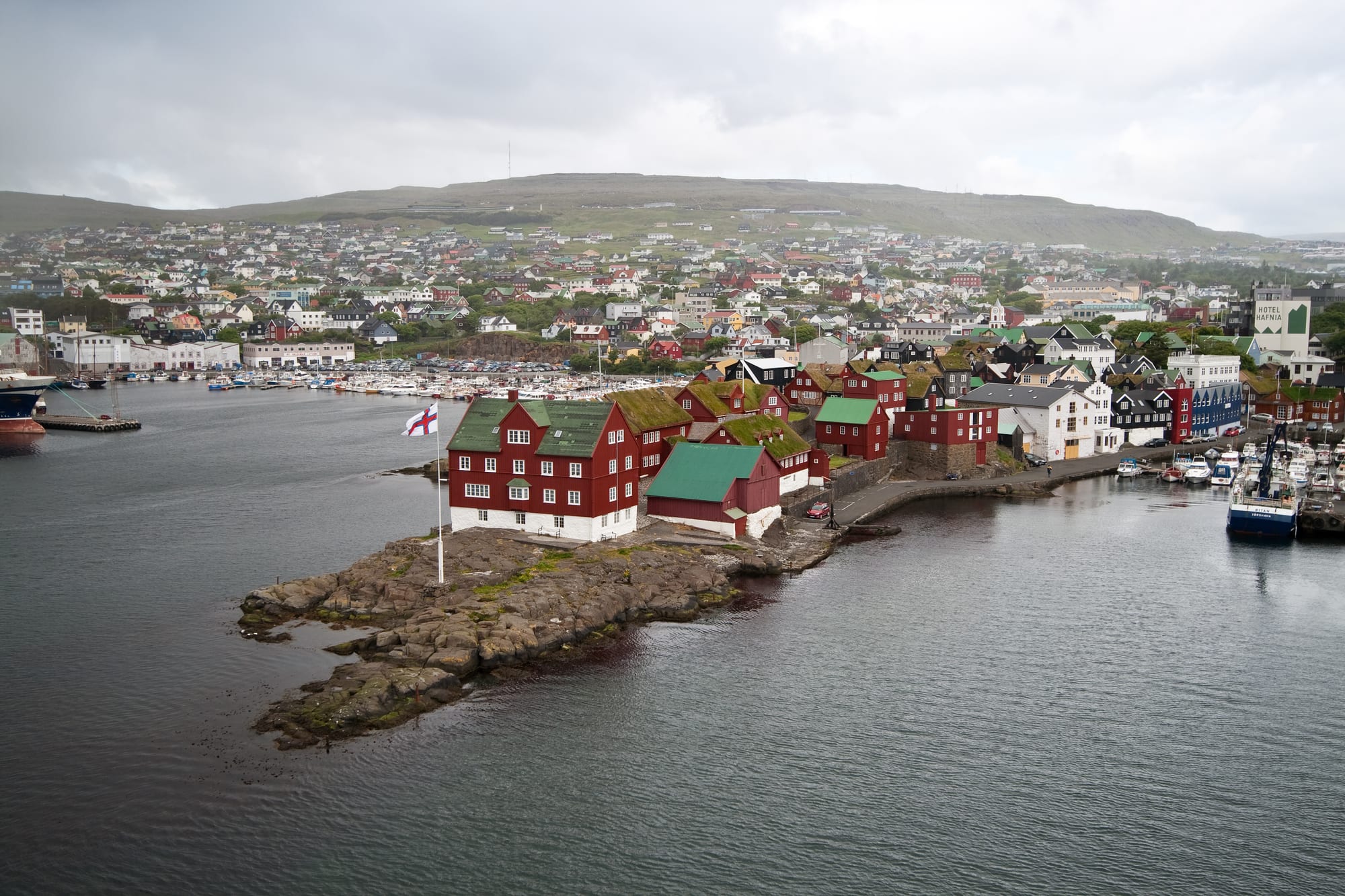
Red wooden buildings with green and turf roofs on a rocky point in the harbour, a Faroese flag flying, and the town climbing the hillside behind

Faroe Islands

Tórshavn

The Tinganes peninsula, seat of the Faroese government, between the two halves of Tórshavn's harbour. (Stig Nygaard / Wikimedia Commons · CC BY 2.0)

The capital of the Faroe Islands, on the east coast of Streymoy, where Norse settlers held their assembly on the rocky Tinganes peninsula. For centuries the only legal trading place of the islands, it grew from a few hundred people into a small modern capital after free trade arrived in 1856, and today holds the government, the university and most of the islands' cultural life.

Neighbourhoods

  • Tinganes and the old town
    • First-time visitors
    • Historic district

    The narrow rocky peninsula that splits the harbour in two, where the Norse assembly met and the government still sits. Its narrow alleys are lived in and worked in, not an open-air museum.

    Open in Maps
  • The harbour and town centre
    • Close to public transport
    • Restaurants and shops

    The streets around the western and eastern harbours, below the fort of Skansin, hold most of the shops, cafés and restaurants, and the ferry terminal. The cathedral stands at the landward end of Tinganes.

    Open in Maps
  • Hoyvík
    • Museums
    • Quiet and residential

    Once a separate village, now merged into the city as its northern suburb, with residential streets and the National Museum of the Faroe Islands.

    Open in Maps
  • Argir
    • Quiet and residential

    A former village to the south whose name probably comes from an Old Irish word for summer pasture. It has grown into the city and joined the municipality in 1997.

    Open in Maps

Things to do

Historic Tórshavn

  • Tinganesneighborhood

    The 'parliament point', where Norse settlers held their assembly in the Viking age and the Faroese government has its historic seat.

    Open in Maps
  • Tórshavn Cathedrallandmark

    A white-painted, slate-roofed church built in 1788 at the north end of Tinganes, the second-oldest surviving church in the islands.

    Open in Maps
  • Skansinlandmark

    The fort built in 1580 by Magnus Heinason to protect the town from raiders, expanded in 1780 and used by the British as a base in the Second World War; two British guns stand among older Danish cannon, beneath a lighthouse.

    Open in Maps

Museums and culture

  • Nordic Houseattraction

    The islands' main venue for Nordic and Faroese culture, opened in 1983, with a 2,000-square-metre turf roof designed to resemble a hill of elves.

    Open in Maps
  • Listasavn Føroyamuseum

    The National Gallery of the Faroe Islands, at the northern end of the town park, with a permanent collection of Faroese art, including works by Sámal Joensen-Mikines, and changing exhibitions.

    Open in Maps
  • National Museum of the Faroe Islandsmuseum

    The national museum, in Hoyvík, covering the history of the islands.

    Open in Maps
  • Museum of Natural Historymuseum

    The islands' natural history museum, with a small botanical garden of 150 Faroese plants.

    Open in Maps

Sport

  • Tórsvøllurattraction

    The national football stadium at Gundadalur, built in 1999 and home to the Faroe Islands national team.

    Open in Maps

Short trips from the city

  • Kirkjubøurattraction

    The southernmost village on Streymoy and the islands' most important historical site, with the ruins of the Magnus Cathedral from around 1300, Saint Olav's Church from the 12th century and an old farmhouse; some city buses run there.

    Open in Maps
  • Nólsoyattraction

    The island and village about 4 km east of the capital, across the water from the harbour and part of Tórshavn municipality since 2005.

    Open in Maps

Seasonal events

  • Ólavsøka28–29 July

    The biggest summer festival of the Faroes, regarded by most Faroese as the national holiday along with Flag Day, with a procession through the centre, the finals of the national rowing competition, chain dancing open to everyone, and the opening of the Løgting's session on Saint Olaf's Day.

  • Tórshavn Jazz Festivalannually

    A jazz festival held in the city every year since 1983.

Eat and drink

Long-standing places and food districts in Tórshavn. Hours, ratings and directions come from your maps app, always current.

Tórshavn classics

  • Faroese specialitiesrestaurant

    Restaurants in the capital serve the islands' traditional foods — skerpikjøt, wind-dried mutton; ræst kjøt and ræstur fiskur, matured mutton and fish; and fresh fish from the North Atlantic.

    Open in Maps

Food districts

  • The harbourneighborhood

    Several of the city's restaurants and cafés stand by the harbour and the sea, close to Tinganes.

    Open in Maps

Experience Tórshavn

History

According to tradition, the Norse settlers of the ninth century chose the flat rocks of Tinganes, the peninsula that splits the harbour into Eystaravág and Vestaravág, for their main assembly, the ting, meeting there each summer on what was then uninhabited ground. The Færeyinga saga records that "the place of the ting of the Faroese was on Streymoy, and there is the harbour that is called Tórshavn" — Thor's harbour. Through the Middle Ages the narrow peninsula was most of the town.

In 1271 the Norwegian Crown made Tórshavn the seat of a royal trade monopoly, and for centuries it was the only legal place for islanders to buy and sell goods. In 1580 the trader and naval hero Magnus Heinason built the fort of Skansin to guard against raiders; in 1584 the town had just 101 inhabitants. A gunpowder explosion set Tinganes ablaze in 1673, and in 1709 smallpox killed about 250 of the 300 people then living there. Niels Ryberg, who ran the trade in the later 18th century, was the first to see the profit fishing could bring; the town's cathedral dates from 1788. In 1808, during the Gunboat War, a British warship briefly captured Skansin, and a privateer then plundered the town.

Free trade arrived in 1856 and transformed the economy, with Tórshavn at its centre. It became a market town in 1909 and gained a modern harbour in 1927. In the Second World War, Skansin served as the Royal Navy's headquarters during the British occupation. From 1974 to 2005 surrounding villages, from Hoyvík and Argir to Kirkjubøur and the island of Nólsoy, were merged into the municipality.

Culture & Customs

As the capital, Tórshavn concentrates the islands' cultural institutions. The Nordic House, opened in 1983 after an architectural competition in which 158 architects took part, promotes Nordic and Faroese culture under a great turf roof braced against hurricane winds. Listasavn Føroya, the National Gallery, holds Faroese art from Sámal Joensen-Mikines onwards, and the painter Ingálvur av Reyni (1920–2005) is among the city's notable people.

The year's high point is Ólavsøka, on 28 and 29 July, the biggest summer festival in the islands, regarded by most Faroese as the national holiday. Sports people, city councillors, a brass band and riders on horseback parade to Vaglið in the centre, the national rowing finals are held in the harbour, the Løgting opens its new session on Saint Olaf's Day, and the chain dance, open to everyone, is usually held in the theatre, Sjónleikarhúsið. A jazz festival has been held every year since 1983.

Football is the city's main sport. Tórshavn has several clubs, including HB Tórshavn, B36 Tórshavn and Argja Bóltfelag, and the national team plays at Tórsvøllur in Gundadalur, the islands' largest sports centre. The old houses of Tinganes are still homes and government offices, and the alleys are not an open-air museum.

Daily Life

The city had 14,223 people in 2024, and the wider urban area, including the suburbs of Hoyvík and Argir, about 22,400. Tórshavn is the seat of the Faroese government, whose historic offices stand on Tinganes while other ministries are spread across the city, and of the University of the Faroe Islands, the national archives, the main hospital and colleges for teachers and navigators.

The economy of the city reflects its role as the capital: government and public services, the university and hospital, trade and shipping through a harbour that the ocean keeps free of ice, the Smyril Line ferry to Denmark and Iceland, and visitors. Fishing, which Niels Ryberg first tried to turn to profit in the 18th century and which later became the islands' most important economic activity, remains part of the harbour scene.

Daily life is shaped by the weather and the short distances. Free red buses link the residential districts on the hillsides with the centre, many shops close early on Saturday, and Sunday is quiet, with nearly everything shut. Football matches, concerts at the Nordic House and the summer festival season fill the calendar.

Food

Traditional Faroese food is built on lamb and fish and on old methods of preservation — brine, drying and maturing. The most popular treat is skerpikjøt, well-aged, wind-dried mutton, made in a slatted drying shed, the hjallur, that still stands beside many Faroese homes. Ræst kjøt is semi-dried mutton, and ræstur fiskur matured fish. Garnatálg is another old speciality, and the islands' seabirds, including puffins, were traditionally eaten too.

Tvøst og spik, pilot-whale meat and blubber, is a Faroese speciality that comes from the grindadráp, the traditional drive hunt of pilot whales; the practice is defended locally as essential to Faroese culture and draws international criticism. Fresh fish from the North Atlantic is eaten year-round, though in recent decades tastes have moved closer to the European norm and vegetables play a larger part.

Föroya Bjór, founded in Klaksvík in 1888 and one of the oldest companies in the islands, brews beer there, and since a change in the law in 2011 local breweries and distilleries may also make strong beer and spirits. Stronger drinks are sold only through the government's Rúsdrekkasøla shops and licensed venues, so an evening drink usually means a licensed restaurant or bar.

Planning tools

Budget

Tórshavn is expensive, on a par with the rest of the Nordic countries. Alcohol in particular is very expensive. City buses are free, many sights can be seen from the street, and supermarkets keep food costs down.

Daily Budget Midrange
USD 250–460 (hotel or guesthouse, restaurant meals, car hire, tunnel tolls, boat trips)
Daily Budget Shoestring
USD 100–160 (hostel or guesthouse, supermarket food, free city buses)

Use the free red city buses rather than taxis, and buy picnic food at the supermarkets.

Best Time to Visit

Summer brings the longest days and the busiest calendar, peaking with Ólavsøka on 28–29 July; even then daytime highs barely pass 13°C. Winter is dark, windy and wet but mild for the latitude, with days around 6°C.

Suggested Number of Days

The capital itself needs a day or two. Most visitors base themselves here and add several days for the rest of the islands, more when weather and ferry timetables are unsettled.

First Visit
1–2 days
With Surroundings
4–6 days

Transportation

Red city buses have been free since 2007 and reach most of the city, and some run as far as Kirkjubøur; services are thinner at weekends. Parking in the centre is free but time-limited, and a parking disc showing the arrival time must be set on the dashboard. Beyond the city a hire car is the easiest way to travel.

Respect the posted parking limits — fines are paid at the police station.

Airport & Station Connections

Vágar Airport, the only airport in the islands, is on Vágar, about 46 km west of Tórshavn. A bus links it with the city but is not well timed with arrivals; shared taxi shuttles can be booked ahead, and hire cars are available at the airport. The Smyril Line car ferry sails into the harbour from Hirtshals in Denmark and Seyðisfjörður in Iceland.

Walkability

The centre is compact and easy on foot: Tinganes, the cathedral, Skansin, the shops and the harbour are a few minutes apart, and the Nordic House and the art museum are a short walk inland. Streets climb steeply from the harbour, and wind and rain are frequent companions.

Safety

The Faroes are extremely safe, with negligible crime. In Tórshavn the practical hazards are the weather — strong wind, rain and slippery streets — and the cold sea along the harbour edge.

Dress for wind and rain at any time of year and keep well back from unfenced edges on coastal walks. Check current official travel advice before travelling.

Climate

A subpolar oceanic climate, strongly moderated by the ocean. Cloud and ice-free water keep winters exceptionally mild for the latitude, while summers are much cooler than in Scandinavia at similar latitudes.

Summer
cool — daily highs barely exceed 13°C in the warmest month
Winter
mild for the latitude — daytime temperatures usually around 6°C, average lows above 0°C, though frost can come in any month outside summer

Local Customs

Many smaller shops close early on Saturday, and nearly everything is closed on Sunday. Stronger beer, wine and spirits are sold only in the government monopoly stores, Rúsdrekkasøla, and in licensed restaurants, cafés and bars. The houses on Tinganes are homes and offices, not an open-air museum.

Walk quietly through the Tinganes alleys and respect private homes; plan Sunday meals and shopping ahead.

Common Payment Methods

The Faroese government prints its own króna banknotes, used alongside Danish coins. Credit card payment is available everywhere.