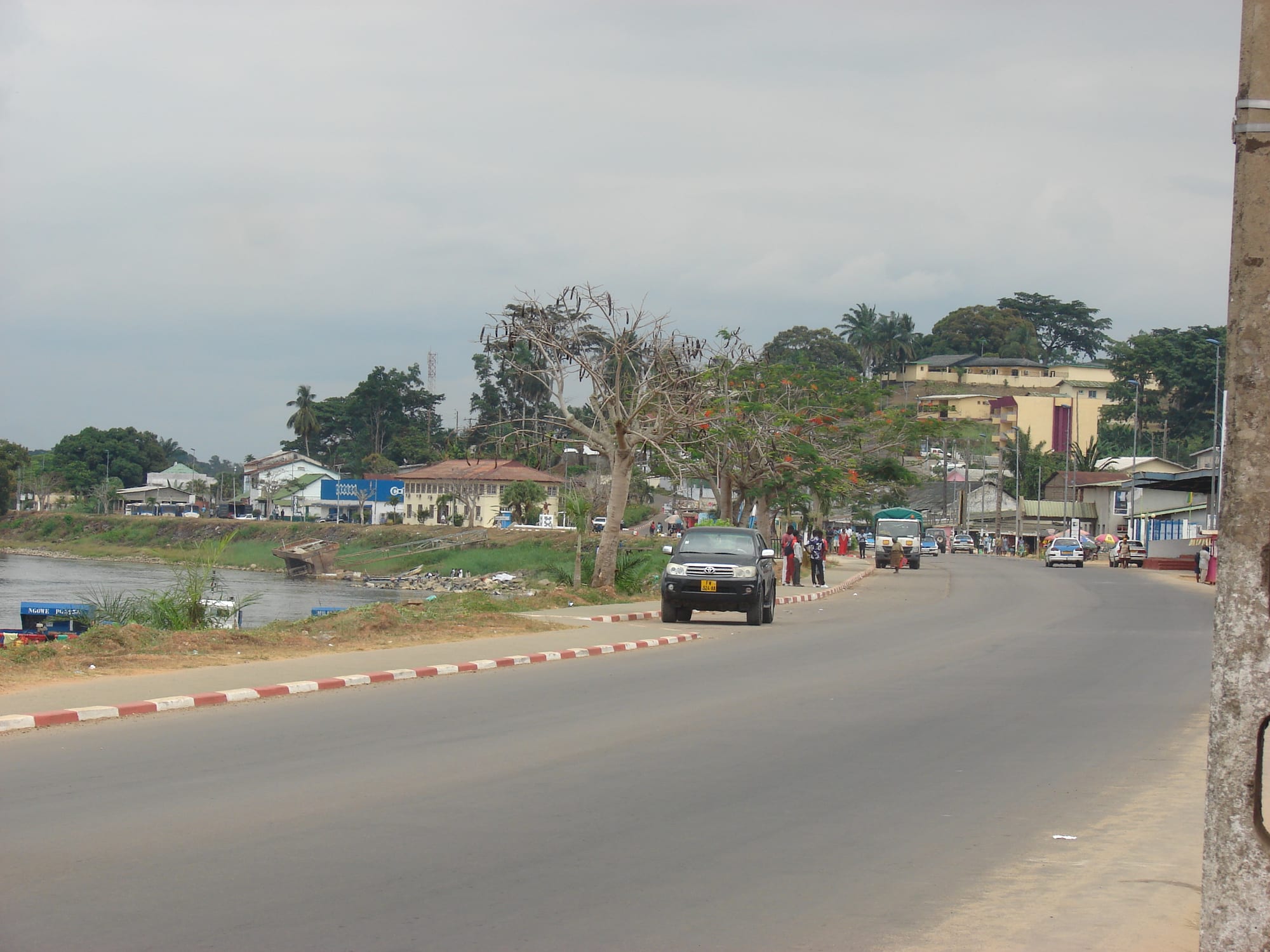
A road running beside the brown Ogooué river at Lambaréné, with low shops, palms and a green hill of houses beyond

Gabon

Lambaréné

The riverside road along the Ogooué at Lambaréné. (Lambaiya / Wikimedia Commons · CC BY-SA 4.0)

A river town in central Gabon, set where the Ogooué splits around a long island roughly 240 kilometres from the coast at Libreville. Known above all for the hospital Albert Schweitzer founded here in 1913, it is a quiet place of three linked quarters, river traffic in pirogues and a lake country of channels and fishing villages nearby.

Neighbourhoods

  • The island
    • First-time visitors
    • History
    • Markets

    The original settlement on the island in the Ogooué, holding the older administrative buildings, mission and market. It is the middle of the town's three parts, joined to both banks by bridges, and small enough to cross on foot.

    Open in Maps
  • The right bank and the hospital quarter
    • History
    • Transport

    Rive Droite, the bank that holds the Albert Schweitzer Hospital and its grounds along with the districts of Adouma and Abongo. The national road runs through the town, and shops, bars and taxi stands gather along it.

    Open in Maps
  • The left bank and Isaac
    • Local life
    • Quiet and residential

    Rive Gauche, where the Isaac district holds the majority of the town's population and the small airport. It is largely residential, with housing spreading up the slopes and views over the water from above the river.

    Open in Maps

Things to do

The Schweitzer hospital and the missions

  • Albert Schweitzer Hospitallandmark

    The hospital founded on the Ogooué in 1913 by the Alsatian doctor, organist and theologian Albert Schweitzer, who was awarded the Nobel Peace Prize in 1952 and is buried on the site; it remains a working hospital and research centre.

    Open in Maps
  • Schweitzer museummuseum

    The old hospital buildings beside the river, kept as a museum near the graves of Schweitzer, his wife and several collaborators, and placed on UNESCO's tentative list for World Heritage status in 2009.

    Open in Maps
  • Saint François-Xavier Churchlandmark

    One of the town's three Catholic churches, in the Sainte-Thérèse quarter; Catholicism is the largest faith in Lambaréné, and missions have shaped the town since the colonial era.

    Open in Maps

The river

  • The Ogooué waterfrontviewpoint

    The banks and landings where pirogues and motorboats load passengers, fish and produce, and where the two arms of Gabon's principal river pass either side of the island.

    Open in Maps
  • The bridgeslandmark

    The two road bridges linking the island to the banks on either side, giving an open view up and down the river.

    Open in Maps
  • The island marketmarket

    The town's produce market, facing the riverbank from which pirogues leave for the settlements up and down the river, selling river fish, smoked catch, plantain, cassava and forest fruit.

    Open in Maps

The lakes and villages nearby

  • The lakes regionattraction

    A country of lakes and creeks around the town — Zilé, Onangué, Azingo, Evaro and others, on the edge of the Wonga-Wongué reserve — reached by pirogue and among the area's main tourist sites.

    Open in Maps

Seasonal events

  • Independence Day16–17 August

    Gabon's national day, marked in the town with parades, official ceremonies and family celebrations.

  • The long dry seasonJuly to September

    The months when river levels drop, the skies stay overcast and travel by road and pirogue is easiest, which is when most visitors come.

Eat and drink

Long-standing places and food districts in Lambaréné. Hours, ratings and directions come from your maps app, always current.

Markets and street food

  • The island marketmarket

    River fish fresh and smoked, prawns, plantain, cassava and chillies, with grilled fish and brochettes cooked at stalls nearby.

    Open in Maps
  • Riverside grillsneighborhood

    Informal kitchens along the banks and the main road grilling fish and chicken over wood, served with piment, plantain and cassava.

    Open in Maps

Restaurants

  • Town-centre restaurantsneighborhood

    A handful of small restaurants and hotel dining rooms on the island and the right bank, serving Gabonese sauces, fish and simple French dishes.

    Open in Maps
  • Maquis barsneighborhood

    Open-air bars where cold Régab, palm wine from the villages and grilled food are taken slowly in the evening.

    Open in Maps

Experience Lambaréné

History

The Ogooué was Gabon's highway into the interior, and the point where it divides around an island was a natural meeting place for the river's peoples; the town's name comes from Galoa, a Myene language of the middle Ogooué. In the 1870s the explorer Pierre Savorgnan de Brazza traced the river towards its source, and he stayed at Lambaréné on several occasions; Protestant and Catholic missions followed, with stations in the town and along the river nearby.

The event that fixed the town's name abroad came in 1913, when Albert Schweitzer, an Alsatian theologian, organist and physician, arrived with his wife Hélène and opened a hospital at the Paris Missionary Society's station on the river. Interned as a German citizen during the First World War and back after it, he rebuilt the hospital in the 1920s, moving it in 1927 to a larger site a few kilometres away, and ran it until his death in 1965. The Nobel Peace Prize he received in 1952 made Lambaréné internationally known, and also drew criticism of the paternalism of his methods, an argument that has followed his reputation ever since.

Around the hospital, the town grew as a colonial administrative and river-trade centre. The national road now crosses the town, and two bridges tie the island to both banks. Today Lambaréné is the capital of Moyen-Ogooué province, a modest town whose hospital remains a working institution and a centre for research into tropical diseases.

Culture & Customs

The town is Galoa and Myene in its older identity — river people whose language, songs and funerary traditions belong to the middle Ogooué — with Fang, Punu, Eshira and others settled here through a century of work and migration. French is the shared language, and the missions have shaped public culture since the nineteenth century: Catholic and Protestant congregations are large — Catholicism is the largest faith — and new Christian movements have multiplied since the 1980s.

Traditional practice continues alongside this. Bwiti, the initiatory religion centred on the iboga root, with its night-long ceremonies of harp and drum, is practised in the region and is a private religious matter rather than anything staged for visitors; mask and dance traditions appear at funerals and celebrations rather than on a schedule.

Lambaréné's other cultural fact is Schweitzer himself. The hospital, its museum and the graves beside the river draw visitors from Europe, and the town is used to explaining a complicated legacy: a man widely honoured for the medical work he built, and criticised for the colonial attitudes that came with it. Life otherwise moves at the pace of the river — pirogues in the early morning, football in the late afternoon, and long evenings in the maquis bars.

Daily Life

About 40,000 people lived in Lambaréné at the 2013 census, which makes it one of Gabon's larger inland towns while still feeling small. The island holds the older offices and the market; the right bank holds the hospital; and the left bank, around the Isaac district, is where most residents live.

Work is in administration, the hospital and its research unit, schools, small trade and transport, with fishing and farming in the villages around. Many households combine a wage with a plot of cassava and plantain or with fish from the river. Young people leave for Libreville and Port-Gentil in search of work, a pattern repeated across the interior.

The day starts before dawn on the water, when pirogues cross to the market with fish and produce, and the town is quiet by mid-afternoon heat. Supplies, fuel and electricity can be unreliable, and the rains bring flooding to low-lying banks. Weekends mean church, football, funerals held over several days, and family visits by boat to villages downstream.

Food

Lambaréné eats from the river. Freshwater fish — captured by net and line, eaten fresh or smoked over wood — is the everyday protein, served with cassava in its many forms: bâton de manioc, fermented dough steamed in leaves, or the leaves themselves stewed with palm oil and groundnut. Plantain, taro and rice complete the plate, and piment made from small fierce chillies is on every table.

The sauces are Gabonese standards. Nyembwe, pounded palm nuts cooked to a thick orange sauce, is served with chicken or fish and is counted a national dish; odika, ground from wild mango seeds, gives a dark, rich sauce usually eaten with fish. Bushmeat is part of the traditional diet of the region and is sold in the markets, though several species are protected and the trade is regulated. Fruit from the forest and gardens — mango, safou, pineapple, papaya — turns up on stalls in season.

Drinks are Régab lager, palm wine tapped in the villages and brought in by pirogue, and sweetened bissap from hibiscus flowers. Bread, coffee and pastries from the French tradition are the usual breakfast in the town, and strong sweet tea is drunk at any hour.

Planning tools

Budget

Lambaréné is cheaper than Libreville but still costly by regional standards, and choice is limited: a few modest hotels and mission guesthouses, market food and small restaurants. The real expenses are transport — the road journey from the capital and hired pirogues for the lakes, which are priced by the boat and the fuel rather than per person.

Daily Budget Midrange
USD 120–220 (better hotel room, restaurant meals, a hired pirogue for a day on the lakes)
Daily Budget Shoestring
USD 45–80 (basic hotel or mission guesthouse, market food, shared transport)

Boat trips are agreed in advance with the boatman, fuel included, and cash is needed for everything outside the few hotels.

Best Time to Visit

July to September, the long dry season, is the most comfortable: cooler overcast days, less rain and easier road travel from the capital. The rainy season from October to June raises the river and makes tracks difficult, though it is broken by a short dry spell around December and January.

Suggested Number of Days

A day is enough for the hospital, the museum and a walk across the island. Two or three days suit anyone adding a pirogue trip into the lakes and the fishing villages, which depends on water levels and on arranging a boat.

First Visit
1 day
With Surroundings
2–3 days

Transportation

The town is small and its three parts are linked by bridges, with shared taxis running between the banks and along the main road for a fixed fare. Beyond the town, travel is by pirogue and motorboat on the river and the lakes, or by bush taxi along the highway. There is no railway station here; the Trans-Gabon line runs well to the east.

Fares for taxis and boats are agreed before setting off, and boats generally leave when full unless hired outright.

Airport & Station Connections

Lambaréné lies on the main north-south highway about 240 kilometres from Libreville, four to five hours by road, and shared bush taxis and minibuses make the trip daily from the capital. The road continues south towards Mouila and Tchibanga. There is a small airstrip, but scheduled flights are limited, and the river, once the main route to the coast, now carries local traffic rather than long-distance passengers.

Walkability

The island quarter is flat, compact and easily walked, and the bridges make crossings to both banks straightforward on foot, though the roads are busy and pavements intermittent. The hospital lies on the right bank, walkable in dry weather but usually reached by taxi. Heat, humidity and sudden rain shape the pace of any walk.

Safety

Libreville and the main towns are relatively calm, with street crime — muggings, phone theft, and break-ins — the main concern, especially after dark. Since the August 2023 military takeover, and the 2025 election that made its leader president, there is a heavier security presence and occasional restrictions. In Lambaréné the practical risks are the river itself — strong currents and crocodiles — and the highway, which carries fast traffic through the town.

Boats should be taken with experienced boatmen and life jackets where available, swimming in the river is unwise, and official and military sites must not be photographed. Check current official travel advice before travelling.

Climate

Tropical and humid, hot throughout the year with an average temperature of about 27°C and the seasons marked by rain rather than temperature. The long dry season runs from July to September, cooler and overcast; the rainy season lasts from October to June, broken by a short dry spell around December and January.

Summer
the long dry season, July to September, is overcast and a little cooler, around 27°C by day, with little rain
Winter
the rainy months are hot and humid near 30°C, with heavy afternoon storms and a high, fast-flowing river

Local Customs

French is the language of daily dealings, and greetings and a handshake come before any request. The town is proud of its hospital and of Schweitzer's association with it, but the site is a working medical institution: visits keep to the museum and the marked areas, and patients and staff are not photographed. Most residents are Christian, and the missions are part of everyday life; Bwiti and other traditional practices are private and respected.

Permission should be asked before photographing people, particularly at the hospital and in villages; modest dress is expected in churches and mission grounds, and small tips are appreciated rather than expected.

Common Payment Methods

The currency is the Central African CFA franc (XAF), pegged to the euro. This is a cash town: the market, taxis, boats and most guesthouses take nothing else, card acceptance is very limited, and ATMs are few, so money is best drawn or changed in Libreville before travelling. Euros in cash are the easiest currency to bring.