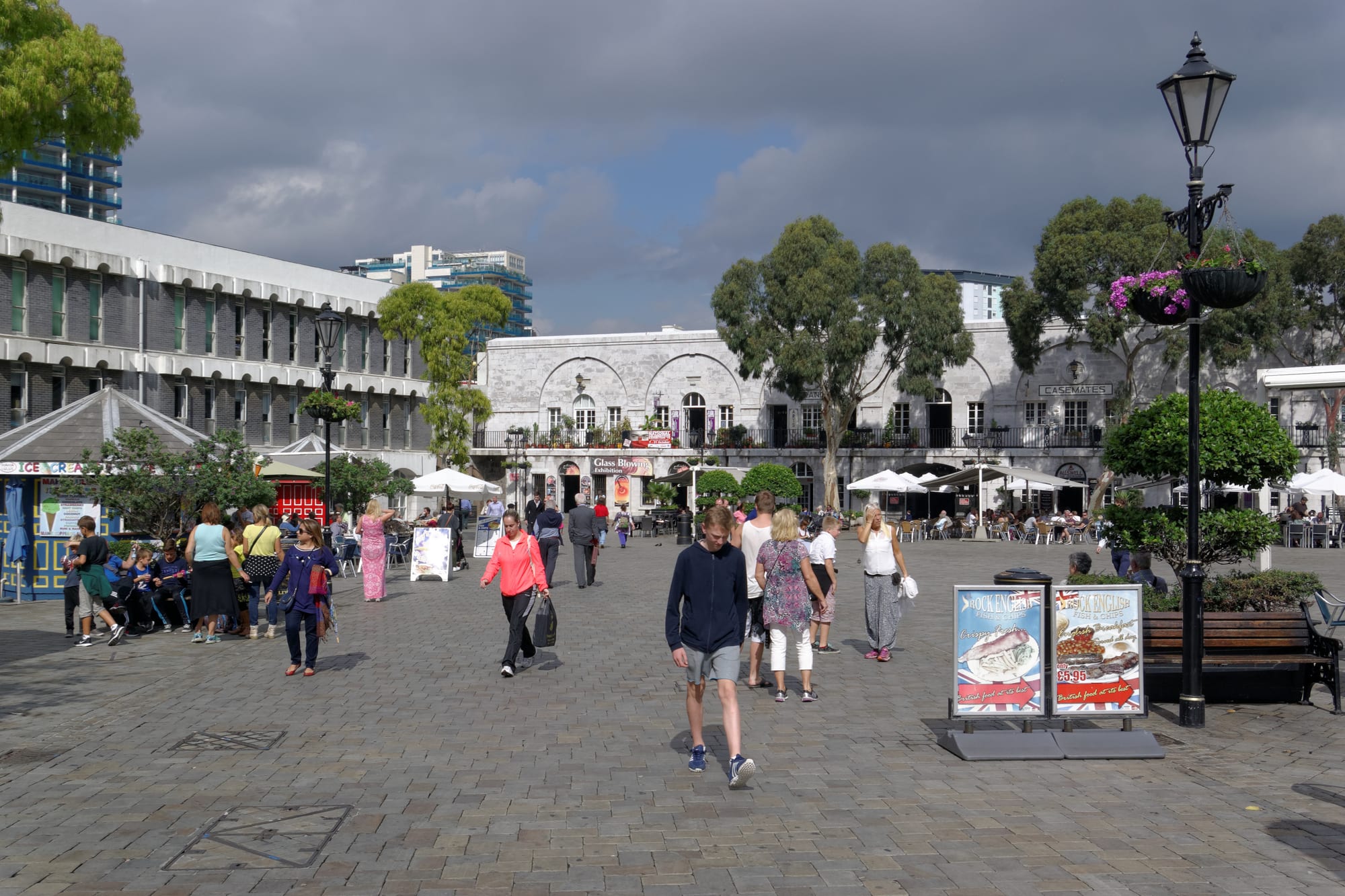
A wide paved square with trees, lamp posts and café tables in front of pale stone barracks, under a cloudy sky

Gibraltar

Gibraltar

Grand Casemates Square, at the northern end of Main Street in Gibraltar. (Berthold Werner / Wikimedia Commons · CC BY-SA 3.0)

A British overseas territory and, since 2022, a city, built on the western slopes of a limestone rock at the entrance to the Mediterranean, with Spain to the north and Morocco across the strait. Moorish, Spanish and British fortress-builders shaped it; 32,194 people lived here at the 2012 census, mostly on the Westside, and the economy rests on finance, online gambling, the port and tourism.

Neighbourhoods

  • Main Street and the Town Area
    • First-time visitors
    • Historic district
    • Shopping

    The old town on the Westside, threaded by pedestrianised Main Street. Genoese, Portuguese, Andalusian, Moorish and British Regency buildings hold shops, pubs and cafés, with Grand Casemates Square at the northern end and the cable car station near the southern end.

    Open in Maps
  • Ocean Village and the marinas
    • Nightlife
    • Best for food
    • Waterfront

    A marina development on the west side, with a casino, restaurants and bars.

    Open in Maps
  • South District and Europa Point
    • Views
    • Quiet and residential

    The southern end of the territory, running down to Europa Point, the southernmost tip, with its lighthouse, mosque and shrine and views across the strait to Africa.

    Open in Maps
  • Catalan Bay
    • Beaches
    • Village atmosphere

    A small fishing village and beach on the eastern side of the Rock, away from the Westside.

    Open in Maps
  • Sandy Bay
    • Beaches
    • Quiet and residential

    A village, bay and beach on the Mediterranean east coast, south of Catalan Bay and reached along Sir Herbert Miles Road, on the opposite side of the Rock from the main town.

    Open in Maps

Things to do

Famous landmarks

  • Moorish Castlelandmark

    A medieval fortification above the town whose Tower of Homage, the highest tower surviving from the period of Islamic rule in the Iberian Peninsula, is clearly visible across the town.

    Open in Maps
  • Grand Casemates Squarelandmark

    The larger of the city's two main squares, named after the bombproof barracks completed in 1817 at its northern end, and lined with pubs, bars and restaurants.

    Open in Maps
  • Europa Pointviewpoint

    The southernmost point of Gibraltar, with a lighthouse built in 1838–41, the Ibrahim-al-Ibrahim Mosque, the shrine of Our Lady of Europe and a 19th-century gun battery.

    Open in Maps
  • Trafalgar Cemeterylandmark

    A small cemetery in an old Spanish defensive ditch just south of the city walls, named after the Battle of Trafalgar of 1805, although only two of the battle's victims are buried here.

    Open in Maps
  • Cathedral of St. Mary the Crownedlandmark

    The Catholic cathedral, the main centre of Catholic worship in the Diocese of Gibraltar.

    Open in Maps
  • Cathedral of the Holy Trinitylandmark

    The Anglican cathedral on Cathedral Square, the cathedral of the Church of England's Diocese in Europe.

    Open in Maps

The Upper Rock

  • Gibraltar Nature Reservepark

    The protected reserve covering more than 40 per cent of the territory, on a limestone ridge rising to 426 metres, home to the Barbary macaques and a resting point for migrating birds.

    Open in Maps
  • Gibraltar Cable Cartransit hub

    An aerial tramway built in 1966, from a base station beside the Alameda Gardens near the southern end of Main Street to a top station on a former gun battery.

    Open in Maps
  • Barbary macaquesattraction

    The only wild monkey population in Europe — around 300 animals in five troops on the Upper Rock as of 2020; feeding them is an offence.

    Open in Maps
  • St. Michael's Caveattraction

    A network of limestone caves more than 300 metres above sea level, used for picnics, concerts and even duels in Victorian times; its largest chamber now serves as an auditorium.

    Open in Maps
  • Great Siege Tunnelsattraction

    Tunnels dug through the solid limestone of the Rock's northern end by British soldiers during the Great Siege, begun in May 1782.

    Open in Maps
  • O'Hara's Batterylandmark

    An artillery battery at the highest point of the Rock, armed with a 9.2-inch gun since 1901.

    Open in Maps
  • Mediterranean Stepstrail

    A steep path built by the British military up the southern end of the Rock, with views over the strait, Europa Point, the east-side beaches and the Costa del Sol.

    Open in Maps

Museums and heritage

  • Gibraltar National Museummuseum

    The museum of the Rock's history, culture and natural history, founded in 1930, which incorporates the remains of a 14th-century Moorish bathhouse.

    Open in Maps
  • Gorham's Caveattraction

    A sea-level cave a few metres from the Mediterranean, one of the last known homes of the Neanderthals in Europe, and the heart of a four-cave complex listed as a UNESCO World Heritage Site.

    Open in Maps
  • Great Synagoguelandmark

    A synagogue known in Ladino as the Esnoga Grande, serving Gibraltar's long-established Jewish community.

    Open in Maps

Gardens and beaches

  • Gibraltar Botanic Gardenspark

    The Alameda Gardens, about six hectares commissioned in 1816 by the governor George Don as a place of recreation for the garrison, with a small wildlife park.

    Open in Maps
  • Catalan Bay beachbeach

    The beach of the old fishing village on the east side of the Rock.

    Open in Maps
  • Sandy Bay beachbeach

    A beach on a small Mediterranean bay south of Catalan Bay.

    Open in Maps

Seasonal events

  • Gibraltar National Day10 September

    The territory's national day, a public holiday marking the 1967 sovereignty referendum, first held in 1992; since 2008 the Mayor has read a National Day declaration at a civic rally outside the City Hall.

  • Easter and Christmas bollosEaster and Christmas

    Bollo de hornazo, a sweet, dry bread, is eaten around Easter as in Spain, and in Gibraltar it is popular at Christmas as well.

Eat and drink

Long-standing places and food districts in Gibraltar. Hours, ratings and directions come from your maps app, always current.

Gibraltar classics

  • Calentitarestaurant

    A local dish: a baked, pancake-like slice of chickpea flour, water, olive oil, salt and pepper, related to the farinata of Genoa.

    Open in Maps
  • Rostorestaurant

    Penne in a tomato sauce with beef, mushrooms and carrots, topped with grated cheese — a pasta dish of Italian origin whose name probably comes from 'arrosto'.

    Open in Maps

Food districts

  • Grand Casemates Squareneighborhood

    The hub of Gibraltar's nightlife, filled with pubs, bars and restaurants with outdoor tables.

    Open in Maps
  • Irish Townneighborhood

    The street running parallel to Main Street, with a number of pubs.

    Open in Maps
  • Ocean Village and Marina Bayneighborhood

    The marinas on the west side, with waterside restaurants, bars and pubs.

    Open in Maps

Experience Gibraltar

History

The ancient Greeks and Romans knew the Rock as Mons Calpe, one of the Pillars of Hercules, and Neanderthals lived in its sea caves long before. In 711 an army under Tariq ibn Ziyad crossed from North Africa and landed in the vicinity of Gibraltar, beginning the Muslim conquest of Iberia, and the Rock took his name, Jabal Tariq, "the Mount of Tariq", later corrupted into Gibraltar. The Moors fortified it; the Tower of Homage of the Moorish Castle still looks down over the town, and Main Street follows a route set out in the 14th century. Spanish rule followed until 1704, when Anglo-Dutch forces captured the town during the War of the Spanish Succession, and the Treaty of Utrecht ceded it to Britain in perpetuity in 1713.

Gibraltar became a fortress and naval base. During the Great Siege of the late 18th century the British dug tunnels through the solid limestone of the Rock's northern end, and in 1830 Gibraltar was formally declared a colony. In the first half of the 19th century settlers from Britain and around the Mediterranean — Italians, Portuguese, Maltese, Jews and French — raised the population to more than 17,000 by 1860. In the Second World War most civilians were evacuated, chiefly to London but also to Morocco, Madeira and Jamaica.

In the 1967 referendum Gibraltarians voted overwhelmingly to remain British, and Franco closed the land frontier in 1969. In the Brexit referendum of 2016, 96 per cent of voters chose to remain in the EU, but Gibraltar left with the United Kingdom in 2020. Its city status came into force in August 2022, and on 14 July 2026 the UK, Spain, Gibraltar and the EU signed a treaty in Brussels removing border controls at the frontier with Spain.

Culture & Customs

Gibraltarians, who often call themselves Llanitos, descend from a mix of British, Spanish, Genoese, Maltese, Portuguese, Catalan, Sephardic Jewish, Sicilian, Moroccan and Indian settlers. Many speak Llanito, a vernacular unique to Gibraltar that switches between English and Andalusian Spanish, although English is increasingly dominant and many young people speak little Llanito.

Religious life is varied for so small a place. About 72 per cent of people are Roman Catholic, and there is a long-established Jewish community of some 760 people, as well as Muslim and Hindu communities and members of the Baháʼí Faith. Gibraltar has a Catholic and an Anglican cathedral, the Great Synagogue and a mosque at Europa Point.

Gibraltar National Day on 10 September commemorates the 1967 referendum. First held in 1992 in John Mackintosh Square to build support for self-determination, it soon moved to larger venues; since 2008 its main event has been a civic rally outside the City Hall, where the Mayor reads a National Day declaration. The macaques of the Upper Rock are part of local lore: in 1944 Winston Churchill, worried by their dwindling numbers, asked the Colonial Secretary to ensure that something was done about them.

Daily Life

Gibraltar had 32,194 usual residents at the 2012 census, the vast majority of them on the Westside, between the Rock's western slopes and the bay; it is one of the most densely populated territories in the world. Land reclamation makes up about a tenth of its area but houses more than 40 per cent of its people.

The economy rests on four sectors: financial services, online gambling, maritime services such as ship repair and fuel supply, and tourism, including duty-free shopping. Many bookmakers and online gaming companies moved here in the early 2000s for its regulated, low-tax regime. The British military, which once provided most of the work, now accounts for only about seven per cent of the economy.

Around 45 per cent of all jobs are held by frontier workers who live in Spain, most of them Spanish, so a smooth frontier matters to daily life on both sides. During the Brexit talks the Chief Minister warned that a frontier without free-flowing crossings would put nearly half of the territory's jobs at risk.

Food

Gibraltar's cooking reflects its long ties with Andalusia and Britain and the Mediterranean settlers who made it home. Calentita, a local dish, is a baked, pancake-like slice of chickpea flour, water, olive oil, salt and pepper, similar to the farinata of Genoa; its name, a Spanish diminutive meaning "nice and warm", is said to come from the cry of street vendors. Panissa uses similar ingredients, but they are simmered and stirred for over an hour into a paste that is left to set.

Rosto, a pasta dish of Italian origin, is penne in a tomato sauce with beef or sometimes pork, mushrooms and carrots, topped with grated cheese. Fideos al horno is baked macaroni with a meat sauce, egg and bacon, close to Maltese imqarrun, and rolitos, of Maltese origin, are known in English as beef olives. Bollo de hornazo, a sweet, dry bread, is eaten at Easter and, in Gibraltar, at Christmas too.

For eating out, Grand Casemates Square is lined with pubs and restaurants, Irish Town has more pubs, and the marinas at Ocean Village and Marina Bay offer waterside dining. There are also kosher restaurants, bakeries and shops serving the Jewish community.

Planning tools

Budget

Gibraltar is mid-to-high priced, and many visitors stay across the frontier in La Línea and walk over. The Upper Rock is the main paid sight, with a ticket covering the nature reserve, the caves and the tunnels, and the cable car and dolphin-watching boat trips add to the bill.

Daily Budget Midrange
USD 200–375 (Gibraltar hotel, restaurant meals, the cable car and Upper Rock ticket, a dolphin trip)
Daily Budget Shoestring
USD 95–150 (room in La Línea, pub lunch, buses, walking up the Rock)

The one-day GibraltarPass, bought online, covers the cable car or a minibus tour of the Rock and entry to the nature reserve and its main sights.

Best Time to Visit

Spring and autumn are the most comfortable seasons, warm without the heat and humidity of August. Summer is hot and dry; winters are mild and rainy. National Day, the territory's public holiday, falls on 10 September.

Suggested Number of Days

Many visitors come for a day from Spain or a cruise ship, which is enough for the town and the Upper Rock in a rush. Two days allow time for the museums, the east-side beaches and a boat trip without hurrying.

First Visit
1–2 days
With Surroundings
2–3 days

Transportation

Gibraltar is less than seven square kilometres, but it is long and thin, so distances can be further than expected. Two bus companies cover it — Citibus routes 5 and 10 to the frontier and airport, and the government Gibraltar Bus Company on the other routes, including route 2 to the cable car and Europa Point. An app-based e-scooter scheme operates. Traffic drives on the right.

The town has a complex one-way system, narrow streets and little parking, so many visitors park in La Línea and walk across.

Airport & Station Connections

Gibraltar International Airport, between the frontier and the town, has flights from London Heathrow, Gatwick, Bristol and Manchester. Málaga Airport, about 120 kilometres east, has far more routes. Most people arrive overland from Spain: La Línea's bus station is a few minutes' walk from the frontier, and since 2023 cars use a tunnel instead of crossing the runway, which pedestrians may still walk over. A treaty signed in July 2026 removed border controls at the land frontier with Spain. Cruise ships call at the port about 1.3 kilometres from Casemates.

Walkability

The Westside town is easy to explore on foot, from the frontier across the runway to Casemates and along Main Street. The roads and paths up to the Upper Rock are very steep, and taxis, minibus tours and the cable car take the strain out of the climb.

Safety

Very safe, with low crime. Gibraltar has an efficient police force, and the main risks for visitors are the Barbary macaques on the Upper Rock, which are wild and will bite if frightened or annoyed, and the steep paths in the summer heat.

Never feed or touch the macaques — feeding them is an offence that can bring a fine of up to £4,000 — and keep food and bags out of sight near them. Check current official travel advice before travelling.

Climate

A Mediterranean climate, with mild, rainy winters and very warm to hot, humid summers that have very little rain. The average daily high across the year is about 22°C.

Summer
hot and humid — in August, the warmest month, days average about 28°C and nights about 21°C
Winter
mild and rainy — in January, the coldest month, days average about 16°C and nights about 11°C

Local Customs

English is the official language, but most local people also speak Spanish and converse in Llanito, a mix of Andalusian Spanish and British English, and many café and restaurant staff come from Spain. People from Gibraltar call themselves Gibraltarians or Llanitos. Gibraltar is roughly three-quarters Catholic, with Anglican, Jewish, Muslim and Hindu communities.

Many café and restaurant staff are Spanish speakers from across the frontier, so a little Spanish can help; leave the macaques' food and bags alone on the Upper Rock.

Common Payment Methods

The currency is the Gibraltar pound, equal in value to sterling; British pounds are accepted everywhere, but Gibraltar notes and coins are not accepted outside the territory, even in the UK, and the local banks change them back free of charge. Most shops take euros, often at a poor rate. Cards are not taken in every shop and restaurant, so some cash is useful.