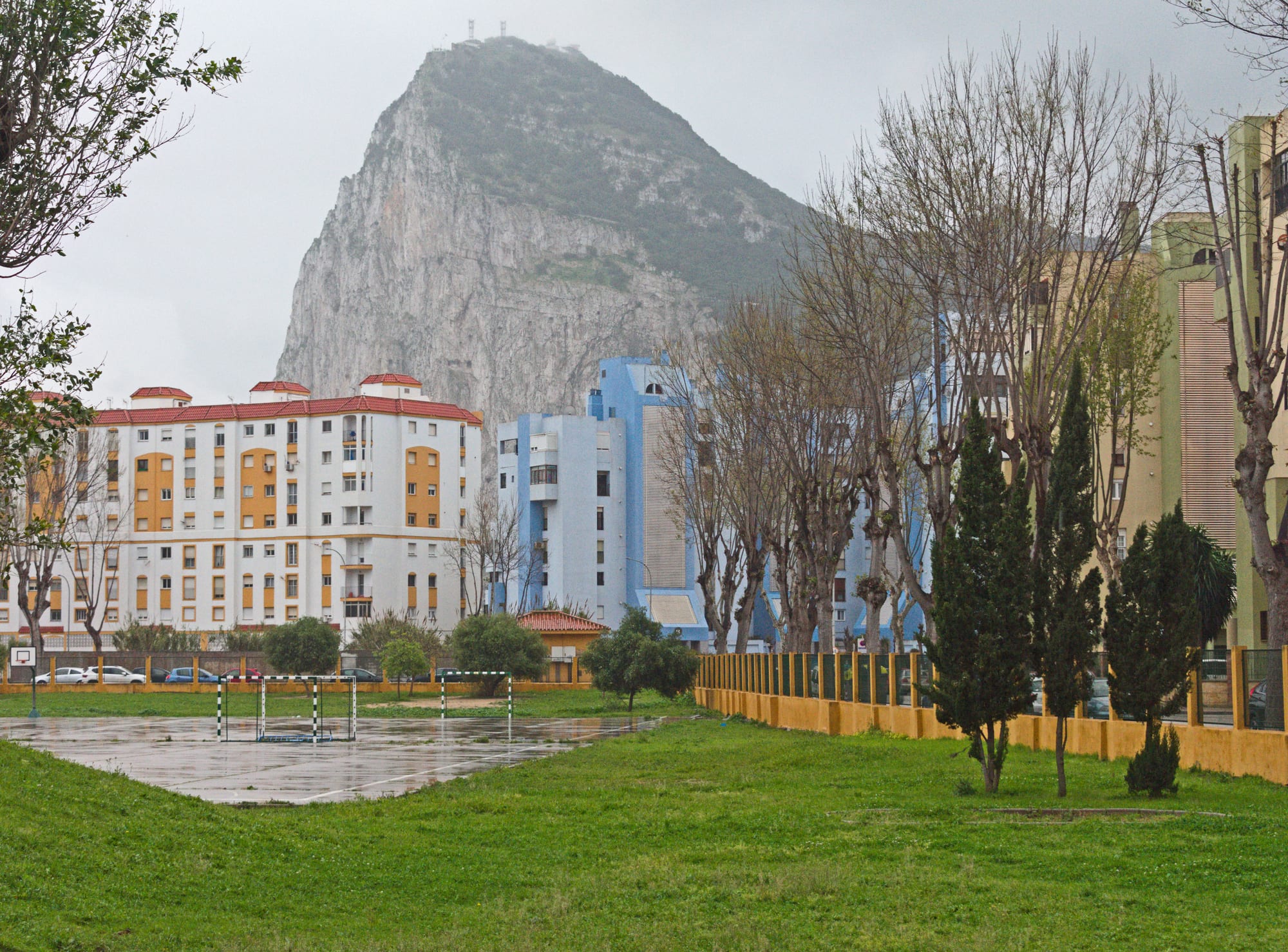
A steep, isolated limestone ridge rising sheer from a flat isthmus and a town at its base, the sea on either side

Gibraltar

The Rock of Gibraltar seen from La Línea on the Spanish side — a 426-metre limestone monolith at the entrance to the Mediterranean. (Ymblanter / Wikimedia Commons · CC BY-SA 4.0)

A 6.8-square-kilometre British Overseas Territory on a limestone monolith at the southern tip of Spain, guarding the strait between the Atlantic and the Mediterranean — British since 1704, claimed by Spain, and overwhelmingly determined to stay British.

Explore Gibraltar

History

The Rock sheltered some of Europe's last Neanderthals, whose traces of habitation were found in Gorham's Cave, now a UNESCO World Heritage Site. Its name is Arabic — Jabal Tariq, "Tariq's mountain" — after the commander who landed here in 711 to launch the Muslim conquest of Iberia. Moorish and then Castilian rule followed, until an Anglo-Dutch force captured Gibraltar in 1704 during the War of the Spanish Succession. The 1713 Treaty of Utrecht ceded it to Britain "in perpetuity", and it has been British ever since.

Gibraltar withstood the Great Siege of 1779–83 and grew into a vital Royal Navy base, central to the Napoleonic Wars — Nelson's body passed through after Trafalgar — and to the Second World War, when much of the population was evacuated and the Rock was honeycombed with tunnels. Franco's Spain sealed the land frontier completely in 1969 to pressure the territory; it reopened partially in 1982 and fully in 1985.

Gibraltarians have voted twice, in 1967 and 2002, to reject Spanish or joint sovereignty, each time by around 99 per cent. In 2016 the territory voted 96 per cent to remain in the EU, but left with the rest of the United Kingdom. After nine years of negotiation, the UK, Spain, Gibraltar and the EU signed a treaty in Brussels on 14 July 2026 that removed routine controls at the frontier with Spain and brought Gibraltar into the Schengen travel area and the EU customs union; it has applied provisionally since the next day while parliaments ratify it, with the Schengen entry checks moved to Gibraltar's airport and port.

  • Gibraltar: The Rock at the Gate — A limestone monolith guarding the strait between two seas and two continents — the landing place of the Muslim conquest of Spain, British since 1704, and still claimed by Madrid

Culture & Customs

Gibraltarians — "Llanitos" — are a distinct people of Genoese, Maltese, Portuguese, Spanish, British, Jewish, and Indian descent. They speak English officially and Llanito informally, a rapid Spanish–English code-switch peppered with words from half a dozen languages. British institutions — the pound, red pillar boxes, bobbies, pubs, and Marks & Spencer — sit on top of a Mediterranean, largely Catholic daily rhythm.

Local patriotism is strong and public. National Day on 10 September fills the squares with people in red and white; the mass release of 30,000 balloons that was once its highlight ended in 2016 over concerns for marine wildlife. The religious mix is unusually broad for its size, with a long-established Sephardi Jewish community and Hindu and Muslim communities alongside the Catholic and Anglican churches.

  • Gibraltar: Two Tongues, Many Faiths, One Rock — A people who switch between English and Spanish in a single sentence, synagogues, churches and a mosque on one small peninsula, and a calendar that runs from the Three Kings to a sea of red and white

Daily Life

About 38,000 people live on a densely built rock, much of it on land reclaimed from the bay. The economy runs on financial services, online gaming — many betting companies are based here — ship bunkering and repair in the busy port, and tourism, much of it day-trippers from the Costa del Sol. Taxes are low.

Thousands of workers, Spanish and other nationalities, commute across the frontier every day — they hold something like 45 per cent of all the jobs on the Rock — which makes a smooth border essential to normal life. Housing is tight and expensive, and while cars are common the territory is small enough to walk across in an hour.

  • Gibraltar: A Border Crossed Twice a Day — A British territory of 6.8 square kilometres where more than half of private-sector jobs are held by people who commute in from Spain every morning, and where Llanito, a running blend of Andalusian Spanish and English, is still widely heard on the street

Food

Gibraltarian cooking blends Genoese, Spanish, British, and North African influences. Calentita, a baked bread-like dish of chickpea flour, olive oil and water, is the best-known local dish and gives its name to the food festival; panissa and rosto (penne in a tomato sauce with beef) are other local staples, and bollo de hornazo appears at Easter.

The pubs serve fish and chips, pies, and Sunday roasts; Spanish tapas, seafood, and tortilla are everywhere; and there is good Moroccan and Indian food. Sherry and Spanish wine come from just across the border.

  • Gibraltar: Food and the National Dish — A baked chickpea-flour cake linked to Genoese settlers that became genuinely Gibraltar's own, on a tiny British territory shaped as much by Spain, Genoa and its Jewish community as by Britain

Attractions & Natural Wonders

The Rock itself is the attraction. The Upper Rock Nature Reserve — reached by cable car or road — takes in the Barbary macaques, the only wild monkeys in Europe; St Michael's Cave, a vast chamber used as a concert hall and a wartime hospital; the Great Siege Tunnels and the Second World War tunnels bored through the limestone; the Moorish Castle; and viewing platforms and footpaths including the Windsor Suspension Bridge, opened in 2016 across a ravine on the Royal Anglian Way, with O'Hara's Battery at the summit.

At the base, the pedestrianised Main Street runs through duty-free shops to Casemates Square, and the Gibraltar National Museum tells the story of the Neanderthal skull found here (the original went to London) and is built over the remains of a fourteenth-century Moorish bathhouse. Europa Point at the southern tip has a lighthouse, a mosque, and a clear view across the strait to the mountains of Morocco.

The airport runway that cuts across the old road into Spain is a sight in itself — cars now use the tunnel, but people on foot still walk over the tarmac between flights — and boat trips from the marina go out to watch the dolphins that live in the Bay of Gibraltar.

Planning basics

Budget

Mid-to-high. Hotels are few and not cheap, so many visitors stay in Spain at La Línea and walk across. Pub meals and the cable car are moderately priced; the combined Upper Rock nature-reserve ticket adds up for a family.

Daily Budget Midrange
GBP 150–280 (Gibraltar hotel, restaurant meals, the cable car and full Upper Rock ticket, a dolphin trip)
Daily Budget Shoestring
GBP 70–110 (stay in La Línea and cross on foot, pub lunch, walk the town, one Rock attraction)

Stay on the Spanish side and walk over the frontier; buy the combined Upper Rock ticket if you want the caves, tunnels, and castle as well as the apes.

Visa Requirements

Crossing into Gibraltar changed in July 2026. Under the EU–UK Agreement in respect of Gibraltar, signed on 14 July 2026 and applied provisionally from the following day while it is ratified, routine controls at the land frontier with Spain were removed and Gibraltar now takes part in the Schengen travel area and the EU customs union. Entry checks are made instead at Gibraltar's airport and port, where Spanish officials carry out the Schengen check alongside Gibraltar officers. Citizens of the EU/EEA, Switzerland, the US, Canada, Australia, and many others still enter visa-free; since April 2026 non-EEA visitors, UK citizens included, are registered by the EU Entry/Exit System at the air and sea border, while Gibraltar residents are exempt.

Typical Stay
Visa-free for most Western passports

Carry your passport (or, for EU/Swiss citizens, a national ID card); there is no longer a routine check when you walk over from La Línea, but you are checked arriving by air or sea.

Safety

Very safe, with low crime. Watch for bag-snatching in tourist crowds, and keep your distance from the Barbary macaques on the Upper Rock — they bite, scratch, and snatch bags and food, and feeding or touching them is prohibited. The land frontier with Spain no longer has routine controls, though checks apply at the airport and the port.

Health
Standard EU-level medical care; the summer sun and the steep Rock paths are the main practical hazards

Don't feed, touch, or carry visible food near the apes; keep bags zipped and close; and check frontier waiting times before you cross.

Climate

Mediterranean: hot, dry summers, often 28–32°C and humid in July and August, and mild, wet winters around 11–17°C from December to February. The easterly "Levanter" wind forms a cloud cap over the Rock and can make it grey and damp even in summer.

Summer
Hot, dry, humid (July–August)
Winter
Mild, wet (December–February)

Transportation

Gibraltar International Airport has flights to the UK and Morocco, and its single runway crosses the old main road to Spain; since a tunnel and bypass opened in March 2023, cars no longer wait for aircraft, though pedestrians still cross the runway when it is open. Most visitors arrive overland — you can walk across the frontier from La Línea in minutes, or park on the Spanish side. Málaga airport is about 1 hour 45 minutes away. In Gibraltar, buses, taxis, and the cable car cover everything, and the centre is walkable; a car is more hindrance than help.

Walk or bus across the frontier rather than driving; routine frontier controls were removed in July 2026, so crossing on foot is quick.

Best Time to Visit

April to June and September to October for warm, clear weather and thinner crowds. Summer is hot and busy with cruise and coach day-trippers; winter is mild but wetter and the Levanter is more frequent.

Events
Gibraltar National Day (10 September), when the territory dresses in red and white; the Calentita food festival; the Mediterranean Sea kayak and swim events; Literary Week

Currency

The Gibraltar pound is issued locally and is at par with, and interchangeable with, sterling within the territory; Bank of England notes circulate freely, but Gibraltar notes are not legal tender in the UK. Euros are taken in many shops at a slightly poor rate. Cards are standard.

Symbol
£
Currency Code
GIP — Gibraltar pound (at par with sterling)

Language

English is the official language, used in government and schools. Almost everyone also speaks Spanish, and the everyday vernacular is Llanito, which switches fluidly between English and Andalusian Spanish and borrows from Genoese, Hebrew, and other languages.

Vernacular
Llanito (Spanish–English) and Spanish
Official Language
English