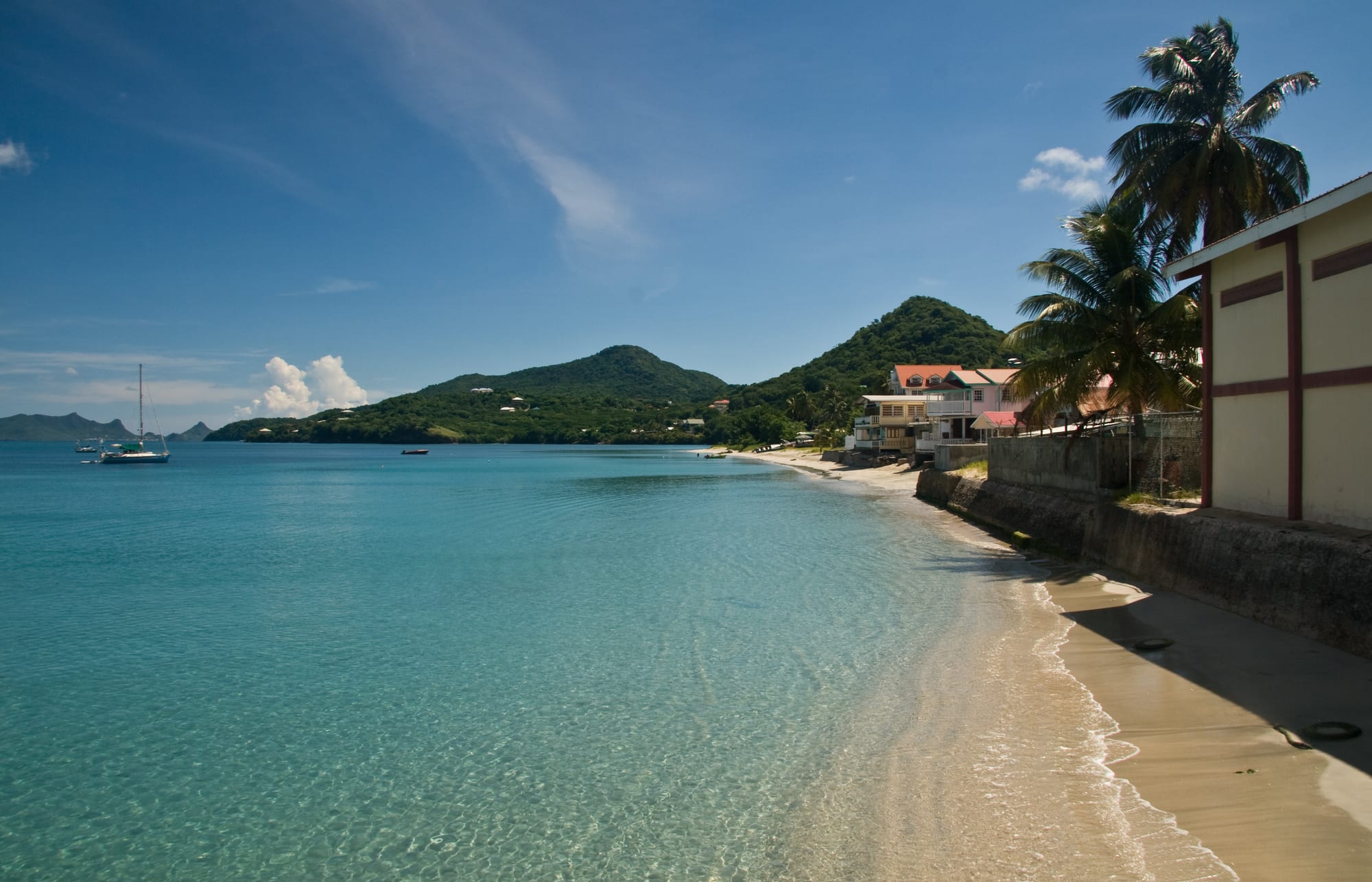
Clear turquoise water along a narrow sandy beach at Hillsborough, with houses, palm trees and green hills behind

Grenada

Carriacou

The beach and waterfront at Hillsborough, Carriacou's only town. (FishSpeaker / Wikimedia Commons · CC BY 3.0)

The largest island of the Grenadines, north-east of Grenada's main island, whose Carib name meant 'land of reefs'. Settled by the French and worked as British plantations, it kept its Big Drum dances, boat-building village and long-running regatta. Hurricane Beryl struck it in July 2024, damaging or destroying almost every building on the island.

Neighbourhoods

  • Hillsborough
    • First-time visitors
    • Local life
    • Close to public transport

    The island's only town, home to about 1,000 people and the retail and administrative centre for both Carriacou and Petite Martinique. Its waterfront and narrow beach face Sandy Island, and minibuses to the island's villages start here.

    Open in Maps
  • Tyrell Bay and Harvey Vale
    • Yachting
    • Best for food
    • Ferry port

    The sheltered bay on the south-west coast where the island's port and the ferry pier are, a popular anchorage used by yachts to shelter from hurricanes. Bars and restaurants line the shore of the village, also called Harvey Vale or Argyle.

    Open in Maps
  • L'Esterre and Paradise Beach
    • Beaches
    • Snorkelling
    • Quiet

    A small settlement just west of the airport, beside Paradise Beach, where white sand and calm water are sheltered by the barrier reef.

    Open in Maps
  • Windward
    • Boat-building
    • Local life
    • Quiet

    The village on the exposed north-eastern coast, home to the island's traditional boat-building and to many of its people of Scottish and Irish ancestry.

    Open in Maps

Things to do

Beaches and islets

  • Sandy Islandbeach

    The thin strip of sand seen off Hillsborough, reached by boat trips for picnics; there is no shade, water or other facilities.

    Open in Maps
  • Paradise Beachbeach

    One of the island's best-known beaches, near L'Esterre, with white sand and calm water sheltered by the barrier reef.

    Open in Maps
  • Anse La Rochebeach

    A bay on the north-west corner reached by a coastal trail, with a beach, snorkelling, a prominent rock just offshore and fort and plantation ruins at its southern end.

    Open in Maps
  • White Islandbeach

    A small islet off the south coast with sandy beaches, used as a picnic spot.

    Open in Maps

Reefs and diving

  • The leeward reefsattraction

    Most diving takes place on the calmer Caribbean side of the island, where 33 dive sites suit all levels, with nurse sharks, rays and hawksbill and green turtles often seen.

    Open in Maps
  • Westsider and Boris wrecksattraction

    Two tugboats, each about 30 metres long, sunk off the island as artificial wrecks for divers in 2004 and 2007.

    Open in Maps

Around the island

  • Tyrell Bayneighborhood

    The island's port and main anchorage, where yachts gather and the ferries from Grenada dock.

    Open in Maps
  • Windward boat-buildingneighborhood

    The north-eastern village where Carriacou's tradition of building wooden boats by hand continues.

    Open in Maps
  • High North Peaktrail

    The highest point on Carriacou, at 291 metres, reached on poorly marked trails through dense woodland where iguanas, land tortoises and hummingbirds may be seen.

    Open in Maps

Short trips from the island

  • Petite Martiniqueattraction

    Grenada's other inhabited island in the Grenadines, about 2.5 miles away, with a population of around 900 and its own Whitsuntide regatta; Hurricane Beryl also caused extensive damage there.

    Open in Maps

Seasonal events

  • Carriacou Carnivaljust before Lent

    The island's carnival, with parades of oily jab-jabbers — a masquerade first brought to Carriacou in 1922 — and Shakespeare recitation matches.

  • Carriacou Maroon and String Band Music Festivalusually April

    A festival named after the island's village maroons — gatherings where traditional food is cooked and the Big Drum is danced — with string band music.

  • Carriacou Regattafirst weekend of August

    A race for locally built boats, held since 1965, with festivities on shore.

  • Petite Martinique Whitsuntide RegattaWhitsun weekend

    Boat races and onshore festivities on the neighbouring island.

  • Parangthe weekend before Christmas

    A celebration of the island's traditional music and culture, in which musicians go from place to place mixing Christmas songs with calypso satire.

Eat and drink

Long-standing places and food districts in Carriacou. Hours, ratings and directions come from your maps app, always current.

Carriacou classics

  • Tyrell Bay waterfrontneighborhood

    The bars and restaurants along the bay where yachts anchor, serving fish and island cooking at the water's edge.

    Open in Maps
  • Hillsboroughneighborhood

    The town's small restaurants and bars along the main street and waterfront.

    Open in Maps
  • Carriacou's rum shopsneighborhood

    The island has more than 100 rum shops, the small bars found in almost every village; rum is not distilled on Carriacou but is sold everywhere.

    Open in Maps

Experience Carriacou

History

Amerindian settlers reached Carriacou between about 500 and 1000 AD and called it Kayryouacou, "the land of reefs". The first recorded European visitor was Jean-Baptiste Du Tertre, who came in 1656, and the French were the first to colonise it; in 1720 the pirate Bartholomew Roberts seized a French ship nearby and renamed it the Royal Fortune. The first census, in 1750, counted 199 people. After the Seven Years' War France ceded Carriacou with Grenada to Britain in 1763, and the British turned it into plantation land: by 1776 the population was 3,239, of whom 3,153 were enslaved. Limes and citrus were the leading exports of the 18th century. The French held the island again from 1779 to 1783.

Settlers from Madeira arrived in 1845, and the island has been a dependency of Grenada since independence in 1974. On 1 November 1983, during the US-led invasion, Marines landed on Carriacou by sea and helicopter; the nineteen Grenadian soldiers defending it surrendered without a fight.

Hurricanes have shaped its modern history. The first recorded one struck in 1944, Hurricane Janet blew the upper floor off the Beausejour great house in 1955, and Ivan and Emily followed in 2004 and 2005. On 1 July 2024 Hurricane Beryl made landfall on Carriacou as a Category 4 storm, the strongest ever to hit Grenada or its dependencies. It damaged or destroyed 99 per cent of the island's buildings, stripped it of its vegetation and badly damaged its marinas.

Culture & Customs

Carriacou is best known for the Big Drum, or Nation dance, which celebrates the West African ancestors brought to the island in slavery. Its songs have allowed families to trace their ancestry to particular peoples, among them the Akan (Cromanti), Temne, Hausa, Igbo, Arada, Moko, Chamba and Mandinka. Two boula drums, now usually made from rum casks, and a cutter drum — called Mama, Papa and Baby — accompany singing and chanting, while barefoot dancers in headscarves and white dresses perform inside a ring. The dance is held at maroons, village festivals held in spring to call for rain, and at wakes, tombstone feasts, weddings, fishing-boat launchings and times of illness or misfortune.

European dances survive too: the quadrille is still performed at festivals and historic events, and the island's painter Canute Caliste was also a quadrille violinist. Its masquerades include the Pierrot Mas, introduced in the 19th century, and the jab-jab devils of carnival, first brought to the island in 1922, while the August regatta, held since 1965, celebrates the island's locally built boats.

Islanders call themselves Kayaks. Many have emigrated, especially to Huddersfield and London in England and to New York, and many return for holidays or to retire. The island appears in Paule Marshall's novel Praisesong for the Widow, and the memory of the island, which her parents left for New York, runs through Audre Lorde's autobiographical Zami.

Daily Life

About 6,100 people lived on Carriacou in 2022. Hillsborough, with roughly 1,000, is the only town; the rest live in small villages such as L'Esterre, Harvey Vale and Windward. Although the Grenadian constitution guarantees local government, none has ever been established, and the island and Petite Martinique form a single constituency in Grenada's parliament.

The economy rests on the sea. Tyrell Bay is the island's port and a favourite anchorage for visiting yachts, and divers come for reefs that are among the least spoiled in the region. The island is a popular holiday destination for Grenadians as well as foreign visitors, many of whom arrive by yacht. Windward keeps up the old craft of building wooden boats, and more than 100 rum shops serve as the island's meeting places. The hospital is small, so serious cases are sent to St. George's.

Hurricane Beryl in July 2024 touched every part of daily life. It damaged or destroyed almost every building, stripped the island of its vegetation and badly damaged its marinas, and it was said to have flattened the island.

Food

Carriacou's food is closely bound up with its gatherings. At a village maroon, food is cooked through the day in large pots over open fires before the Big Drum begins at night, and libations of rum and water, known as "wetting of the ground", invite the ancestors to join the dance. The Big Drum is also danced at wakes, tombstone feasts and boat launchings. Village maroons are held in spring to call for rain, and the island's Maroon and String Band Music Festival is usually held in April.

The island shares Grenada's national dish, oil down — breadfruit, salted meat, dumplings and vegetables cooked in coconut milk until only a little oil is left in the pot. Limes and citrus were once the island's chief exports.

Rum is everywhere, although none is distilled on Carriacou: it is drunk in the more than 100 rum shops scattered through the villages, the small bars where islanders meet. Visitors eat mostly at the restaurants and bars along Tyrell Bay and in Hillsborough, many of them on the water's edge.

Planning tools

Budget

Places to stay on Carriacou are mostly small guesthouses, apartments and cottages around Hillsborough, Tyrell Bay and the villages. Diving and boat trips to the islets are the main costs, while minibuses, rum shops and local food keep a day cheap.

Daily Budget Midrange
USD 170–320 (guesthouse or apartment, restaurants, taxis, a dive or boat trip)
Daily Budget Shoestring
USD 75–120 (guesthouse, local food, minibuses)

Hillsborough has a bank with a cash machine, but carry enough cash for minibuses, taxis and small shops, and confirm that a room has reopened after the 2024 hurricane before travelling.

Best Time to Visit

The dry season runs from January to June and the rainy season from July to December, which overlaps the hurricane season. December to April is somewhat cooler and drier. The Maroon festival in April and the regatta in early August are the island's best-known events.

Suggested Number of Days

Two or three days are enough to see the island, its town and beaches. Divers and anyone wanting to visit the neighbouring islands usually stay longer. Day trips from Grenada's main island leave only a few hours between boats, so an overnight stay works better.

First Visit
2–3 days
With Surroundings
4–6 days

Transportation

Minibuses run from Hillsborough to the island's settlements on fixed routes, mostly in daytime and not on Sundays. Taxis wait at the ferry pier, and cars and jeeps can be hired with a local driving permit. Boat trips go out to Sandy Island, White Island and the dive sites.

Roads are narrow and hilly; arrange taxis in advance for evenings, when minibuses stop.

Airport & Station Connections

Lauriston Airport, also known as Carriacou Island Airport, lies just west of Hillsborough and has small-plane flights from Maurice Bishop International Airport on Grenada. Ferries from St. George's dock at Tyrell Bay; a direct crossing takes about an hour and a half, and some sailings call at Petite Martinique. Long-haul flights reach Grenada too late to connect the same day, so most visitors spend a night on the main island.

Walkability

Hillsborough can be walked in half an hour, and the airport is not much further. Beyond the town the island is hilly, with coastal and woodland trails to bays such as Anse La Roche, but the roads have no pavements and the sun is strong, so most visitors use minibuses or taxis.

Safety

Grenada is one of the safer Caribbean islands, with low levels of violent crime, though petty theft, occasional burglary of rooms and villas, and opportunistic robbery do occur. On Carriacou the main practical concerns are sun, water safety and care of valuables. The island's hospital is small, and serious cases are transferred to St. George's.

Carry adequate health insurance, use sun protection, take care in rough surf on the windward coast, and keep valuables out of sight. Check current official travel advice before travelling.

Climate

Tropical, warm all year and cooled by the trade winds, with a dry season from January to June and a rainy season from July to December. The island lies clear of the main hurricane belt but was struck in 1944, 1955, 2004, 2005 and, hardest of all, in 2024.

Summer
July to December is the rainy, humid season and the hurricane risk is highest; across the islands days reach about 32°C
Winter
January to June is the dry season; across the islands temperatures range from about 22 to 32°C and rarely fall below 18°C

Local Customs

Away from the beach people dress conservatively, and church and family are central to island life. Big Drum dances at maroons, wakes and tombstone feasts are community ceremonies honouring the ancestors: the drummers, singers and dancers enter the ring while everyone else watches from outside.

Keep swimwear for the beach, and ask before photographing people or ceremonies.

Common Payment Methods

The currency is the East Caribbean dollar, pegged to the US dollar at 2.70; US dollars are widely accepted, with change usually given in EC dollars. Cash is needed for minibuses, taxis, rum shops and small stores, and many small businesses do not take cards.