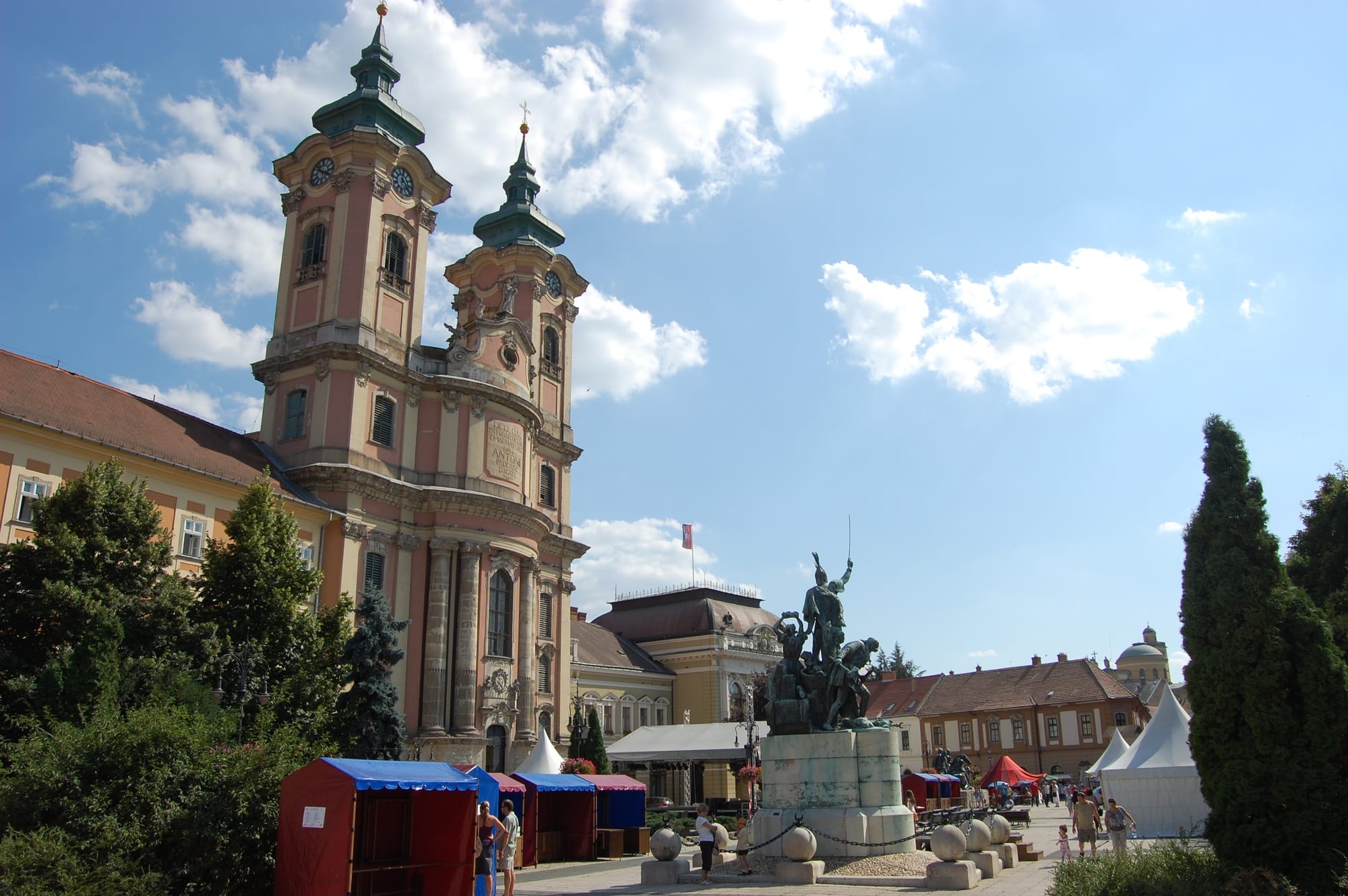
A twin-towered pink baroque church beside a square with a bronze statue of fighting soldiers and red market stalls

Northern Hungary, Hungary

Eger

The Minorite Church and the siege memorial on Dobó István tér, the main square of Eger. (h_laca / Wikimedia Commons · CC BY 3.0)

The seat of Heves county, a baroque town of about 49,000 people (2022 census) on the Eger Stream between the Mátra and Bükk hills. Its castle held off an Ottoman army in 1552 and later fell for 91 years of Turkish rule; its bishops then rebuilt it in baroque, and today it is known for its minaret, thermal baths, university and the Bikavér red wine of its cellar valley.

Neighbourhoods

  • The town centre (Belváros)
    • First-time visitors
    • Historic district
    • Best for food

    The baroque core around Dobó István tér, the pedestrianised main square with the Minorite Church and the town hall, and the streets leading to the cathedral and the Lyceum. Shops, cafés and restaurants fill the car-free streets.

    Open in Maps
  • Castle Hill and Almagyar
    • Historic district
    • Views
    • Quiet and residential

    The oldest part of Eger, with the castle above the centre, and the steep residential hill of Almagyar beside it, one of the town's sought-after areas, with fine views and part of the university campus.

    Open in Maps
  • Szépasszony-völgy
    • Wine
    • Nightlife

    The Valley of the Beautiful Woman on the south-western edge of town, about 2 km from the centre, where around 200 small wine cellars cut into the volcanic tuff open as tasting rooms, many with simple restaurants.

    Open in Maps
  • Felnémet
    • Quiet and residential
    • Close to the hills

    A former village to the north, joined to Eger in 1961 and still rural in character, with the parish church of St Rosalia, and the road and railway leading into the Bükk.

    Open in Maps

Things to do

Famous landmarks

  • Eger Castlelandmark

    The hilltop fortress on the site of the first cathedral, where Captain István Dobó's small garrison repelled the Ottoman army in 1552; walls, casemates and museums tell the story.

    Open in Maps
  • Eger minaretlandmark

    A 40-metre Ottoman minaret, the highest and best preserved of three left in Hungary and one of the most northerly in Europe; it can be climbed for a view of the centre.

    Open in Maps
  • Cathedral Basilica of Egerlandmark

    The neoclassical cathedral built in 1831–37 to designs by József Hild for Archbishop Pyrker, with a dome 40 metres high.

    Open in Maps
  • Minorite Churchlandmark

    The twin-towered baroque church of 1758–67 on Dobó István tér, designed by Kilian Ignaz Dientzenhofer of Prague, with ceiling frescoes by Márton Reindl.

    Open in Maps
  • The Lyceummuseum

    A Zopf-style building of 1765–85, now part of the university, with a library under Johann Lukas Kracker's ceiling fresco of the Council of Trent, an astronomical museum and a camera obscura projecting the town onto a table.

    Open in Maps

Underground Eger and the baths

  • Town under the townattraction

    The network of cellars cut beneath the streets near the cathedral, known as Város a város alatt.

    Open in Maps
  • Turkish bathattraction

    A bath house of the Ottoman period, commissioned by Abdi Pasha, still in use for bathing.

    Open in Maps
  • Archbishop's Gardenpark

    The largest park in Eger, the Érsekkert, with sports grounds, a small lake and a fountain.

    Open in Maps

Wine

  • István cellar and National Wine Museummuseum

    A small wine museum in the former wine cellar of the archbishops.

    Open in Maps
  • Valley of the Beautiful Womanattraction

    Eger's cellar valley, around 200 wine cellars in a horseshoe of tuff; a small tourist train runs to it from the town centre.

    Open in Maps

Short trips from the town

  • Egerszalókattraction

    An open-air spa village west of Eger, fed by hot mineral water from an aquifer beneath the volcanic Mátra.

    Open in Maps
  • Szilvásváradattraction

    A village on the edge of the Bükk, reached by local train from Eger, with the Szalajka valley, the Fátyol (Veil) waterfall, a forest railway and a Lipizzaner stud.

    Open in Maps
  • Bükk National Parkpark

    Hungary's third national park, founded in 1977, protecting the forested limestone mountains, caves and ravines of the Bükk.

    Open in Maps

Seasonal events

  • Eger Spring Festivallate March to early April

    A season of concerts and cultural events across the town.

  • Bull's Blood Wine Feastmid-July

    A festival devoted to Egri Bikavér, the town's best-known red.

  • Castle Festivitieslate July

    Historical celebrations in the castle, with costumed re-enactments recalling the frontier wars.

  • Baroque Festival of EgerJuly–August

    Concerts and events in the baroque churches and squares.

  • Festival of Szépasszonyvölgymid-August

    A summer festival in the cellar valley.

Eat and drink

Long-standing places and food districts in Eger. Hours, ratings and directions come from your maps app, always current.

Eger classics

  • Cellars of the Valley of the Beautiful Womanneighborhood

    Wine poured straight from the barrel in small cellars and csárdas, the classic Eger evening; Bikavér is the star, alongside dry whites.

    Open in Maps
  • Dobó István tér and the old-town streetsneighborhood

    Cafés and restaurants on and around the pedestrianised main square and the streets towards the cathedral.

    Open in Maps

Markets

  • Eger market hallmarket

    The farmers' market hall on Katona tér, busy most mornings except Sunday.

    Open in Maps

Experience Eger

History

People have lived in the Eger basin since the Stone Age. King Stephen I founded a bishopric here around 1009 and the first cathedral rose on Castle Hill; Walloon settlers in the 11th and 12th centuries brought western culture and helped establish the vineyards. The Mongols burned the town in 1241, but it recovered, gained a stone fortress and reached a medieval peak in the 14th and 15th centuries, when forests were cleared for vines.

After Mohács the fortress faced the Ottomans. In 1552 Captain István Dobó and a small garrison held it against a far larger army — a story told by the poet Sebestyén Tinódi Lantos and, in 1899, by Géza Gárdonyi's novel Eclipse of the Crescent Moon. Rebuilt by Italian engineers, the castle was handed over in 1596, beginning 91 years of Ottoman rule in which Eger became the seat of a province, churches became mosques and baths were built. The Holy League starved it into surrender in December 1687.

The 18th century was Eger's golden age. Bishops rebuilt it in baroque, rococo and neoclassical style — the Lyceum, palaces, the county hall and churches — artists and craftsmen flocked in, the population rose from 1,200 in 1688 to more than 17,000 in 1787, and the vineyards grew twelvefold. Fires in 1800 and 1827 and a cholera outbreak followed; Eger became an archdiocese in 1804, and Archbishop Pyrker founded the first Hungarian teacher training college in 1828 and built the cathedral. Bypassed by the main railway, it remained a school town, the "Hungarian Athens". Its Jewish community was murdered in 1944. In 1968 the baroque centre was protected from redevelopment.

Culture & Customs

The siege of 1552 is the heart of Eger's identity. The castle, the statue on Dobó István tér and the castle festivities each July recall the defenders, and the legend that they drank red wine the Ottomans took for bull's blood lies behind the name Egri Bikavér. Gárdonyi's novel, one of the most popular in Hungary, keeps the story alive, and Turkish visitors now come because of the shared history too.

The church shaped the town. As the seat of an archdiocese, Eger has an unusual concentration of baroque churches, palaces and seminaries, and the Lyceum, with its frescoed library, observatory and camera obscura, grew into today's Eszterházy Károly Catholic University, founded in 1774 and owned by the archdiocese since 2021. Archbishop Pyrker's gift of paintings to the nation became the core of the Museum of Fine Arts in Budapest.

The calendar is crowded with festivals: a spring festival, a feast of Bull's Blood in July, a baroque festival through the summer, a medieval market and a dance festival, and a festival in the cellar valley in August. Wine culture runs through it all, from the tasting rooms of Szépasszony-völgy to the harvest each autumn.

Daily Life

About 49,000 people lived in Eger at the 2022 census, the second-largest city in Northern Hungary after Miskolc and the county seat of Heves. Around a third of them live in Felsőváros, the largest housing estate, with its four- and ten-storey blocks; others live in districts of detached houses such as Lajosváros, on the hills of Almagyar and Hajdúhegy, or in the former village of Felnémet.

Industry arrived after 1945, including a large factory complex at Berva founded in 1951 and privatised in 1992, and several multinational companies now operate in the industrial zone east of town. The university, the church, county administration, wine and tourism are the other mainstays. Most visitors come for a single day, many of them from Slovakia.

Students give the centre a younger feel during term, and residents use the Archbishop's Garden, the thermal baths and the swimming pools designed by Imre Makovecz, while the Bükk hills just to the north offer forest walks.

Food

Wine comes first in Eger. Egri Bikavér, Bull's Blood of Eger, is a blended red whose name was recorded by the early 19th century; it is made today in three quality tiers — classicus, superior and grand superior — and the Nagy- Eged Hill is the region's grand cru site. Kékfrankos, the grape known abroad as Blaufränkisch, is a major part of the blend. The traditional whites are Egri Leányka, Debrői Hárslevelű and Egerszóláti Olaszrizling, and Chardonnay and Pinot Noir have arrived more recently.

The cellars of the Valley of the Beautiful Woman are cut into soft volcanic tuff, and the moulds and fungi on their walls are said to help the wine age. Many cellars serve wine straight from the barrel alongside simple food, and the town is also known for Egri Víz, a brandy dating from the 18th century.

Restaurants in the centre serve the Hungarian classics: gulyás, in Hungary a soup of meat and vegetables seasoned with paprika; pörkölt, a stew of boneless meat, onion and sweet paprika; chicken paprikás with nokedli dumplings and sour cream; and palacsinta pancakes. In Szilvásvárad, in the Bükk to the north, trout and truffle dishes are local specialities, and the farmers' market hall on Katona tér sells local produce.

Planning tools

Budget

Eger is cheaper than Budapest and Lake Balaton, with plenty of good-value guesthouses, and cellar tastings in the Valley of the Beautiful Woman cost little. Spa and wine-estate hotels in the area sit at the upper end.

Daily Budget Midrange
USD 90–170 (hotel or spa hotel, restaurant dinners, castle and bath tickets, a hire car for the hills)
Daily Budget Shoestring
USD 40–70 (guesthouse, cellar tastings, set-menu lunches, trains and buses)

The main square, the old-town streets and the cellar valley cost nothing to stroll, and tastings are inexpensive.

Best Time to Visit

May to October. Summer brings the wine and castle festivals and the cellar valley at its liveliest, and September to October is harvest time, when the forests of the Bükk turn colour. Winter is quiet, but the thermal baths and cellars stay open, and late March brings the spring festival.

Suggested Number of Days

Two days suit a first visit to the town and its cellars. Three or four allow time for the spa villages and the Bükk hills nearby, and more for walkers or anyone touring the wider wine region.

First Visit
2 days
With Surroundings
3–4 days

Transportation

The centre is compact and largely pedestrianised. Volánbusz local buses serve most districts, mainly on north–south routes, and line 12 links the railway station, the bus station and the centre. Local trains run north towards Szilvásvárad, and a car is useful for the hill villages.

The railway station is about 1.5 km from the centre; the bus station is closer, near the cathedral.

Airport & Station Connections

InterRegio trains from Budapest take about one and a half hours, and buses leave for the capital roughly every half hour, taking about two hours. The main station is 1.5 km from the centre, with smaller stops near the castle and in Felnémet. Budapest's Ferenc Liszt Airport is the nearest major international airport.

Walkability

Very walkable. The main square, cathedral, Lyceum, minaret and castle are all within a few minutes of each other, though the castle and Almagyar involve steep climbs. The Valley of the Beautiful Woman is a walk of 15–20 minutes from the centre.

Safety

Hungary is a safe country with low levels of violent crime. Eger is a calm town where visitors meet few problems; the main risks are slippery steps on the castle hill and in cellars, and ticks on forest walks in the hills.

Pace the wine tastings, use tick repellent in the Bükk and check for ticks after forest walks. Check current official travel advice before travelling.

Climate

A humid continental climate bordering on oceanic, with an annual average of 10.8°C. July is the warmest and wettest month, and January is the only month that averages below freezing.

Summer
warm — July averages 21.6°C, and the record high is 38.6°C
Winter
cold — January averages −0.8°C, and the record low is −18.3°C

Local Customs

Eger's pride rests on the 1552 siege, retold in Géza Gárdonyi's novel, one of the best-known in Hungary, and on its wine. Visitors come from Slovakia and Italy, many speak German, and more and more come from Turkey, drawn by shared history. The town is the seat of an archdiocese, and its churches are active places of worship.

Dress modestly in the cathedral and churches, and keep quiet during services.

Common Payment Methods

The currency is the Hungarian forint (HUF). Cards are widely accepted in the centre, but cash is useful in the smaller cellars of the Valley of the Beautiful Woman and at the market. ATMs are easy to find around the main square.