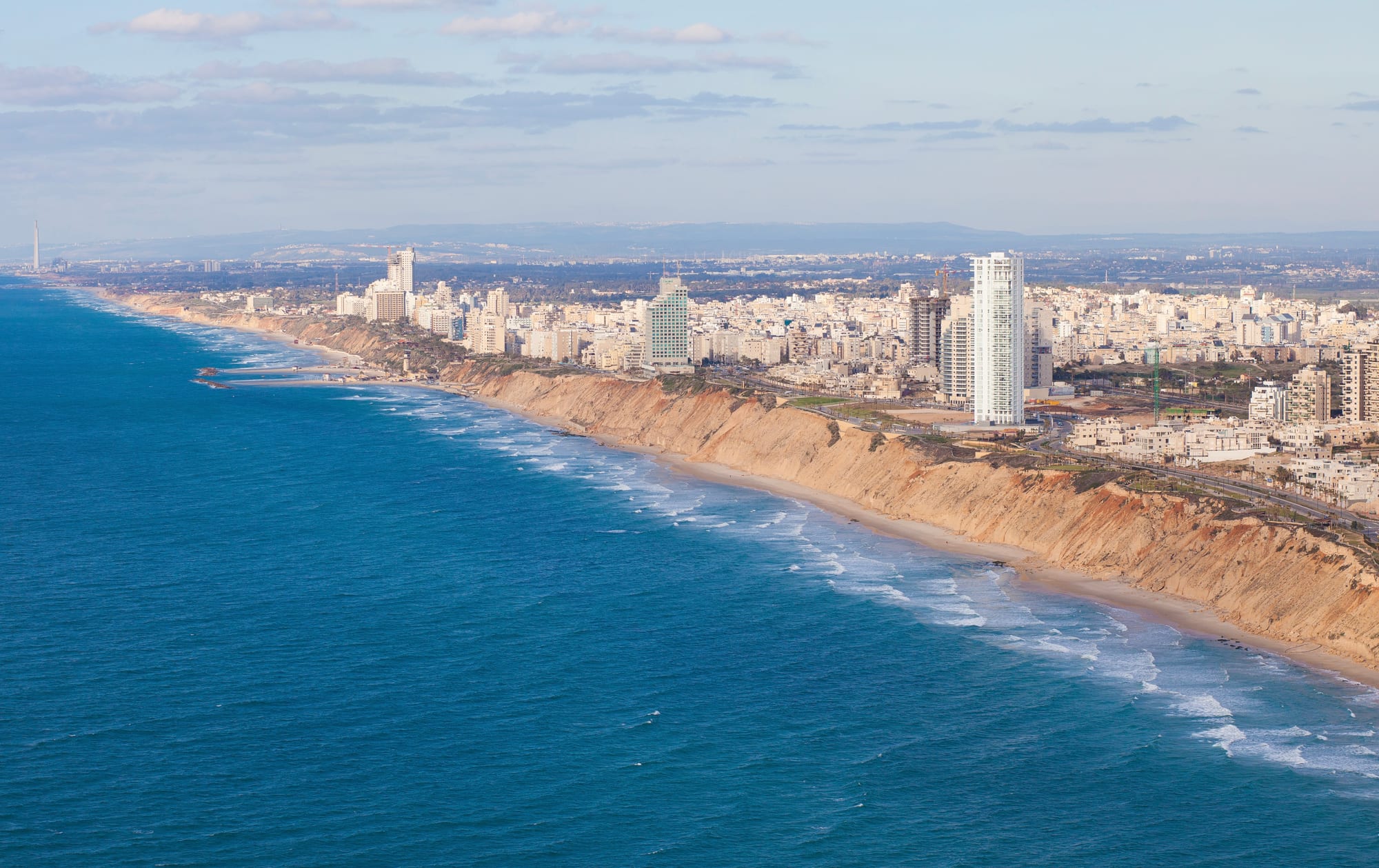
Aerial view of Netanya's sandstone cliffs and long sandy beach, with white apartment towers along the clifftop and the Mediterranean breaking below

Tel Aviv, Jerusalem & the Centre, Israel

Netanya

Netanya's cliffs, beach and clifftop city seen from the air. (Israel_photo_gallery / Wikimedia Commons · CC BY-SA 2.0)

A coastal city on the Sharon plain about 30 kilometres north of Tel Aviv, founded in 1929 among citrus groves and named after the American philanthropist Nathan Straus. Sandstone cliffs run the length of its shore, with wide beaches below and a clifftop promenade above, and diamond polishing built its industry. This page is written to explain the city, not to encourage travel.

Neighbourhoods

  • The city centre and Independence Square
    • First-time visitors
    • Cafés
    • Close to public transport

    The compact heart of the city sits on the clifftop around a large circular plaza that looks straight out to sea. Cafés, bakeries, hotels and shops surround it, a lift and stepped paths lead down to the sand, and much of the area is pedestrianised.

    Open in Maps
  • The clifftop promenade
    • Beaches
    • Walks
    • Quiet and residential

    A landscaped walkway runs for several kilometres along the top of the sandstone cliffs, past gardens, viewpoints and the apartment blocks where much of the city lives. Access points and lifts drop to the separate beaches below.

    Open in Maps
  • Poleg and Ir Yamim
    • Beaches
    • Quiet and residential
    • Shopping

    The newer southern districts, built between the cliffs and the Poleg stream, with wide streets, towers, a shopping centre and the least crowded of the city's beaches at their edge.

    Open in Maps
  • Kiryat Nordau and the north
    • Local life
    • Quiet and residential

    Older residential neighbourhoods inland and to the north, built for waves of immigrants from the 1950s onwards. Markets, small shopping streets and schools give this part of Netanya its everyday character, away from the seafront hotels.

    Open in Maps

Things to do

Beaches and the coast

  • Mikhmoretbeach

    A moshav on the coast about nine kilometres north of Netanya, with sandy bays and a fishing anchorage.

    Open in Maps
  • Nahal Polegpark

    A short coastal stream that reaches the sea at the city's southern edge, cutting through the sandstone ridge in a channel that was widened in antiquity.

    Open in Maps

Nature nearby

  • Alexander Streampark

    A river running down to the sea north of the city, known for the soft-shelled turtles that bask along its banks; its lower course is a national park.

    Open in Maps
  • Hefer Valleypark

    The farming plain inland from Netanya, drained in the 1930s, now fields, fish ponds, orchards and villages crossed by cycling routes.

    Open in Maps
  • Kfar Vitkinattraction

    A moshav founded in 1933 north of the city, with farmland running down to a quiet stretch of coast.

    Open in Maps

In the city

  • Wingate Instituteattraction

    Israel's national institute for physical education and sport, on a campus just south of the city.

    Open in Maps
  • Netanya Stadiumattraction

    A football stadium opened in 2012 in the south of the city, the home ground of Maccabi Netanya.

    Open in Maps

Short trips from the city

  • Caesarealandmark

    Herod's Roman port city up the coast, with a theatre, a hippodrome, an aqueduct and a harbour now partly under water, protected as a national park.

    Open in Maps
  • Apollonialandmark

    The ruins of a Crusader castle and an ancient town on cliffs above the sea at Herzliya, about 15 kilometres south.

    Open in Maps
  • Haderaattraction

    A larger town about 15 kilometres north, founded in 1891 by settlers from Lithuania and Latvia on land that was largely swamp and had to be drained.

    Open in Maps

Eat and drink

Long-standing places and food districts in Netanya. Hours, ratings and directions come from your maps app, always current.

Food streets and markets

  • Independence Square cafésneighborhood

    The clifftop plaza and the streets leading off it are ringed with cafés, ice-cream counters and French-style patisseries, a legacy of the city's large French-speaking community.

    Open in Maps
  • Herzl Streetneighborhood

    The main shopping street running inland from the seafront, with falafel and shawarma counters, bakeries and grill restaurants used by residents rather than visitors.

    Open in Maps
  • The city marketmarket

    A weekday produce market selling fruit, vegetables, olives, cheese, spices and household goods, busiest in the mornings and before Shabbat.

    Open in Maps
  • Fish restaurants at Mikhmoretneighborhood

    Simple seafood places near the anchorage north of the city, serving grilled and fried fish with mezze salads.

    Open in Maps

Experience Netanya

History

Netanya was founded in 1929 by members of the Bnei Binyamin association of farmers, who bought sand dunes and land on the Sharon plain to grow citrus. They named the new settlement after Nathan Straus, the American merchant and philanthropist who funded health and welfare work in the country, and the first houses went up among the groves a little inland from the cliffs. Growth was slow at first, and the Mediterranean beach was as much a working shore as a resort.

Two things changed it. In 1939 the first diamond polishing plant in the country opened here, and Netanya became one of the centres of the diamond trade — an industry that later shifted much of its business to Ramat Gan but left its mark on the city's economy and institutions. At the same time, the beaches and the clifftop air gave it a second life as a seaside resort for Tel Aviv and for visitors from abroad.

After 1948 the population multiplied as immigrants arrived from North Africa, Romania, Iraq and later the former Soviet Union and Ethiopia, and new neighbourhoods were laid out inland and to the north. From the 1990s a substantial French-speaking community settled here, and building moved south along the coast into Poleg and Ir Yamim, where towers now stand above the dunes. The city was among those hit by attacks during the second intifada in the early 2000s.

Culture & Customs

Netanya's character comes from who has moved there. Successive waves of immigration — Sephardi and Mizrahi families in the 1950s, Soviet Jews from 1990, Ethiopian Israelis, and a large French-speaking community from the 2000s — have given the city a mix of languages and kitchens that is unusual even by Israeli standards. Shop signs in French are common near the seafront, Russian is heard in the northern neighbourhoods, and Amharic in others.

Life is lived outdoors and towards the sea. The clifftop promenade functions as a public living room: walkers at dawn, pensioners on the benches through the afternoon, families and buskers in the evening, and the plaza above the beach used for open-air concerts and public events in summer. Paragliders launch from the cliff edge when the sea breeze is right, and the beaches below have their own regulars for matkot, swimming and fishing.

Sport matters here. Maccabi Netanya has played in the top division for most of its history, and the national physical education institute at Wingate, just south of the city, trains much of the country's coaching and sports medicine profession. Religious life is mostly moderate and traditional rather than strict, though the city has Orthodox neighbourhoods and synagogues serving many different immigrant traditions, and Shabbat quietens the streets from Friday afternoon.

Daily Life

About 235,000 people live in Netanya, the seventh-largest city in the country and the biggest on this stretch of coast. Many residents commute south to Tel Aviv or to the office parks along the coastal highway, and the railway station and Highway 2 carry heavy traffic in both directions each morning. Others work in local light industry, the remaining diamond businesses, hospitals, schools and the hotel and restaurant trade.

The city divides fairly clearly. The clifftop strip and the newer southern districts hold hotels, holiday flats and expensive apartments with sea views; inland and northern neighbourhoods built for earlier immigration waves are poorer, and municipal effort has gone into renewing them. Property prices near the sea have risen sharply, partly driven by second homes bought from abroad, which leaves some seafront buildings half empty outside the summer.

Days follow the coastal rhythm: early swimmers and runners on the promenade, schools and offices from Sunday to Thursday, the market busy in the morning, and the seafront filling again as the afternoon cools. Friday is for shopping before Shabbat, and Saturday belongs to the beach. Since February 2026 the war with Iran has added rocket alerts and periods when public gatherings are cancelled to ordinary life here as elsewhere in the country.

Food

Netanya eats what the rest of the coast eats, with an accent of its own. Falafel and shawarma counters, hummus places and bakeries fill the streets leading inland from the seafront, and the city market supplies olives, cheeses, spices, dates and the citrus that the area was planted with a century ago. Sabich, the pita of fried aubergine and hard-boiled egg with tahini and amba, and shakshuka, eggs poached in spiced tomato and pepper, are everyday food here as everywhere in Israel.

The French community has left the clearest mark. Patisseries and boulangeries around the centre sell croissants, éclairs and baguettes alongside rugelach and burekas, and several restaurants cook in a French-Mediterranean style, with kosher versions of dishes that would elsewhere use butter or cream. North African cooking brought by immigrants from Morocco and Tunisia is strong too: couscous with vegetables and meat on Friday, fish in spicy tomato and pepper sauce, and harissa on the table.

The sea provides the rest. Fish restaurants at the small anchorages north of the city, at Mikhmoret and along the shore, grill whatever has come in and serve it with a spread of mezze salads. Fruit from the Sharon plain and the Hefer Valley — citrus, avocados, strawberries in spring — appears in the markets and at roadside stalls, and summer evenings on the promenade run on ice cream and cold watermelon with salty cheese.

Planning tools

Budget

Netanya is cheaper than Tel Aviv and is often used as a coastal base for that reason, with a range of seafront hotels and holiday flats. Prices climb in July and August and around the Jewish holidays, when Israeli families fill the beaches. Beaches, the promenade and the clifftop gardens cost nothing.

Daily Budget Midrange
USD 170–320 (mid-range seafront hotel, restaurant dinners, taxis and day trips)
Daily Budget Shoestring
USD 80–130 (guesthouse or holiday flat, market and street food, buses and trains)

Holiday flats a few streets back from the cliff are much cheaper than seafront hotels, and the train makes Tel Aviv an easy day out from here.

Best Time to Visit

May to June and September to October, when the sea is warm and the beaches are not yet or no longer crowded. July and August are hot, humid and busy with Israeli holidaymakers; winter is mild but wet and windy, and the cliff paths can be slippery. The security situation overrides the season, and Israel has been at war since February 2026.

Suggested Number of Days

A day or two is enough for the beaches, the promenade and the centre. Three or four suit a longer seaside stay with trips along the coast and into the Sharon plain. Beach weather is the main thing that lengthens a visit.

First Visit
1–2 days
With Surroundings
3–4 days

Transportation

The coastal railway stops at a station on the eastern edge of the city, with frequent trains south to Tel Aviv and north to Haifa, and local buses link it to the seafront. City buses cover the neighbourhoods, and intercity buses serve the inland towns. Taxis are easy to find in the centre, and the flat clifftop makes cycling along the promenade straightforward.

Buses and trains stop from Friday afternoon until Saturday evening, so plan beach days and departures around Shabbat.

Airport & Station Connections

Ben Gurion Airport is about 50 kilometres south-east, reached by train with a change or by taxi in roughly 45 minutes. Trains run to Tel Aviv in around half an hour and to Haifa in about the same, and Highway 2 along the coast links the city to both. Aviation across the region has been disrupted since the war with Iran began in February 2026.

Walkability

The centre is small and flat and the clifftop promenade invites long walks, with lifts and stairways down to the beaches for anyone who does not want the climb. Outside that strip the city spreads into residential districts that are better reached by bus or car, and the walk from the railway station to the sea is a long one.

Safety

Everyday crime is low and the seafront is busy and well used. The practical cautions are sea currents — swim only at lifeguarded beaches — and the sandstone cliffs, which are unstable and fenced in places. In times of conflict rocket sirens sound in the area and buildings have shelters or safe rooms. Since 28 February 2026 Israel has been at war with Iran, Iranian missiles have reached the Tel Aviv area to the south, and a nationwide state of emergency closed schools and workplaces and cancelled public gatherings. This page is written to explain the city, not to suggest travelling there.

Learn where the nearest shelter or safe room is, follow Home Front Command instructions, keep off the cliff edges and swim between the flags. Check current official travel advice before travelling.

Climate

Mediterranean and coastal, much like Tel Aviv: hot, humid, rainless summers and mild winters in which nearly all the year's rain falls. Sea breezes take the edge off summer afternoons on the clifftop.

Summer
hot and humid, around 29–31°C by day with warm nights
Winter
mild and rainy, 10–18°C, with storms blowing in off the sea

Local Customs

Netanya is a mixed and largely secular city, with big French-speaking, Russian-speaking, Ethiopian and Anglophone communities, so French and Russian are heard as often as Hebrew in parts of the centre. Beachwear belongs on the beach; the centre itself is casual. Shabbat closes most shops and transport from Friday afternoon, and the north of the city holds the Haredi neighbourhood of Kiryat Sanz, with its own beachfront.

Tipping of about 10 per cent is usual in restaurants. Ask before photographing people, and dress modestly if visiting synagogues.

Common Payment Methods

The currency is the Israeli new shekel. Cards and contactless payment are taken almost everywhere, including buses and beach kiosks, and ATMs are easy to find in the centre. Small amounts of cash help at market stalls.