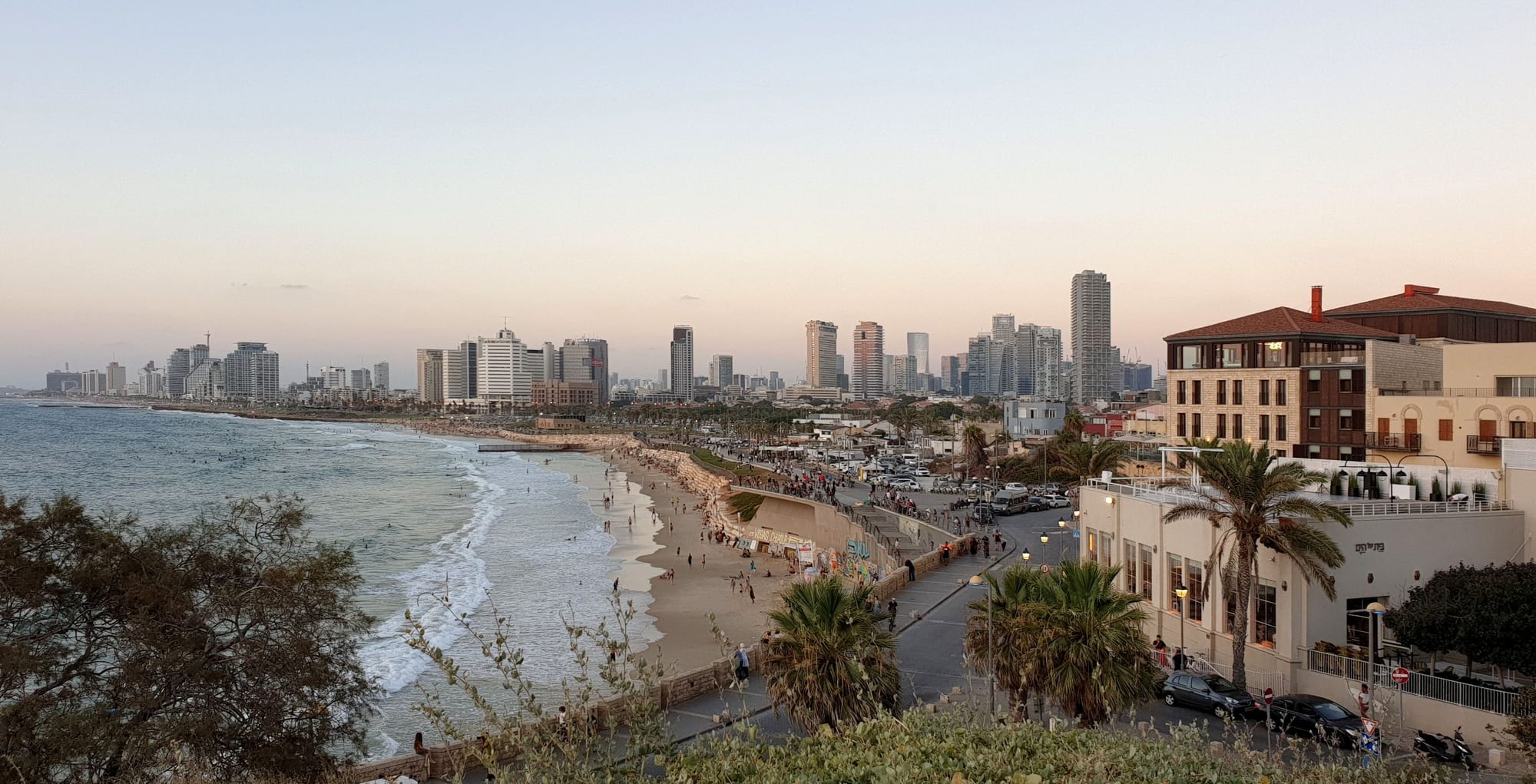
The curving beach and seafront promenade of Tel Aviv at dusk, seen from Jaffa, with the city's towers beyond

Israel

Tel Aviv, Jerusalem & the Centre

The Tel Aviv shoreline and skyline seen from the old city of Jaffa at sunset. (Ariel Manor / Wikimedia Commons · CC BY 2.5)

Israel's populous heart, running from the Mediterranean beaches of Tel Aviv and ancient Jaffa across the citrus-growing coastal plain to the Judean Hills and Jerusalem — a region that holds both the secular, commercial metropolis and the contested holy city, with Ein Karem on Jerusalem's western edge and the old towns of Ramla and Lod between them.

Explore Tel Aviv, Jerusalem & the Centre

History

Jaffa is one of the oldest ports on the Levantine coast, mentioned in Egyptian records and in the Bible as the harbour where Jonah took ship and cedar arrived for Solomon's Temple. It changed hands with every empire — Greek, Roman, Crusader, Mamluk, Ottoman — was stormed by Napoleon in 1799, and grew in the 19th century as the landing place for pilgrims and the centre of the citrus trade. In 1909 Jewish families founded a new garden suburb on the dunes to the north; Tel Aviv outgrew its parent within decades, Israel's independence was declared there on 14 May 1948, and the two were merged as Tel Aviv-Yafo in 1950.

Jerusalem's story is older and heavier. The Bible makes it the capital of David and the site of Solomon's Temple, destroyed by Babylon in 586 BC; Herod rebuilt the Second Temple on a vast platform, and Rome burned it in 70 CE. Byzantine churches, the Dome of the Rock of 691, the Crusader kingdom from 1099, Saladin's reconquest in 1187 and four Ottoman centuries followed; Suleiman the Magnificent built the present Old City walls in the 1530s. Divided by the 1948 war, the city came under Israeli control in 1967, when Israel captured East Jerusalem, including the Old City, and later annexed it — a step most of the international community does not recognise. Israel regards the whole city as its capital; Palestinians claim East Jerusalem as the capital of a future state.

On the plain between them, the Umayyads founded Ramla in the early 8th century as the regional capital. Zionist farming colonies such as Petah Tikva (1878) and Rishon LeZion (1882) came later, and in July 1948 most Arab inhabitants of Lydda (Lod) and Ramla fled or were expelled.

Culture & Customs

The region holds Israel's sharpest contrast. Tel Aviv is secular, liberal and nocturnal, with a beach culture, one of the largest Pride parades in the Middle East and a restaurant and nightlife scene that runs through Friday night. An hour inland, Jerusalem is conservative and devout: Haredi neighbourhoods such as Mea Shearim ask visitors to dress modestly, the city slows to near silence on Shabbat, and Friday prayers at al-Aqsa and Sunday Masses at the Holy Sepulchre shape the week in the Old City.

Jerusalem is also three cities in one. Its Jewish west, its Palestinian east — most of whose Arab residents hold permanent residency rather than Israeli citizenship — and the Old City's Muslim, Christian, Jewish and Armenian quarters each keep their own schools, languages and rhythms. Bnei Brak, beside Tel Aviv, is a centre of Haredi Judaism, while Jaffa, Lod and Ramla remain mixed Arab and Jewish towns, and Abu Ghosh in the hills is an Arab village known for its hummus and its choral music festival.

The calendar is religious in Jerusalem — Passover and Easter processions, the Sukkot pilgrimage, Ramadan nights by Damascus Gate — and cultural on the coast, with Tel Aviv's White Night all-night arts festival and Purim street parties. Manners follow the national style: direct, informal, argumentative, and quick to invite a stranger to a Friday-night meal.

Daily Life

This is where most Israelis live and work. Jerusalem, with more than a million people, is the largest city, while Tel Aviv proper has about 475,000 but anchors the Gush Dan metropolis that includes Ramat Gan, Holon, Bat Yam, Bnei Brak and Herzliya. The Central District's suburbs — Petah Tikva and Rishon LeZion with roughly a quarter of a million each, Netanya, Rehovot, Kfar Saba, Ra'anana and the planned city of Modi'in — fill the plain between.

Tel Aviv and Herzliya concentrate the technology start-ups, banks and the diamond exchange in Ramat Gan; Rehovot has the Weizmann Institute of Science; and Jerusalem lives on government, universities, religion and tourism, with large Haredi and Palestinian communities that are poorer than the national average. Housing is the constant complaint: rents in Tel Aviv are among the highest in the region, and young families push further out along the railways.

The working week runs Sunday to Thursday. Tel Aviv's day starts late and ends later, with the beach promenade busy at dawn and dusk; Jerusalem's is set by prayer times and the Friday rush to the market before Shabbat. Traffic jams on the Ayalon highway and the Jerusalem road are part of daily conversation.

Food

Jerusalem's signature is me'orav Yerushalmi, the "Jerusalem mixed grill" of chicken hearts, livers and other offal fried on a griddle with onion and spices and stuffed into pita; the city also claims kugel Yerushalmi, a peppery-sweet caramelised noodle bake from its old Ashkenazi community, and the sesame-crusted oval ka'ak al-Quds, the Jerusalem bread sold from carts at the Old City gates, eaten with za'atar. Hummus is taken seriously, from counters in the Muslim Quarter to Abu Ghosh, and Machane Yehuda market is the place to shop and graze.

Tel Aviv eats more freely. Sabich, the pita of fried aubergine and hard-boiled egg, spread from the Iraqi Jewish community of Ramat Gan; Jaffa is known for its old bakeries, its shakshuka and its Arab sweet shops selling knafeh, a warm cheese pastry in syrup; and the Carmel Market and Levinsky Market supply spices, dried fruit and borekas. The city's chef-led restaurants helped put modern Israeli cooking on the world map.

The coastal plain gave the world the Jaffa orange, and the Judean Hills around Jerusalem are a growing wine region, with the Trappist monks of Latrun long among its producers. The Carmel winery cellars at Rishon LeZion date from the Rothschild era of the 1890s.

Attractions & Natural Wonders

Jerusalem's Old City is the centrepiece: the Western Wall, the Temple Mount / Haram al-Sharif with the Dome of the Rock and al-Aqsa Mosque, the Church of the Holy Sepulchre at the end of the Via Dolorosa, the walk on the ramparts, and the Tower of David museum by Jaffa Gate. Outside the walls are the Mount of Olives and Gethsemane, the City of David excavations, Yad Vashem, the Israel Museum with the Dead Sea Scrolls, and Machane Yehuda. In the south-western hills, Ein Karem keeps the Church of the Visitation and the Church of St John the Baptist on its terraced slopes, and the Hadassah hospital synagogue nearby has Marc Chagall's stained-glass windows.

Tel Aviv's pleasures are its beaches and promenade, the Bauhaus buildings of the White City along Rothschild Boulevard, the Tel Aviv Museum of Art, Independence Hall, and the old port and Neve Tzedek quarter. Jaffa rises to the south, with its clock tower, the flea market, St Peter's Church and a harbour of fishing boats.

The coastal plain rewards day trips: Ramla's White Tower and underground Pool of Arches, the cliff-top ruins of Apollonia at Herzliya, the sandstone cliffs and beaches of Netanya, the Latrun monastery, and the Soreq stalactite cave near Beit Shemesh. Caesarea's Roman harbour, built by Herod and one of the great ruins of the coast, lies just beyond this region's northern edge, across the Haifa District line.

Cities in Tel Aviv, Jerusalem & the Centre

Planning basics

Budget

This is the most expensive part of an expensive country. Tel Aviv's hotels and restaurants are among the priciest in the Middle East, and Jerusalem is only a little cheaper, with prices climbing further around the Jewish holidays and Christian pilgrimage seasons. Markets such as Machane Yehuda and the Carmel Market, hummus counters and hostels keep costs down, and the towns of the coastal plain are cheaper places to sleep.

Daily Budget Midrange
USD 210–400 (mid-range hotel, restaurant dinners, museum and site tickets, taxis)
Daily Budget Shoestring
USD 100–150 (hostel dorm, market food and hummus counters, buses and light rail)

Stock up before Shabbat: from Friday afternoon Jerusalem largely shuts down, while Tel Aviv keeps many cafés and bars open.

Safety

Street crime is low, and the beaches and centres of Tel Aviv feel relaxed in calm periods. Jerusalem is more tense: clashes, stabbings and heavy policing have recurred around the Old City, Damascus Gate, the Temple Mount and East Jerusalem neighbourhoods, especially on religious holidays and Fridays. In times of conflict, rocket sirens sound across the Tel Aviv area and Jerusalem, and every building has a shelter or safe room.

Learn where the nearest shelter is, avoid demonstrations and Old City gates at prayer times during tense periods, and dress modestly in religious neighbourhoods. Check current official travel advice before travelling.

Climate

The coast around Tel Aviv is Mediterranean and humid, with long hot summers and mild, rainy winters. Jerusalem, at roughly 750–800 metres in the Judean Hills, is drier and noticeably cooler: summer nights are fresh, winter can be cold and wet, and a light snowfall comes every few years.

Summer
humid and 30–32°C on the coast; dry and 28–31°C in Jerusalem, with cool nights
Winter
mild and rainy on the coast, 10–18°C; cold and wet in Jerusalem, 5–12°C, with occasional snow

Transportation

Ben Gurion Airport lies in the Central District between the two cities. The fast railway links Jerusalem, the airport and Tel Aviv in well under an hour, and coastal trains continue to Netanya and beyond. Tel Aviv has a light rail Red Line and Jerusalem a light rail line past the Old City, and dense bus networks cover the suburbs. Driving is slow in traffic, and parking in both centres is hard and costly.

Use the train or a shared sherut taxi between Tel Aviv and Jerusalem, and keep a car for day trips to the Judean Hills and the coastal plain.

Best Time to Visit

March to May and October to November, when both the beach and the hill city are comfortable. Summer suits Tel Aviv's beaches but is hot and crowded; winter brings rain and chilly evenings to Jerusalem. Passover, Easter, Sukkot and Christmas fill Jerusalem's hotels and holy sites, and prices rise with them.