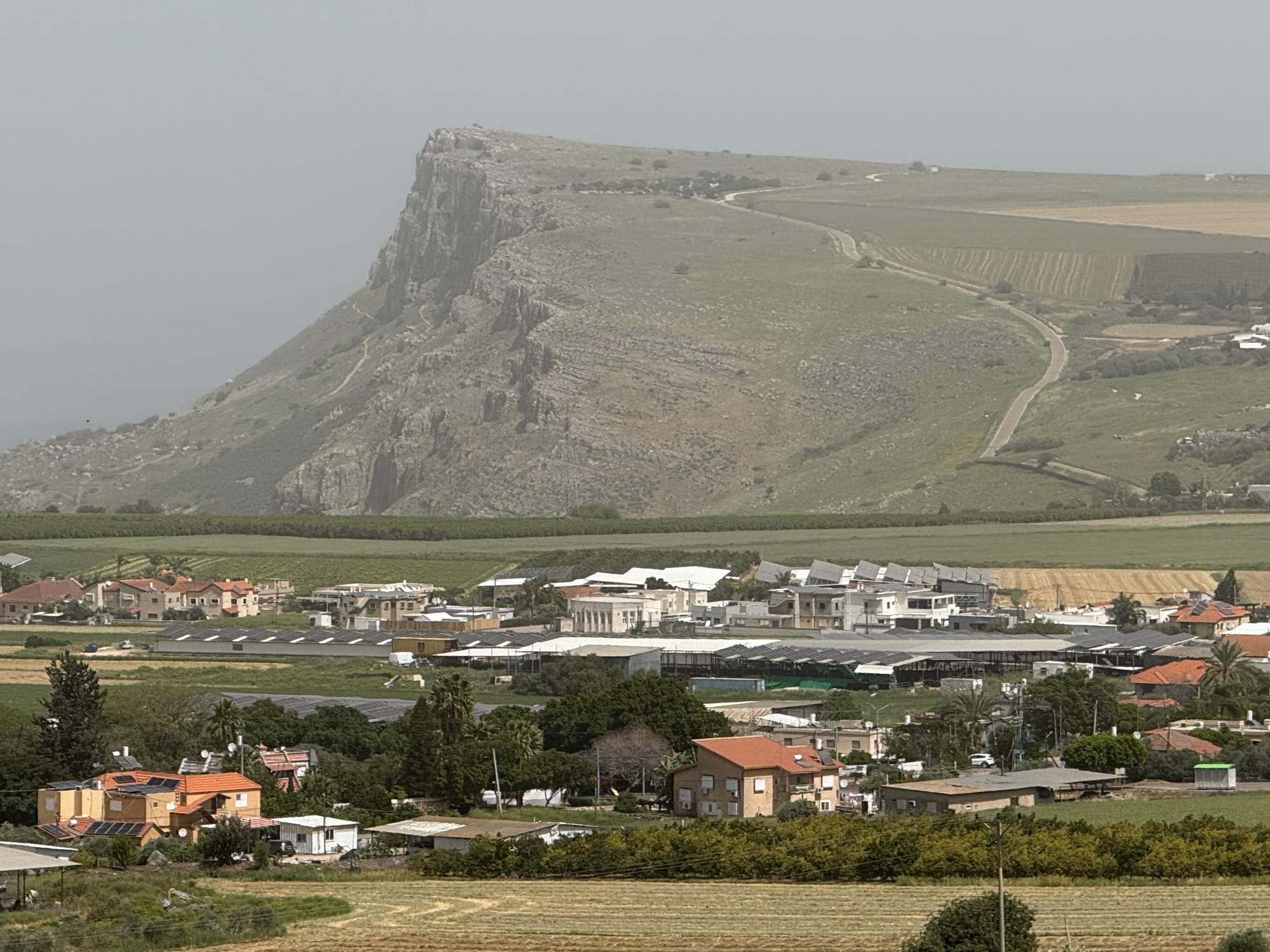
A steep limestone cliff above green fields and a village of red-roofed houses under a hazy sky

Israel

Haifa, the Galilee & the North

Mount Arbel's cliff above the Arbel Valley, north-west of the Sea of Galilee. (שלמה רודד / Wikimedia Commons · CC BY 2.5)

Israel's greenest and most mixed region, stretching from the port city of Haifa on Mount Carmel through the hills of the Galilee to the Sea of Galilee and the Israeli-controlled Golan Heights — home to Acre, Nazareth, Tiberias and Safed, and to large Arab, Druze and Jewish communities living side by side.

Explore Haifa, the Galilee & the North

History

The north has been fought over since the Bronze Age. Megiddo, above the Jezreel Valley, guarded the coastal road so long that its name gave the world "Armageddon"; Beit She'an became Scythopolis, a Roman and Byzantine city destroyed by an earthquake in 749. Jesus grew up in Nazareth and taught around the Sea of Galilee, and after Rome crushed the Jewish revolts the Galilee became the centre of Jewish life: the Mishnah was compiled there and much of the Jerusalem Talmud was compiled in Tiberias, a city Herod Antipas founded around 20 CE.

Acre was the Crusaders' main port and, from 1191, their de facto capital until the Mamluks took it in 1291. It revived under the 18th-century rulers Daher al-Umar and Ahmad al-Jazzar, who held it against Napoleon in 1799. Safed, meanwhile, drew Jewish exiles from Spain in the 16th century and became a centre of Kabbalah. Haifa grew from a small town into the region's port with the railway and the British harbour of the 1930s, and the Bahá'í faith, whose founder was exiled to Acre, made it their world centre.

In 1948 Haifa's Arab population largely fled or was driven out, while Nazareth and many Galilee villages remained Arab. Israel captured most of the Golan Heights from Syria in 1967 and has occupied and administered it since; Israel applied its law there in 1981, a move not recognised by most of the international community, although the United States recognised Israeli sovereignty in 2019. Syria claims the territory.

Culture & Customs

The north is where Israel's communities meet most closely. Haifa prides itself on Jewish–Arab coexistence, with Arabic heard in Wadi Nisnas and the German Colony as much as Hebrew. Nazareth, with about 76,000 people, is one of the largest Arab cities in the country, mostly Muslim with a large Christian community, while the Galilee holds many Arab towns and villages. Druze villages sit on Mount Carmel — Daliyat al-Karmel and Isfiya — and across the Galilee; the Druze, a closed religious community, serve in the army, while most of the Druze of the Golan, such as those of Majdal Shams, have kept Syrian identity and only some have taken Israeli citizenship.

Jewish life ranges from the kibbutzim of the valleys, founded by socialist pioneers, to the devout of Safed and Tiberias. On Lag BaOmer tens of thousands of pilgrims gather at Mount Meron, the tomb of Rabbi Shimon bar Yochai. Safed keeps an artists' quarter and a klezmer festival; Acre holds an alternative theatre festival each autumn; Nazareth's Christmas market and the Bahá'í pilgrimage season bring visitors of other faiths. Hospitality is warm across all communities, and meals in Druze and Arab homes are generous.

Daily Life

Haifa, with about 290,000 people, is the region's capital: a port, an oil refinery and heavy industry around the bay, the Technion and the University of Haifa, and a hi-tech park at its southern entrance. Beyond it lie Hadera and Zikhron Ya'akov to the south, Acre and Nahariya up the coast, Nazareth and Nof HaGalil, Afula and Karmiel inland, and the smaller Tiberias, Safed, Beit She'an and Kiryat Shmona. Katzrin is the largest Israeli settlement on the Golan.

Outside Haifa the economy is farming — fish ponds, orchards, olives, apples and cherries on the Golan — plus tourism, light industry and long commutes towards the coast. Many Arab towns face poorer infrastructure and, in recent years, rising organised crime, a leading public concern. Along the Lebanese border, life has been disrupted by the fighting since 2023, with families displaced for long periods.

Days start early and follow the season: walkers on the trails in spring, holidaymakers on the lakeshore in summer, olive picking in autumn.

Food

The north cooks some of Israel's best Arab and Druze food. The Druze villages of Mount Carmel are known for their huge, thin pita Druzit baked on a domed griddle and spread with labneh (strained yoghurt) and za'atar; Nazareth's restaurants serve Galilean dishes such as stuffed vegetables and kubbeh, the cracked-wheat shell filled with spiced meat, and its sweet shops make knafeh. Acre is famed for its hummus counters and its fish restaurants by the harbour.

Around the lake the classic is "St Peter's fish", grilled whole tilapia served in Tiberias restaurants. The Galilee produces olive oil, goat's cheeses from small hill dairies and honey; the Golan grows apples and cherries.

The north is Israel's leading wine country. Zikhron Ya'akov, founded with Rothschild support in the 1880s, has wine cellars dating from the 1890s; the Golan Heights Winery at Katzrin helped lead the country's move to quality wine in the 1980s; and many small wineries fill the Upper Galilee. Arak, the aniseed spirit, is drunk with mezze in Arab and Druze restaurants.

Attractions & Natural Wonders

Haifa's landmark is the Bahá'í Gardens, nineteen terraces descending Mount Carmel around the golden-domed Shrine of the Báb, part of a UNESCO World Heritage listing with the Shrine of Bahá'u'lláh near Acre. The city also has the Stella Maris Carmelite monastery and cable car, and the German Colony boulevard. Up the coast, Acre's Old City — a UNESCO World Heritage Site — has the Hospitaller Knights' Halls, the Templars' tunnel, the al-Jazzar Mosque and Khan al-Umdan, and further north lie the sea grottoes of Rosh HaNikra. South of Haifa are the Roman harbour and theatre of Caesarea, and the prehistoric caves of Mount Carmel.

Inland, Nazareth centres on the Basilica of the Annunciation and its old market, with Zippori's Roman mosaics, Mount Tabor, Tel Megiddo and the Roman city of Beit She'an nearby. The Sea of Galilee holds Capernaum, the Church of the Multiplication at Tabgha, the Mount of Beatitudes and the Yardenit baptism site, while Tiberias has its hot springs, lakeside promenade and the tomb of Maimonides. Mount Arbel's cliff looks down on the whole lake.

Safed's lanes hold the Ari and Abuhav synagogues and the artists' quarter. The Hula Valley draws migrating cranes each autumn and winter, and Tel Dan and Banias have springs feeding the Jordan. On the Golan, Gamla's ruins, Nimrod Fortress and the ski slopes of Mount Hermon complete the region.

Cities in Haifa, the Galilee & the North

Planning basics

Budget

The north is somewhat cheaper than Tel Aviv and Jerusalem, especially in Haifa, Nazareth and the Arab and Druze villages, where hummus and grill restaurants are good value. Rural guesthouses (tzimmers) in the Galilee and Golan are comfortable but not cheap, particularly at weekends and in the Jewish holidays, and a hire car is close to essential.

Daily Budget Midrange
USD 180–330 (tzimmer or mid-range hotel, restaurant dinners, car hire, site entries)
Daily Budget Shoestring
USD 80–130 (hostel or simple guesthouse, market and hummus meals, buses)

Book Galilee and Golan guesthouses for Friday and Saturday nights early; midweek stays cost noticeably less.

Safety

Everyday crime is low, but the north lies on two sensitive borders. Fire from Lebanon led to the evacuation of many Israeli border communities from late 2023, and the Golan faces Syria across a tense ceasefire line. Rocket sirens have sounded in Haifa and across the Galilee during conflicts, and access near the borders can close at short notice. Some fenced former minefields remain on the Golan.

Follow local instructions near the Lebanese and Syrian frontiers, learn where the nearest shelter is, and never cross fences marked as minefields. Check current official travel advice before travelling.

Climate

Haifa and the coast are Mediterranean and humid. Inland the climate depends on height: the Sea of Galilee, about 200 metres below sea level, is hot and sticky in summer, while Safed and the Upper Galilee hills are cooler and get occasional winter snow. Mount Hermon, at the northern tip of the Golan, is snow-covered for part of most winters.

Summer
humid and around 30°C in Haifa; 35°C or more around the Sea of Galilee; milder in Safed and the Golan
Winter
mild and wet on the coast, 10–18°C; cold and rainy in the hills, with snow on Mount Hermon

Transportation

Trains run up the coast from Tel Aviv to Haifa in about an hour and continue to Acre and Nahariya, with branch lines to Karmiel and through the Jezreel Valley towards Beit She'an. Buses link Haifa, Nazareth, Tiberias and Safed, but service to the Golan and the smaller villages is thin, so a car is the practical way to explore. Haifa has the Carmelit, a short underground funicular up Mount Carmel.

Hire a car for the Galilee and Golan, and keep to marked roads and trails on the Golan, where old minefields are fenced off.

Best Time to Visit

March to May, when the Galilee and Golan are green, wildflowers cover the hills and the waterfalls are running, and October to November after the summer heat. Summer is busy and very hot around the lake; winter brings rain to the hills and, some years, skiing on Mount Hermon. Christmas in Nazareth draws large crowds.