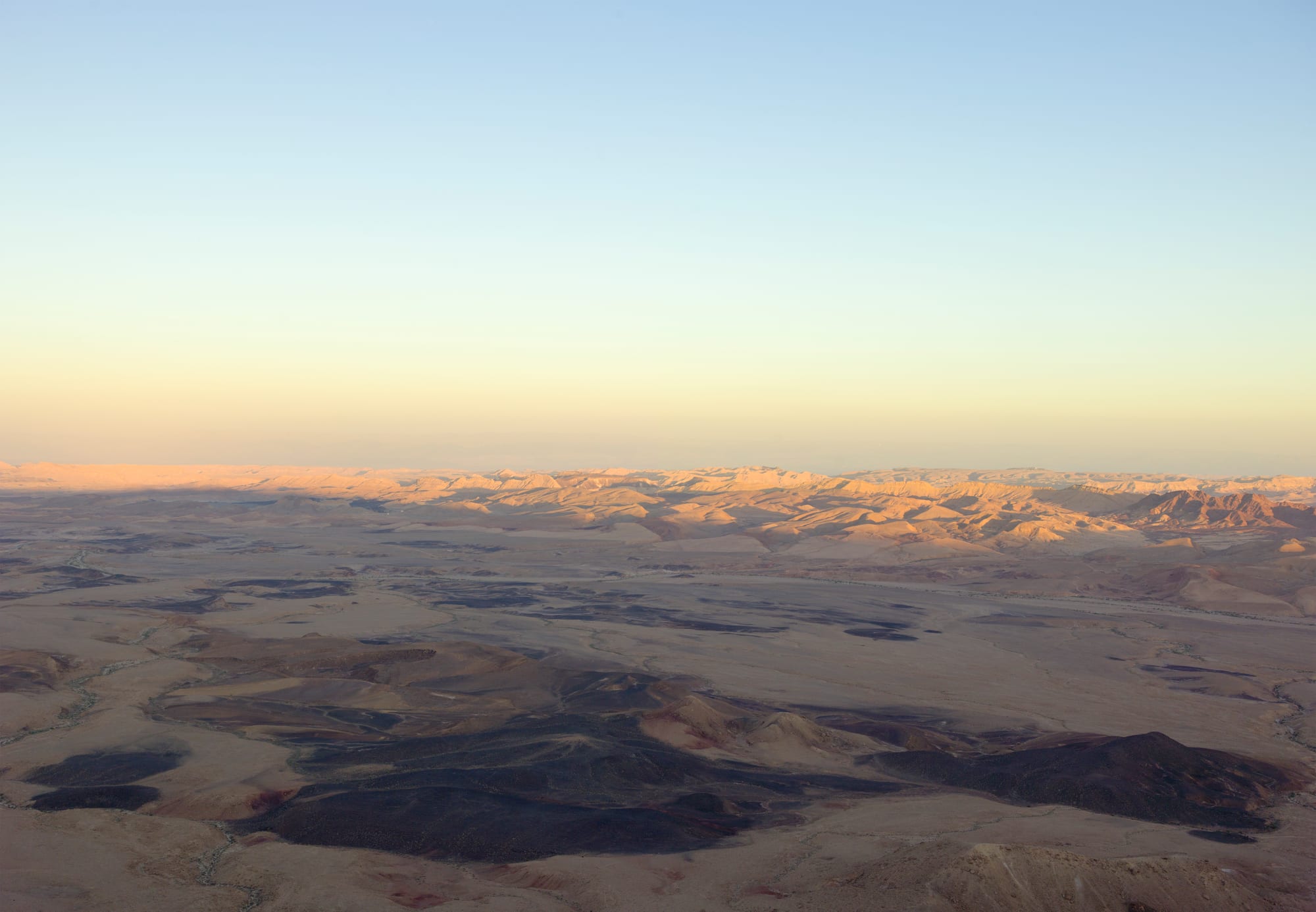
A vast desert basin of pale sand and dark rock outcrops, with rows of low ridges glowing in soft evening light

Israel

The Negev & Eilat

Makhtesh Ramon, the great erosion crater of the Negev, seen from the rim at Mitzpe Ramon. (Godot13 / Wikimedia Commons · CC BY-SA 4.0)

Israel's desert south, covering more than half the country's land but a fraction of its people — from Beersheba and the coastal cities of Ashdod and Ashkelon through the Negev's craters and Nabataean ruins to Masada, the southern Dead Sea shore and the Red Sea resort of Eilat.

Explore The Negev & Eilat

History

The Negev has been a crossing rather than a homeland for most of its past. Copper was mined at Timna from very early times, and Tel Be'er Sheva, a biblical-era walled town, is linked by tradition to the wells of Abraham. From around the third century BC the Nabataeans of Petra ran the incense trade from Arabia to the Mediterranean across the desert, founding Avdat, Mamshit, Shivta and Haluza; under Rome and Byzantium these towns farmed the desert with terraces and cisterns, before declining after the Arab conquest.

At Masada, Herod the Great built a palace-fortress on a mesa above the Dead Sea. During the revolt against Rome it became the last Jewish stronghold, falling to a Roman siege around 73–74 CE; the ramp the legionaries built is still there. Nearby Ein Gedi was a Jewish village famed for its balsam.

The modern story begins with the Ottomans founding Beersheba as an administrative town around 1900; in 1917 Australian light horsemen captured it in a celebrated charge. In 1949 Israeli forces reached the Red Sea at what became Eilat. David Ben-Gurion, the first prime minister, dreamed of settling the desert and retired to the kibbutz of Sde Boker; he is buried nearby. Immigrant towns such as Dimona, Yeruham and Mitzpe Ramon were founded in the 1950s, and Bedouin communities were concentrated in a restricted zone, a source of land disputes that continue. On 7 October 2023, Hamas-led gunmen attacked communities around Gaza, among them Be'eri, Kfar Aza, Nir Oz and Sderot, killing hundreds.

Culture & Customs

The south mixes communities more sharply than anywhere else in Israel. The development towns were settled largely by Jews from Morocco, Tunisia, Iraq and elsewhere in the 1950s, joined from the 1990s by immigrants from the former Soviet Union and Ethiopia, and North African traditions — the Mimouna feast at the end of Passover, pilgrimages to the tombs of revered rabbis — are strong here. Netivot's tomb of the Baba Sali draws large crowds on his anniversary.

The Negev Bedouin, some 200,000 people, keep an Arab tribal culture of extended families, hospitality and herding, though many now live in towns such as Rahat, the largest Bedouin city, and many others in villages the state does not recognise, which lack services. Kibbutzim, from Sde Boker to the Arava farms, add an older pioneer idealism, and Mitzpe Ramon has become a small colony of artists, astronomers and desert-lovers.

Eilat has its own relaxed, seaside character, with a large seasonal workforce, a jazz festival on the Red Sea and an easy dress code, while Beersheba's student population from Ben-Gurion University keeps the capital of the desert younger than its reputation.

Daily Life

Beersheba, with about 210,000 people, is the regional capital, with its university, the Soroka hospital and a growing cyber-technology park. The district also includes the coastal cities of Ashdod, a major port of roughly 225,000, and Ashkelon, together with Kiryat Gat, Sderot, Netivot, Ofakim, Dimona, Arad and Rahat. Eilat has about 56,000 residents; Mitzpe Ramon only a few thousand.

The economy mixes the Ashdod port and industry, the potash and chemical works at Sodom on the Dead Sea, army bases that have moved south, tourism in Eilat and at the Dead Sea, and irrigated desert farming in the Arava. Unemployment and poverty are higher than the national average, particularly among the Bedouin.

Life follows the heat: early starts, shuttered afternoons, evenings outdoors. The Dead Sea's level keeps falling, opening sinkholes that have closed beaches and roads, and the Gaza border communities are still rebuilding after 2023.

Food

Southern cooking reflects its people. North African Jewish kitchens in Beersheba, Dimona and Netivot serve couscous with vegetable broth, chraime — fish in a spicy red pepper and tomato sauce — and stuffed potatoes called mafrum, with sweet sfenj doughnuts at Hanukkah. Beersheba's market and grill restaurants are cheap and busy.

The Bedouin table centres on hospitality: bitter cardamom coffee poured from a brass pot, sweet tea with sage, thin flatbread baked on a domed griddle, and rice and lamb for guests. Several desert lodges and tent camps serve these meals to visitors, seated on floor cushions.

Israel is a major grower of the large Medjool date, and the Negev has wineries that rely on drip irrigation. Goat's cheese from desert farms and fresh Red Sea fish in Eilat round out the menu.

Attractions & Natural Wonders

The Dead Sea's Israeli southern shore holds the region's set pieces. Masada, a UNESCO World Heritage Site, is climbed on foot by the Snake Path at dawn or by cable car to reach Herod's palaces, storerooms and the Roman siege ramp. North of it, the Ein Gedi nature reserve has springs, waterfalls, ibex and an ancient synagogue mosaic, while the resort strip of Ein Bokek offers floating in the hypersaline water and mud treatments. Further south stands Mount Sodom, a ridge of rock salt.

In the heart of the desert, the Ramon crater, or Makhtesh Ramon, drops from the rim at Mitzpe Ramon into a basin of coloured sands and rock formations, with Nubian ibex wandering the town and some of the darkest night skies in the country. The Nabataean towns of Avdat, Mamshit and Shivta are part of the UNESCO-listed Incense Route site, and Ben-Gurion's desert home and grave at Sde Boker look down into the Zin canyon and the springs of Ein Avdat.

Beersheba has its Ottoman old town, the British war cemetery and, just outside, Tel Be'er Sheva, one of the UNESCO-listed Biblical Tels. At the southern tip, Eilat's Red Sea reefs are protected in the Coral Beach Nature Reserve, with an underwater observatory nearby, and inland lie Timna Park and the Red Canyon in the Eilat Mountains.

Cities in The Negev & Eilat

Planning basics

Budget

The Negev itself is one of the cheaper parts of Israel, with desert lodges, hostels and Bedouin tent camps, but the resort areas are not. Hotels at Ein Bokek on the Dead Sea and in Eilat are expensive in the winter high season and on Jewish holidays. Eilat is a VAT-free zone, which takes a little off shopping and hotel bills, and a hire car is the biggest extra cost.

Daily Budget Midrange
USD 200–400 (resort or desert lodge, restaurant meals, car hire, park and dive fees)
Daily Budget Shoestring
USD 80–130 (hostel or desert camp, supermarket and street food, intercity buses)

An Israel Nature and Parks Authority multi-site card can pay off quickly here, as Masada, Ein Gedi, Avdat and other sites all charge entry.

Safety

Much of the Negev is quiet and crime is low, but the region includes the communities next to Gaza, which suffered the attack of 7 October 2023 and where access can be restricted at short notice. Rockets have also targeted Ashkelon, Ashdod, Sderot and Beersheba, and missiles and drones from Yemen have been fired at Eilat. Natural hazards are heat, dehydration, flash floods and sinkholes along the Dead Sea shore.

Stay well away from the Gaza border area, heed flood warnings and closed trails, and never hike in summer midday heat. Check current official travel advice before travelling.

Climate

Desert almost everywhere. Beersheba and the northern Negev are semi-arid, with hot days and cool nights; Mitzpe Ramon, high on the plateau, has cold winter nights. The Dead Sea basin, about 430 metres below sea level, and Eilat on the Red Sea are extremely hot in summer and warm and sunny in winter. Rare winter storms cause flash floods in the wadis.

Summer
very hot and dry, 35–40°C in Beersheba and often above 40°C at the Dead Sea and Eilat
Winter
mild and sunny by day, 18–24°C at Eilat and the Dead Sea; cold at night on the plateau

Transportation

Trains run from Tel Aviv to Beersheba in a little over an hour and on to Dimona. Intercity buses cross the desert to Eilat in roughly five hours, with stops at Mitzpe Ramon, and others follow Route 90 down the Dead Sea shore. Ramon Airport, north of Eilat, handles domestic and international flights. Distances are long and buses thin, so most visitors drive; roads are good but remote.

Carry plenty of water and fuel up before long desert stretches, and start Masada and Ein Gedi walks at dawn.

Best Time to Visit

October to April is the season for hiking the Negev, climbing Masada and bathing in the Dead Sea, when days are warm rather than dangerous. Eilat is a winter sun destination, busy around the Jewish holidays and Christmas; spring also brings huge bird migrations through the Arava. Summer heat makes midday hiking unsafe.