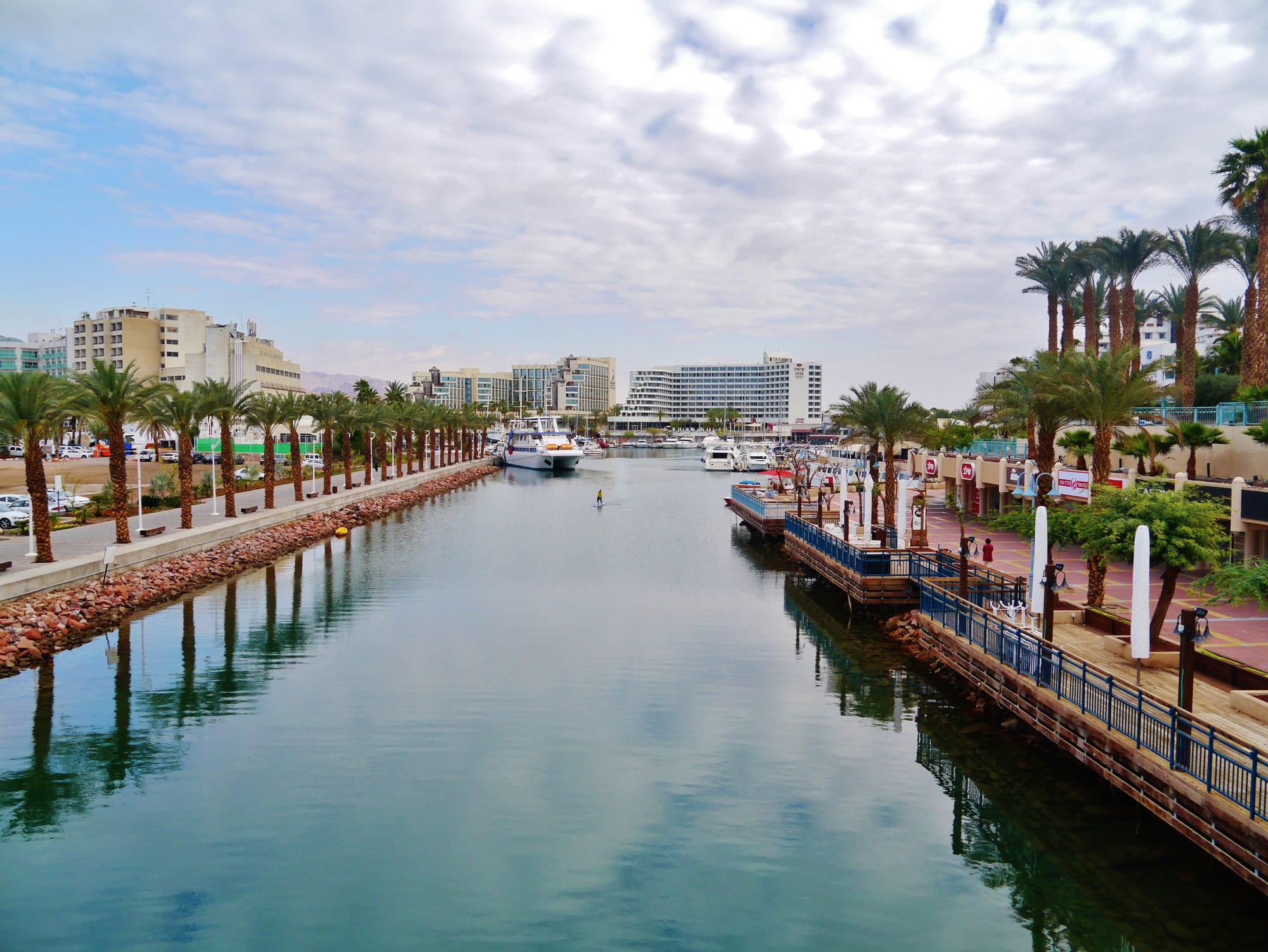
Eilat's lagoon lined with palm trees, boardwalk restaurants and white hotel blocks, with desert mountains behind

The Negev & Eilat, Israel

Eilat

The lagoon at Eilat, with the hotel district and the mountains of the Gulf of Aqaba beyond. (Zairon / Wikimedia Commons · CC BY-SA 4.0)

Israel's southernmost city, on a short stretch of Red Sea coast at the head of the Gulf of Aqaba, hemmed in by bare desert mountains and within sight of Jordan, Egypt and Saudi Arabia. Founded after 1949 as a port and outpost, it grew into a resort of hotels, marinas and coral reefs. This page is written to explain the city, not to encourage travel.

Neighbourhoods

  • North Beach and the hotel district
    • First-time visitors
    • Beaches
    • Nightlife

    The curve of shore at the head of the gulf, where most of the large hotels stand behind a promenade of cafés, shops and boat berths. The lagoon and marina cut inland here, and the beach is busy from morning until late in the evening.

    Open in Maps
  • The lagoon and marina
    • Boats and diving
    • Eating out
    • Evening walks

    A dug basin linked to the sea, crossed by a small opening bridge and ringed by jetties, dive operators and restaurants. Glass-bottomed boats and diving craft leave from here, and the quays stay lively after dark.

    Open in Maps
  • Coral Beach and the southern shore
    • Snorkelling and diving
    • Quiet and residential

    The road south towards the Egyptian border, where the fringing reef comes close to the shore. The nature reserve, the underwater observatory and several dive clubs are strung along it, with less noise than the northern beaches.

    Open in Maps
  • The town centre and the hill neighbourhoods
    • Local life
    • Everyday prices

    Away from the water, Eilat is a workaday desert town of apartment blocks, shopping centres and small grill restaurants climbing the slopes. Prices are lower than on the promenade, and this is where most residents live.

    Open in Maps

Things to do

The Red Sea and its reefs

  • Coral Beach Nature Reservebeach

    A protected stretch of fringing coral reef reached by snorkel straight from the shore, one of the northernmost reef systems in the world.

    Open in Maps
  • Underwater Observatory Marine Parkattraction

    A marine park south of the city whose observation chamber sits below the surface beside the reef, alongside aquariums and turtle and shark pools.

    Open in Maps
  • Dolphin Reefattraction

    An enclosed beach and floating-pier site on the southern shore where a group of dolphins lives in a fenced-off part of the gulf and visitors can swim with them.

    Open in Maps
  • North Beachbeach

    The main city beach at the head of the gulf, a shallow, sheltered strip of sand in front of the hotels with the lights of Aqaba visible across the water.

    Open in Maps
  • Port of Eilattransit hub

    Israel's only Red Sea port, opened for cargo in 1957 to give shipping a route to Asia and Africa; it shut down in July 2025 during the Houthi blockade of the Red Sea.

    Open in Maps

Desert and viewpoints

  • Eilat Mountainsviewpoint

    The granite and sandstone range rising straight behind the city, cut by wadis and crossed by marked trails with long views over the gulf.

    Open in Maps
  • International Birding and Research Center Eilatpark

    Salt pools and planted scrub on the northern edge of town, a ringing station and one of the best-known places to watch the migration that funnels huge numbers of birds up the Arava valley.

    Open in Maps
  • Taba Border Crossingtransit hub

    The crossing to Egypt's Sinai coast a few kilometres south of the city, at the end of the shore road.

    Open in Maps

Short trips from the city

  • Timna Valleypark

    A desert valley about 25 kilometres north with ancient copper mines, rock carvings and sandstone formations including Solomon's Pillars.

    Open in Maps
  • Amram's Pillarslandmark

    Eroded sandstone columns in a side wadi north of Eilat, reached on a short desert walk.

    Open in Maps
  • Red Canyontrail

    A narrow, iron-stained sandstone gorge in the Eilat Mountains, walked on a short circuit with ladders and handholds.

    Open in Maps
  • Hai-Bar Yotvata Nature Reservepark

    A breeding reserve in the Arava, about 35 kilometres north, set up in the 1960s for endangered desert animals such as wild asses, oryx and ostriches.

    Open in Maps
  • Ramon Airporttransit hub

    The airport serving Eilat, opened in 2019 in the Timna valley about 18 kilometres north of the city.

    Open in Maps

Seasonal events

  • Red Sea Jazz FestivalNovember

    An international jazz festival held in Eilat since 1987, with performances on open-air stages at the port; a shorter winter edition runs in January.

  • Spring bird migrationMarch to May

    Eilat sits on one of the world's great migration bottlenecks, and birdwatchers gather in spring as raptors, storks and songbirds pass up the Arava valley.

  • Jewish holiday weeksPassover in spring, Sukkot in autumn, Hanukkah in winter

    Israeli families fill the hotels during the main holidays, when the beaches, promenade and marina are at their busiest.

Eat and drink

Long-standing places and food districts in Eilat. Hours, ratings and directions come from your maps app, always current.

Eilat classics

  • Red Sea fishrestaurant

    Grilled fish and seafood are the resort staple, served along the marina and the promenade, often with Middle Eastern salads.

    Open in Maps
  • Yotvata dairy productscafe

    The kibbutz north of Eilat is known across Israel for its milk and flavoured milk drinks, sold at a roadside stop on Route 90.

    Open in Maps

Food districts

  • The promenade and marinaneighborhood

    The boardwalk between North Beach and the lagoon is lined with restaurants, ice-cream counters and bars, most of them geared to holidaymakers.

    Open in Maps
  • The town centre grillsneighborhood

    Away from the water, small shawarma, hummus and grill places serve residents and seasonal workers at everyday prices.

    Open in Maps
  • Bedouin-style desert mealsrestaurant

    Camps in the hills and the Arava serve tea, cardamom coffee, flatbread and rice with lamb on floor cushions.

    Open in Maps

Experience Eilat

History

Eilat is one of the youngest cities in Israel, but the head of the gulf has been used for far longer: the biblical harbours of Elath and Ezion-Geber are placed somewhere at the head of the gulf, perhaps on the Jordanian side, and copper from Timna to the north was worked from antiquity. Through the Islamic, Crusader and Ottoman centuries the shore held little more than a way station and wells, and by 1948 the site of Umm Rashrash held only an abandoned police post of five clay huts.

Israeli forces reached the Red Sea here in March 1949, at the close of the 1948 war, in an operation that raised an improvised flag over the site. The town was laid out in the 1950s as a strategic outpost, a port and a link to the Indian Ocean, and its harbour opened in 1957. The population grew slowly, drawn by port work, the Timna copper mines and a pipeline carrying oil north from the gulf. A frontier reputation for heat, hard work and cheap rent lasted well into the 1970s.

Tourism transformed the place from the 1970s onwards, as charter flights brought northern Europeans to guaranteed winter sun and the coral reef was recognised as a diving destination. Hotel towers filled the northern shore, a lagoon and marina were dug behind the beach, and the city was made a VAT-free zone in 1985 to encourage the trade. The peace treaty with Jordan in 1994 opened the crossing to neighbouring Aqaba. Ramon Airport, in the desert to the north, replaced the old runway that once cut through the middle of town, freeing land for building.

Culture & Customs

Eilat's culture is that of a resort at the end of a long road. Much of the working population arrives for a season, from elsewhere in Israel and from abroad, and the city has long attracted people looking for a place to start again; the result is an easy-going, informal town where beachwear is acceptable almost anywhere and religious observance is lighter than in most of the country.

Music and the sea shape the calendar. The Red Sea Jazz Festival, running since 1987, brings international musicians to open-air stages at the port, and smaller festivals and holiday concerts fill the hotels at Passover and Sukkot. Diving is more than a pastime: dive clubs, marine biologists working on the reef, and the research station studying coral in the gulf give the city a scientific side that visitors rarely see. Birdwatchers form another seasonal community, drawn by the migration that crosses the Arava twice a year.

The borders are close enough to be part of daily awareness. Aqaba's lights are visible across the water, the Egyptian frontier lies a few kilometres down the shore, and the Saudi coast is in view on a clear day. Residents are used to living in a small, remote city where everyone knows the same handful of streets, and to the seasonal rhythm of crowds arriving and leaving.

Daily Life

About 55,000 people live in Eilat, in apartment neighbourhoods climbing the slopes behind the hotels. The economy rests on tourism above all — hotels, restaurants, dive centres and boats — with some light industry and the desalination and services that keep a city alive in a place with no fresh water of its own. The port, long the other mainstay, shut down in July 2025 after the blockade of Red Sea shipping. Work is seasonal and often low-paid, and housing costs are high for the wages on offer, a long-standing local complaint.

The day is arranged around the heat. Shops and offices open early, the middle of the afternoon is quiet, and the promenade fills again at dusk, when families walk the seafront and the marina restaurants set out tables. The working week runs from Sunday to Thursday, and Eilat keeps more of its businesses open on Shabbat than most Israeli cities.

Isolation is the other constant: the nearest large city is several hours away across the Negev, deliveries come by a single road, and the weather in summer confines much of life indoors. Tourism numbers have fallen since the wider regional conflict began, and the airport, the hotels and the seasonal workforce feel that first. Water, power and the fragile reef just offshore are permanent subjects of local argument, as is the pressure of new building on the little open land the city has left.

Food

Eating in Eilat is resort food with a Middle Eastern base. Fish and seafood from the Red Sea and further afield are grilled or fried and served with a spread of small salads, olives, pickles and warm pita, the meze table that opens almost every sit-down meal in Israel. Hummus, falafel and shawarma are the everyday staples in the town centre, where small grills feed residents and seasonal workers rather than tourists.

The city's mixed population shows on the menu. North African Jewish families from the Negev's older towns brought couscous and chraime, fish poached in a spicy red pepper and tomato sauce, and Yemenite kitchens contribute malawach and jachnun, rich layered breads eaten with grated tomato and a fenugreek relish called hilbeh. Bedouin hospitality in the surrounding desert runs to bitter cardamom coffee, sweet sage tea, flatbread baked on a domed griddle and rice with lamb.

The Arava valley to the north supplies much of what is eaten: Medjool dates from the plantations along Route 90, vegetables grown under desert irrigation, and dairy products from Kibbutz Yotvata, whose flavoured milk is a national institution and whose roadside stop is a fixture of the drive to Eilat. Israeli wines from the Negev highlands appear on most wine lists, and the promenade's cafés serve the strong coffee and fresh juices that are standard across the country.

Planning tools

Budget

Eilat is a resort, and prices follow the season rather than the rest of the Negev. Hotel rates climb sharply during Jewish holidays and the winter sun months and fall in the heat of summer. The city is a VAT-free zone, which takes a little off hotel bills and shopping. Diving courses, boat trips and park entry are the other main costs.

Daily Budget Midrange
USD 200–400 (resort hotel, restaurant meals, car hire, dive and park fees)
Daily Budget Shoestring
USD 80–130 (hostel or guesthouse bed, supermarket and street food, walking and local buses)

Rooms are cheapest in the summer heat and dearest over the holidays; swimming, the promenade and the beaches cost nothing.

Best Time to Visit

October to April, when days are warm and sunny rather than punishing and the sea is still comfortable. Spring adds the bird migration up the Arava. Midsummer regularly passes 40°C, which makes walking in the mountains unsafe, though the hotels are cheaper then. The security situation overrides the season, and Israel has been at war since February 2026.

Suggested Number of Days

The city itself is small and two or three days covers it. Four or five allow the desert parks and reserves to the north as well. Divers and birdwatchers stay longer, and a hire car changes how much can be reached.

First Visit
2–3 days
With Surroundings
4–5 days

Transportation

Eilat is compact and much of it is walkable along the shore. Local buses run between the town, the hotel strip and the southern beaches, and taxis are easy to find. Intercity buses connect to Beersheba, Tel Aviv and Jerusalem across the desert, a journey of several hours. Most visitors who want the surrounding parks hire a car.

Carry water and fuel up before long desert drives on Route 90 and Route 12, where services are far apart.

Airport & Station Connections

Ramon Airport, about 18 kilometres north in the Timna valley, replaced the old city airfield in 2019 and handles domestic and international flights. Intercity buses take roughly five hours from Tel Aviv and about three from Beersheba. Land crossings lead to Aqaba in Jordan and to Taba in Egypt. Aviation in the region has been disrupted since the war with Iran began in February 2026.

Walkability

The promenade, lagoon, marina and North Beach form a flat, connected walking area, and the hotel district is designed to be crossed on foot. The southern beaches are several kilometres from the centre along a busy road, and the residential neighbourhoods climb steep slopes. Heat, not distance, is the limit for much of the year, and shade is scarce away from the seafront.

Safety

Since 28 February 2026 Israel has been at war with Iran, and Eilat was targeted by missiles and drones in March 2026. Missiles and drones fired from Yemen have also been aimed at the city, and one struck the terminal at Ramon Airport in September 2025, injuring two people; the Houthi offensive at the Bab al-Mandab strait from September 2026 has disrupted Red Sea shipping, and the port closed in July 2025. Everyday crime is low. The main ordinary hazards are heat and dehydration, flash floods in the wadis after rare storms, and diving and snorkelling accidents on the reef.

Learn the local shelter and alert arrangements, keep to marked trails and avoid the mountains in midday heat, and treat flood warnings seriously. Check current official travel advice before travelling.

Climate

Hot desert climate at the head of the gulf, with very little rain in any month and long hours of sun. The sea keeps humidity moderate, and strong afternoon winds funnel down the valley.

Summer
extremely hot and dry, with daytime highs commonly around 40°C and warm nights
Winter
mild and sunny, with days usually around 20–24°C and cool evenings

Local Customs

Eilat is the most relaxed place in Israel about dress: beachwear is normal on the promenade, and the city is less observant than most of the country, so many restaurants and shops stay open on Shabbat. The working week runs Sunday to Thursday. Hebrew is the main language, Arabic and Russian are widely heard, and English is understood in the tourist trade.

Tipping of about 10 per cent is usual in restaurants, security checks at entrances are routine, and the reef is protected — nothing may be touched, stood on or taken.

Common Payment Methods

The currency is the Israeli new shekel. Cards and contactless payment are accepted almost everywhere, and ATMs are common in the centre and the hotel district. Small cash amounts are useful for markets, taxis and kiosks. Eilat's VAT exemption means some prices are quoted without the tax charged elsewhere in the country.