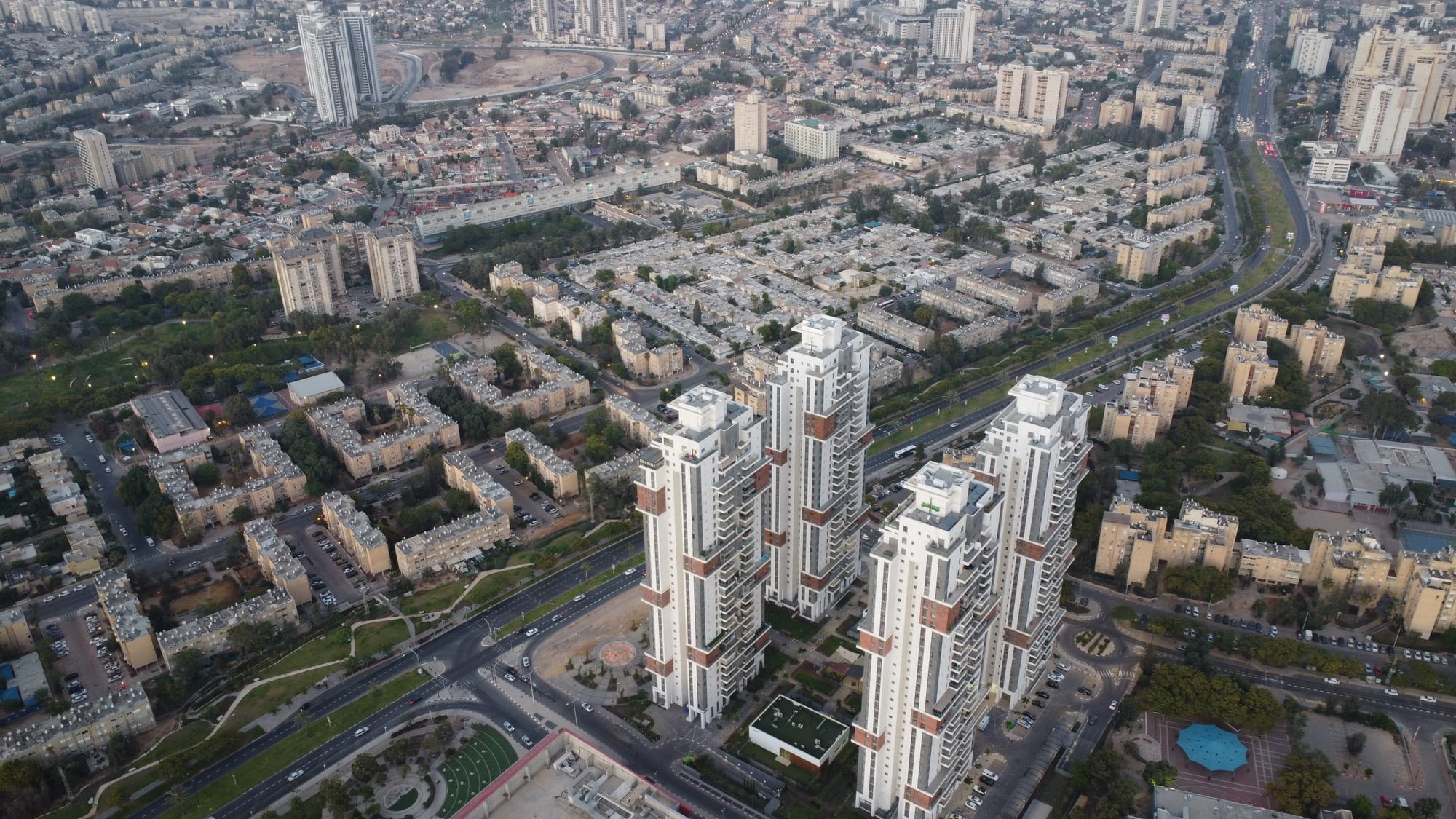
Aerial view of Beersheba, with white apartment towers, dense blocks of flats, tree-lined avenues and wide roads

The Negev & Eilat, Israel

Beersheba

Beersheba from the air, its apartment blocks and avenues spread across the northern Negev. (Yonatan Dodin / Wikimedia Commons · CC BY 4.0)

The largest city of the Negev, on the edge of the desert where the coastal plain gives out. Laid out by the Ottomans around 1900 on a site linked by tradition to Abraham's wells, it grew after 1948 into a city of immigrant housing blocks, a major university and hospital, and a growing technology quarter. This page is written to explain the city, not to encourage travel.

Neighbourhoods

  • The Old City
    • First-time visitors
    • Historic district
    • Bars and cafés

    The Ottoman grid laid out around 1900, with single-storey stone houses, the old mosque, the former governor's residence and the war cemetery nearby. Restored streets here hold galleries, bars and restaurants, and it is the only part of the city that feels old.

    Open in Maps
  • The city centre and the market quarter
    • Everyday prices
    • Markets
    • Close to public transport

    North of the Old City, around the central bus and railway stations, a dense mix of shops, offices, falafel counters and market stalls. The open market and the Bedouin market ground are within walking distance.

    Open in Maps
  • The university and hospital quarter
    • Students and nightlife
    • Close to public transport

    Ben-Gurion University, the Soroka Medical Centre and the advanced-technologies park stand together beside the northern railway station. Student flats, cheap food and late-opening cafés fill the surrounding streets.

    Open in Maps
  • The northern neighbourhoods
    • Quiet and residential
    • Families

    Ramot, Neve Ze'ev and the newer quarters spreading north and west are where most of the city lives — apartment towers, gardens, schools and shopping centres laid out from the 1980s onwards.

    Open in Maps

Things to do

Historic Beersheba

  • Tel Be'er Shevalandmark

    The mound of the biblical-era walled town east of the modern city, with a deep well, a horned altar and a water system, listed by UNESCO among the Biblical Tels.

    Open in Maps
  • Beersheba War Cemeterylandmark

    The Commonwealth war cemetery from the 1917 campaign, holding the graves of British and Anzac soldiers; a memorial centre was opened in its grounds in 2017.

    Open in Maps
  • Abraham's Wellattraction

    A well on the edge of the Old City, associated by long tradition with the biblical account of Abraham at Beersheba and dating to at least the twelfth century, now a visitor centre housing the city's archaeology museum.

    Open in Maps
  • The Old City gridneighborhood

    The Ottoman street plan of about 1900 with its stone houses, the former Turkish governor's residence and the mosque built for the new town.

    Open in Maps

Museums and science

  • Negev Museum of Artmuseum

    The city's art museum in the restored Ottoman governor's residence in the Old City, showing Israeli and international work.

    Open in Maps
  • Carasso Science Parkmuseum

    A large hands-on science centre for families near the Old City.

    Open in Maps
  • Israeli Air Force Museummuseum

    An open-air collection of Israeli and captured foreign aircraft, anti-aircraft weapons and exhibitions at Hatzerim air base, a short drive west of the city.

    Open in Maps

Parks, campus and landmarks

  • Monument to the Negev Brigadelandmark

    Dani Karavan's concrete monument to the Palmach Negev Brigade, built between 1963 and 1968 on a hill east of the city, a walk-through composition of towers, tunnels and inscribed walls.

    Open in Maps
  • Ben-Gurion University of the Negevattraction

    The university founded in 1969 to anchor the desert's development, with an open campus of modern architecture and desert gardens.

    Open in Maps
  • Beersheba River Parkpark

    A large park along the usually dry Beersheba stream south of the centre, with lawns, a lake, cycle paths and an amphitheatre.

    Open in Maps

Markets

  • The Bedouin marketmarket

    A long-running open-air market on the southern edge of the centre, where Bedouin traders sell food, clothing and household goods alongside other stallholders.

    Open in Maps

Short trips from the city

  • Tel Aradlandmark

    A Bronze Age city and an Israelite fortress with a rare temple, on a desert hill about 35 kilometres east.

    Open in Maps
  • Yatir Forestpark

    The largest planted forest in Israel, on the hills north-east of the city at the edge of the desert, with trails and picnic grounds.

    Open in Maps
  • Rahatneighborhood

    The largest Bedouin city in Israel, given its name and status in 1972, about 15 kilometres north, with markets and a food scene of its own.

    Open in Maps

Seasonal events

  • Commemoration of the 1917 chargelate October

    Ceremonies at the Commonwealth war cemetery and in the Old City mark the anniversary of the Australian Light Horse charge that took the town.

  • Sukkot and Passover holiday weeksautumn and spring

    The school holidays fill the parks, the science park and the desert sites around the city with Israeli families.

Eat and drink

Long-standing places and food districts in Beersheba. Hours, ratings and directions come from your maps app, always current.

Beersheba classics

  • North African Jewish cookingrestaurant

    Couscous with vegetable broth, chraime — fish in a spicy red pepper and tomato sauce — and stuffed vegetables, brought by the Moroccan and Tunisian families who settled the city after 1948.

    Open in Maps
  • Grill restaurants and hummus countersrestaurant

    Skewered meats, offal in pita, hummus with chickpeas and olive oil and heaps of salads are the everyday food of the centre.

    Open in Maps

Markets and food districts

  • The city marketmarket

    The covered and open stalls near the centre sell desert dates, olives, spices, cheeses and vegetables from the Negev and the coastal plain.

    Open in Maps
  • The Old City streetsneighborhood

    Restored Ottoman houses in the Old City hold bars, cafés and restaurants, the liveliest evening quarter in the Negev.

    Open in Maps
  • Bedouin foodrestaurant

    Hospitality tents and restaurants in and around Rahat and the desert villages serve cardamom coffee, flatbread from a domed griddle and rice with lamb.

    Open in Maps

Experience Beersheba

History

The wells that gave Beersheba its name made it a meeting point long before there was a town: Tel Be'er Sheva, a fortified settlement of the Iron Age on a low hill east of the modern centre, is connected by tradition with the biblical patriarchs Abraham and Isaac, and its deep well and horned altar are among the best-known finds of Negev archaeology. The site was abandoned in antiquity, and for many centuries the area belonged to the Bedouin tribes of the northern desert, who watered their flocks here.

The modern city was created by the Ottoman administration around 1900 as a district centre for those tribes — a planned grid of stone houses, a mosque, a school and a governor's residence, laid out from scratch for a district that had no town. British Empire forces took Beersheba on 31 October 1917 in a battle remembered for a charge by the Australian Light Horse; the Commonwealth war cemetery dates from that campaign. Under the British Mandate it remained a small market town.

Israeli forces captured Beersheba in October 1948 and it became the base for settling the Negev. Immigrants from North Africa, Iraq, Romania and later the Soviet Union and Ethiopia filled successive rings of housing blocks, and the population multiplied many times over within a few decades. Ben-Gurion University opened in 1969, the Soroka hospital grew into the region's medical centre, and from the 2010s the army's technology units and a cyber park beside the railway station gave the city a new role. Restoration of the Ottoman Old City has turned its oldest streets into the Negev's main evening quarter.

Culture & Customs

Beersheba is a city of arrivals, and its culture reflects each wave. North African Jewish traditions remain strong in its synagogues, its food and the Mimouna celebrations at the end of Passover; the Russian-speaking community that came in the 1990s supports its own shops, newspapers and cultural life and makes up a large share of the population; Ethiopian Israelis, Indian Jewish families and Bedouin residents add further layers. Little of this is packaged for visitors, which is part of the city's character.

The university sets much of the tone. Some twenty thousand students keep the Old City's bars and cafés busy, support a theatre company, galleries and a conservatory, and give the city an average age well below the national one. The city is also proud of its role in Israeli sport, with a football club that has won national titles and a basketball team, and of its part in the country's technology sector.

Relations with the Negev Bedouin, some of whom live in recognised towns such as Rahat and others in villages the state does not recognise, run through daily life here: they study at the university, are treated at the hospital and trade at the market, while disputes over land and services continue. Manners are direct and informal, Hebrew, Arabic and Russian are all heard in the street, and the working week ends on Friday afternoon, when the city goes quiet for Shabbat.

Daily Life

About 224,000 people live in Beersheba, making it the eighth most populous city in Israel and by far the largest in the south. Most live in apartment blocks in the lettered quarters built between the 1950s and 1970s or in the newer northern neighbourhoods, and the city is still growing outwards as young families priced out of the centre of the country move south.

Work is concentrated in a few large institutions: the Soroka Medical Centre, one of the biggest hospitals in the country; Ben-Gurion University and its research institutes; the municipality and regional government; the army bases that have moved to the Negev; and the technology and cyber-security companies clustered in the park beside the northern railway station. Chemical plants at Ne'ot Hovav and Rotem lie to the south. Incomes are below the national average and poverty is higher, particularly in the older quarters.

The rhythm of the day is set by heat and by the Jewish week. Mornings start early, the middle of the day empties the streets in summer, and evenings bring people out to the river park, the malls and the Old City. Trains to Tel Aviv carry commuters north each morning and students home each Thursday. Water supply, industrial pollution to the south, traffic and the slow expansion of housing into the desert are the standing local issues, alongside the effects of the wider conflict on a city within range of rocket fire.

Food

Beersheba eats like the communities that built it. North African Jewish kitchens set the standard: couscous steamed over a broth of vegetables and chickpeas, chraime — fish simmered in a hot red pepper and tomato sauce — mafrum, potatoes stuffed with spiced meat, and harissa on the table. Iraqi families contribute kubbeh dumplings in tart soups and sabich, the pita of fried aubergine, egg and tahini, and Yemenite cooking adds malawach and jachnun, layered breads eaten with grated tomato and the fenugreek relish hilbeh.

The city's everyday food is the Israeli standard done cheaply and well: hummus served warm with whole chickpeas and olive oil, falafel, shawarma carved into pita with salads and pickles, bourekas from the bakeries and strong coffee. Grill restaurants near the market serve skewers and meorav, the mixed grill of chicken cuts. The open market sells Medjool dates from the Arava, olives, spices, Negev goat's cheese and seasonal vegetables, and the Bedouin market adds stalls of its own.

Bedouin hospitality is part of the region's food culture: coffee bitter with cardamom poured from a long-spouted pot, sweet tea flavoured with sage, thin bread baked on a domed griddle and rice with lamb for guests, served in and around Rahat and the desert villages. Wines from the Negev highlands, grown under drip irrigation, appear on local lists, and the Old City's restored streets hold the bars, cafés and modern restaurants that draw students and visitors at night.

Planning tools

Budget

Beersheba is markedly cheaper than Tel Aviv or Jerusalem. It is a working university city rather than a resort, so hotel rooms are limited but reasonably priced, and market food, hummus counters and student restaurants keep daily costs low. Car hire for trips into the desert is usually the biggest single expense.

Daily Budget Midrange
USD 200–400 (city hotel, restaurant meals, car hire, museum and park fees)
Daily Budget Shoestring
USD 60–110 (hostel or guesthouse bed, market and street food, buses and trains)

Trains to Tel Aviv are cheap and frequent, and the Old City, the river park and the Negev Brigade monument cost nothing to visit.

Best Time to Visit

October to April, when the northern Negev is warm rather than punishing and brief winter rains green the hills. Spring can bring flowers and, in some years, dust storms. Summer is long, dry and very hot, with the city emptying into air-conditioned interiors by the middle of the day. The security situation overrides the season, and Israel has been at war since February 2026.

Suggested Number of Days

A day or two covers the Old City, the museums and the biblical tel. Three or four make sense for anyone using the city as a base for the desert to the south and east. A car and the season change the number more than anything else.

First Visit
1–2 days
With Surroundings
3–4 days

Transportation

The city has two railway stations, with trains to Tel Aviv in a little over an hour, and a central bus station that serves the whole Negev. Local buses cover the neighbourhoods; there are no trams or metro. Distances inside the city are long and the street layout is spread out, so residents rely on cars, and visitors on buses or taxis.

Public transport stops from Friday afternoon until Saturday evening for Shabbat, so plan travel around it or hire a car.

Airport & Station Connections

Beersheba lies about 110 kilometres south of Tel Aviv and 80 kilometres south-west of Jerusalem, on the main road and rail routes into the Negev. Trains run frequently from Tel Aviv, and buses continue south to Mitzpe Ramon, the Dead Sea and Eilat. Ben Gurion Airport, near Tel Aviv, is the nearest international airport; flights in the region have been disrupted since the war with Iran began in February 2026.

Walkability

The Old City, the market quarter and the central stations form a compact area that is comfortable on foot in the cooler months. Beyond it the city was built for cars, with wide roads, long blocks and large gaps between the neighbourhoods, and summer heat makes walking hard from late morning to late afternoon. The river park provides a shaded, level route away from traffic.

Safety

Since 28 February 2026 Israel has been at war with Iran; a missile hit a chemical plant in the Ne'ot Hovav industrial zone south of the city, and Beersheba has been targeted by rockets in earlier rounds of conflict. Ordinary crime is moderate and rarely touches visitors, though the area around the central station is best avoided late at night. Heat, dehydration and flash floods in the dry streambeds after storms are the natural hazards.

Learning the local shelter and alert arrangements is sensible, dry riverbeds should be avoided when rain is forecast, and water is essential in summer. Check current official travel advice before travelling.

Climate

Semi-arid, on the boundary between the Mediterranean climate of the north and the desert. Rain falls only in winter and is sparse and unreliable; skies are clear most of the year and nights are cooler than the days in every season.

Summer
hot and dry, typically 32–36°C by day with low humidity and comfortable evenings
Winter
mild days around 17–20°C, chilly nights, and occasional heavy rain that floods the wadis

Local Customs

A mixed city: descendants of the North African, Iraqi and Romanian immigrants of the 1950s, a large Russian-speaking population that arrived in the 1990s, Ethiopian Israelis, students from across the country and Bedouin who come in to work, study and trade. The week runs Sunday to Thursday, and Shabbat closes most shops from Friday afternoon.

Tipping of about 10 per cent is usual in restaurants, modest dress is appreciated in Bedouin towns, and it is polite to ask before photographing people at the market.

Common Payment Methods

The currency is the Israeli new shekel. Cards and contactless payment work in shops, restaurants and on public transport, and ATMs are plentiful. Market stalls, taxis and small kiosks may prefer cash, so keeping a modest amount in small notes is useful, particularly before heading into the desert.