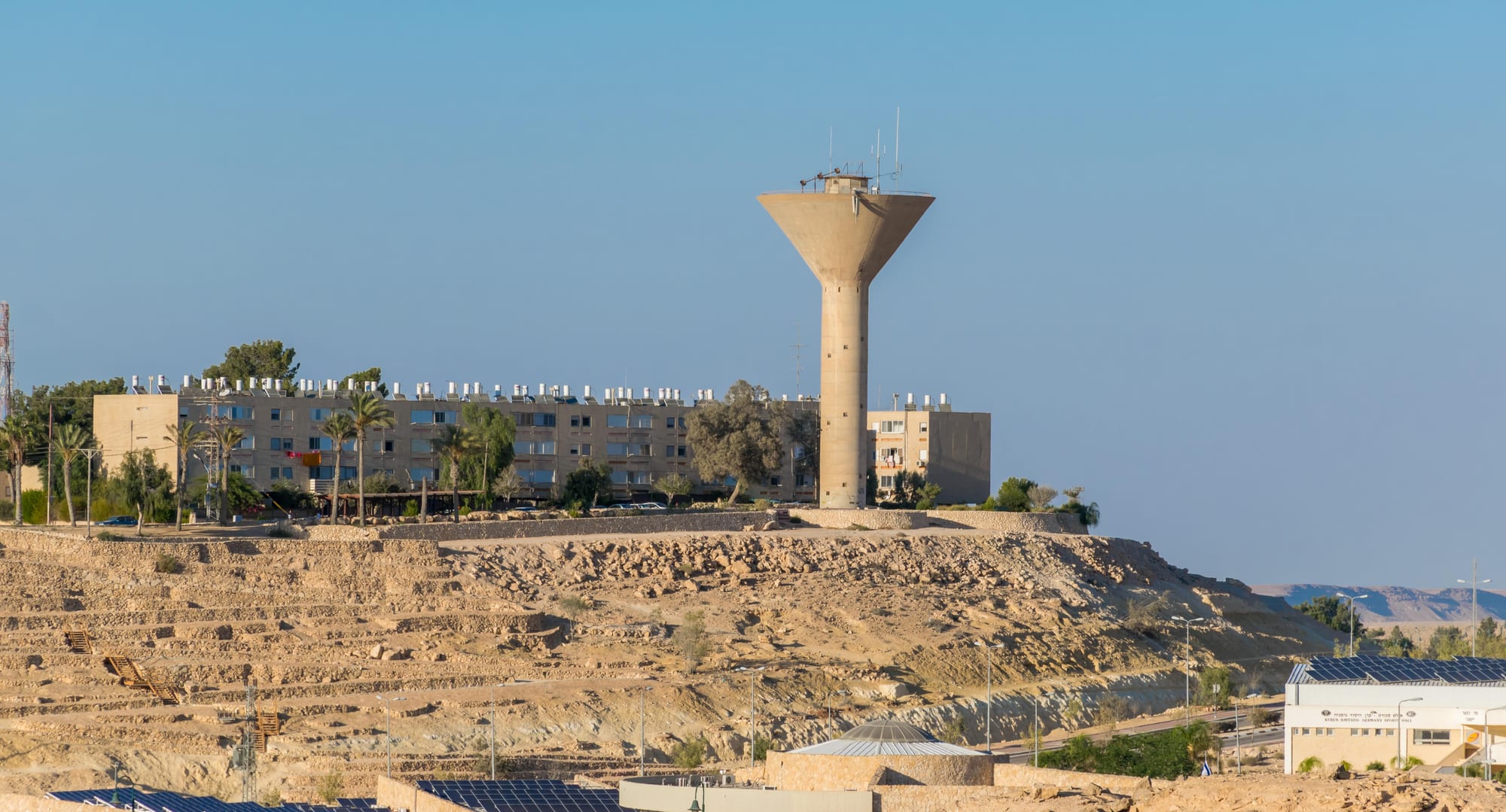
A concrete water tower and low apartment blocks on a stony desert ridge at Mitzpe Ramon under a clear sky

The Negev & Eilat, Israel

Mitzpe Ramon

The edge of Mitzpe Ramon on the Negev highlands, above the rim of Makhtesh Ramon. (Mark Nakasone / Wikimedia Commons · CC BY 2.0)

A small town on the Negev highlands, built on the northern rim of Makhtesh Ramon, the largest of the desert's erosion craters. Founded in the 1950s as a road camp and settled by immigrant families, it has since become a base for desert hiking, wildlife watching and some of the darkest night skies in Israel. This page is written to explain the town, not to encourage travel.

Neighbourhoods

  • The crater rim
    • First-time visitors
    • Views
    • Walks

    The southern edge of town, where the ground falls away into the makhtesh. A promenade runs along the cliff past the visitor centre and the larger hotels, and Nubian ibex often graze on the verges.

    Open in Maps
  • The town centre
    • Everyday prices
    • Local life

    A compact grid of 1950s and 1960s apartment blocks around a small commercial centre with a supermarket, bakery, falafel counters and a few cafés. Most residents live here, a short walk from the rim.

    Open in Maps
  • The artists' quarter
    • Arts and crafts
    • Quiet

    A former light-industrial zone of plain sheds on the edge of town, reused over the past two decades by artists, workshops, a hostel and guest accommodation. It is low-key and best explored on foot.

    Open in Maps
  • The desert edge and the ranches
    • Camping and lodges
    • Stargazing

    Beyond the built-up streets stand desert lodges, campsites and animal farms scattered along the approach roads. Nights here are dark and cold and the silence is complete.

    Open in Maps

Things to do

The crater and the desert

  • Makhtesh Ramonlandmark

    The largest erosion crater in the world, some 40 kilometres long, opening directly below the town and filled with coloured rock, volcanic dykes and desert wildlife.

    Open in Maps
  • Israel National Trailtrail

    The long-distance route crosses the makhtesh near the town, and its rim sections give the easiest way to walk above the crater.

    Open in Maps
  • The rim promenadeviewpoint

    A paved cliff-top walk along the northern edge of the crater, with sheer drops, sculpture installations and long views south across the desert.

    Open in Maps

Wildlife and the night sky

  • Wise Observatoryattraction

    Tel Aviv University's astronomical observatory, founded in 1971 about five kilometres west of the town and the only professional observatory in Israel, sited for the dry, dark desert sky.

    Open in Maps
  • Alpaca Farmattraction

    A farm just outside town whose herd of some 400 alpacas and llamas, one of the few of its size outside South America, grazes open desert ground; it began as a wool enterprise.

    Open in Maps

Short trips from the town

  • Avdatlandmark

    A hilltop Nabataean and Byzantine town on the ancient incense route about 20 kilometres north, listed by UNESCO in 2005 as part of the Incense Route and Desert Cities of the Negev.

    Open in Maps
  • Ein Avdatpark

    A canyon national park north of the town where springs and pools sit between white chalk walls, with ibex and vultures overhead.

    Open in Maps
  • Sde Bokerattraction

    The kibbutz where David Ben-Gurion settled after leaving office; his hut and his grave above the Zin valley are nearby.

    Open in Maps
  • Shivtalandmark

    The ruins of a Nabataean and Byzantine desert town with three churches and elaborate water systems, also part of the Incense Route World Heritage Site.

    Open in Maps

Eat and drink

Long-standing places and food districts in Mitzpe Ramon. Hours, ratings and directions come from your maps app, always current.

Desert cooking

  • Bedouin-style mealsrestaurant

    Camps and lodges around the town serve bitter cardamom coffee, sweet sage tea, flatbread baked on a domed griddle and rice with lamb, eaten on floor cushions.

    Open in Maps
  • Negev goat's cheeserestaurant

    Small goat farms along the highway north of the town make and sell fresh and aged cheeses, usually served with desert herbs and bread.

    Open in Maps
  • Negev winesrestaurant

    Vineyards on the highlands, irrigated drop by drop, supply the boutique wines that appear on most local menus.

    Open in Maps

In town

  • The town centreneighborhood

    Falafel, hummus, shawarma and bakery pastries at everyday prices in the small commercial centre, where residents rather than visitors eat.

    Open in Maps
  • The artists' quarterneighborhood

    Cafés and a bakery occupy converted workshop sheds in the old industrial zone, alongside artists' studios and a hostel.

    Open in Maps

Experience Mitzpe Ramon

History

Mitzpe Ramon began in 1951 as a camp for the workers building Highway 40, the road from Beersheba towards Eilat, on a rim of the Negev plateau that had been crossed for centuries by caravan and Bedouin routes but never settled. The makhtesh below had long been known to geologists as an unusual landform — an erosion crater, not a meteorite or volcanic one, formed where a hard cap of rock was breached and the softer layers beneath were washed away.

The first permanent residents, young families from elsewhere in Israel, settled in 1956, and the town filled like other development towns of the period with new immigrants directed to the desert, among them many from the Soviet Union in the 1990s. Work came from the road, from quarries and from military installations nearby. When the main highway to Eilat was rerouted through the Arava, the town lost much of its passing trade and went through decades of unemployment and departure, with the young leaving for the coast.

Its revival came from the desert itself. The crater and its surroundings were protected as a nature reserve, a visitor centre opened on the rim, and from the 1990s the town began marketing itself for hiking, cycling, wildlife and dark-sky astronomy. Hotels and lodges were built along the cliff edge, the old industrial zone was taken over by artists and small workshops, and a place once known mainly as a stop on the road to Eilat became a destination in its own right.

Culture & Customs

For a town of a few thousand people, Mitzpe Ramon holds unusually varied communities side by side. The descendants of the original immigrant settlers form the core; religious families occupy part of the town; and a steady inflow of artists, musicians, desert guides and people seeking quiet has arrived since the 1990s. Bedouin families live and herd in the surrounding highlands.

The desert shapes the local identity more than anything else. Residents talk in terms of the makhtesh, the weather and the night sky, and there is a strong conservation ethos: light pollution, litter, off-road driving and the habituation of the ibex that wander into the streets are all live local concerns. Galleries, studios and craft workshops cluster in the old industrial sheds, and small music and desert-culture gatherings are held through the cooler months.

Manners are informal and directness is normal, as across Israel, but the pace is slower than in the cities. Shabbat is widely observed: shops shut on Friday afternoon, the buses stop, and the rim promenade fills instead with families walking. Visitors are expected to treat the crater as a nature reserve rather than a playground — staying on trails, taking rubbish out, and keeping the darkness intact.

Daily Life

Close to 6,000 people live in Mitzpe Ramon, a small local authority and the most isolated town in the central Negev. Most housing is in low blocks and terraces from the town's first decades, with newer private houses on the edges; the population is young by Israeli standards and turnover is high, as people arrive for a few years of desert life and others leave for work.

Tourism is now the main employer — hotels, lodges, guiding, cafés and the visitor centre — alongside the local council, schools, quarrying, small manufacturing and jobs at nearby military and research installations. Wages are below the national average and the nearest hospital, university and large shops are in Beersheba, an hour and a half away, so the drive north is part of ordinary life.

The day begins early, before the heat, and pauses in the afternoon. Evenings are spent outdoors in the mild months, and the cold, clear nights of winter are when the town's astronomy is at its best. Ibex come down into the streets to graze, which is charming and also a problem for gardens and traffic. Water, the cost of housing driven up by holiday lets, and the balance between growth and the quiet that people come for are the recurring local arguments.

Food

Eating in Mitzpe Ramon is desert cooking rather than city cuisine. Bedouin hospitality sets the tone at the camps and lodges around the town: coffee bitter with cardamom poured from a long-spouted brass pot, sweet tea with sage or wormwood, thin flatbread baked on a domed metal griddle, and rice with lamb or chicken for guests, all eaten seated low on cushions.

The Negev's own produce turns up on local menus. Goat farms along the highway to the north make fresh and aged cheeses, often served with desert herbs; vineyards on the highlands, watered drop by drop, supply boutique wines; and Medjool dates and desert-grown vegetables come from the Arava valley. North African Jewish cooking, brought by the families who settled the development towns, contributes couscous with vegetable broth, chraime — fish in a spicy red pepper and tomato sauce — and sfenj doughnuts at Hanukkah.

In the town centre, the everyday food is the same as anywhere in Israel: hummus with chickpeas and olive oil, falafel in pita with salads and tahini, shawarma, bourekas and pastries from the bakery, and strong coffee. The old industrial zone has a scattering of cafés and a bakery. Supplies come up the road from Beersheba, so choice is limited and self-caterers heading into the desert are advised to buy before they leave town.

Planning tools

Budget

One of the cheaper bases in southern Israel, with hostels, guesthouses, desert camps and a handful of hotels on the rim. Food in the town centre is inexpensive; lodge dinners and guided tours cost considerably more. A hire car is the largest single expense for most visitors, since the desert sites lie far apart.

Daily Budget Midrange
USD 200–400 (rim hotel or desert lodge, restaurant meals, car hire, park fees)
Daily Budget Shoestring
USD 70–120 (hostel bed or desert camp, supermarket and falafel meals, intercity buses)

Book rooms well ahead for Jewish holidays and spring weekends, when the whole town fills; the rim promenade and the crater viewpoints are free.

Best Time to Visit

October to April for walking, when days are warm and the light is clear. Spring brings brief desert flowering after rain. Nights on the plateau are cold from December to February and can drop near freezing, so warm layers matter. Summer midday heat makes hiking unsafe. The security situation overrides the season, and Israel has been at war since February 2026.

Suggested Number of Days

The town is small and a night or two covers the rim, a walk and a look at the sky. Three or four days suit walkers and those touring the desert sites to the north. Having a car, and the season, change the number most.

First Visit
1–2 days
With Surroundings
3–4 days

Transportation

The town is small enough to walk across, and the rim promenade runs from the centre. Intercity buses connect to Beersheba in about an hour and a half and continue south to Eilat, but services are infrequent and stop before Shabbat. Almost everything beyond the town — the crater floor, the Nabataean sites, the canyons — needs a car or an organised tour.

Fill the tank in town before driving into the desert, carry more water than seems necessary, and do not enter dry riverbeds when rain is forecast anywhere upstream.

Airport & Station Connections

Mitzpe Ramon sits on Route 40 in the middle of the Negev, roughly 80 kilometres south of Beersheba and about 150 kilometres north of Eilat. Most visitors drive. Buses run from Beersheba, which has train connections to Tel Aviv, and the Eilat buses stop here on the way through. Ramon Airport, near Eilat, is the nearest airport despite the shared name.

Walkability

The centre, the rim and the artists' quarter are all within a walk of one another on flat ground, and the promenade above the crater is the town's main pedestrian route. Beyond that the desert begins immediately: trails down into the makhtesh are steep and exposed, and distances between the outlying lodges and farms are too great to cover comfortably on foot.

Safety

Since 28 February 2026 Israel has been at war with Iran, and the wider region has been affected; an Iranian missile struck the town of Dimona, north-east of here, in March 2026. Crime in Mitzpe Ramon itself is very low. The everyday risks are natural: heat and dehydration, cold nights, unfenced cliff edges on the rim, flash floods in the wadis after storms, and losing the route on unmarked desert ground.

Keep well back from the crater edge, hike only on marked trails with water and a charged phone, avoid the midday sun in summer, and heed flood warnings and trail closures. Check current official travel advice before travelling.

Climate

Desert climate tempered by altitude: the town stands around 850 metres above sea level, so it is cooler than the Arava and the Dead Sea basin and the temperature falls sharply after sunset all year. Rain is scarce and falls in winter, occasionally as violent storms.

Summer
hot and very dry by day, usually in the low to mid 30s °C, with markedly cooler nights
Winter
mild days of about 13–17°C and cold nights that can approach freezing, with rare snow

Local Customs

A small town where people greet each other in the street and much of the social life happens in the open. The population mixes the families of the original immigrant settlers, religious residents, artists and desert guides who arrived later, and Bedouin from the surrounding area. Shabbat, from Friday afternoon to Saturday evening, closes most shops and stops the buses.

Ask before photographing residents, dress modestly away from the lodges, keep noise down at night near the rim where the darkness and quiet are the point, and never feed the ibex that wander the streets.

Common Payment Methods

The currency is the Israeli new shekel. Cards are accepted in hotels, restaurants and the supermarket, and there are ATMs in the commercial centre, but the choice is limited compared with the cities. Carry some cash for desert camps, small farms and stalls, and draw money before heading further into the Negev.