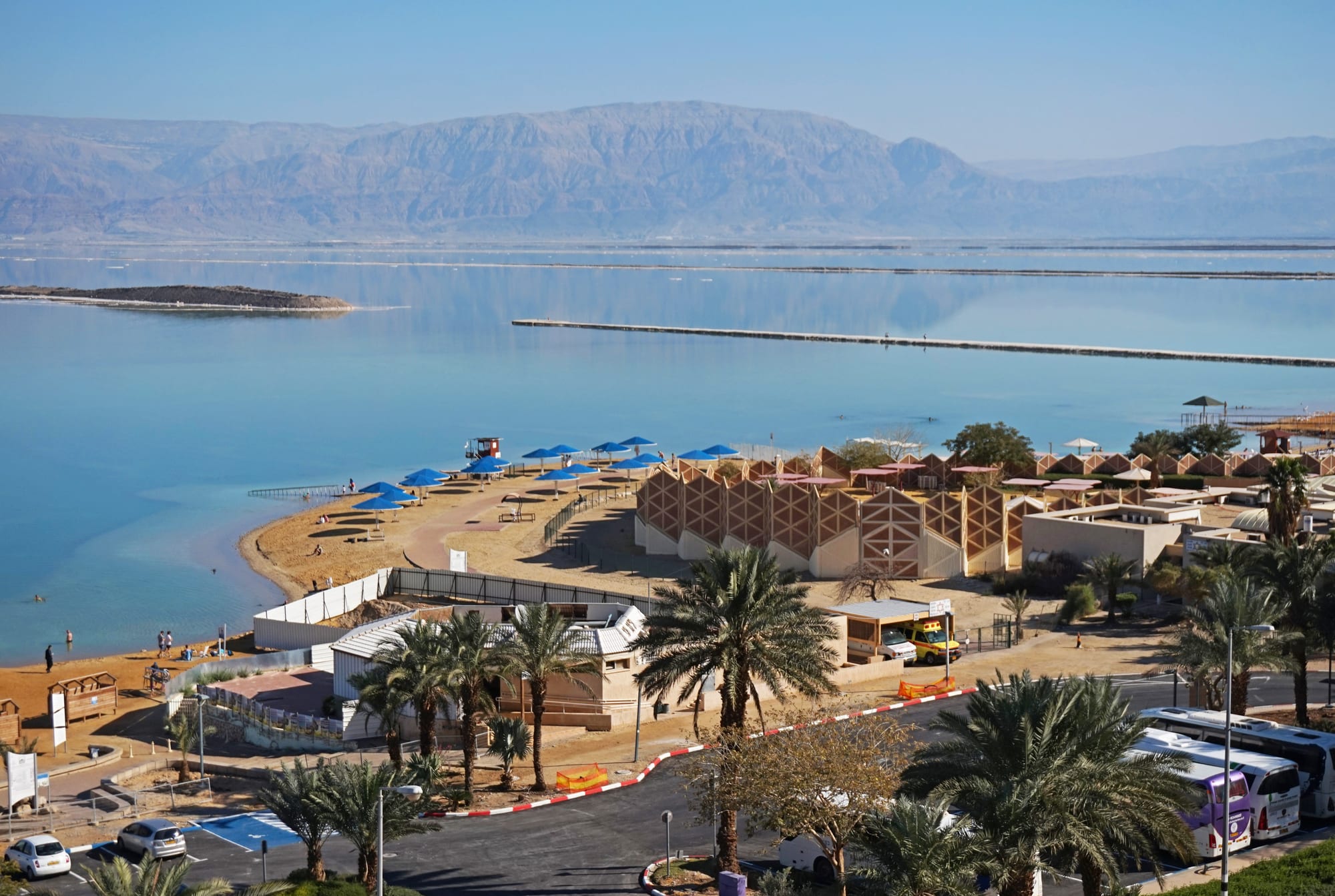
A sandy beach with parasols and shade huts beside pale blue salt water, with bare desert mountains rising beyond

The Negev & Eilat, Israel

Ein Bokek

The public beach at Ein Bokek on the southern Dead Sea shore, with the mountains of the far bank beyond. (Tiia Monto / Wikimedia Commons · CC BY-SA 3.0)

A strip of hotels and public beaches on the southern Dead Sea shore, more than 400 metres below sea level between desert cliffs and the water. Built from the 1960s around bathing, mud treatments and dry warm air, it has almost no permanent residents and serves as the nearest base for Masada and Ein Gedi. This page is written to explain the place, not to encourage travel.

Neighbourhoods

  • The hotel strip
    • First-time visitors
    • Spas
    • Close to the beach

    A single line of large hotels along the shore, most with their own spa buildings and pools, linked by a promenade and a shaded shopping arcade. Everything is within a few minutes on foot, and the free public beaches sit between the hotels and the water.

    Open in Maps
  • The public beaches
    • Beaches
    • Families

    Municipal stretches of shore with shade structures, showers, lifeguards in season and gentle entry into the water, open without charge. The salt crust underfoot and the mineral water make the walk in slow and careful.

    Open in Maps
  • Neve Zohar
    • Quiet and residential
    • Budget stays

    A small settlement a few kilometres south, with a handful of simpler guesthouses, a hostel and the regional council offices. It is the closest thing to an ordinary village on this part of the shore, and a base for those avoiding the big hotels.

    Open in Maps

Things to do

The shore

  • Dead Seaattraction

    The hypersaline lake at the lowest land point on earth, dense enough that bathers float without effort and salt crystallises along the shoreline.

    Open in Maps
  • Ein Bokek beachbeach

    The free public shore in front of the hotels, with shade, showers and shallow entry, where black mineral mud is applied before rinsing off in the water.

    Open in Maps
  • The southern salt pansattraction

    The shallow evaporation ponds that hold water in front of the hotels, separated by causeways and worked by the potash industry to the south.

    Open in Maps

Short trips from the strip

  • Masadalandmark

    Herod's palace-fortress on an isolated mesa, a UNESCO World Heritage Site reached by cable car or the Snake Path, with the Roman siege ramp still visible.

    Open in Maps
  • Ein Gedipark

    A spring-fed oasis and nature reserve north along the shore, with waterfalls, pools, ibex and hyrax in the cliffs, and an ancient synagogue mosaic.

    Open in Maps
  • Mount Sodomviewpoint

    A ridge of rock salt running along the south-western shore, riddled with caves and eroded into pillars, one of them known as Lot's Wife.

    Open in Maps
  • Aradattraction

    A planned desert town on the plateau above the sea, known for its dry, clean air, with the ruins of Tel Arad nearby.

    Open in Maps

Seasonal events

  • Winter sun seasonNovember to March

    The busiest months, when mild, dry days bring Israeli and European visitors to the shore while the rest of the country is wet.

  • Jewish holiday weeksPassover in spring and Sukkot in autumn

    Hotels fill with Israeli families during the long holidays and rates rise sharply across the strip.

  • Summer low seasonJuly and August

    Extreme heat empties the beaches in the middle of the day, and bathing shifts to early morning and evening.

Eat and drink

Long-standing places and food districts in Ein Bokek. Hours, ratings and directions come from your maps app, always current.

Eating on the strip

  • Hotel dining roomsrestaurant

    Most guests eat in their hotel, where large buffets of salads, grilled meats, fish and pastries are the standard, and kosher kitchens keep meat and dairy separate.

    Open in Maps
  • The shopping arcadeneighborhood

    A cluster of cafés, fast-food counters, pizza, falafel and ice cream between the hotels, the main alternative to eating in.

    Open in Maps
  • Dates and desert producemarket

    Roadside stalls and shops along the Dead Sea and Arava roads sell Medjool dates, date syrup and cosmetics made from Dead Sea minerals.

    Open in Maps

Experience Ein Bokek

History

The shore here has been used since antiquity, though never densely settled: the narrow strip between cliff and water carried the road along the western side of the sea, and the spring at Ein Bokek supported a small oasis. Remains of a Roman-era fort, Metzad Bokek, commanding the road, and of an ancient perfume and medicine workshop have been excavated there, and the Dead Sea's asphalt, which rises naturally from its bed, was exported to Egypt for mummification.

The modern place owes everything to industry and tourism. From the 1930s the Palestine Potash Company, later the Dead Sea Works, began extracting minerals at the southern end of the sea, and the town of Sodom grew as a works rather than a settlement. The first hotels appeared at Ein Bokek in the 1960s, when the combination of mineral water, mud, warm dry air and filtered sunlight was promoted for skin and joint conditions, and the strip grew through the following decades into a line of large hotels with spas attached.

Its setting has changed in a way few resorts experience. The Dead Sea's level has fallen sharply since the mid-20th century, as the Jordan's water is diverted and minerals are extracted: the level is now more than 430 metres below sea level, and the southern basin is held as a chain of shallow evaporation ponds worked for minerals and divided by a dike along the international border. Further north, the falling shoreline has opened sinkholes that have closed beaches and stretches of road.

Culture & Customs

Ein Bokek has no old community, no religious centre and no market: it is a purpose-built resort, and its culture is that of a spa. Days are organised around floating, mud, showers and rest, and the pace is deliberately slow. The population on any given day is made up of hotel guests, staff who commute in, and pilgrims and tour groups stopping between Masada and Jerusalem.

Its visitors have long been mixed. Israeli families come for holidays and weekends; European and, historically, Russian and German visitors come in winter for the sun; and a steady stream arrives for treatment of psoriasis and other skin conditions, sometimes for several weeks, which gives parts of the strip a clinical as well as a holiday feel. Signage and hotel staff work in Hebrew, English, Arabic and Russian.

Local etiquette is straightforward. Swimwear belongs on the beach and at the pools, not in the arcade; the shore is public and free, which is unusual for a resort and a point of local pride; and Shabbat is observed in most hotels, with kosher kitchens, adjusted lifts and a quieter Saturday. Because the water is dangerous to swallow or get in the eyes, lifeguards and signs give firm instructions that visitors are expected to follow rather than test.

Daily Life

Almost nobody lives at Ein Bokek. It is a hotel district within the Tamar Regional Council, and its working population — housekeepers, therapists, cooks, lifeguards and drivers — travels in daily from Arad, Dimona, Yeruham and the small Dead Sea communities, with a few hundred people living at Neve Zohar and the kibbutzim and moshavim nearby. Thousands of guests may be on the strip at once, far outnumbering residents.

The wider local economy has two legs: tourism along the shore, and the potash, bromine and magnesium works at Sodom to the south, one of the region's largest employers and the reason the evaporation ponds exist at all. Agriculture in the Arava valley and the date plantations of the Dead Sea communities add a third. Water, salt harvesting and the sea's falling level are constant subjects of local and national argument, as are plans for the shoreline's future.

The daily rhythm is set by the heat. Bathing happens early and late, the middle of the day is spent indoors or in the shade, and buses and delivery lorries arrive in the morning along Route 90. Occupancy is strongly seasonal and has been badly affected by the disruption to tourism since 2023 and by the war from 2026, which is felt at once in a place with no other trade.

Food

Eating at Ein Bokek happens mostly in the hotels, where the Israeli buffet sets the pattern: a large breakfast of eggs, salads, soft cheeses, olives, herring, smoked fish, yoghurt and pastries, and a dinner of salads, grilled meat or fish, rice, roast vegetables and sweet trays. Many kitchens are kosher, so dairy appears at breakfast and meat at dinner, and the two are not served together.

Outside the hotels the arcade supplies the usual Israeli street food: falafel and hummus, shawarma carved into pita with pickles and tahini, pizza, grilled skewers, fresh juices and ice cream. Nothing here is a local speciality — the strip is too new and too small to have developed one — but the kitchens draw on the same Middle Eastern and North African repertoire as the desert towns inland, where couscous, chraime fish in spicy tomato sauce and slow-cooked stews are the everyday food.

The genuine local products are agricultural and mineral. The Dead Sea communities and the Arava farms grow large Medjool dates, sold whole or as syrup, alongside desert-grown vegetables, herbs and melons, and small wineries in the Negev use drip irrigation to produce wine in an arid climate. Bedouin hospitality nearby means cardamom coffee and sweet sage tea, and the mineral salts and mud that fill the shop windows are food-adjacent only in that they come from the same water people bathe in.

Planning tools

Budget

Ein Bokek is a resort with almost no cheap options: hotel rates carry the cost, and they rise steeply in winter, at weekends and over Jewish holidays. Food is mostly bought in the hotels or the arcade, both dearer than in inland towns. The beaches themselves are free, and a hire car is the main additional expense.

Daily Budget Midrange
USD 200–400 (Dead Sea hotel with half board, spa entry, car hire, park fees)
Daily Budget Shoestring
USD 80–140 (guesthouse or hostel bed at Neve Zohar, supermarket food, intercity buses)

Half-board rates are often better value than eating separately, and the public beaches cost nothing, so a spa day does not have to be bought with the room.

Best Time to Visit

October to April, when days are warm and dry rather than dangerous and the shore is at its most comfortable. Winter is the high season, with mild sunshine while the rest of the country is wet. Summer brings temperatures well above 40°C, which limit time outdoors. The security situation overrides the season, and Israel has been at war since February 2026.

Suggested Number of Days

One or two nights suit most visits, which is long enough for the shore and the spa treatments. Three or four days works for those using the strip as a base for the wider desert, and longer stays are usually for medical or skin treatment.

First Visit
1–2 days
With Surroundings
3–4 days

Transportation

The strip is served by intercity buses along Route 90 from Jerusalem, Beersheba, Arad and Eilat, stopping at the hotels, and most visitors otherwise arrive by car. There is no railway. Distances between the shore sites are long and there is no local transport beyond the buses, so a car makes the surrounding desert much easier.

Fill the tank before long desert stretches, carry water in the car, and note that buses and many services stop from Friday afternoon until Saturday evening.

Airport & Station Connections

Ein Bokek lies about 25 kilometres east of Arad on the shore road, about two hours by road from Jerusalem or Beersheba and some three hours from Eilat. Ben Gurion Airport, near Tel Aviv, is the country's main gateway; aviation has been disrupted since the war with Iran began in February 2026.

Walkability

The whole resort is walkable along one flat promenade, with hotels, the arcade and the beaches strung along it in a couple of kilometres. Beyond that there are no pavements and nowhere to walk to, since the next settlements are kilometres away across open desert, and summer heat makes even short walks demanding.

Safety

Crime is very low and the strip is quiet and well lit. The real hazards are environmental: extreme heat and dehydration, the highly saline water, which stings and can badly injure the eyes, sinkholes opening along stretches of the receding shore further north, and flash floods in the wadis after rain. Since 28 February 2026 Israel has been at war with Iran. This page is written to explain the place, not to suggest travelling there.

Keep the water out of the eyes and mouth, limit floating to short spells, shower afterwards, drink far more than usual, and never enter areas fenced off for sinkholes. Check current official travel advice before travelling.

Climate

Desert climate at the lowest point on land, with very high evaporation, low humidity and barely any rain. The thick air and haze filter sunlight, one reason the shore has long been used for skin treatment, though sunburn is still easy.

Summer
extremely hot and dry, regularly above 40°C by day and warm at night
Winter
mild and sunny, generally 18–24°C by day and cooler after dark

Local Customs

The strip is relaxed and swimwear is normal on the beach and around the pools, but not in the arcade or hotel dining rooms. Many hotels keep kosher kitchens and mark Shabbat from Friday afternoon to Saturday evening, with lifts and service adjusted; some spas have separate bathing hours for men and women.

Cover up away from the water, ask before photographing other bathers, and check spa timetables if separate-gender hours matter.

Common Payment Methods

The currency is the Israeli new shekel. Cards and contactless payment are accepted in hotels, shops and restaurants, and there are ATMs in the arcade. Small cash amounts are useful for roadside stalls and tips.