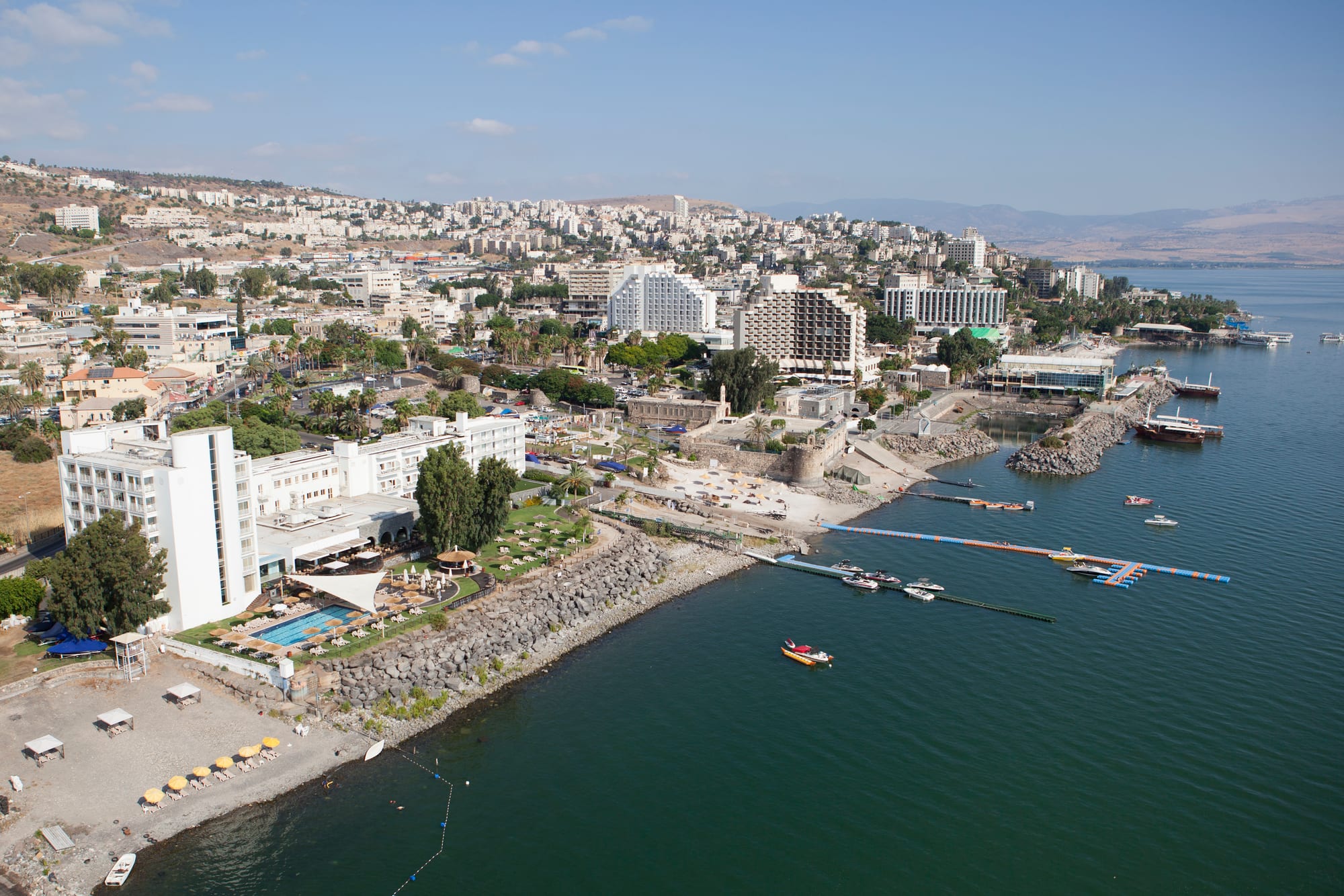
A town of white hotels and apartment blocks rising from a rocky lakeshore, with jetties and small boats on calm green water

Haifa, the Galilee & the North, Israel

Tiberias

Tiberias on the western shore of the Sea of Galilee, seen from above the lake. (israeltourism from Israel / Wikimedia Commons · CC BY-SA 2.0)

A lakeside town on the western shore of the Sea of Galilee, about 200 metres below sea level, founded by Herod Antipas around 20 CE and later a centre of Jewish learning. Hot springs, revered tombs and the Christian sites of the lakeshore draw visitors to a resort strip of hotels below steep hills. This page is written to explain the town, not to encourage travel.

Neighbourhoods

  • The lakefront and promenade
    • First-time visitors
    • Waterfront
    • Best for food

    The strip along the water where most hotels, fish restaurants, bars and the marina stand, with a paved promenade running beside the lake. Remains of the town's black basalt walls and old buildings survive among the modern blocks, and the area stays busy late on summer evenings.

    Open in Maps
  • The old town and the midrahov
    • Historic district
    • Close to public transport

    The compact centre just uphill from the water, around the pedestrian street and the market, with the bus station, banks and everyday shops. It mixes Ottoman-era stone buildings with 1960s concrete and is the practical heart of the town.

    Open in Maps
  • Upper Tiberias
    • Quiet and residential
    • Views

    Residential neighbourhoods on the slopes several hundred metres above the lake, cooler than the shore and with wide views across the water to the Golan. Largely apartment blocks and family housing, with a few hotels, and a steep drive or bus ride from the centre.

    Open in Maps
  • Hamat Tiberias and the southern shore
    • Hot springs
    • Quiet and residential

    The mineral springs and archaeological site a short way south along the lake, with spa hotels and bathing complexes and the road continuing towards the Jordan valley. Quieter than the centre and mostly reached by car or bus.

    Open in Maps

Things to do

Landmarks and holy places

  • Tomb of Maimonideslandmark

    The burial place of the 12th-century philosopher and physician Moses Maimonides, a site of Jewish pilgrimage in the centre of the town.

    Open in Maps
  • Hamat Tiberiasattraction

    A national park on the southern shore built around hot mineral springs, with the mosaic floor of a Roman-era synagogue showing a zodiac wheel.

    Open in Maps
  • The black basalt walls and old buildingslandmark

    Fragments of the Crusader and Ottoman fortifications, along with mosques, churches and khans in dark volcanic stone, stand among the newer lakefront blocks.

    Open in Maps
  • Sea of Galileeattraction

    The freshwater lake below sea level that the town looks out on, used for swimming, boat trips and fishing, and ringed by holy sites.

    Open in Maps

Short trips around the lake

  • Capernaumattraction

    The excavated lakeside village on the northern shore, with a white limestone synagogue and a church built over a first-century house.

    Open in Maps
  • Mount of Beatitudeslandmark

    A hillside above the northern shore with an octagonal church and gardens, traditionally linked with the Sermon on the Mount.

    Open in Maps
  • Tabghalandmark

    A shore site with the Church of the Multiplication and its Byzantine mosaics, and a small chapel by the water.

    Open in Maps
  • Magdalaattraction

    Excavations of a first-century lakeside town north of Tiberias, including a synagogue and harbour, with a modern visitor centre.

    Open in Maps
  • Mount Arbelviewpoint

    A cliff above the north-western shore, with cave fortifications and a path along the top giving a view over the whole lake.

    Open in Maps
  • Yardenitattraction

    A baptism site on the Jordan River where it leaves the lake, with steps into the water and gardens.

    Open in Maps
  • Hamat Gaderattraction

    Hot springs and Roman bath ruins in the Yarmouk valley south-east of the lake, now a bathing and leisure complex.

    Open in Maps
  • Safedattraction

    A hill town north-west of the lake, cooler than the shore, known for its old synagogues, blue-painted lanes and artists' quarter.

    Open in Maps

Seasonal events

  • Tiberias Marathonwinter

    A road marathon run along the lakeshore in the mild winter air, held annually since 1977.

  • Jewish holiday season on the lakePassover in spring and Sukkot in autumn

    Hotels and beaches fill with Israeli families during the long holidays, and prices rise across the town.

  • Summer lakeside seasonJune to September

    Night swimming, boat trips and open-air music along the promenade, when daytime heat pushes life to the evening.

Eat and drink

Long-standing places and food districts in Tiberias. Hours, ratings and directions come from your maps app, always current.

Tiberias classics

  • Lakeside fish restaurantsrestaurant

    Tables along the promenade serving grilled whole tilapia, known locally as St Peter's fish, with chips, salads and tahini.

    Open in Maps
  • Grill houses and shawarma countersrestaurant

    Skewers of lamb and chicken, kebabs and shawarma in pita, served with pickles and salads in the streets behind the waterfront.

    Open in Maps

Markets and cafés

  • The town marketmarket

    Fruit and vegetables, olives, spices, cheeses and bakery stalls in the centre, busiest in the morning and before Shabbat.

    Open in Maps
  • Promenade caféscafe

    Coffee, cold drinks and ice cream at tables facing the water, where much of the town's social life happens after dark.

    Open in Maps

Experience Tiberias

History

Tiberias was founded around 20 CE by Herod Antipas, the Roman client ruler of the Galilee, and named for the emperor Tiberius. Built partly over a burial ground, it was avoided by observant Jews at first, but after the failed revolts against Rome the centre of Jewish life moved north into the Galilee, and Tiberias became its capital. The Sanhedrin sat there, much of the Jerusalem Talmud was compiled in the city, and in the early medieval centuries scholars known as the Masoretes fixed the vowel and accent system still used in the Hebrew Bible.

The town changed hands repeatedly. It passed to the Arab caliphates in the seventh century, was taken by the Crusaders, who made it the seat of a principality, and fell to Saladin in 1187, in the same days as the battle of Hattin, fought about 10 kilometres west of the town. Earthquakes and neglect reduced it to a village, and it was rebuilt in the 18th century by Daher al-Umar, whose black basalt walls still show along the lakefront. The Galilee earthquake of 1837 wrecked the walls and many houses and killed hundreds of people, after which the town was rebuilt.

Under Ottoman and then British rule Tiberias had a mixed Jewish and Arab population; in 1948 its Arab residents were evacuated by British troops and refused re-entry after the war, and the town was resettled, while malaria control and drainage of the surrounding marshes made the lake shore habitable year-round. Since the 1960s it has lived largely on tourism, with hotel building along the waterfront, periods of decline, and repeated attempts to renew the promenade and the old core.

Culture & Customs

Tiberias is counted as one of Judaism's four holy cities, along with Jerusalem, Hebron and Safed, and pilgrimage shapes much of its life. The tomb of Maimonides draws visitors all year, and other revered graves in and around the town bring groups of worshippers, particularly on anniversaries, when buses fill the streets and singing carries late into the night. A substantial religious population lives in the town, and Shabbat is observed visibly in the centre.

For Christians the town is a base rather than a destination: the shoreline sites where the Gospels place much of Jesus's ministry lie within a short drive north, so pilgrim groups stay in Tiberias and travel out each day. The result is a place where Hebrew, Arabic, English, Russian and Spanish are all heard along one promenade.

Alongside this runs a plainly secular holiday culture. Israeli families come for the water, the hot springs and the cheap winter sun, and the promenade in summer is given over to ice cream, arcade games, music and boat trips. The town has a reputation for being both very traditional and very touristic at once, with local pride in the lake, the fish and the view of the Golan across the water, and long-running debate about the state of the waterfront.

Daily Life

About 52,000 people live in Tiberias, a mixed population that includes families descended from immigrants from North Africa, Iraq and the former Soviet Union, together with a growing religious community. The town is the service centre for the lakeside kibbutzim and moshavim, the Jordan valley farms and the villages of the eastern Galilee, and its hospital serves a wide area.

Tourism and hospitality are the main employers, alongside health care, local government, farming in the valleys and commuting to Haifa or the Jezreel Valley. Wages are below the national average, unemployment has been persistent, and the town has long argued that its hotel strip underperforms compared with Eilat or the Dead Sea. The lake's level, which falls in dry years and is watched closely, matters to farming and to the look of the shoreline.

The rhythm follows the heat: early mornings at the market and on the water, shuttered afternoons in summer, and evenings outdoors on the promenade. Fridays end early as the town closes for Shabbat, and the streets fill again on Saturday night. Since 2023 the Galilee's border tensions and, from 2026, the war have cut visitor numbers heavily, which is felt directly in a town that lives on tourism.

Food

The dish associated with Tiberias is the whole grilled tilapia sold along the lakefront as St Peter's fish, served with chips, tahini and a spread of salads. Some of what reaches the table comes from fish farms rather than the lake, but the ritual of eating fish facing the water is fixed. Musht, the local name for the same family of fish, appears on menus in both Hebrew and Arabic.

Beyond the fish, the food is standard Israeli and Levantine: hummus eaten warm for breakfast, falafel and shawarma in pita from the streets behind the promenade, grilled skewers with grilled onion and pickles, and mezze salads of aubergine, beetroot, cabbage and tahini. Many hotels serve the large Israeli buffet breakfast of eggs, cheeses, salads, herring and pastries, and kosher kitchens keep meat and dairy apart, which shapes what is on offer where.

The market supplies dates and citrus from the Jordan valley, olives and olive oil from the Galilee hills, and fresh herbs. Sweet shops sell knafeh and baklava, coffee is drunk either as strong Arabic coffee with cardamom or as espresso, and beer and Galilee wines are served on the promenade in the evening, with arak drunk alongside mezze in the Arab-style restaurants of the area.

Planning tools

Budget

Tiberias is a domestic holiday town, so prices swing with the calendar: hotel rooms are cheap midweek in the off season and expensive on Jewish holidays, in summer and at weekends. Food on the promenade costs more than in the streets behind it, and a hire car is the usual way to reach the sites around the lake.

Daily Budget Midrange
USD 170–320 (lakeside hotel, restaurant dinners, car hire, site entries)
Daily Budget Shoestring
USD 70–120 (hostel or guesthouse bed, market food and falafel, buses)

An Israel Nature and Parks Authority multi-site card pays off if several lakeside sites are visited; avoid the main Jewish holidays if cost matters.

Best Time to Visit

October to April, when the lake basin is warm rather than punishing and the hills around are green in late winter and spring. Summer is very hot and humid, with nights that stay warm, though the water and the evening promenade compensate. The security situation overrides the season, and Israel has been at war since February 2026.

Suggested Number of Days

The town itself is small and a day is generally enough. Most visitors use it as a base for the lake and the eastern Galilee, which takes three or four days, and longer if walks in the hills or the Golan are added.

First Visit
1–2 days
With Surroundings
3–4 days

Transportation

Buses connect Tiberias with Haifa, Nazareth, Afula, Safed, Jerusalem and Tel Aviv, and local routes climb to the upper neighbourhoods. There is no railway station, and services around the lake are limited, so most visitors drive. Boats cross to the eastern shore in season, and a cycle path runs along parts of the lakeside.

Roads climb steeply out of the basin in every direction; buses and most services stop from Friday afternoon until Saturday evening.

Airport & Station Connections

Tiberias lies about 70 kilometres east of Haifa and roughly 150 kilometres north-east of Tel Aviv, some two to three hours by bus or car. The nearest railway stations are in the Jezreel Valley and at Beit She'an, with buses onward. Ben Gurion Airport is the country's main gateway; aviation has been disrupted since the war with Iran began in February 2026.

Walkability

The lakefront, promenade and centre form a flat, walkable strip perhaps two kilometres long, and everything a visitor needs there is close together. Beyond it the town rises very steeply, so upper neighbourhoods and some hotels mean a hard climb or a bus. Summer heat makes walking uncomfortable in the middle of the day.

Safety

Everyday crime is low, with petty theft on crowded beaches the usual risk. The setting matters more: the north lies on sensitive borders, rocket sirens have sounded across the Galilee during conflicts, and Israel has been at war with Iran since 28 February 2026, with Hezbollah firing into northern Israel from March 2026. Heat, dehydration and swimming in unsupervised parts of the lake are the practical hazards. This page is written to explain the town, not to suggest travelling there.

Learn where the nearest public shelter is and follow local instructions; swim only at supervised beaches and carry water in summer, when the basin is far hotter than the coast. Check current official travel advice before travelling.

Climate

Hot and dry, and hotter than anywhere on the coast because the town sits in a basin some 200 metres below sea level. Rain falls between November and March, and the hills above are several degrees cooler than the shore.

Summer
very hot and humid, often 35°C or more by day, with warm nights
Winter
mild and pleasant, generally 12–20°C, with rain and occasional storms

Local Customs

Tiberias is one of Judaism's four holy cities and has a large religious population, so modest dress is expected away from the beaches and particularly at the tombs, where men and women pray separately and heads are covered. The town closes for Shabbat from Friday afternoon to Saturday evening, when most shops, buses and some restaurants stop.

Cover shoulders and knees at the tombs and synagogues, avoid photography at prayer, and plan for Friday afternoon closures by shopping earlier in the day.

Common Payment Methods

The currency is the Israeli new shekel. Cards and contactless payment are accepted in hotels, restaurants and shops, and ATMs are in the centre. Market stalls and small kiosks may prefer cash, and cash is useful on Fridays when queues are long.