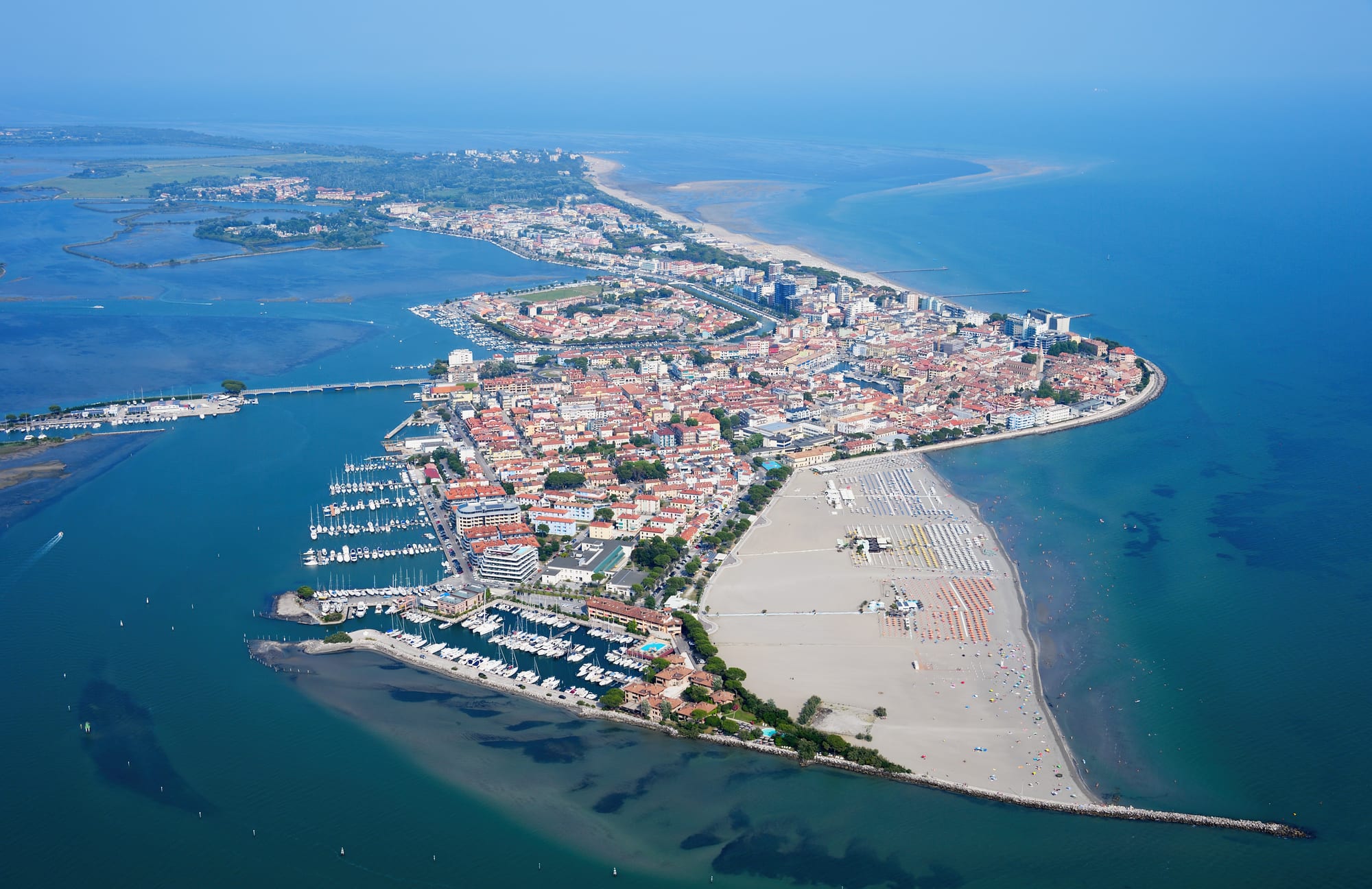
Aerial view of a red-roofed island town between a lagoon and the sea, with marinas, a curving breakwater and a wide sandy beach

Friuli Venezia Giulia, Italy

Grado

Grado seen from the air from the west, between its lagoon and the Adriatic. (Carsten Steger / Wikimedia Commons · CC BY-SA 4.0)

An island town in its own lagoon at the head of the Adriatic, between Venice and Trieste. Refugees from Aquileia settled it in late Roman times and from 568 it was a seat of patriarchs; a children's seaside hospice and Austrian holidaymakers later made it a spa resort. Today it combines an early Christian old town of narrow lanes with long sandy beaches and boat trips across the lagoon.

Neighbourhoods

  • Gravo vecia, the old town
    • First-time visitors
    • Historic district
    • Best for food

    The old town inside the line of the Roman castrum, a pedestrian tangle of lanes and small squares around the basilica of Sant'Eufemia. Many of the town's shops, bars and restaurants are here.

    Open in Maps
  • The beach front and Città Giardino
    • Beaches
    • Families

    East of the old town, the main beach runs for almost three kilometres in front of the Città Giardino district, south-facing and sloping gently into the sea. The curving sea wall built by the Austrians links it to the older Costa Azzurra beach.

    Open in Maps
  • Isola della Schiusa
    • Quiet and residential
    • Marinas

    An island created recently with fill material in the lagoon and joined to the old town by two bridges, now fully built up with homes, marinas and holiday flats.

    Open in Maps
  • Grado Pineta
    • Beaches
    • Watersports

    The beach district at the eastern end of the island, beyond the beach known as 'al Bosco', and an important spot for kitesurfing, with shallow water and no waves.

    Open in Maps

Things to do

Early Christian Grado

  • Basilica of Sant'Eufemialandmark

    The former cathedral built after 568 by Patriarch Elijah, famous for its sixth-century floor mosaics, with an octagonal baptistery beside it and a bell tower topped by the copper Archangel Michael that has become the town's symbol.

    Open in Maps
  • Santa Maria delle Grazielandmark

    A basilica begun in the 4th to 5th centuries and renovated in the 6th, with a Baroque restoration of 1640.

    Open in Maps
  • Remains of the basilica of Piazza Vittorialandmark

    The remains of an early Christian basilica lie under the town hall on Piazza Vittoria.

    Open in Maps

Beaches

  • Main beach (Spiaggia GIT)beach

    Almost three kilometres of south-facing sand that slopes gently into the sea, holder of a Blue Flag since 1989.

    Open in Maps
  • Costa Azzurra beachbeach

    The westernmost beach, known locally as the old beach, continuing as the promenade along the curving Austrian-built sea wall of Lungomare Nazario Sauro.

    Open in Maps

The lagoon

  • Barbanaattraction

    A small island at the northern end of the lagoon, reached by boat from Grado in about 25 minutes, with a Marian sanctuary whose origins go back to 582 and a community of Benedictine monks.

    Open in Maps
  • Grado Lagoonpark

    Boat trips cross the lagoon to its dozens of islands and to the casoni, the thatched huts once used by Grado's fishermen during the long fishing season.

    Open in Maps
  • Valle Cavanata Nature Reservepark

    A 327-hectare protected area at the eastern end of the lagoon near Fossalon.

    Open in Maps

Short trips from the town

  • Aquileiaattraction

    The Roman city from which Grado's first settlers fled, whose ruins, mosaics and early Christian basilica are a UNESCO World Heritage Site.

    Open in Maps

Seasonal events

  • Perdon de Barbanafirst Sunday in July

    Grado's main religious tradition, a votive procession in which a statue of the Madonna is carried by a flotilla of flag-decked boats from Sant'Eufemia across the lagoon to Barbana, recalling the end of a plague in 1237.

Eat and drink

Long-standing places and food districts in Grado. Hours, ratings and directions come from your maps app, always current.

Grado classics

  • Old-town restaurantsneighborhood

    The lanes and small squares of Gravo vecia hold many of the town's restaurants, where fish from the Adriatic and the lagoon is the speciality, including boreto alla graisana, Grado's fish soup.

    Open in Maps
  • Piazza Duca d'Aostaneighborhood

    A square with several restaurants, among them an osteria.

    Open in Maps

Cafés and bars

  • Bars of the old townneighborhood

    The pedestrian old town is full of bars, where white wine, often as a spritz, comes with small snacks at aperitivo time.

    Open in Maps

Experience Grado

History

In Roman times Grado, known as ad Aquae Gradatae, was the first port for ships entering the Natissa river on their way upstream to Aquileia, and the remains of villas, inscriptions and sarcophagi still turn up. As the Western Empire weakened, people from Aquileia fled to the island; in 452, when the Huns attacked, Bishop Nicetas took refuge here, and Grado's first cathedral, the first church of Santa Maria delle Grazie and the baptistery date from that time. When the Lombards took Aquileia in 568, its metropolitan Paulinus moved to Byzantine-held Grado, and the transfer of the see was formalised in 579. Grado became known as the New Aquileia and was the home base of the patriarchate's fleet.

Early in the 7th century a rival patriarch was elected in the old Aquileia, and the two lines of patriarchs disputed authority for centuries; in the 11th century Patriarch Poppo of the old Aquileia sacked the island. In 1451 Pope Nicholas V moved the seat of the patriarchate to Venice, and Grado declined into a minor place. The English sacked it in 1810, burning the archives, and the French in 1812.

Austria acquired Grado in 1815 and kept it until 1918. In 1873 the doctor Giuseppe Barellai founded a seaside hospice for children here, and the island became a destination for sea-water cures, above all for Austrians. A road across the lagoon followed in 1905, and in 1936 a swing bridge finally ended the island's isolation. A national museum of underwater archaeology, built around the Roman merchant ship Julia Felix found off Grado in 1986, opened in December 2025.

Culture & Customs

Grado is called the 'first Venice' because of its place in the origins of Venetian civilisation, and its people speak a Venetian dialect, gradese, rather than the Friulian of the surrounding plain. The poet Biagio Marin, born in Grado, wrote about the island in that dialect, and a festival of songs in gradese has been held since 1946.

Religion and the lagoon shape the calendar. The Perdon de Barbana, the town's principal tradition, takes place on the first Sunday of July: a statue of the Madonna is carried from the basilica of Sant'Eufemia by a procession of boats decked with flags to the sanctuary on Barbana, in thanks for the end of a plague in 1237. The copper Archangel Michael on Sant'Eufemia's bell tower, the Anzolo, is the town's symbol.

The lagoon has its own culture. Fishermen once spent much of the year in casoni, simple thatched huts on the islands, coming back to Grado only in the colder months, and the typical boat is the batela, flat-bottomed and rowed. Summer brings a different crowd — families on the beaches, sailors in the marinas and kitesurfers at Grado Pineta — continuing a resort tradition that began with Austrian visitors taking sea-water cures.

Daily Life

The municipality has about 7,500 residents, and covers some 90 square kilometres between the mouth of the Isonzo, the sea and the lagoon, from Porto Buso to Fossalon. Besides the main island, people live year-round on the Isola della Schiusa, joined by two bridges, and on Barbana, while Fossalon on the mainland is farmland reclaimed in the first half of the 20th century.

Once mainly a fishing town, Grado now lives largely from tourism, with hotels, campsites, marinas and the thermal and sea-water treatments that first made it a resort. The town's districts each have their own character: the old town of Gravo vecia inside the Roman walls, Borgo de fora, the Schiusa, the Colmata, Squero, the Città Giardino and Valle Goppion among them. Summer fills the hotels, campsites and beaches; the rest of the year the town is much quieter.

The sea is a constant presence. The curving sea wall along the front was built by the Austrians to protect the old town from storm surges, and the storm of 27 October 2012 knocked down the historic diving board that had stood in front of the main beach since the early 20th century. The lagoon around the island is known for its birdlife, and its eastern end is protected as the Valle Cavanata reserve.

Food

Grado's cooking is fish cooking, based on the catch of the Adriatic and the lagoon. Its best-known dish is boreto alla graisana, Grado-style fish soup, made without tomato and with turbot as the main fish — one of the peculiarities of the wider Friulian kitchen. The old town's restaurants, many of them on the lanes and squares around the basilica, are where most visitors try it.

At aperitivo time, the custom across Friuli is a glass of white wine, often as a spritz, with small snacks such as meatballs, nervetti, salt cod and masanette, small crabs. In Grado that means the bars of the pedestrian old town. The wines on the table are those of the Friulian plain and hills, whites above all.

The lagoon has long fed the town: the fishermen who lived in the casoni for much of the year brought their catch back to Grado, and fish ponds still operate on islands such as Ravaiarina. Away from the waterfront, the food of the Friulian plain — prosciutto di San Daniele, Montasio cheese and polenta — is as common here as anywhere in the region.

Planning tools

Budget

Grado is a seaside resort, and prices follow the season: August is the most expensive month and spring and autumn are cheaper. Beach umbrellas and loungers on the equipped beaches add to the daily cost. Eating fish in the old town costs more than a meal of bread, ham and wine at a bar.

Daily Budget Midrange
USD 150–270 (mid-range hotel or apartment, fish dinners, beach loungers, a boat trip in the lagoon)
Daily Budget Shoestring
USD 70–120 (campsite or simple room, bakery snacks and bar food, buses)

Book rooms early for July and August, when the beaches and marinas are at their busiest.

Best Time to Visit

June to September for the beaches, with July and August the busiest. Late spring and early autumn are quieter and suit the old town, the basilicas and the lagoon. The Perdon de Barbana on the first Sunday of July is the town's great occasion.

Suggested Number of Days

One or two days are enough for the old town and the lagoon. Beach holidays usually run longer, and Grado works as a base for the Roman and Venetian towns of the plain, which adds a day or two.

First Visit
1–2 days
With Surroundings
3–5 days

Transportation

The old town and beach front are compact and walkable. Buses link the bus station in the centre with Cervignano station, Udine, Trieste, Monfalcone, Gorizia and the airport. In summer, motorboats connect Grado with Trieste and Lignano.

Boats to Barbana leave from the waterfront at Riva Zaccaria Gregori.

Airport & Station Connections

Trieste Airport at Ronchi dei Legionari is about 18 km away, linked by taxi or bus. The nearest railway station is Cervignano, about 16 km away, with buses on to Grado. Drivers leave the A4 Venice–Trieste motorway at Palmanova and follow the road through Cervignano and Aquileia, then cross to the island on the causeway and swing bridge.

Walkability

The old town is pedestrian-only and easily walked in a few minutes from end to end; the sea wall promenade runs for about a kilometre beside the beach. Grado Pineta and Fossalon are further out and easier by bus or car.

Safety

Italy is generally safe, with low levels of violent crime against visitors. Grado is a quiet family resort, and the main concerns are the sea and the weather rather than crime: autumn storms can bring heavy seas onto the front, as in October 2012.

Use the guarded beaches in summer and keep valuables out of sight in parked cars. Check current official travel advice before travelling.

Climate

A mild climate: average temperatures range from about 4°C in January to about 25°C in July. Lying south of the Friulian plain and far from the mountains, the island is breezy and less rainy than inland Friuli, which earned it the name L'Isola del Sole, the Island of the Sun.

Summer
warm and breezy, with July averaging about 25°C
Winter
cool, with January averaging about 4°C

Local Customs

Grado has its own Venetian dialect, gradese, rather than the Friulian of the plain, and its poet Biagio Marin wrote about the island in it. The town is proud of being called the 'first Venice' for its role in the birth of Venetian civilisation.

Dress modestly in Sant'Eufemia and at the Barbana sanctuary, with shoulders and knees covered, and stay quiet during services.

Common Payment Methods

The currency is the euro. Cards and contactless payment are widely accepted in hotels, shops and restaurants, while beach kiosks and small bars may prefer cash for small sums; there are ATMs in the centre.