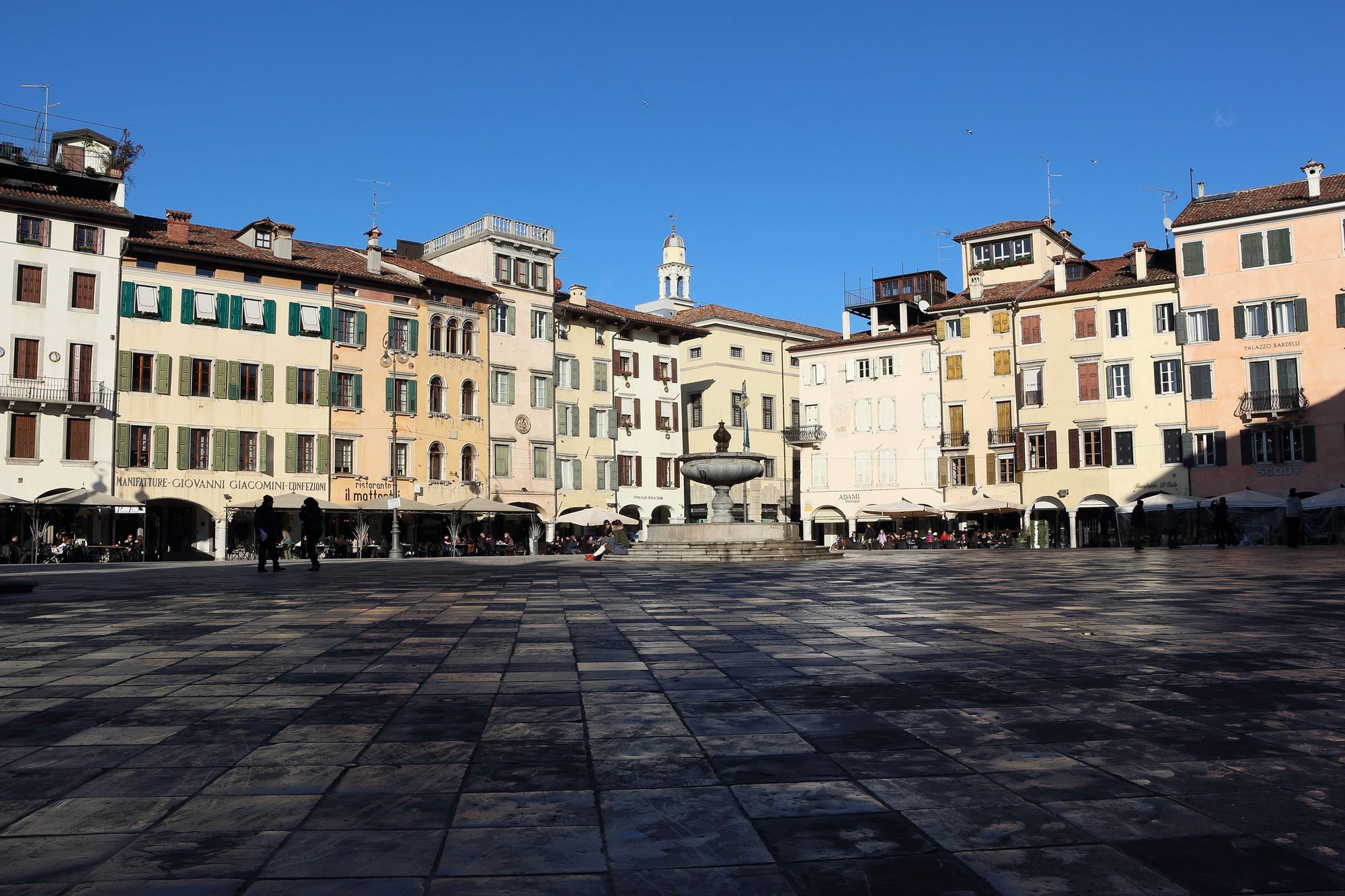
A wide paved square ringed by pastel arcaded houses with green shutters, a stone fountain at its centre under a deep blue sky

Friuli Venezia Giulia, Italy

Udine

Piazza Matteotti, better known as Piazza San Giacomo, in the centre of Udine. (CajetanM / Wikimedia Commons · CC BY-SA 3.0)

The historic capital of Friuli, on the plain between the Adriatic and the Carnic Alps, grown around a castle on an ancient man-made mound. Seat of the patriarchs of Aquileia and then the second city of the Venetian state, it keeps Venetian-style squares and Tiepolo frescoes, and is now a quiet university and market town of about 98,000 people.

Neighbourhoods

  • Piazza Libertà and the castle hill
    • First-time visitors
    • Historic district

    The oldest square in the city, below the castle, with the Venetian-Gothic Loggia del Lionello facing a clock tower modelled on the one in St Mark's Square. A Venetian Gothic portico with steps and ramps climbs from here to the castle and the church of Santa Maria di Castello.

    Open in Maps
  • Piazza San Giacomo and the pedestrian centre
    • Cafés and wine bars
    • Shopping
    • Best for food

    Piazza Matteotti, still called Piazza San Giacomo after its 14th-century church, was the medieval market square and is the heart of the town. Arcaded houses with café tables surround it, and the pedestrian streets around it form Udine's open-air shopping district.

    Open in Maps
  • Borgo Grazzano and the historic borghi
    • Local life
    • Quiet and residential

    Seven historic borghi lie inside the line of the old medieval walls, and a committee of the historic borghi organises festivals and cultural events in each of them. Borgo Grazzano holds the ethnographic museum of rural Friuli and is known for its frog festival.

    Open in Maps

Things to do

Famous landmarks

  • Udine Castlelandmark

    A Renaissance palace begun in 1517 on a hill that studies have shown to be a Bronze Age mound, with an early parliament hall painted by Giovanni da Udine and the city's history and art museums.

    Open in Maps
  • Piazza Libertàlandmark

    The Venetian-style main square, with the striped Loggia del Lionello, the Loggia di San Giovanni, a 1542 fountain and columns carrying the lion of St Mark and Justice.

    Open in Maps
  • Santa Maria di Castellolandmark

    Probably the oldest church in Udine, beside the castle, with fragments from the Lombard era and a façade rebuilt after the earthquake of 1511.

    Open in Maps
  • Udine Cathedrallandmark

    Begun in 1236 and consecrated in 1335, with a Romanesque-Gothic exterior, a Baroque interior holding works by Tiepolo, and a bell-tower chapel frescoed by Vitale da Bologna in 1349.

    Open in Maps
  • Oratorio della Puritàlandmark

    A small 18th-century oratory beside the cathedral, decorated with frescoes by Giambattista Tiepolo and his son Giandomenico.

    Open in Maps
  • Piazza Matteottilandmark

    The arcaded former market square known to everyone as Piazza San Giacomo, with its fountain and the church of San Giacomo, built for the confraternity of furriers.

    Open in Maps
  • Tempio Ossario dei Caduti d'Italialandmark

    A large domed church of 1931 by Alessandro Limongelli and Provino Valle that holds the remains of soldiers who died in the First World War.

    Open in Maps

Museums

  • Diocesan Museum and Tiepolo Galleriesmuseum

    Housed in the former residence of the patriarchs of Aquileia, the archbishop's palace, with rooms frescoed by Giambattista Tiepolo.

    Open in Maps
  • Casa Cavazzinimuseum

    The museum of modern and contemporary art, in a palace restored to a design by Gae Aulenti, showing Italian art from the late 19th century onwards and frescoes by Afro and Mirko Basaldella.

    Open in Maps
  • Ethnographic Museum of Friulimuseum

    A collection in Borgo Grazzano illustrating the rural life of Friuli.

    Open in Maps

Parks, gardens and sport

  • Orto Botanico Friulanopark

    A botanical garden founded in 1951, with irises, local flora, succulents, ferns and desert plants.

    Open in Maps
  • Stadio Friuliattraction

    The home ground of Udinese, a 1976 stadium of about 25,000 seats that was a venue at the 1990 World Cup.

    Open in Maps

Short trips from the city

  • Cividale del Friuliattraction

    The town in the foothills of the eastern Alps where the patriarchs lived before Udine, known for its Lombard Temple; the Lombard-era part of its historic centre is a UNESCO World Heritage Site.

    Open in Maps
  • Palmanovaattraction

    A star-shaped fortress town built by the Venetian Republic in 1593, its fortifications part of a UNESCO World Heritage Site.

    Open in Maps
  • Aquileiaattraction

    Once a major Roman city and early centre of Christianity, whose ruins, mosaics and early Christian basilica are a UNESCO World Heritage Site.

    Open in Maps

Seasonal events

  • Far East Film FestivalApril

    An annual festival of popular East Asian cinema held since 1997, one of the most important showcases of Asian film in Europe.

  • Udin&JazzJune

    A long-running jazz festival that has brought international names to the city.

  • Friuli DocSeptember

    A four-day food and wine festival held since 1995, with stands and food stalls set up in the main squares and streets of the old centre.

Eat and drink

Long-standing places and food districts in Udine. Hours, ratings and directions come from your maps app, always current.

Udine classics

  • Osterie of the old centrerestaurant

    The surviving osterie of the old town are where Udine's own dishes are served — frico, polenta, brovada and musetto, soups and game — with a glass of Friulian white or red.

    Open in Maps
  • Caffè Contarenacafe

    A café with an Art Nouveau interior close to Piazza Libertà.

    Open in Maps

Squares and wine bars

  • Piazza San Giacomoneighborhood

    The pedestrian square at the centre of town, ringed by café tables — the classic place for a coffee or a tajut, the Friulian word for a small glass of wine.

    Open in Maps
  • Borgo Grazzanoneighborhood

    One of the historic borghi of the old town, known for its traditional festival of frogs, which are called crots in Friulian.

    Open in Maps

Experience Udine

History

Udine's centre is a hill in an otherwise flat plain, and the town grew around it. Legend says Attila the Hun had his soldiers pile up earth in their helmets so he could watch Aquileia burn in 452; recent studies show the mound is indeed artificial, but from the Bronze Age, some 3,000 to 3,500 years old. The town is first recorded in 983, when Emperor Otto II gave the castle on the hill to the patriarchs of Aquileia, the feudal lords of Friuli. In 1222 Patriarch Bertoldo of Andechs moved here from earthquake-damaged Cividale, and the founding of a market in 1223 made Udine the leading centre of trade in the area.

Venice conquered the city in 1420, and Udine became the second-largest city of the Venetian state. In 1511 a short civil war was followed by an earthquake and plague; the castle and the patriarchal palace were rebuilt from 1517, and Andrea Palladio worked here in the 1550s. In the 18th century the patriarchal palace was enlarged under Patriarch Dionisio Dolfin, and Giambattista Tiepolo frescoed its rooms. After Venice fell in 1797 the city passed between Austria and Napoleon's Kingdom of Italy, then belonged to Austrian Lombardy-Venetia until it joined Italy in 1866. In 1880 the city council ordered the remaining sections of the medieval walls to be demolished.

From May 1915 to October 1917 Udine was the seat of the Italian High Command and was nicknamed the Capitale della Guerra, the War Capital. After the defeat at Caporetto it was occupied by German and then Austro-Hungarian troops until late 1918. From 1943 to April 1945 it was under direct German administration. Today it is the main city of Friuli and the capital of the regional decentralisation entity of Udine.

Culture & Customs

Udine is the main city of Friuli, and for centuries it was a Venetian city, in contrast to Austrian Trieste. Along with Italian, Friulian is often spoken in the streets and is taught in the city's schools, and a Venetian variant once common here is in decline. The look of the centre is Venetian — loggias, a clock tower with figures that strike the hours, the lion of St Mark on a column — a reminder of almost four centuries of rule from the lagoon.

The city's best-known cultural event looks far to the east: since 1997 the Far East Film Festival has made Udine one of Europe's main showcases for popular East Asian cinema, filling the Teatro Nuovo Giovanni da Udine and the Visionario cinema every spring. Udin&Jazz in June, a guitar festival in the castle's parliament hall and the literary prize Premio Friuli Storia add to the calendar, and Friuli Doc in September fills the squares with food and wine stands. The patron saints, Hermagoras and Fortunatus, are celebrated on 12 July.

Football matters: Udinese, founded in 1896, have played in every Serie A season since 1995–96, and their stadium also hosts the city's biggest concerts. The local basketball club, APU Udine, has played in the top league. Daily sociability centres on the squares, and the habit of a tajut — a small glass of white or red at the bar — is part of the city's character.

Daily Life

About 98,000 people live in the municipality, according to the 2025 figure, and about 176,000 in the urban area. After a fall in the 1990s, the population has grown again thanks to immigration: at the start of 2024, foreign residents made up about 15 per cent of the city's people, the second-highest share among the region's provincial capitals. A Slovene-speaking community lives in the border area close by.

The economy rests on administration, commerce and services. Udine is the seat of the regional decentralisation entity of Udine, of regional offices, hospitals, banks and the University of Udine, and it has long been the market town for the whole of Friuli, with shopping centres spread across its hinterland. The big steelworks and food factories have closed, but iron and engineering firms such as Danieli and ABS are still important employers, and in 2010 the city ranked first among the region's provincial capitals for average taxable income.

Life is unhurried. The pedestrian streets fill in the early evening, students from the university give the centre some energy, and the historic borghi inside the old walls organise their own festivals. The railway station is the most important in the region, used by about 7.6 million travellers a year.

Food

Udine eats Friulian food, which is hearty: polenta, frico, soups and minestrone, pork products, brovada and musetto, frittatas made with wild herbs, and game, usually with a glass of white or red wine. Frico, the most typical dish of Friuli, began as a way of using up cheese rinds; the soft version is made of Montasio cheese pressed into a cake with potatoes and onions and fried until crisp on both sides, while a thin version is just melted cheese crisped in the pan.

Slovenia is half an hour away, and goulash and ćevapčići served with polenta have entered the local repertoire. From Trieste come jota and boiled meats, and from the hills prosciutto di San Daniele, trout and asparagus. Montasio cheese and cured meats such as salame, soppressa and lardo are produced locally, and Udine's bread has a distinctive double-horn shape. Among the sweets are gubana and strucchi, crostoli at carnival and favette for All Souls.

Some dishes belong to particular days: tripe on Christmas Eve, herring with onion on Ash Wednesday and mulled wine at Epiphany. Borgo Grazzano holds a festival of frogs, crots in Friulian. The local wines include Friulano, Ramandolo, Verduzzo and Ribolla Gialla among the whites and Refosco dal Peduncolo Rosso and Schioppettino among the reds,.

Planning tools

Budget

Udine is one of the better-value cities in northern Italy, cheaper than Venice and with osterie that serve generous local food. Prices rise during the big festivals and when Udinese play at home, and a car only adds to the cost for trips into the hills and wine country.

Daily Budget Midrange
USD 140–250 (mid-range hotel, restaurant dinners, museum tickets, train day trips)
Daily Budget Shoestring
USD 65–110 (hostel or simple B&B, osteria meals and bakery snacks, city buses and regional trains)

The squares, the castle hill and the cathedral can all be enjoyed without spending much; a glass of wine standing at a bar is part of daily life and inexpensive.

Best Time to Visit

May to June and September to October are the most comfortable months. The Far East Film Festival fills the city in April and Friuli Doc in September. High summer is hot and stormy, and winter is the driest season, though relatively cold.

Suggested Number of Days

The compact centre suits one or two days. Allow three or four to use Udine as a base for the Lombard, Venetian and Roman towns of the plain, which are all within easy reach by train, bus or car.

First Visit
1–2 days
With Surroundings
3–4 days

Transportation

The old centre is small and largely pedestrian, and city buses connect the station and the outer districts. Udine is the main rail junction of Friuli Venezia Giulia, with lines to Venice, Trieste, Tarvisio, Gemona and Cividale, so most day trips work by train. A car is easiest for the wine hills.

With trains to Venice and Trieste almost every hour, a car is rarely needed for the cities; hire one only for the hills.

Airport & Station Connections

Trieste Airport at Ronchi dei Legionari is the nearest airport, about 44 km south of Udine; Venice Marco Polo and Treviso are about an hour away. Trains run to Venice in about an hour and a half and to Trieste in just over an hour, and international services reach Vienna and Munich. By motorway, Trieste is about an hour away and the Austrian border at Villach about an hour and a half.

Walkability

Very walkable. Piazza Libertà, the castle hill, the cathedral and Piazza San Giacomo are all a few minutes apart, and the pedestrian shopping streets link them. The climb to the castle is short but steep, by the portico steps and ramps.

Safety

Italy is generally safe, with low levels of violent crime against visitors. Udine is a calm provincial city, and the busiest moments are football matches, concerts at the stadium and the large festivals in the old centre. Summer thunderstorms can bring heavy hail.

Keep an eye on bags in crowded squares during festivals and leave nothing visible in parked cars. Check current official travel advice before travelling.

Climate

A humid subtropical climate with abundant rain all year; spring and autumn are the wettest seasons and Udine is one of the rainiest provincial capitals in Italy. Snow is light, around 10 cm a year on average, and the summer brings frequent thunderstorms.

Summer
fairly hot, with frequent thunderstorms that can bring heavy hail; on the coast at nearby Trieste, summer highs are about 29°C
Winter
the least rainy season and relatively cold, with around 10 cm of snow a year on average; colder than the coast at Trieste, where rainy winter days reach about 6–11°C

Local Customs

Italian is the main language, and Friulian is often heard too and is taught in local schools. A tajut, a small glass of wine taken standing at a bar or in a square, is a fixture of the day, and the historic borghi each keep their own festivals.

Dress modestly in churches, with shoulders and knees covered, and avoid visiting during services; ask before photographing people.

Common Payment Methods

The currency is the euro. Cards and contactless payment are widely accepted, though small bars and market stalls may prefer cash for small sums, and ATMs are easy to find in the centre.