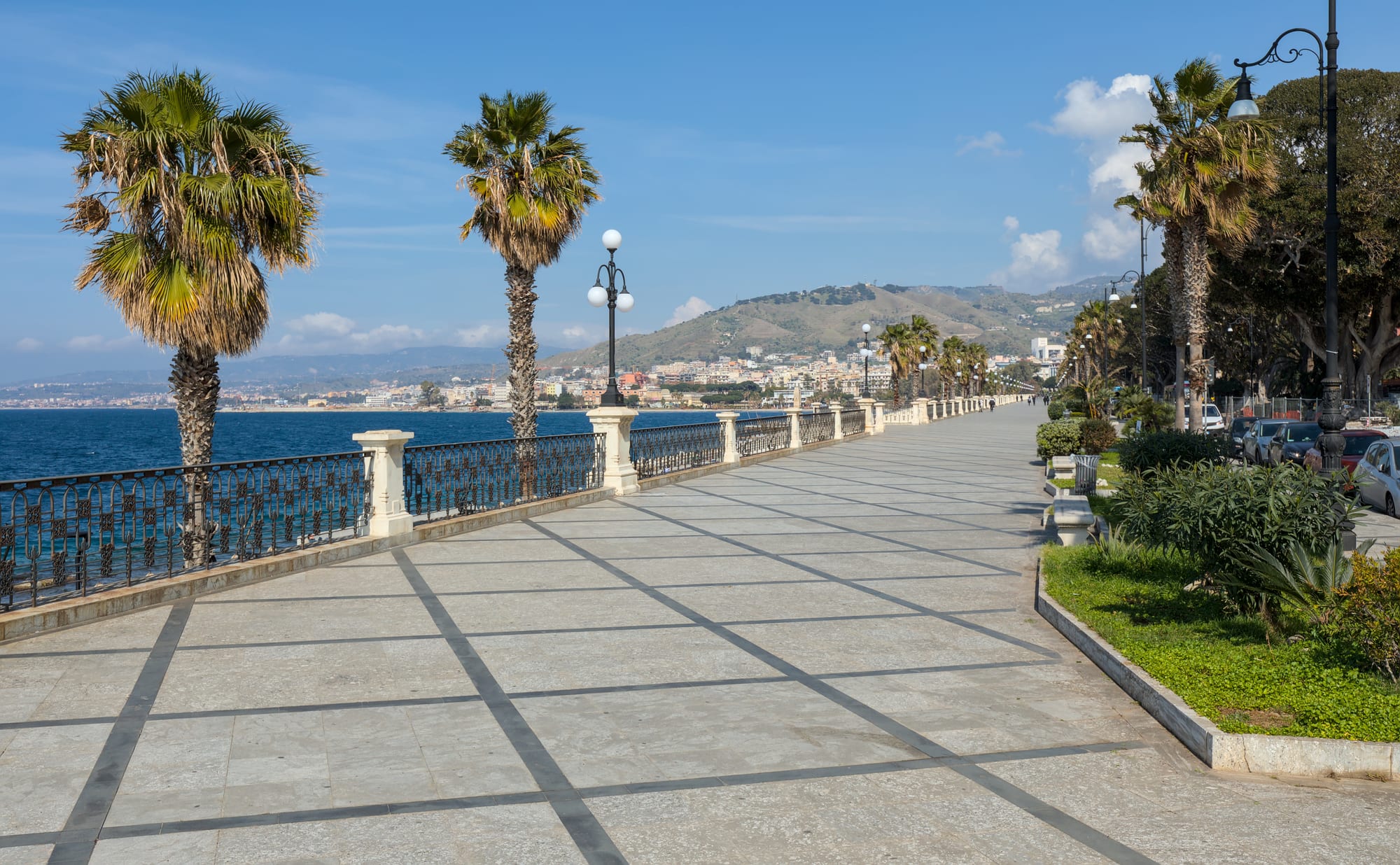
Wide paved seafront promenade with palm trees and iron railings beside a blue sea, with hills and houses in the distance

Calabria, Italy

Reggio Calabria

The Lungomare Falcomatà, the seafront promenade of Reggio Calabria on the Strait of Messina. (Benjamin Smith / Wikimedia Commons · CC BY-SA 4.0)

The largest city in Calabria, on the toe of Italy facing Messina across the Strait of Messina. Founded by Greek colonists in the 8th century BC and levelled by the earthquake and tsunami of 1908, it was rebuilt on a grid of Liberty-style streets behind a palm-lined seafront, and its museum holds the Riace Bronzes.

Neighbourhoods

  • Centro storico
    • First-time visitors
    • Museums
    • Close to public transport

    The rebuilt centre, laid out after 1908 as straight parallel streets running along the coast and lined with Liberty buildings. The mostly pedestrian Corso Garibaldi links Piazza Garibaldi by the central station with the cathedral square, Piazza Italia and Piazza De Nava, where the national museum stands.

    Open in Maps
  • Lungomare Falcomatà
    • Seafront walks
    • Nightlife
    • Views of Sicily

    The promenade along the strait, planted with magnolias and exotic palms and lined with Liberty villas, Greek walls and Roman baths. It is where the city swims, strolls and goes out on summer nights, with Sicily in full view across the water.

    Open in Maps
  • Catona and the northern shore
    • Beaches
    • Summer events

    The northern quarters of the city, including Gallico and Catona, facing Sicily across the strait. Catona's Arena Neri hosts open-air events from July to September.

    Open in Maps
  • Pellaro and the southern coast
    • Local life
    • Bergamot country

    The coast south of the airport, where citrus groves, vineyards and the bergamot trees that made the city's fortune grow along the shore. Pellaro has an ethnographic museum.

    Open in Maps

Things to do

Museums

  • Museo Nazionale della Magna Greciamuseum

    The national archaeological museum in a 1932 building by Marcello Piacentini, with finds from the Greek cities of Calabria, Basilicata and Sicily and the Riace Bronzes — two full-size Greek bronze warriors found in the sea off Riace Marina in 1972.

    Open in Maps
  • Pinacoteca Civicamuseum

    The town art gallery, with two works by Antonello da Messina alongside paintings by Mattia Preti and Luca Giordano.

    Open in Maps

Landmarks and ancient remains

  • Aragonese Castlelandmark

    A castle first built before 540, enlarged by the Normans and by the Aragonese in 1459 and partly demolished after earthquakes, now used for art exhibitions and with views over the city and strait.

    Open in Maps
  • Reggio Calabria Cathedrallandmark

    The cathedral of the Assumption, rebuilt after the 1908 earthquake in an eclectic style with Romanesque and Gothic elements and consecrated in 1928.

    Open in Maps
  • Chiesa degli Ottimatilandmark

    A church beside the castle on Via Castello, rebuilt after the 1908 earthquake in neo-Byzantine style and completed in 1933.

    Open in Maps
  • Greek walls and Roman bathslandmark

    Stretches of the ancient Greek city walls, in four separate sections, and the remains of a Roman bath house along the promenade.

    Open in Maps
  • Villa Genoese Zerbilandmark

    A neo-Gothic villa of 1925 in the style of 14th-century Venice, midway along the seafront, opened for exhibitions as a southern seat of the Venice Biennale.

    Open in Maps

The seafront and city walks

  • Lungomare Falcomatàtrail

    The seafront boulevard named after the mayor who led the city's recovery in the 1990s, called 'the most beautiful kilometre of Italy' and the heart of summer evenings.

    Open in Maps
  • Arena dello Strettoattraction

    A modern open-air amphitheatre midway along the promenade, facing the strait.

    Open in Maps
  • Corso Garibaldineighborhood

    The main, mostly pedestrian shopping street, crossing the principal squares of the centre.

    Open in Maps

Short trips from the city

  • Scillaattraction

    The fishing town on the strait's narrowest point that is the traditional home of the sea monster Scylla, with Ruffo Castle on its headland, reached by regional train.

    Open in Maps
  • Aspromonte National Parkpark

    The mountains behind the city, rising close to 2,000 metres, with beech and fir forests, wolves and eagles, a UNESCO Global Geopark since 2021 and the ski resort of Gambarie.

    Open in Maps
  • Pentedattiloattraction

    A village under a rock shaped like five fingers that was abandoned and has been rebuilt and repopulated since the 1980s.

    Open in Maps
  • Messinaattraction

    The Sicilian city across the strait, reached by ferry, catamaran or hydrofoil — the crossing on deck is worth it for the view alone.

    Open in Maps

Seasonal events

  • Festa della Madonna della ConsolazioneFrom the second Saturday in September, for a week

    The city's great festival: the image of the Madonna is carried from the Basilica dell'Eremo along Corso Garibaldi to the cathedral, and the celebrations last a week.

  • Summer at the Arena NeriJuly to September

    A season of open-air events in the Catona quarter.

Eat and drink

Long-standing places and food districts in Reggio Calabria. Hours, ratings and directions come from your maps app, always current.

Reggio classics

  • Gelateria Cesarecafe

    A green kiosk on Piazza Indipendenza, a favourite since 1918 and known for gelato in a brioche.

    Open in Maps
  • Swordfish and seafood restaurantsneighborhood

    Swordfish Reggio-style, stockfish and fried fish appear across the city's menus, alongside crispellini, small fried bread balls stuffed with fish.

    Open in Maps

Cafés and bars

  • Lungomare barsneighborhood

    Kiosks and bars along the promenade where a beer, a cocktail or a glass of bergamot liqueur comes with a view of Sicily.

    Open in Maps
  • Cafés of Corso Garibaldicafe

    Bars along the main street serve granita with cream and brioche, gelato and the local coffee-flavoured gassosa.

    Open in Maps

Experience Reggio Calabria

History

Reggio is the oldest city in Calabria. Greek colonists from Chalcis settled here in 730 or 743 BC on the site of an older settlement called Erythra, "the red", and named their colony Rhegion. Under the tyrant Anaxilas, early in the 5th century BC, Rhegion took Zancle, today's Messina, and controlled both shores of the strait. Dionysius I of Syracuse destroyed it in 387 BC; it recovered, allied with Rome in 282 BC, and kept its Greek language and mint as Rhegium.

Under Byzantine rule it was repeatedly the capital of the Duchy of Calabria and, until the 15th century, one of the most important Greek-rite bishoprics in Italy. The Byzantines brought mulberries and silkworms from Syria, and silk became the city's wealth. Arabs held it at times in the 10th and 11th centuries, the Normans took it for good in 1060. Spanish rule brought heavy taxes, plague and Ottoman raids, and the earthquake of 1783 devastated it.

At dawn on 28 December 1908 an earthquake and a tsunami of up to 12 metres killed an estimated 25,000 people in Reggio, more than a quarter of its population. The city was rebuilt on a grid, was heavily bombed and taken by the British Eighth Army in 1943, and in 1970–71 rose in the Moti di Reggio against the choice of Catanzaro as regional capital. Twenty years of rising 'Ndrangheta crime and urban decay followed; from the 1990s the "Reggio Spring" revived the city, symbolised by the rebuilt seafront. In 2012 the whole city council was dissolved for mafia infiltration, the first time this had happened to a provincial capital.

Culture & Customs

Reggio calls itself the City of Bronzes, after the Riace warriors, and the City of Bergamot, after the citrus grown almost nowhere else. It is also the city of the Fata Morgana, the mirage that on rare days makes the Sicilian coast seem only a few metres away, with houses, cars and people clearly visible. Its Greek and Byzantine past survives in words of local speech, in religious icons and in some recipes.

The year's great event is the Festa della Madonna della Consolazione, which starts on the second Saturday of September, when the Madonna's image is carried from the Basilica dell'Eremo down Corso Garibaldi to the cathedral and the city celebrates for a week. The Teatro Comunale Francesco Cilea, rebuilt after 1908, and the Liberty-style Politeama Siracusa of 1922 stage music and theatre, and the Villa Genoese Zerbi has hosted Venice Biennale exhibitions.

Reggio has a long line of artists and scholars, from the ancient poet Ibycus to the Futurist Umberto Boccioni and the fashion designer Gianni Versace. The Mediterranea University, founded in 1968, was the first in Calabria, and the city also has a university for foreigners, an academy of fine arts and a conservatory. Football means the Stadio Oreste Granillo and the Derby dello Stretto against Messina, twenty-five minutes away by ferry.

Daily Life

About 168,000 people live in the city, according to a 2025 figure, and some 512,000 in the wider metropolitan area. The municipality stretches for kilometres along the coast, from Catona and Gallico in the north through the centre to Pellaro in the south, and up into the hills; one study of 386 European cities found Reggio had the least green space of all. Ties with Messina, across the strait, are close.

The city lacks an adequate industrial base. Its economy rests on the port and fishing, agriculture and exports — fruit, and above all the essential oil of bergamot, used in the perfume industry — along with small firms that assemble railway carriages and make machinery. The beaches and the museum draw visitors, and the universities bring students to the centre.

Life follows the southern rhythm: shops close for a long break in the middle of the day, and in summer the city comes out after dark to walk the Lungomare and eat gelato on the Corso. The 'Ndrangheta remains a heavy presence in the local economy, and in 2012 the city council was dissolved over infiltration by it.

Food

Reggio's cooking takes from both Naples and Sicily but rests on its own sea and land. Swordfish is cooked Reggio-style or grilled with salmoriglio, and stockfish, piscistoccu, is prepared in several ways. Among the pastas are pasta ca muddhica e chi lici, with breadcrumbs and anchovies, and maccarruni 'i casa with ragù. Antipasti include aubergines preserved in oil, sun-dried tomatoes and crushed olives, and street stalls fry crispellini, small balls of bread stuffed with fish.

Sweets are a point of pride. Granita with cream and brioche is a local speciality, and gelato is taken seriously, with a local flavour called crema reggina and turruni gelatu, an iced nougat; Gelateria Cesare has served gelato in brioche from its kiosk on Piazza Indipendenza since 1918. Christmas brings crispeddhi and petrali, Easter the cuddhuraci and Carnival the pignolata, and almond pastries are made too.

The bergamot, a fragrant citrus the colour of a lime that grows only along this coast, flavours bergotto, a liqueur not unlike limoncello, and its oil scents Earl Grey tea. Other local drinks include piparillo, a chilli liqueur, and gassosa al caffè, a coffee-flavoured soda.

Planning tools

Budget

Calabria is among the cheapest regions in Italy, and Reggio is a working city rather than a resort, so rooms, food and local transport cost less than in Sicily's tourist towns across the strait. The museum ticket and ferries are the main extra costs.

Daily Budget Midrange
USD 100–200 (central hotel, seafood dinners, the museum, a ferry to Messina)
Daily Budget Shoestring
USD 45–85 (B&B or budget room, pizza, gelato and market food, city buses)

The promenade, the Greek walls and the view of Sicily are free; the foot-passenger crossing to Messina is a cheap way to see the strait.

Best Time to Visit

Spring and autumn are the most comfortable months for walking the city and the Aspromonte. Summer is hot, but the promenade, the beaches and the evening crowds are at their liveliest, and September brings the week-long festival of the Madonna della Consolazione. Winters are short and mild.

Suggested Number of Days

The museum and the seafront fill a day or two. Adding the coast to the north, the mountains behind the city and a crossing to Sicily stretches a stay to several days; the mountain villages are much easier with a car.

First Visit
1–2 days
With Surroundings
3–5 days

Transportation

The centre is compact, and city buses run by ATAM mostly converge on Piazza Garibaldi in front of the central station; tickets are sold at newsagents and tobacconists. Regional trains stop at several local stations within the city and run north along the coast to Scilla and south past the airport. A car helps for the Aspromonte and the villages.

Buy bus tickets before boarding, and check whether a return ferry lands at Reggio or at Villa San Giovanni, 14 km north.

Airport & Station Connections

Reggio Calabria Airport, also called the Aeroporto dello Stretto, is about 5 km south of the historic centre, with buses to downtown and the port; Lamezia Terme, Calabria's principal airport, lies further north. Long-distance trains from Rome and Naples run down the Tyrrhenian coast through Villa San Giovanni to Reggio di Calabria Centrale. Ferries, catamarans and hydrofoils cross the strait to Messina, and the A2 motorway ends at the city.

Walkability

The centre is easy on foot: the grid of streets runs parallel to the sea, Corso Garibaldi is largely pedestrian, and the promenade makes a long, level walk past the main sights. The city climbs steeply behind the centre towards the hills, and the outlying quarters along the coast are far apart.

Safety

Italy is generally safe, with low levels of violent crime against visitors. Reggio is home to the 'Ndrangheta, which does not target visitors, and the centre and promenade are busy and safe. Petty theft and break-ins to parked cars are the usual risks. The city sits in Italy's highest earthquake-risk category, and summer heat and wildfires affect the hills.

Keep valuables out of parked cars, keep bags close at the station and port, and learn the earthquake guidance posted in hotels. Check current official travel advice before travelling.

Climate

A Mediterranean climate, with warmer days and cooler nights than Messina across the strait and noticeably less rain. Summer sea breezes from the north and cooler air off the Aspromonte make the heat more bearable.

Summer
hot and dry; in Messina, across the strait, heat waves driven by southern winds can reach 40°C
Winter
mild and short — the temperature hardly ever approaches freezing, and the yearly average is about 17°C

Local Customs

Reggio is a city of the evening passeggiata along the Lungomare and the Corso, of family Sunday lunches and of devotion to the Madonna della Consolazione. Greek words survive in local speech. Churches expect covered shoulders and no beachwear. Tipping is not expected as it is in North America; rounding up the bill is a courteous gesture.

Dress modestly in churches, and expect shops to close for a long midday break outside the main streets.

Common Payment Methods

Italy uses the euro. Cards are widely accepted in hotels, restaurants and shops; keep some cash for small bars, kiosks and market stalls. Cash machines are easy to find in the centre.