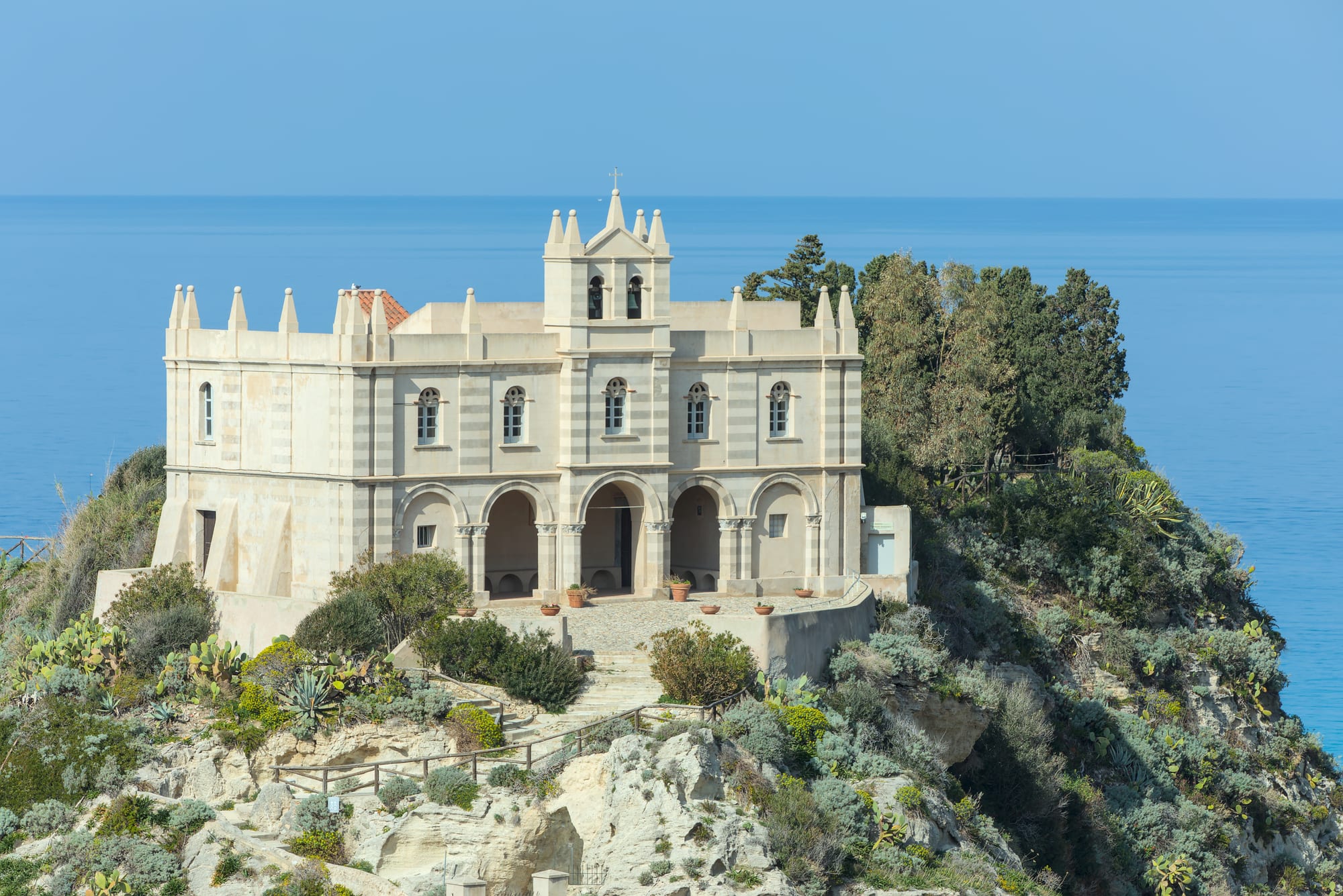
Pale stone church with pinnacles and an arcaded porch on a rocky, scrub-covered headland above a calm blue sea

Calabria, Italy

Tropea

The church of Santa Maria dell'Isola on its promontory at Tropea. (Benjamin Smith / Wikimedia Commons · CC BY-SA 4.0)

A small resort town on Calabria's Tyrrhenian coast, its old centre built on a sheer rock about 60 metres above the sea and facing the church of Santa Maria dell'Isola on its own promontory. Norman, Aragonese and noble families left churches and palazzi; today summer tourism, sandy beaches and the famous red onion carry the town.

Neighbourhoods

  • Historic centre
    • First-time visitors
    • Historic district
    • Best for food

    The upper town on the rock, once walled and entered only through defended gates, where daily life goes on among 18th- and 19th-century noble palazzi with carved stone portals. Many B&Bs occupy old palazzi here, and balcony-like viewpoints over the sea open at the ends of its lanes.

    Open in Maps
  • Marina
    • Beaches
    • Harbour

    The lower part of town at the foot of the cliff, beside the sea, the beaches and the small tourist port. Long flights of steps climb from the shore to the old centre, and camping grounds sit close to the sand.

    Open in Maps
  • Newer town
    • Quiet and residential
    • Close to the station

    The districts spreading inland from the old centre, including Carmine and Campo, where most of the hotels, the hospital and the railway station are found. Campo di Sopra is still largely gardens and fields with some housing.

    Open in Maps

Things to do

The old town and its churches

  • Santa Maria dell'Isolalandmark

    The sanctuary on a rock that was once an island, thought to have begun as a hermitage of eastern monks and given its present look after the earthquake of 1905; its garden looks out towards Stromboli.

    Open in Maps
  • Tropea Cathedrallandmark

    The Romanesque co-cathedral built under the Normans in the 12th century, holding the image of the Madonna di Romania, a black crucifix made in France around 1600, and two unexploded bombs from 1943.

    Open in Maps
  • Diocesan Museummuseum

    Housed in the old bishop's rooms beside the cathedral, with the cathedral's gold and silver, paintings, sculpture and archaeological finds.

    Open in Maps
  • Chiesa del Gesùlandmark

    A Jesuit church on a Greek-cross plan, standing where the old Greek-rite cathedral of San Nicola was demolished in 1594.

    Open in Maps
  • Scala Letterariaattraction

    A flight of painted steps created by residents and local businesses in 2021, each step bearing the title and author of a literary work, from Calabrian writers to Tolstoy and Oscar Wilde.

    Open in Maps
  • Affaccio dei Sospiriviewpoint

    One of the town's many sea-facing viewpoints at the edge of the cliff, considered among the most beautiful in Italy.

    Open in Maps

Short trips along the coast

  • Capo Vaticanobeach

    A cape of white-grey granite in the neighbouring comune of Ricadi, with beaches and a climate considered ideal for growing the red onion of Tropea.

    Open in Maps
  • Pizzoattraction

    A seaport on a cliff over the Gulf of Saint Euphemia, with the 15th-century Aragonese castle where Joachim Murat, former King of Naples, was shot in 1815, and the birthplace of tartufo gelato.

    Open in Maps
  • Stromboliattraction

    The constantly active volcanic island in the Aeolian chain, nicknamed the Lighthouse of the Mediterranean, reached by boat from Tropea's port.

    Open in Maps

Seasonal events

  • Feast of the Madonna di Romania27 March and 9 September

    The town's patron is honoured twice a year with a procession through the streets of the old centre.

  • I tri da' Cruci3 May

    A feast of the Holy Cross that ends with a figure of a camel, packed with fireworks, dancing to the drumbeat of the carica tumbula.

  • Red Onion and Blue Fish FestivalJuly

    The Sagra della Cipolla Rossa di Tropea e del Pesce azzurro, a food festival celebrating the local onion and oily fish such as anchovies and sardines.

  • Feast of the Assumption15 August

    A statue of the Holy Family kept in the church on the rock is carried in procession on the sea.

  • Tropea Blues FestivalSeptember

    A week of blues, with dozens of bands playing on stages and in venues around the historic centre.

Eat and drink

Long-standing places and food districts in Tropea. Hours, ratings and directions come from your maps app, always current.

Tropea classics

  • Restaurants and pizzerias of the old townneighborhood

    Calabrian cooking in the lanes of the upper town, where pizza, arancini and other dishes labelled 'Tropeana' come with the local red onion.

    Open in Maps
  • Local produce shopsmarket

    Shops selling red onions and onion jam, 'nduja from Spilinga, pecorino from Monte Poro, olive oil, chilli pastes and wine from the surrounding villages.

    Open in Maps

Cafés and sweets

  • Cafés and gelaterie of the old towncafe

    The town's cafés serve tartufo di Pizzo, a ball of gelato with a molten chocolate centre, alongside the local amari.

    Open in Maps
  • Pizzo's gelaterieneighborhood

    The neighbouring seaport where tartufo was created, a dessert of chocolate and hazelnut gelato balls filled with molten chocolate and dusted with cocoa.

    Open in Maps

Experience Tropea

History

Legend says Tropea was founded by Hercules on his way back from the Pillars of Hercules, and tombs from the time of the Greek colonies have been found nearby. The name probably comes from a Greek phrase for an alternating wind that blows in from the sea — in the Calabrian dialect "trupìa" still means a sudden summer storm. The town's recorded story begins in the Roman era, when Sextus Pompey defeated Octavian along this coast, and the Romans built a commercial port to the south near today's Santa Domenica.

Its position on a natural terrace above the sea made it important to the Byzantines, who left churches such as the one on the promontory. After a long siege Arab raiders took the town from the Byzantines; the Normans won it back, and under them it prospered, building the cathedral in the 12th century. Prosperity continued under the Aragonese. Noble families built palazzi on the rock, some with great cisterns cut into the stone to store grain from Monte Poro, which was sent down through terracotta pipes to ships moored below. The Jesuits replaced the old Greek-rite cathedral of San Nicola with their own church in the 1590s, and the earthquake of 1905 badly damaged the sanctuary on the rock.

In September 1943 American fighter planes dropped six bombs on the town and none exploded, an escape credited to the Madonna di Romania, the patron; two of the bombs are displayed in the cathedral. Tropea won the title of Borgo dei Borghi on the RAI 3 programme Kilimangiaro in 2021, and it has flown the Blue Flag for clean bathing water since 2020.

Culture & Customs

The town's calendar follows its saints. The Madonna di Romania is honoured with processions on 27 March and 9 September, Santa Domenica, a martyr born in Tropea, on 6 July, and on 15 August the statue of the Holy Family from the church on the rock goes to sea in procession. On 3 May the feast of the Holy Cross, I tri da' Cruci, ends with a fireworks-filled camel dancing to the drum rhythm of the carica tumbula. Good Friday brings a dusk procession of the dead Christ, and on 21 March a lunch is offered to the devout for the feast of St Joseph.

Tropea has a literary streak out of proportion to its size: it gives its name to a national literary prize, the Premio Letterario Tropea, whose final winner is chosen by the mayors of Calabria's municipalities, and in 2021 residents painted the Scala Letteraria, a stairway of book titles. Every September the Tropea Blues Festival fills the old centre with bands for a week. Television made the town familiar to Italians through the RAI series Gente di mare, filmed here and first broadcast in 2005.

The philosopher Pasquale Galluppi is buried in the cathedral, and the actor Raf Vallone is among the town's notable names. The Giro d'Italia has finished stages here twice, in 2005 and 2011, and the town has a stadium, the Stadio del Sole.

Daily Life

About 5,700 people live in Tropea, according to a 2026 figure, in one of the smallest municipalities in Calabria by area, just 3.66 square kilometres. More than a quarter of residents are over 65, and immigrants, most often from Romania and Ukraine, make up about 7 per cent of the population. Daily life is lived in the upper town on the rock, while the Marina below is given over to the beaches and the port; the hospital and carabinieri barracks are in the newer Campo district.

The economy rests on summer tourism, from early June to the end of September. Many B&Bs occupy palazzi in the historic centre, hotels stand mostly in the newer town, and much of the holiday accommodation is in the villages around it that once belonged to Tropea, among them Parghelia, Drapia, Zambrone and the coast of Capo Vaticano. Tropea is the main centre of the Coast of the Gods, the stretch of shore that runs from Pizzo to Nicotera, and in 2023 it was the most searched-for village in Italy on Google.

Farming remains part of the picture. For many years growing, processing and selling the red onion of Tropea, cultivated along the Tyrrhenian coast between Nicotera and Campora San Giovanni, was one of the most important activities in the area, and shops in town sell produce and crafts from the neighbouring villages, including terracotta and wicker baskets.

Food

The red onion of Tropea, cipolla rossa di Tropea, is the town's emblem. It is sweeter than white onions and is protected as a PGI product, and it appears on pizza, arancini and many other dishes labelled "Tropeana", as well as in jams and preserves sold all over town. The coast around Capo Vaticano is considered to have the ideal climate for growing it. In July the Sagra della Cipolla Rossa di Tropea e del Pesce azzurro pairs it with oily blue fish.

The surrounding villages supply much of the rest of the table. 'Nduja, a spicy, spreadable pork sausage from nearby Spilinga, is made from pork trimmings and fat with sun-dried Calabrian chilli, smoked and aged for months, and is usually spread on bread or eaten with mature cheese. Pecorino from Monte Poro, extra-virgin olive oil, Calabrian chilli pastes, the bomb-shaped "Bomba Calabrese" condiment and local wines fill the shop shelves.

For something sweet, the cafés serve tartufo di Pizzo, created in the seaport a short way up the coast: a ball of chocolate and hazelnut gelato with molten chocolate at its heart, dusted in cocoa, and protected as a PGI product. Drinks lean towards the herbal — Vecchio Amaro del Capo takes its name from nearby Capo Vaticano, liquorice-flavoured liqueurs are made locally, and a local brewery even produces an onion-flavoured beer.

Planning tools

Budget

Calabria is one of the cheaper parts of Italy, but Tropea is its best-known resort and prices climb steeply in August. Many rooms are in B&Bs inside old palazzi or in holiday homes in the neighbouring villages, and pizzerias and trattorias keep eating costs reasonable outside high season.

Daily Budget Midrange
USD 110–230 (sea-view room, restaurant dinners, a boat trip or a hire car)
Daily Budget Shoestring
USD 55–95 (B&B or campsite, pizza and street snacks, regional trains)

June and September cost far less than August; the beaches, the viewpoints and the old-town lanes are free.

Best Time to Visit

The season runs from early June to the end of September, when the beaches, boats and restaurants are all working; May and October are quieter and milder. August is the busiest and most expensive month, with Italian holidaymakers filling the town. In winter much of the resort closes and rain is most frequent.

Suggested Number of Days

The old town itself can be seen in a day or two. A beach holiday or a stay that takes in the rest of the coast, the neighbouring towns and a boat to the islands usually runs to most of a week. Without a car, train times shape how much can be fitted in.

First Visit
1–2 days
With Surroundings
4–6 days

Transportation

Tropea is small enough to cover on foot, and traffic is limited in the historic centre, which is a restricted zone for cars; parking near the beaches is paid almost everywhere. Taxis can be called by phone or found near the station, and tuk-tuk taxis wait near the beaches. Scooters and cars are easy to hire for the coast.

Do not drive into the historic centre's restricted traffic zone; park outside it and walk.

Airport & Station Connections

The nearest airport is Lamezia Terme International Airport, the principal airport of Calabria, and Reggio Calabria's airport lies further south. Tropea station, at the top of the town a short walk from the centre, is on the old coastal line of the southern Tyrrhenian railway, served by regional trains between Lamezia Terme and Rosarno; from Lamezia Terme the journey takes roughly an hour. Drivers leave the A2 motorway for Pizzo or Rosarno. Boats link the port with the Aeolian Islands.

Walkability

The historic centre is compact and fairly flat, and pleasant to wander. The catch is the cliff: walking between the old town and the beaches means climbing long, steep flights of steps, which is hard work in summer heat.

Safety

Italy is generally safe, with low levels of violent crime against visitors. Tropea is a quiet resort, and the usual concerns are petty theft at busy beaches and break-ins to parked cars. The practical hazards are summer heat, wildfires in the surrounding hills and the steep steps down the cliff.

Keep valuables out of parked cars and off unattended beach towels, carry water on the climb back up from the shore, and follow fire bans in summer. Check current official travel advice before travelling.

Climate

A Mediterranean climate with mild winters and warm, dry summers. On the 1961–90 averages, rain falls on about 78 days a year, little of it in summer and most of it in autumn and winter.

Summer
warm and dry — August, the warmest month, averages about 25°C
Winter
mild — January and February average about 10.5°C, with most of the year's rain

Local Customs

Tropea is a resort, but it is also a religious town with processions for its patron saints, and churches expect modest dress — covered shoulders and no swimwear. Lunch and the afternoon break slow the town down, and the evening walk through the old centre is the social heart of summer. Tipping is not expected as it is in North America; rounding up the bill is a courteous gesture.

Cover up when leaving the beach for the old town's churches, and step aside for processions on feast days.

Common Payment Methods

Italy uses the euro. Cards are accepted in most hotels, restaurants and shops, but small bars, beach kiosks and market stalls may prefer cash, and there are cash machines in the town centre.