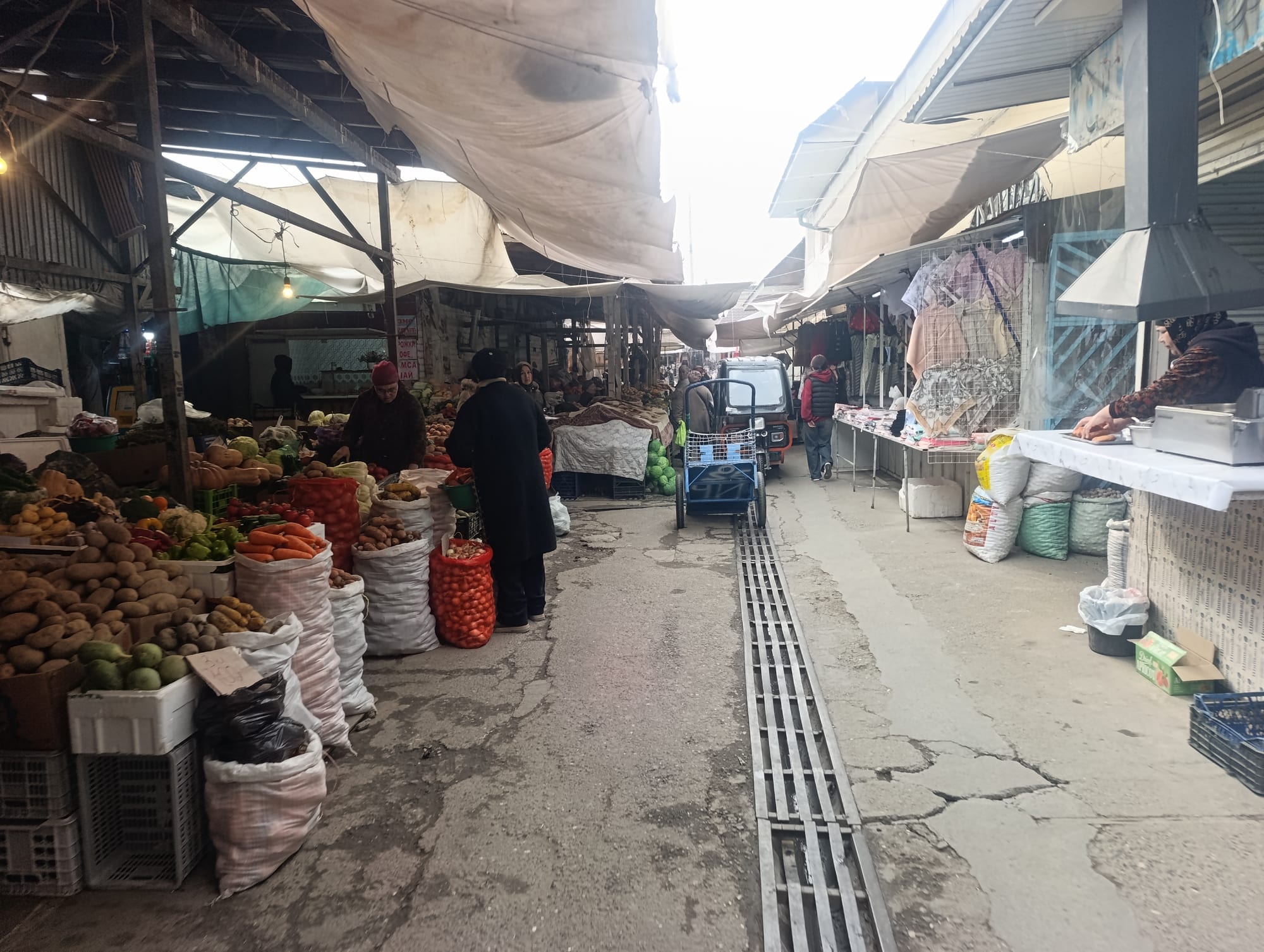
A covered market lane with sacks of potatoes, crates of vegetables and cloth stalls under canvas awnings

Osh & the South, Kyrgyzstan

Jalal-Abad

Produce and cloth stalls in the central bazaar of Jalal-Abad. (Mirzoulugʻbek / Wikimedia Commons · CC0)

A southern Kyrgyz city in the foothills above the Fergana Valley, long known for the mineral springs and sanatoriums on the hill above it and renamed Manas in 2025. It is a low-rise place of tree-lined streets, a large central bazaar and Soviet-era blocks, and the usual base for the walnut forests of Arslanbob and the lakes further north-west.

Neighbourhoods

  • The city centre
    • First-time visitors
    • Close to public transport
    • Parks

    The grid of streets around the main square and central park holds the administration, the theatre, hotels, cafés and the shared-taxi stands. It is flat, shaded by plane trees and easy to cross on foot.

    Open in Maps
  • The bazaar quarter
    • Best for food
    • Local life
    • Shopping

    The central bazaar and the lanes around it are the busiest part of the city, with produce rows, cloth and hardware stalls, bakeries and tea houses. Trade begins soon after dawn and thins out through the afternoon.

    Open in Maps
  • The sanatorium hill
    • Quiet and residential
    • Views
    • Spa stays

    Above the city, on the slope where the mineral springs rise, stand the spa buildings, guest blocks and wooded grounds that made the town's name. The air is cooler here and the views run out across the valley.

    Open in Maps
  • The microdistricts and the outskirts
    • Quiet and residential
    • Budget stays

    Blocks of flats and streets of single-storey courtyard houses spread out from the centre towards the ring road, with local markets, schools and mosques. Much of the population lives here, and the bus stands for other towns are on this edge.

    Open in Maps

Things to do

In the city

  • The central bazaarmarket

    The city's main market, selling fruit, vegetables, dried apricots and walnuts, cloth, hats and household goods, with cooked food and tea among the rows.

    Open in Maps
  • The central parkpark

    A shaded park of plane trees, fountains and fairground rides near the main square, busiest on warm evenings and at weekends.

    Open in Maps

Springs and parks

  • The mineral springs and sanatoriumsattraction

    The spa complex on the hill above the city, built around warm mineral waters and mud treatments, which drew visitors from across the Soviet Union and still receives Kyrgyz and Uzbek patients.

    Open in Maps
  • The wooded slopes above the spaviewpoint

    Paths and picnic grounds climb through trees behind the sanatorium hill, giving views over the city and out across the Fergana lowlands.

    Open in Maps

Short trips from the city

  • Arslanbobattraction

    An Uzbek village under the walnut forests of the Babash-Ata foothills, with two waterfalls above it, about an hour and a half to the north.

    Open in Maps
  • Bazar-Korgonmarket

    A valley town on the main road towards Arslanbob, with a large bazaar and the junction where traffic turns off into the mountains.

    Open in Maps
  • Uzgenlandmark

    A Karakhanid minaret and three carved brick mausoleums of the 11th and 12th centuries stand in this old town to the south-east, surrounded by rice fields.

    Open in Maps
  • Sary-Chelekpark

    A deep blue mountain lake in a biosphere reserve in the western Tian Shan, reached through orchards and forest on a long drive north-west.

    Open in Maps
  • Oshattraction

    The capital of the south, about 50 kilometres away, built around the UNESCO-listed rock of Sulayman Mountain and one of Central Asia's oldest markets.

    Open in Maps

Seasonal events

  • NowruzMarch

    The spring new year, marked with sumalak cooked overnight in large cauldrons, concerts and games on the main square.

  • Orozo Aitvaries with the lunar calendar

    The festival ending Ramadan, with mass morning prayers, visiting between households and long family meals.

  • Kurman Aitvaries with the lunar calendar

    The feast of sacrifice, when meat is shared among relatives, neighbours and the poor.

  • Independence Daylate August

    The national holiday on 31 August, marked with concerts, sports and fireworks.

Eat and drink

Long-standing places and food districts in Jalal-Abad. Hours, ratings and directions come from your maps app, always current.

Markets and food streets

  • The central bazaarmarket

    Tandoor bread, samsa, dried fruit and walnuts from the forests to the north, kurut, spices and pickles, with stalls of cooked food among the trading rows.

    Open in Maps
  • Chaikhanas around the centreneighborhood

    Tea houses on and around the main streets serve shashlik from the coals, laghman, manty and pots of green tea on raised platforms.

    Open in Maps
  • Plov houses and canteensneighborhood

    Simple Uzbek and Kyrgyz canteens cook plov in wide kazans, usually serving it from late morning until it runs out.

    Open in Maps

Experience Jalal-Abad

History

The settlement grew up around mineral springs in the foothills above the Fergana Valley, on a route that pilgrims and traders used between the valley towns and the mountains, and the waters were held to have healing properties long before any spa was built. A small Kokand fortress was built here in the early 19th century and a village grew up around it, the area belonging to the khanate that ruled the valley until Russian forces took it in the 1870s.

Under Russian and then Soviet rule the town was developed for its water. A proper resort was laid out on the hill, and by the middle of the 20th century its sanatoriums treated patients sent from across the Soviet Union for courses of mineral water and mud. Around the spa the town filled out with administration, light industry, food processing and blocks of flats, and it became the capital of a region covering the walnut forests, the Toktogul reservoir and much of the western Tian Shan.

Independence in 1991 cost the town most of its Soviet-era visitors and much of its industry. It was one of the centres of the protests that brought down the government in 2005, and in June 2010 it suffered the ethnic violence that struck the south, with buildings burned and hundreds killed across the region. Rebuilding followed, and trade, farming and remittances have carried the economy since. In 2025 the city was renamed after Manas, the hero of the Kyrgyz national epic, while the region kept the name Jalal-Abad.

Culture & Customs

This is a mixed southern city where Kyrgyz and Uzbek families live in the same streets, both languages are heard in the bazaar, and Russian is less common than in the north. The Uzbek contribution shows in the walled courtyard houses of the older quarters, in bread baked in tandoors and in the style of the tea houses; the Kyrgyz contribution in felt hats, horse culture and the pull of the mountain pastures above the town in summer.

Religious life is more visible than in Bishkek. Mosques fill on Fridays, the fasting month is widely observed, and the two Eid festivals — Orozo Ait and Kurman Ait — are the biggest family occasions of the year, when meat is shared between households. Nowruz in March brings communal cooking of sumalak and concerts on the main square.

The spa tradition gave the city a particular character: taking the waters is still seen as a health practice rather than a holiday, and older people come for a fortnight's course. Hospitality follows the regional pattern, with guests fed generously, elders served first and tea poured continuously into small bowls. The events of 2010 are remembered and rarely discussed openly with outsiders, and the renaming of the city in 2025 is a reminder of how strongly the Manas epic is tied to national identity.

Daily Life

About 120,000 people live in Jalal-Abad, which makes it one of the larger Kyrgyz cities, though it feels like a big town: streets of single-storey houses behind walls, a handful of Soviet blocks, plane trees and a low skyline. Villages run almost continuously into the suburbs along the valley roads.

The economy rests on trade and farming. The bazaar is the city's engine, selling the produce of the irrigated land around — fruit, vegetables, rice, cotton and tobacco — along with walnuts from the forests to the north. There is food processing and light manufacturing, administration for the region, a university, and the sanatoriums on the hill. As across the south, money sent home from men and women working in Russia supports a large share of households and pays for house-building and weddings.

The day begins early, especially in summer, when the bazaar is at its busiest by seven and the streets empty in the afternoon heat; evenings bring people to the park, the tea houses and the courtyards. Water and electricity supply, roads, dust and a shortage of work for young people are the recurring local concerns, and many families count the return of migrant relatives among the main events of the year.

Food

The city eats the Fergana table, close to Uzbek cooking. Plov — paloo in Kyrgyz — is the dish of weddings and guests: rice cooked slowly with mutton, carrot, onion and cumin in a wide kazan, and the region's most famous version uses the short-grain rice from Uzgen, south-east of the city. Plov houses cook one batch a day and stop when it is finished.

Everyday food runs to samsa, mutton and onion pastries baked against the wall of a tandoor; shashlik grilled over coals and served with raw onion; manty, large steamed dumplings; laghman, hand-pulled noodles in broth or fried with vegetables; and shurpa, a fatty meat and vegetable soup. Round nan bread comes from neighbourhood tandoors and is treated with respect. Uyghur and Dungan dishes, including spicier noodle and cold salad dishes, appear on many menus.

The bazaar is where the region's produce is clearest: apricots, melons, grapes and pomegranates in season, dried fruit for winter, and walnuts from the Arslanbob forests sold by the sack in autumn. Kurut, hard salty balls of strained yoghurt, is eaten as a snack, and chalap, a salted yoghurt drink, is drunk cold in summer. Green tea accompanies every meal, and bottled mineral water from the springs above the city is sold across Kyrgyzstan.

Planning tools

Budget

Jalal-Abad is cheap even by Kyrgyz standards. Hotels are simple and inexpensive, bazaar meals cost very little, and shared taxis serve the whole region for small sums. The main extra costs are a hired car for Sary-Chelek or the mountain valleys and, for those who want it, a stay or course of treatment at one of the sanatoriums.

Daily Budget Midrange
USD 50–100 (comfortable hotel or sanatorium room, restaurant meals, a hired driver for a day)
Daily Budget Shoestring
USD 20–35 (guesthouse or basic hotel, bazaar food, marshrutkas and shared taxis)

Carry Kyrgyz som in cash for the bazaar, minibuses and village trips; cash machines are available in the centre but not in the mountains beyond.

Best Time to Visit

April to early June and September to October, when the heat of the Fergana rim is moderate, the hills are green in spring and the bazaar is heaped with fruit, nuts and melons in autumn. July and August are hot in the city but the season for the high valleys and lakes, and winter is mild but grey, with occasional snow.

Suggested Number of Days

One day covers the city itself. Three or four make sense if it is used as a base for the walnut forests, the mountain lakes and the towns of the valley, and a spa stay can take longer still.

First Visit
1 day
With Surroundings
3–4 days

Transportation

Marshrutka minibuses and shared taxis run fixed routes through the city and out to the microdistricts, paid in cash, and taxis are cheap for short hops. Long-distance shared taxis leave from stands on the edge of the centre for Osh, Bishkek, Bazar-Korgon, Arslanbob and the towns of the region, filling up before they depart.

Destinations are written in Cyrillic on windscreens, so it helps to have the name written down or pointed out; long journeys are best begun in the morning.

Airport & Station Connections

Most people arrive by road. Shared taxis and minibuses take roughly an hour and a half from Osh and ten to twelve hours from Bishkek over two high passes. The city's airport handles only domestic flights, some of them seasonal or occasional, and Osh airport is the dependable option for flights. The Uzbek border is a short distance away across the valley floor.

Walkability

The centre is flat, compact and shaded, and the square, park, bazaar and main streets are all within a short walk of one another. Pavements are uneven and crossings informal, the summer sun is strong in the middle of the day, and the sanatorium hill is a steady climb, so a taxi is the usual way up. The outer districts need a minibus.

Safety

The city is calm for visitors, although it saw serious ethnic violence in June 2010 and the tension between Kyrgyz and Uzbek communities has not entirely gone; politics and ethnicity are subjects to leave alone. Petty theft in the bazaar and on crowded minibuses is the everyday risk, and traffic is fast and unpredictable.

Carry a passport at all times, keep away from the unmarked border areas and enclaves of the Fergana Valley, and take a taxi rather than walking unlit streets late at night. Check current official travel advice before travelling.

Climate

A dry continental climate on the edge of the Fergana Valley, with heat much like Osh's on the valley rim. Most rain falls from March to May, summers are long and hot, and winters are short.

Summer
hot and dry, often 32–38°C in the afternoon, with warm nights
Winter
mild by Kyrgyz standards, with days around 0–5°C and light snow that rarely lies long

Local Customs

Southern Kyrgyzstan is more conservative and more visibly Muslim than the north: modest dress is normal, and shoulders and knees should be covered at mosques and shrines. Greetings are unhurried, with a handshake between men and a hand on the heart for elders, shoes come off at the door of a home, and guests are pressed to eat. Bargaining in the bazaar is expected and good-humoured.

Ask before photographing people, especially women and worshippers; alcohol is sold but drunk discreetly, and tipping is not expected beyond rounding up a bill.

Common Payment Methods

The currency is the Kyrgyz som. The bazaar, minibuses and small guesthouses work in cash, while hotels, supermarkets and larger restaurants in the centre usually take cards. Cash machines and exchange booths are found in the centre, and US dollars are the easiest currency to change.