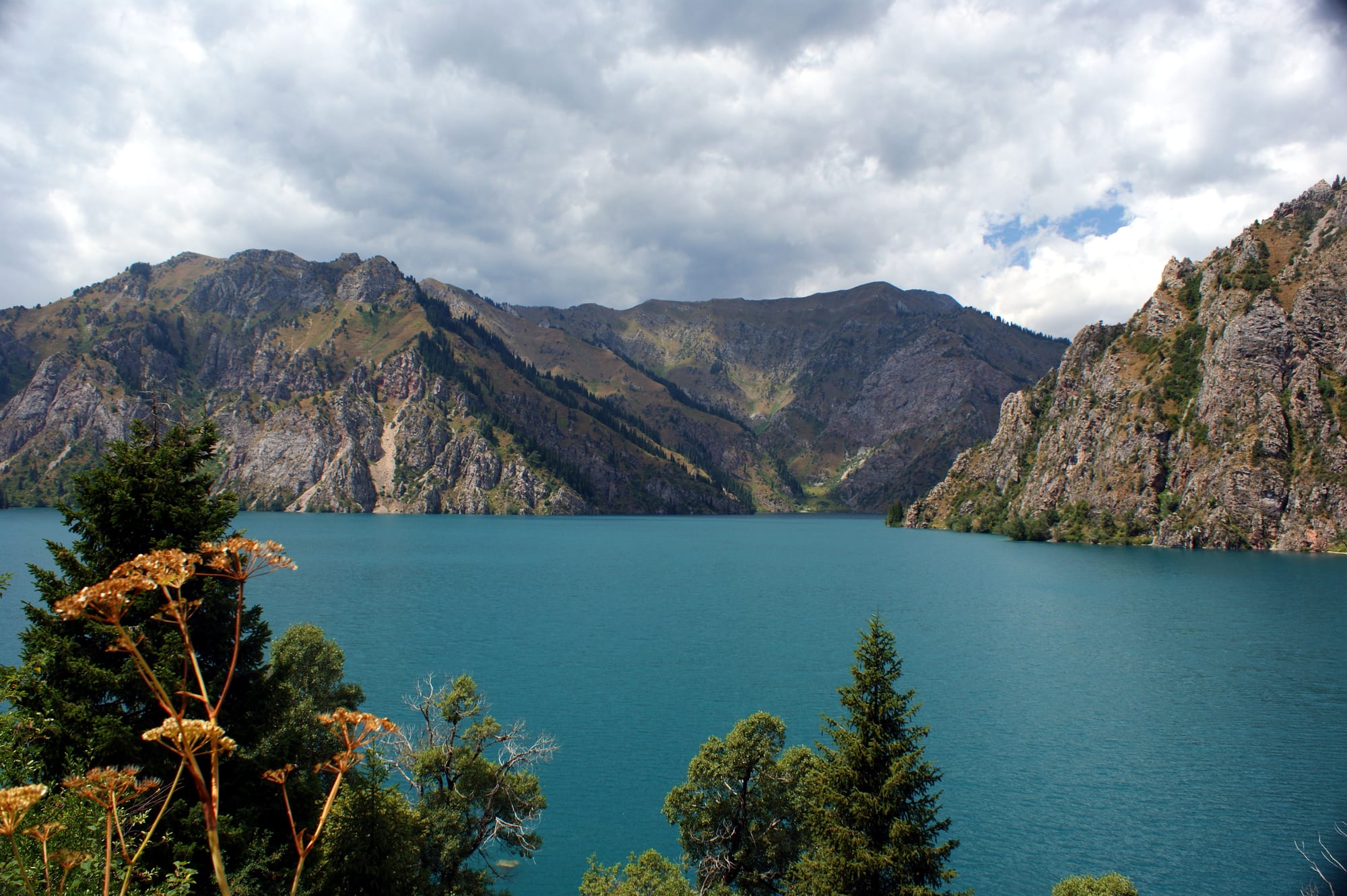
A turquoise lake between steep grey-green rocky mountains, with fir trees and dried umbellifer flowers in the foreground

Kyrgyzstan

Osh & the South

Lake Sary-Chelek in the Sary-Chelek reserve, Aksy District, Jalal-Abad Region. (Kondephy / Wikimedia Commons · CC BY-SA 4.0)

Southern Kyrgyzstan, wrapped around the eastern rim of the Fergana Valley — the ancient bazaar city of Osh, the walnut forests and lakes of Jalal-Abad, the high Alay valley beneath the Pamirs and the tangled borders of Batken. It is hotter, more agricultural and more Uzbek-influenced than the north.

Explore Osh & the South

History

Osh is one of the oldest cities in Central Asia; UNESCO estimates it to be more than 3,000 years old. Its bazaar, held on the same spot for some 2,000 years, was a major market on the Silk Road. Under the Karakhanids in the 11th and 12th centuries, Uzgen served as one of their capitals, and its minaret and mausoleums survive. Babur, the Timurid prince from Fergana who later founded the Mughal Empire, built a small prayer house on Sulaiman-Too in 1510.

Before Russian rule the area belonged to the Khanate of Kokand, which ruled the Kyrgyz herders of the Alay and the Uzbek farmers and traders of the valley towns. The most famous southern figure of that era is Kurmanjan Datka, the "Queen of the Alay", who led the Alay Kyrgyz and accepted, under duress, the Russian annexation of the Alay in 1876.

Soviet border-making in the 1920s split the Fergana Valley between three republics, leaving Uzbek and Tajik enclaves inside what became Batken Region. In 1990 deadly clashes over land broke out in Osh and Uzgen, and in June 2010 violence between Kyrgyz and Uzbeks in Osh and Jalal-Abad killed several hundred people, most of them Uzbek, and displaced some 80,000. Batken became a separate region in 1999, the year militants kidnapped a group of Japanese geologists in its mountains. Border clashes with Tajikistan in 2021 and 2022 killed dozens and forced villagers to flee, before a 2025 border agreement.

Culture & Customs

The south is more conservative and more visibly Muslim than the north, with more headscarves, busier mosques and Kyrgyz spoken far more than Russian. It is also ethnically mixed: Osh's population includes Kyrgyz, Uzbeks and smaller groups, and Uzbek neighbourhoods sit alongside Kyrgyz districts. Southern politicians and business networks carry weight nationally, and the north–south rivalry colours elections.

Sulaiman-Too has been a place of pilgrimage for centuries. Legend holds that women who climb to the shrine and crawl through an opening in the holy rock will give birth to healthy children, and UNESCO calls it the most complete example of a sacred mountain anywhere in Central Asia. Arslanbob takes its name from a revered local saint, and his 16th-century shrine stands near the village centre.

The Alay keeps the herding life of the high pastures, and its people honour Kurmanjan Datka, whose image is on the 50-som note. In Batken, the Aigul-Tash mountain is a botanical reserve protecting the aigul, a flower found nowhere else. Nowruz, the spring new year, is celebrated in the Fergana towns.

Daily Life

Osh, with about 320,000 people, is Kyrgyzstan's second city and the capital of the south: low-rise, dusty and busy, long centred on its riverside bazaar, which in 2025 was moved to a modern site a few kilometres north. Manas, called Jalal-Abad until 2025, has about 120,000 people and is known for its mineral springs and sanatoriums, while Uzgen, Kara-Suu with its border bazaar, Batken and Kyzyl-Kiya are smaller towns.

The economy runs on irrigated farming, trade with Uzbekistan, and money sent home by migrants working in Russia. The Toktogul reservoir in Jalal-Abad Region feeds the country's largest power plant, and Kyzyl-Kiya is one of the oldest coal-mining centres in Kyrgyzstan. Arslanbob's families gather walnuts each September.

Days start early to beat the heat, with the bazaar busiest in the morning and tea houses full in the evenings. Water, pasture and borders remain the most sensitive local issues.

Food

The south cooks the Fergana table. Its best-known plov, Uzgen paloo, is made with rice grown locally in Uzgen District. Samsa, meat pastries, shashlik of mutton grilled over coals with raw onions, manty, laghman and flat round nan bread are everyday food, Uzbek and Uyghur cooking are common, and Osh's bazaar sells kurut, dried salty balls of strained yoghurt.

Fruit and nuts are the region's pride. Arslanbob's walnuts, from forests thought to have been planted about a thousand years ago, were Kyrgyzstan's first known export to Europe, and the whole of Jalal-Abad Region is known for them. Walnuts are prized for their oil and protein and have long served as a form of barter.

Green tea, poured into bowls, is the constant drink, and chalap, a fizzy drink made from ayran, is drunk cold in summer. Mineral water from around Manas is bottled and sold across the country, and on the Alay pastures fresh kymyz, fermented mare's milk, is drunk from about May to August.

Attractions & Natural Wonders

Osh is built around Sulaiman-Too, a UNESCO World Heritage Site: stairs climb to Babur's rebuilt prayer house on the highest peak, and a museum of archaeology and history is set into the rock. An hour or so east, Uzgen has its Karakhanid minaret and three carved brick mausoleums.

Jalal-Abad Region takes in the western Tian Shan. Arslanbob sits among the walnut forest, with trails to a large and a small waterfall and to the Babash-Ata ridge. Further north-west, Sary-Chelek lake lies in a biosphere reserve with smaller lakes in the forest around it, and the Toktogul reservoir fills a long valley on the road towards Bishkek.

South of Osh, the road climbs over the Taldyk pass into the Alay valley, a wide grassland facing the white wall of the Trans-Alay range. Sary-Mogol is the base for trekking to the Achik-Tash base camp of Lenin Peak, at 7,134 metres the second-highest point of both Kyrgyzstan and Tajikistan.

The Batken valleys in the far south-west are the least visited: the southern mountains have sheer rock faces known to climbers, the Turkestan Range rises in granite towers, and the Aigul-Tash reserve protects the endemic aigul flower.

Cities in Osh & the South

Planning basics

Budget

The south is cheaper than Bishkek. Osh has a good range of hostels and mid-range hotels, and Arslanbob, the Alay valley and Batken run on community-based homestays with meals included. Costs rise with hired vehicles for Sary-Chelek, the Alay and Lenin Peak base camp, and expeditions to the Batken climbing valleys.

Daily Budget Midrange
USD 50–100 (Osh hotel or good guesthouse, restaurants, a hired driver)
Daily Budget Shoestring
USD 25–40 (hostel or homestay, bazaar meals, marshrutkas and shared taxis)

Change money in Osh; Arslanbob and the Alay have few or no cash machines, and homestays expect cash.

Safety

Osh and Manas are calm for visitors today, though the 2010 violence left lasting tension between communities. The Batken border areas with Tajikistan saw deadly fighting in 2021 and 2022, and enclave boundaries are unmarked in places. Mountain hazards — altitude near Lenin Peak, river crossings and landslides — are the everyday risk.

Avoid the exact border lines and enclaves in Batken and around the Fergana Valley, carry a passport at all times, and acclimatise slowly in the Alay. Check current official travel advice before travelling.

Climate

The Fergana rim is the hottest part of Kyrgyzstan: Osh and Manas (Jalal-Abad until 2025) have long, dry summers and short, mild winters by Kyrgyz standards. Arslanbob and Sary-Chelek sit higher and stay green and cooler, while the Alay valley, at around 3,000 metres, is cold and windy with a very short summer and severe winters.

Summer
hot in Osh and Manas, often 32–38°C; mild in Arslanbob; cool in the Alay, near freezing at night
Winter
around freezing in the valley towns, with some snow; bitterly cold and snowbound in the Alay and high Batken

Transportation

Osh airport has frequent flights to Bishkek, about an hour, and some international connections; the road from Bishkek over two high passes takes roughly ten to twelve hours by shared taxi. Marshrutkas link Osh with Uzgen and Manas, and shared taxis reach Arslanbob. Sary-Chelek, the Alay valley and Batken's side valleys need a hired car or 4x4. Roads to Batken wind around foreign enclaves and border zones.

Flying between Bishkek and Osh saves a long day; the road over the passes can close briefly in winter storms.

Best Time to Visit

April to June and September to October for Osh, Uzgen and Manas, when the heat is bearable. Late June to early September for Sary-Chelek, the Alay valley, Lenin Peak and the Batken climbing valleys. Arslanbob's walnut harvest is in September, when the villagers gather nuts in the forest.