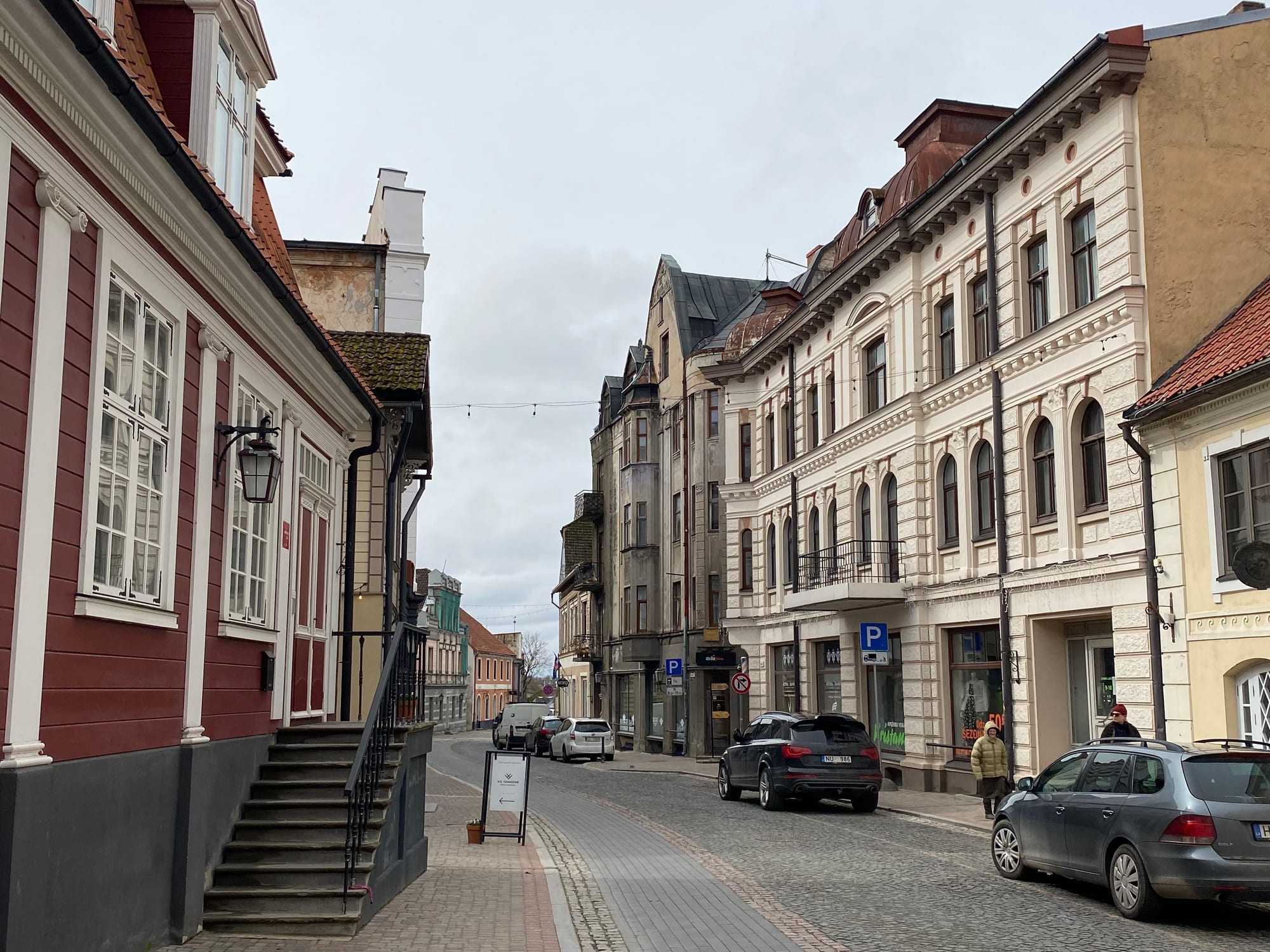
A cobbled street lined with a red timber house and cream and grey stone buildings under an overcast sky

Eastern Latvia: Vidzeme & Latgale, Latvia

Cēsis

Rīgas iela, the main street of the old town of Cēsis. (Dor Shabashewitz / Wikimedia Commons · CC BY 4.0)

A town of about 15,000 people on ridges above the Gauja valley in Vidzeme, about 90 km north-east of Riga. It grew around a castle of the Livonian Order, whose masters made it their main residence, and later gave its name to the battles of 1919; today it is a cobbled old town, a brewing centre and a base for Gauja National Park.

Neighbourhoods

  • Old Town
    • First-time visitors
    • Historic district
    • Best for food

    The historic centre of about 27 hectares keeps its medieval street plan and pieces of the town wall, though the oldest houses date from the 18th century after repeated rebuilding. Rīgas iela, the main walking street, has shops and restaurants, and St John's Church rises above the Square of Roses.

    Open in Maps
  • Castle Park and the castle complex
    • History
    • Parks

    The medieval castle ruins, the New Castle with the town museum, and the landscaped Castle Park around Riekstu Hill, where the Vends had their fortified settlement in the 11th and 12th centuries. The park also hosts the LAMPA Conversation Festival.

    Open in Maps
  • Around the station and Unity Square
    • Close to public transport
    • Arts and culture

    The newer side of the centre, grown up after the railway arrived in 1889, around Unity Square with its Victory Monument and the concert hall on Rauna street. The brewery and the station are a short walk away.

    Open in Maps

Things to do

Castle and old town

  • Cēsis Castlelandmark

    Founded by the Livonian Brothers of the Sword around 1214 and later the seat of the Livonian Order's masters, the castle was heavily damaged in the Livonian War, including the siege of 1577, and is one of the best-preserved medieval castles in Latvia.

    Open in Maps
  • Cēsis Museum in the New Castlemuseum

    The manor house of 1762, built out of a 16th-century fortification beside the ruins, holding the town museum's collections on the Latvian flag, the battles of 1919 and the castle.

    Open in Maps
  • St John's Churchlandmark

    A Lutheran church built in the late 13th century, its tower rebuilt in Neo-Gothic style in 1853; the tower can be climbed for views over the old town and the castle.

    Open in Maps
  • Victory Monumentlandmark

    The monument in Unity Square to the Latvian and Estonian victory in the battles of 1919, blown up in the Soviet period and rebuilt in 1998.

    Open in Maps

Music, beer and the outdoors

  • Vidzeme Concert Hall 'Cēsis'attraction

    An 800-seat concert hall opened in 2014 in a rebuilt community building of 1915, with chamber and organ halls, a cinema and exhibition spaces, and home to the art festival and the Cello Cēsis festival.

    Open in Maps
  • Cēsu Alus breweryattraction

    The brewery that traces its roots to 1590, the largest beer producer in Latvia; its historic brewery buildings date from 1878.

    Open in Maps
  • Svētavots Nature Park and Holy Springpark

    A nature park around a spring on the western edge of town.

    Open in Maps
  • Žagarkalns Ski Centreattraction

    The town's ski centre, with downhill slopes open in the winter season.

    Open in Maps

Short trips from the town

  • Gauja National Parkpark

    Latvia's largest national park, running along the old valley of the Gauja between Sigulda and Cēsis, with rock outcrops, springs and walking and canoeing routes.

    Open in Maps
  • Āraiši lake fortressmuseum

    An archaeological museum with the original and reconstructed remains of a 9th–10th-century Latgalian fortress built on a lake.

    Open in Maps
  • Līgatneattraction

    A small Gauja valley town built around a 19th-century paper mill, known for its nature trails with native animals and a Soviet-era bunker built for nuclear war.

    Open in Maps
  • Siguldaattraction

    The Gauja valley town that takes in the old centres of Turaida and Krimulda, one of Latvia's main tourist centres.

    Open in Maps

Seasonal events

  • Cēsis Art FestivalJuly–August

    A summer festival begun in 2007 that combines visual art, music, opera, theatre and film across the town.

  • Medieval Day at Cēsis Castleearly August

    A yearly day of medieval re-enactment in the castle grounds, held on the first Saturday of August.

Eat and drink

Long-standing places and food districts in Cēsis. Hours, ratings and directions come from your maps app, always current.

Cēsis classics

  • Cēsu Alusrestaurant

    The town's brewery, which produced almost two-thirds of all the beer made in Latvia in 2018, and whose beer is sold across the country.

    Open in Maps

Food districts

  • Rīgas ielaneighborhood

    The old town's central walking street, with a cluster of shops, cafés and restaurants between the castle and the Square of Roses.

    Open in Maps
  • Old town cafésneighborhood

    Small cafés and bistros in the lanes around St John's Church and the castle, some with summer terraces.

    Open in Maps

Experience Cēsis

History

The first settlement here was a fortified village of the Vends on Riekstu Hill, in what is now Castle Park, in the 11th and 12th centuries; the German name Wenden comes from them. The Livonian Brothers of the Sword took control in 1207 and began a stone castle on the neighbouring plateau, probably around 1214. Events of 1206 recorded in the Chronicle of Henry of Livonia are taken as the start of the town's recorded history. Cēsis was named as a town in 1323, joined the Hanseatic League in the early 15th century, and after the order's castle in Riga was destroyed in 1484 it became the main residence of the order's masters. A chronicle account of a red banner with a white stripe carried by troops from Cēsis in 1279 is regarded in Latvia as the prototype of the national flag.

The Livonian War ended that importance: during the siege of 1577 several hundred people sheltering in the castle blew themselves up with gunpowder rather than surrender to Ivan the Terrible. Polish, then Swedish rule followed, and Russian troops took the town in 1703. A road link to the Riga–Pskov highway followed in 1868 and the Riga–Pskov railway in 1889, speeding the growth of brewing, metalworking and printing.

In June 1919 Estonian and Latvian forces defeated German troops in the Battles of Cēsis, a turning point in the War of Independence. Seventy years later the town again led: Latvia's first local branch of the Popular Front was founded here in September 1988, and in October that year the red-white-red flag was raised over the New Castle.

Culture & Customs

For a town of its size, Cēsis has an unusually full cultural calendar. The Vidzeme Concert Hall, opened in 2014, gives it an 800-seat auditorium, an organ hall and a cinema, and is home to the Cēsis Art Festival — begun in 2007 as a summer mix of visual art, music, opera, theatre and film — as well as a cello festival and a festival devoted to the composer Pēteris Vasks. The town's music school is named after the composer Alfrēds Kalniņš.

Civic life is part of the culture too. Since 2015 the LAMPA Conversation Festival has filled Castle Park with public discussions between citizens, institutions, media and political parties. Cēsis bid twice to be Latvia's European Capital of Culture, and the work done for the 2027 bid became a year-long programme as Latvian Capital of Culture 2025.

National memory runs deep: the town's museum keeps collections on the Latvian flag and the 1919 battles, the Victory Monument stands in Unity Square, and Medieval Day each August brings the castle back to life. Historically the town had a substantial Baltic German community, but Latvians were a majority by 1897 and about 90 per cent of the population by 1925.

Daily Life

At the beginning of 2026 Cēsis had 14,899 residents, on about 19 square kilometres of the northern Vidzeme Upland, with the Gauja running for some 5 km along the town's edge. It is the administrative centre of Cēsis Municipality and a regional hub for schools: two state gymnasiums, the music secondary school, a technology and design college, branches of Riga Technical University and the University of Latvia, and a space education centre opened in 2023.

The economy grew on the 19th-century railway and road links, with brewing, food production, metalworking and printing. Today services, trade, food production, transport and logistics, forestry and the creative industries matter most, and the Cēsu Alus brewery remains one of the town's longest-standing industrial enterprises.

Daily rhythms follow the seasons: walks and canoeing on the Gauja in summer, festival evenings in Castle Park and at the concert hall, and skiing at the Žagarkalns ski centre in winter. Regional roads lead towards Riga, Valmiera, Limbaži and Madona, and the station on the Riga–Valga line links the town with the capital and Estonia.

Food

Cēsis is a beer town first. Cēsu Alus traces its roots to 1590 and is regarded as the oldest brewery in the Baltic and Nordic countries; it is also Latvia's largest beer producer, responsible for almost two-thirds of the country's beer in 2018. Beer, alus, is the drink most Latvians choose anyway, and the 19th-century railway and road links helped the town's brewing grow.

The food is the mainstream Latvian table. Dark rye bread, rupjmaize, made from coarse rye flour, malt and caraway, has been a staple for centuries, and fried rye bread with garlic, ķiploku grauzdiņi, is a common bar starter. Speķrauši, buns filled with finely cut streaky bacon and onion, are a favourite snack, and cottage cheese, biezpiens, is traditionally eaten with boiled potatoes, lightly salted herring, spring onions and sour cream.

Hot- and cold-smoked meat and fish are common, and potato pancakes with smoked salmon and sour cream are popular. For dessert there is rye bread soup, maizes zupa, made from rye bread, whipped cream, dried fruit and cranberries. Kvass, brewed from fermented rye or black bread, remains popular. Rīgas iela and the lanes around the old town hold most of the cafés and restaurants.

Planning tools

Budget

Cēsis costs less than Riga, though it is a popular weekend escape from the capital, so summer weekends and festival dates are busier and dearer. Guesthouses, cafés and the castle and museum tickets keep a stay modest; a hire car adds to the bill but makes the Gauja valley easier.

Daily Budget Midrange
USD 95–175 (hotel or country guesthouse, restaurant meals, castle and museum tickets, a hire car)
Daily Budget Shoestring
USD 45–80 (guesthouse or hostel, cafés and self-catering, trains and buses)

Book ahead for summer weekends and the art festival; much of the old town, the parks and the Gauja valley trails cost nothing.

Best Time to Visit

June to early September for the art festival, Medieval Day, outdoor cafés and canoeing and walking in the Gauja valley. Late September and October bring autumn colour to the valley. Winter is cold and snowy, with skiing on the town's slopes and concerts at the concert hall.

Suggested Number of Days

The old town and castle fill a day or two. Allow three or four days to use Cēsis as a base for the surrounding valley, its walking and canoe routes and the neighbouring towns; festival dates and a car both change how much fits in.

First Visit
1–2 days
With Surroundings
3–4 days

Transportation

Cēsis is on the Riga–Valga railway, with trains to Riga, Sigulda, Valmiera and Valga in Estonia. Many regional bus routes serve the town and the surrounding area. Town buses are infrequent, so most people walk or take a local taxi.

Use the train for Riga and Sigulda; watch the meter in taxis, and hire a car for the remoter parts of the Gauja valley.

Airport & Station Connections

Riga Airport is the main gateway; Cēsis lies about 90 km north-east of Riga. Most visitors come from the capital by train on the Riga–Valga line, by direct bus, or by car via the A2 highway, which passes about 9 km from the town.

Walkability

The centre is small and easy to cover on foot, and most pavements are asphalt or flat brick paving, though the old streets are cobbled. The castle, the old town, Unity Square, the concert hall and the station are all a short walk apart; the Gauja and its trails lie below the town's ridges.

Safety

Latvia is a safe country with low levels of violent crime. Cēsis is a quiet town; the practical risks are taxi overcharging, ticks in the forests of the Gauja valley, and ice on cobbles and roads in winter.

Watch the meter in taxis, check for ticks after forest walks and allow for icy roads in winter. Check current official travel advice before travelling.

Climate

Humid continental. Across eastern Latvia, far from the sea's moderating influence, summers are a little warmer than on the coast and winters colder and snowier; Cēsis sits in the northern Vidzeme Upland, where snow is reliable in most winters.

Summer
mild to warm across eastern Latvia, around 18–24°C, with thunderstorms on hot days
Winter
cold and snowy across eastern Latvia, often -5 to -10°C, with colder spells in the uplands

Local Customs

Tipping is reserved: rounding up the bill by around 5–10 per cent is enough but not required, and some places add a service charge. Latvians tend to be reserved and respect personal space, and do not usually greet strangers unless introduced. The Victory Monument and the castle are bound up with national memory, and St John's is a working Lutheran church.

Drinking alcohol in public outside bars and restaurants is considered bad manners and can bring a fine; keep visits to the church quiet during services.

Common Payment Methods

Latvia uses the euro. Cards and contactless payment work almost everywhere, and some places no longer take cash; ATMs are found even in small towns. A little cash is handy for small rural attractions.