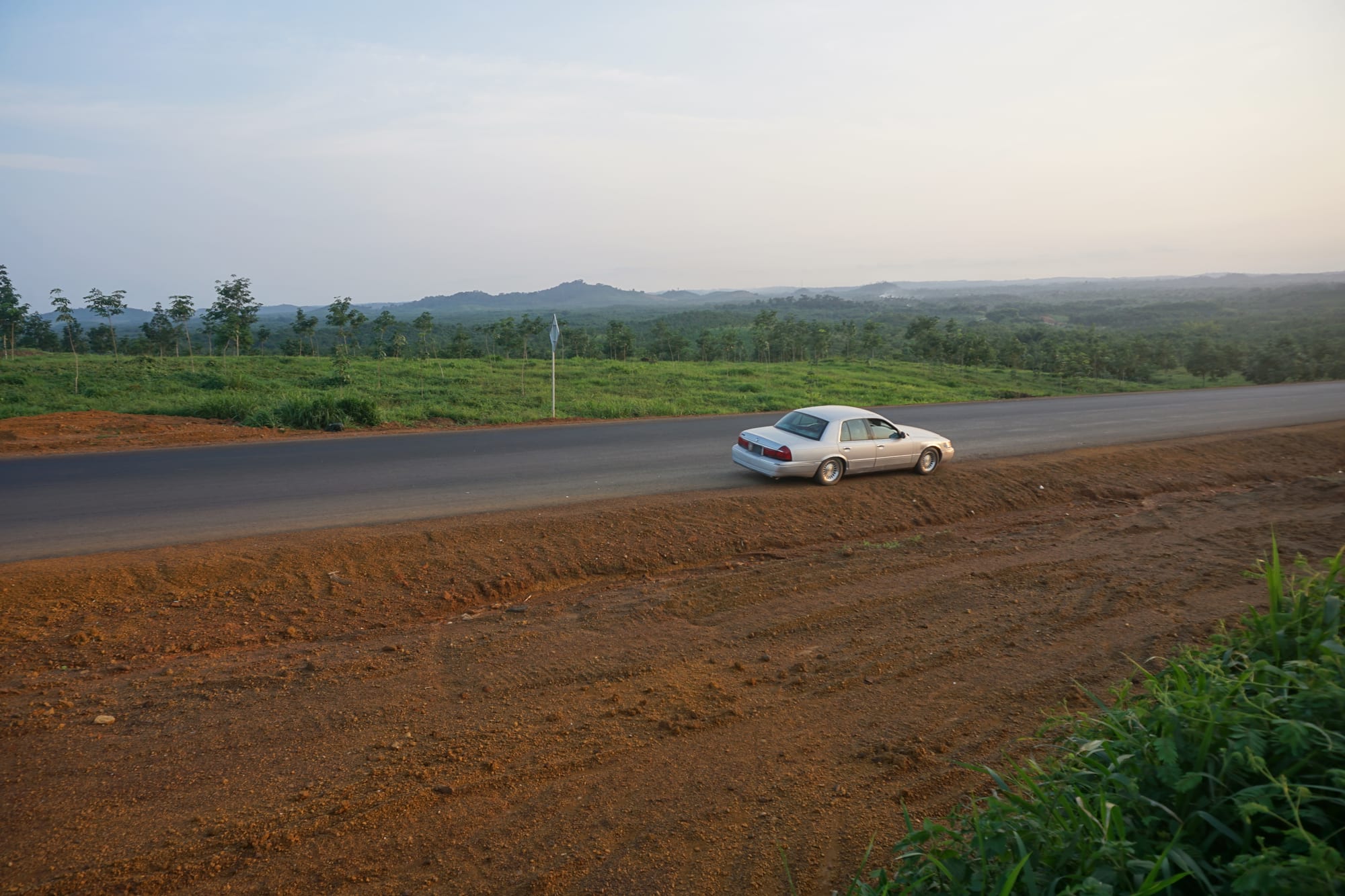
A car on an empty paved highway cut through red earth, with green farmland and low forested hills stretching to the horizon

Gbarnga, Nimba & the Interior, Liberia

Gbarnga

The highway between Monrovia and Gbarnga, running through the farmland and low hills of central Liberia. (Jefferson Krua / Wikimedia Commons · CC BY-SA 4.0)

The capital of Bong County and the main town of Liberia's central interior, on the paved highway that runs from Monrovia towards the Guinean border. It grew as a Kpelle market and administrative centre, served as Charles Taylor's wartime base in the early 1990s, and is now a crossroads of traders, students from nearby Cuttington University and traffic heading north and east.

Neighbourhoods

  • The highway and the town centre
    • Markets
    • First-time visitors
    • Transport connections

    The centre of the town is strung along the main road, where shops, money changers, guesthouses and the taxi park sit within a few hundred metres; the old central market here was demolished in 2024, when trade moved to the new General Market. Almost everything arriving in or leaving central Liberia passes through it.

    Open in Maps
  • The administrative quarter
    • Historic interest
    • Quiet and residential

    County offices, the courthouse, schools and church compounds stand a little back from the highway on the higher ground, together with the buildings that served as the seat of power in the town during the early 1990s.

    Open in Maps
  • Towards Suakoko
    • Students
    • Quiet and residential
    • Countryside

    The road west towards Suakoko passes Phebe hospital and the Cuttington University campus, with staff housing, research farms and villages among the rubber and oil palm — greener and calmer than the town centre.

    Open in Maps
  • The outlying quarters
    • Local life
    • Markets

    Beyond the centre the town spreads into residential quarters of single-storey houses and small farms, with neighbourhood markets, churches and mosques, and motorbike taxis linking them to the highway.

    Open in Maps

Things to do

University and institutions

  • Cuttington Universityattraction

    The oldest private, coeducational, four-year degree-granting institution in sub-Saharan Africa, founded in 1889 at Cape Palmas and moved to Suakoko near Gbarnga in 1948, with a campus, a library and a rural setting west of the town.

    Open in Maps

Around the town

  • Suakokoattraction

    The small town west of Gbarnga that holds the university and Phebe hospital, named after Suah Koko, a Kpelle woman chief.

    Open in Maps

Short trips from the town

  • Bong Minesattraction

    The company town built for the German- and Italian-owned iron-ore mine, set up in 1958 and worked from 1965 to 1990, with its own rail line to the port at Monrovia and open-pit workings in the hills.

    Open in Maps
  • Tototaattraction

    A market town on the Monrovia road, long associated with President Tubman's rubber-farm retreat and a stop for traffic crossing Bong County.

    Open in Maps

Seasonal events

  • Independence Day26 July

    Liberia's national day, marked in the county capital with parades, church services and public gatherings.

  • National Thanksgiving DayFirst Thursday in November

    A Liberian holiday made national by statute in 1883 and kept mainly with church services.

  • The rice harvestLate in the year, after the rains

    The end of the farming year on the upland rice farms around the town, when markets fill and village celebrations are held.

Eat and drink

Long-standing places and food districts in Gbarnga. Hours, ratings and directions come from your maps app, always current.

What is eaten here

  • Country rice with palm butterrestaurant

    Upland rice grown on Bong County farms, served under a thick stew of oil-palm fruit cooked with meat, fish and pepper.

    Open in Maps
  • Bitterball and cassava leaf soupsrestaurant

    Small bitter garden eggs, pounded cassava leaf and potato greens are the everyday soups of the interior, simmered with palm oil and dried fish.

    Open in Maps
  • Dumboy and fufurestaurant

    Pounded cassava, fresh or fermented, eaten with a peppery soup — the dish most associated with Kpelle households.

    Open in Maps

Markets and roadside food

  • Gbarnga General Marketmarket

    The town's main market, opened in 2024 to replace the old central market in the town centre, selling rice, cassava, palm oil, kola nuts, peppers, forest produce and goods trucked up from Monrovia and across the Guinean border.

    Open in Maps
  • Highway roadside stallsmarket

    Roasted corn, groundnuts, fried plantain, cassava chips, bread and grilled meat sold to passing traffic along the main road.

    Open in Maps

Experience Gbarnga

History

Gbarnga began as a Kpelle settlement in the central forest belt, in country whose towns traded kola, iron, cloth and salt with the Mande world to the north long before Liberia's coastal republic reached inland. The government in Monrovia extended its authority over the interior only in the late nineteenth and early twentieth centuries, when district commissioners, hut tax and the Liberian Frontier Force brought the area under the state, and Gbarnga became the administrative seat for Bong County.

Two institutions shaped the modern town. Cuttington College, founded by the Episcopal Church in 1889 on the coast, moved to Suakoko, a short way west, in 1948, bringing a university, a library and a teaching hospital to the interior, and the highway from Monrovia, paved in stages through the twentieth century, made Gbarnga the natural market for a wide farming region. By the 1970s it was the main market town of the central interior.

The civil wars changed it. After the National Patriotic Front of Liberia entered the country through Nimba in December 1989, Charles Taylor established his headquarters at Gbarnga and ran the territory he controlled from here during the early 1990s, a period in which the town was both a seat of power and cut off from Monrovia. It was fought over and looted, and the university and hospital were damaged and closed for years. Both reopened, the university in 1998, and after the 2003 peace agreement the town resumed its place as the market and administrative centre of the interior.

Culture & Customs

Gbarnga is the centre of Kpelle Liberia, the country's largest language group, and Kpelle is heard as much as Liberian English in the market and the taxi park. Masked performances at funerals and celebrations, drumming, storytelling and the authority of town chiefs and elders are living parts of county life rather than displays for visitors, and the Poro and Sande societies still govern initiation into adulthood in many villages, with groves and bush schools that outsiders do not enter.

The town also carries an institutional culture from Cuttington: students, teachers, nurses and agricultural researchers from across Liberia give Gbarnga a mixed population and a debating, churchgoing public life. Episcopal, Lutheran, Baptist and Pentecostal congregations are numerous, and the Mandingo trading community supports mosques in the centre. Friday and Sunday shape the week for different parts of the town.

Football on dust pitches, radio, hipco and gospel music from shops, and the constant movement of traders set the tone. The wartime years are a subject people discuss with care, and reconciliation work over land, belonging and the displacement of families has continued for two decades. Courtesy is formal: greetings before business, elders first, and patience with a pace of conversation that does not hurry.

Daily Life

Gbarnga had 34,046 residents at the 2008 census, the fourth most populous urban area in Liberia and one of the larger towns of the interior, and the surrounding district adds many more in farming villages. The economy is trade and agriculture: upland rice, cassava, plantain and vegetables from family farms, cocoa, coffee, rubber and oil palm as cash crops, and the buying, bulking and trucking of all of it through the town's market to Monrovia and across the border.

Salaried work comes from the county administration, the university, the hospital, schools and aid organisations, which together give the town a professional class unusual for its size. Electricity depends on generators and solar systems rather than a reliable grid, water comes from pumps and wells, and mobile phones carry money as well as messages.

The day begins early, with the market active soon after dawn and shared taxis leaving for Monrovia and Ganta before the heat. Afternoons slow, and the highway stays busy into the evening. The recurring concerns of town life are the state of the feeder roads that bring crops in, the price of imported rice and fuel, youth unemployment, and the pull of Monrovia on young people who finish school.

Food

The interior eats country rice — upland rice grown on the farms of Bong, Lofa and Nimba — and the measure of a meal here is a plate of it under a soup. Palm butter, made from oil-palm fruit boiled and pounded to a thick orange stew, is the richest; cassava leaf, pounded fine and cooked long with palm oil and dried fish, is the most common; and potato greens and the soup made with bitterballs, small bitter garden eggs, complete the everyday range.

Dumboy and fufu, both pounded cassava, are eaten with pepper soup, and pepper is used generously in all of it. Dried and smoked fish brought up from the coast, along with chicken, goat and, in villages, bushmeat, provide most of the protein. Forest produce fills the market stalls: palm oil, kola nuts, wild mushrooms, snails, honey and bundles of greens.

Roadside food is the mark of a highway town — roasted corn and groundnuts, fried plantain and cassava chips, doughnuts, meat pies and grilled chicken sold to travellers waiting on taxis. Palm wine tapped in the villages and cane juice, the raw sugarcane spirit, are the drinks of gatherings, with bottled beer and soft drinks in the town. Bong County grows coffee and cocoa, though both are sold on rather than drunk locally.

Planning tools

Budget

Gbarnga is among the cheaper places to stay in Liberia. Guesthouses are basic, cook shops inexpensive, and motorbike taxis cost very little. Costs rise only with transport — a hired four-wheel drive for the back roads — and with the generator-powered comforts of the few better rooms.

Daily Budget Midrange
USD 120–250 (the best local hotel, meals, a four-wheel drive with driver and guide fees)
Daily Budget Shoestring
USD 30–55 (basic guesthouse, cook shops, shared taxis and motorbike taxis)

Cash in Liberian and US dollars should be brought from Monrovia, as banks here are few and ATMs often out of service.

Best Time to Visit

December to April, the dry season, when the highway and the side roads to the villages are firm and travel across the interior is straightforward. The rains from about May to October turn unpaved roads to mud, though the paved highway itself stays open.

Suggested Number of Days

The town itself is a market and a crossroads and takes little time. Two or three days make sense for anyone adding the countryside of Bong County or using Gbarnga as a base between Monrovia and Nimba, which is how most travellers pass through.

First Visit
1 day
With Surroundings
2–3 days

Transportation

Shared taxis and minibuses run along the paved highway from Monrovia to Ganta and beyond, and the taxi park in the centre is the town's transport hub. Inside the town, motorbike taxis carry almost everyone, and they also reach villages on tracks that cars cannot use in the rains. A hired four-wheel drive is needed for the back roads.

Long-distance shared taxis fill and leave in the early morning, so departures later in the day can mean a long wait at the park.

Airport & Station Connections

Gbarnga lies about 180 kilometres north-east of Monrovia on the paved highway through Kakata and Totota, roughly three to four hours by shared taxi or private vehicle. Ganta is around an hour further on, and the road continues to the Guinean border. There is no passenger rail and no scheduled air service to the town.

Walkability

The centre is walkable end to end in perhaps twenty minutes, with the taxi park and the shops along one road. Beyond that the town is spread out, verges are dust or mud depending on the season, there are no pavements to speak of and traffic moves fast on the highway, so motorbike taxis do most of the work.

Safety

Gbarnga is calm, and the main risks are practical rather than criminal: road accidents on the highway and on motorbike taxis, thin medical facilities, and malaria and other tropical illness. Petty theft occurs in the market and at the taxi park. The rainy season isolates villages off the paved road.

Travel by day with a reliable driver, carry supplies and a charged phone, and take malaria precautions. A helmet on a motorbike taxi and valuables out of sight in the market cover most of the rest. Check current official travel advice before travelling.

Climate

Tropical and humid, a little less extreme than the coast. The rains run from about May to October and are heavy, while from December to February the harmattan brings haze, dust and cooler nights than Monrovia sees.

Summer
the wet season from about May to October, around 22–29°C, with heavy rain and deep mud on unpaved roads
Winter
the dry season from November to April, about 22–33°C, hot by day with harmattan haze and cooler nights

Local Customs

This is Kpelle country, and Kpelle is spoken alongside Liberian English. Elders are greeted first, and formal visits to a village normally begin with the town chief. The Poro and Sande societies remain important, and their bush schools, groves and ceremonies are not open to outsiders; signs of a closed area should be respected absolutely. Most people are Christian, with a Muslim Mandingo trading community in the town.

Permission should be asked before photographing people, markets or anything connected with traditional societies, and questions about initiation are best left unasked.

Common Payment Methods

Liberian dollars are used for day-to-day purchases and US dollars for lodging and larger sums. Cards are effectively unusable, bank branches are limited and ATMs unreliable, and mobile money is widely used by residents, so visitors should carry enough cash, with small notes for taxis and the market.