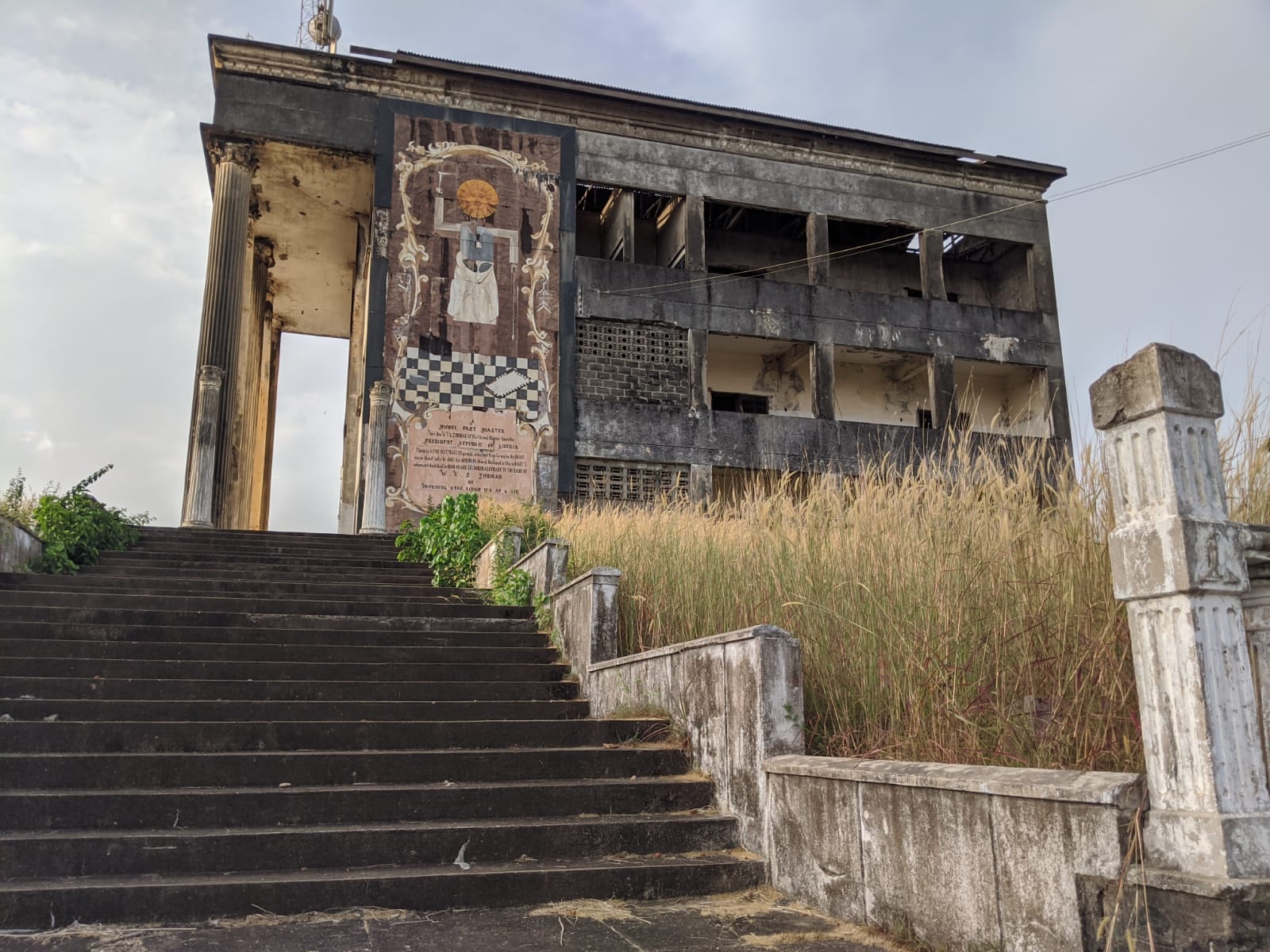
A ruined classical building with columns and a painted panel above a long flight of concrete steps, grass growing around it

Monrovia & the Coast, Liberia

Harper

The abandoned Morning Star Masonic Lodge, one of the best-known ruins in Harper. (Sophieroad / Wikimedia Commons · CC BY-SA 4.0)

The capital of Maryland County at the far south-eastern corner of Liberia, on the headland of Cape Palmas near the border with Côte d'Ivoire. Founded in 1834 as the settlement of 'Maryland in Africa', it became the home town of President William Tubman and was built up in his era, then emptied by the civil wars. Ruined mansions, a lighthouse, a university and long Atlantic beaches remain.

Neighbourhoods

  • Cape Palmas and the old settler town
    • Historic district
    • First-time visitors
    • Architecture

    The headland itself, where the 1834 settlement was laid out. Broken mansions, churches, the Masonic lodge and county offices stand along streets that end at the sea, and the lighthouse marks the point where the coast turns east.

    Open in Maps
  • The beach and waterfront
    • Beaches
    • Quiet
    • Fishing community

    Long stretches of sand run north and east from the cape, backed by palms and fishing settlements where canoes are launched through the surf. There is almost no development along them beyond the town's edge.

    Open in Maps
  • The mainland side and Tubman University
    • Students
    • Local life
    • Markets

    Inland from the cape, the town spreads across the low ground towards the lagoon and the road out, with the market, schools, the hospital and the campus of William V. S. Tubman University giving this side most of the town's daily activity.

    Open in Maps

Things to do

The cape and the coast

  • Cape Palmaslandmark

    The rocky headland the town is built on, long used as a navigation mark, where the West African coast turns from south-east to east.

    Open in Maps

Learning and institutions

  • William V. S. Tubman Universityattraction

    One of Liberia's two public universities, founded in 1978 as a college of technology, closed in the first civil war and reopened with university status in 2009, named after the president who came from the town.

    Open in Maps

Rivers and the border

  • Cavalla Riverattraction

    Liberia's longest river, about 20 kilometres east of the town, forming the southern two-thirds of the boundary with Côte d'Ivoire before reaching the Atlantic.

    Open in Maps

Short trips from the town

  • Pleeboattraction

    The rubber and market town on the road north from Harper and the largest place in Maryland County, with more people than the capital itself.

    Open in Maps

Seasonal events

  • Independence Day26 July

    Liberia's national day, marked with parades, church services and gatherings in the county capital.

  • National Thanksgiving DayFirst Thursday in November

    A Liberian holiday made national by statute in 1883 and kept mainly with church services.

  • Decoration DaySecond Wednesday in March

    A public holiday for cleaning and decorating family graves, observed in the town's old settler cemeteries.

Eat and drink

Long-standing places and food districts in Harper. Hours, ratings and directions come from your maps app, always current.

What is eaten here

  • Fish and seafood from the capemarket

    Canoes land snapper, barracuda, kingfish and shellfish on the beaches, and much of the catch is smoked before it reaches the market.

    Open in Maps
  • Palm butter and cassava leaf over ricerestaurant

    The everyday meal of the coast — oil-palm pulp or pounded cassava leaf stewed with fish or meat and hot pepper, served over rice.

    Open in Maps
  • Dumboy and pepper souprestaurant

    Cassava boiled and pounded into a smooth dough, eaten with a peppery fish or meat soup in the Grebo and Kru manner.

    Open in Maps

Markets

  • Harper marketmarket

    The town's daily market for rice, cassava, plantain, greens, palm oil, fish and goods trucked or carried in from Pleebo and the Ivorian border.

    Open in Maps

Experience Harper

History

The settlement was founded in 1834 by the Maryland State Colonization Society, which chose Cape Palmas for its own colony of free African-Americans rather than joining the settlements around Monrovia. It was named Harper after Robert Goodloe Harper, a Maryland politician involved in the colonisation movement. The Grebo people already living on and around the cape leased and then contested the land, and relations between the settlers and Grebo towns were repeatedly violent. "Maryland in Africa" declared itself an independent republic in 1854, and after a war with Grebo and Kru communities in 1856 it asked Monrovia for help; Liberia annexed the territory in 1857.

Harper became the county seat of Maryland County and a small Atlantic port trading palm oil, piassava and later rubber. Its defining period came with William Tubman, born here in 1895 and president of Liberia from 1944 until his death in 1971, who directed money to his home town: government buildings, a Masonic lodge, paved streets, a lighthouse and the large houses of the Americo-Liberian families who gave the place the nickname of a second capital.

The 1980 coup ended that patronage, and the civil wars from 1989 to 2003 hit the south-east hard. Much of the population scattered into Côte d'Ivoire and the forest, and the mansions, the Masonic lodge and the public buildings were left ruined; Tubman's own house stood roofless and occupied by squatters in 2021. Since 2003 the town has recovered slowly: the university expanded, the county administration returned, and the roads that connect it to the rest of Liberia remain the central question of its future.

Culture & Customs

Harper's identity rests on two layers. The settler layer is Episcopalian and Methodist churches, Masonic ritual, American family names, brass bands at national holidays and a social formality that outlasted the wealth that paid for it. The Grebo layer is the older and larger one — Grebo is the language of the county, spoken alongside Liberian English, and Grebo towns around the cape keep their own chieftaincies, masquerades and the Poro and Sande societies that oversee initiation.

Kru communities along the coast share the seafaring reputation earned across the region: generations worked as sailors, surfmen and dockers on ships from Freetown to Lagos, and families in the town still have relatives who left by sea. The Ivorian border some twenty kilometres away means French words, Ivorian music and cross-border kin are part of everyday life, and trade and marriage run both ways.

Tubman's memory is inescapable here, in the buildings he financed, the university that carries his name and the ruins of his house. Public life is ceremonial: church services, funerals and national holidays are the main gatherings, attended in careful clothes. Visitors are a novelty rather than an industry, and courtesy — greeting first, asking before photographing, going through the county or town authorities for anything formal — goes a long way.

Daily Life

Harper had 17,837 residents at the 2008 census, Liberia's eleventh largest town and one of its smaller county capitals, with more people in the Grebo towns and fishing villages around the cape. Livelihoods are fishing, farming cassava, rice and vegetables, petty trade, the rubber economy around Pleebo inland, and salaried work in the county administration, the hospital, the schools and the university.

Services are limited by distance. Electricity comes from generators and solar installations rather than a national grid, water from wells and pumps, and goods arrive by road from Monrovia or across the border from Côte d'Ivoire, which makes them expensive. When the rains cut the road, prices in the market rise and fuel runs short, a cycle residents plan for each year.

The pattern of the day is early: canoes out before dawn, the market busiest in the morning, quiet heat in the afternoon, and evenings on verandas and in front of shops. Students give the town a different rhythm in term time. The ruins in the middle of it all are a part of daily life rather than a monument — children play around them, goats graze the lots, and there is an ongoing debate in the county about whether to restore any of them.

Food

Cooking here is coastal and Grebo. Fish is central: snapper, barracuda, kingfish and the small fish called bonny come in by canoe, eaten fresh in a peppery broth or smoked on wood racks to keep, after which it seasons almost everything else. Crab, shrimp and oysters come from the lagoons and river mouths, and periwinkles are gathered on the rocks.

Rice is the base of every proper meal, with palm butter — oil-palm fruit boiled and pounded into a thick stew — cassava leaf, potato greens or a bitterleaf soup poured over it. Dumboy, cassava pounded smooth, and fufu are eaten with pepper soup, and pepper is used with a freedom that visitors are warned about. Palm oil gives most dishes their colour and weight.

The land around supplies cassava, plantain, yam, coconut and, from the plantations inland, rubber rather than food. Roadside eating is grilled fish and plantain, roasted corn, doughnuts and cassava chips. Palm wine tapped in the villages and cane juice are the local drinks, with bottled beer and soft drinks brought in by road. Ivorian goods crossing the Cavalla add coffee, bread and tinned foods to the market stalls.

Planning tools

Budget

Harper is inexpensive once reached and expensive to reach. Guesthouses are simple and few, meals cost little, and there is not much to spend money on. The budget is dominated by getting there: a four-wheel drive with driver and fuel for a long overland journey, or an irregular flight or boat.

Daily Budget Midrange
USD 110–220 (the better local lodging, meals, a hired vehicle with driver)
Daily Budget Shoestring
USD 30–55 (basic guesthouse, cook shops, shared taxis and motorbikes)

All cash for a stay should be carried in from Monrovia in both Liberian and US dollars, as card payment and working ATMs cannot be relied on this far south-east.

Best Time to Visit

December to April, the drier months, when the long road from Monrovia is at its most passable and the beaches are sunniest. The south-east has a short drier spell in the middle of the rains as well, but from May to October the route can be slow or cut, and journeys need flexible timing.

Suggested Number of Days

Two days are enough for the old town, the cape and the shore without hurrying. Three or four allow for the country inland and along the border. Because reaching Harper takes so long, most visitors stay longer than the town alone would suggest.

First Visit
2 days
With Surroundings
3–4 days

Transportation

The town is small and most local movement is on foot or by motorbike taxi, which also serve the villages and the beaches. Shared taxis and minibuses run inland to Pleebo and on towards Zwedru and Fish Town when the roads allow. Canoes and small boats cross the lagoon and the river mouths. There is no city transport system and few private vehicles.

Anyone continuing overland should ask locally about the state of the roads before setting out, as conditions change from week to week in the rains.

Airport & Station Connections

Harper is among the most isolated county capitals in Liberia, several hundred kilometres from Monrovia by road through the south-eastern counties, a journey that takes a full day or considerably more depending on conditions and usually needs four-wheel drive. Domestic flights to the airfield outside town and coastal boats have operated at times but not to a dependable schedule. The Ivorian border lies about 20 kilometres east, across the Cavalla River.

Walkability

The old town on the cape is easily walked: the lighthouse, the ruined mansions, the churches and the county offices lie within a few hundred metres of one another, with the sea in view for most of it. Distances to the market, the university and the beaches are longer, pavements are absent and the heat is heavy, so motorbikes cover the rest.

Safety

The town is peaceful and crime against visitors is uncommon, but it is remote: medical care is limited to a hospital with basic facilities, and serious cases have to be moved to Monrovia. The greatest risks are the overland journey itself, strong ocean currents on unpatrolled beaches, and malaria, which is present all year.

Use a trusted driver at night in Monrovia, swim only at known safe spots, and take malaria precautions. Road travel in the south-east is safest by day with an experienced driver, and a medical kit and insurance covering evacuation matter more here than in the capital. Check current official travel advice before travelling.

Climate

Hot and humid all year, with temperatures around 24 to 31°C. The main rains fall from about May to October, but the south-eastern corner has a shorter drier break in the middle of them, and the coast is tempered by sea breeze.

Summer
the wet season from about May to October, around 24–29°C, with heavy rain, rough seas and difficult roads
Winter
the dry season from November to April, about 26–32°C, sunny and humid, with some harmattan haze early in the year

Local Customs

This is Grebo country with a settler overlay, and both traditions are respected: churches from the Episcopal and Methodist missions are long established, while Poro and Sande societies remain part of village life inland. Greetings come before business, elders are addressed first, and Sunday dress is formal. Permission is expected before photographing people, the lighthouse area or official buildings.

Asking before entering a fishing beach, a compound or a village, and greeting the local authority for anything beyond a short visit, are the normal courtesies here.

Common Payment Methods

Liberian dollars serve for everyday purchases and US dollars for lodging and larger amounts. Cards are not used, banking is minimal and ATMs unreliable, and mobile money is the most common way residents move funds, so visitors should arrive with enough cash, including small notes.