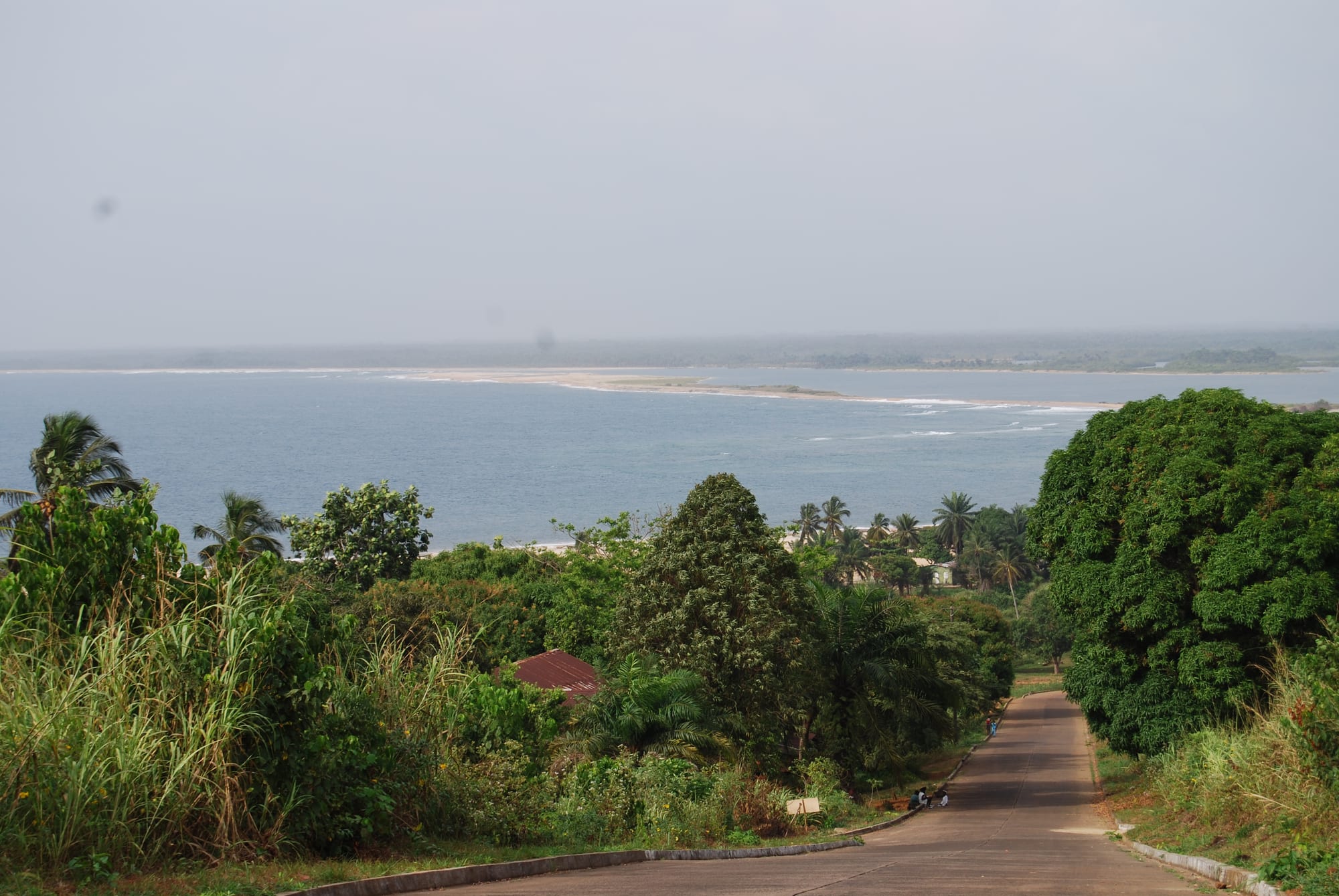
A paved road running downhill through greenery towards palm trees, a broad bay and a long sandbar under a hazy sky

Monrovia & the Coast, Liberia

Robertsport

The road down through Robertsport towards the bay and the sandbar separating Lake Piso from the Atlantic. (mjmkeating / Wikimedia Commons · CC BY 2.0)

The capital of Grand Cape Mount County in north-western Liberia, set on a wooded ridge between the Atlantic and the tidal lagoon of Lake Piso, about 80 kilometres from Monrovia. Founded as a settler town in 1856 and named after Liberia's first president, it is now a fishing town of a few thousand people, known for long point-break surf, empty beaches and the ruined Tubman-era cultural centre on its ridge.

Neighbourhoods

  • The ridge and the old town
    • Historic district
    • First-time visitors
    • Views

    The settler town sits on the slope of Cape Mount above the water, its grid of quiet lanes holding churches, the county offices, school buildings and the shell of the Tubman-era cultural centre under mango and palm trees.

    Open in Maps
  • The beach and fishing shore
    • Beaches
    • Surfing
    • Local life

    Below the ridge, a long curve of sand backed by palms where canoes are drawn up, nets are mended and fish is smoked. The surf camps and simple lodges are strung along this shore, and the point breaks are at its northern end.

    Open in Maps
  • The Lake Piso side
    • Boat trips
    • Birdlife
    • Quiet and residential

    On the lagoon side of the peninsula, villages fish the brackish water for shrimp, crab and fish, and dugouts cross to settlements and sandbanks. It is calmer water than the ocean and the usual starting point for boat trips.

    Open in Maps

Things to do

The lagoon and the coast

  • Lake Pisoattraction

    Liberia's largest lake, a tidal lagoon joined to the sea beside the town, fished from dugout canoes and ringed by mangrove and sandbank.

    Open in Maps

Short trips from the town

  • Bo Watersidetransit hub

    The main road crossing into Sierra Leone on the Mano River, north-west of the town.

    Open in Maps
  • Mano Riverattraction

    The river that forms the border with Sierra Leone, reaching the Atlantic north-west of Cape Mount.

    Open in Maps
  • Tubmanburgattraction

    The capital of Bomi County about 60 kilometres inland towards Monrovia, an iron-ore and diamond mining town below the Bomi Hills until the first civil war.

    Open in Maps

Seasonal events

  • Independence Day26 July

    Liberia's national day, marked in the county capital with parades, church services and gatherings.

  • National Thanksgiving DayFirst Thursday in November

    A Liberian holiday made national by statute in 1883 and kept mainly with church services.

  • The big-swell surf seasonJuly to September

    The wettest months bring the biggest and most consistent swell to the point breaks, which is when surfers come despite the weather.

Eat and drink

Long-standing places and food districts in Robertsport. Hours, ratings and directions come from your maps app, always current.

What is eaten here

  • Fresh and smoked fishmarket

    Barracuda, snapper, grouper and bonny come ashore by canoe, and much of the catch is smoked over wood racks on the beach before going to market.

    Open in Maps
  • Palm butter and ricerestaurant

    The standard meal of the coast — oil-palm fruit stewed thick with fish or meat and hot pepper, served over rice.

    Open in Maps
  • Shrimp and crab from Lake Pisorestaurant

    The lagoon supplies shrimp, crab and oysters, usually grilled or cooked into a peppery soup at the beach lodges and local kitchens.

    Open in Maps

Markets and stalls

  • Robertsport town marketmarket

    A small daily market for rice, cassava, greens, peppers, palm oil and household goods, with produce brought in from farms around the lagoon.

    Open in Maps

Experience Robertsport

History

The Liberian government signed a treaty with the Vai in 1849 that gave it the territory of Cape Mount, and Robertsport was founded in 1856 as a settlement for newly arrived African-American immigrants, beside the Vai towns that already traded along the lagoon and the coast. It took the name Robertsport from Joseph Jenkins Roberts, Liberia's first president, and became the administrative centre of Grand Cape Mount County. The Vai, whose territory this is, had developed their own syllabic script in the 1830s, devised by Momolu Duwalu Bukele and one of the two most successful indigenous scripts in West Africa, and the area was already connected to Atlantic and inland trade.

For more than a century Robertsport was a small port and mission town. Episcopal and Baptist missions built churches and schools on the ridge, and under President William Tubman, in office from 1944 to 1971, the town received public buildings, and the Tubman Center of African Culture, built in 1964 for the president's sixty-ninth birthday, of the kind that came to favoured coastal towns in that era.

The civil wars of 1989 to 2003 emptied it. Fighting and displacement pushed much of the population towards Monrovia or across the nearby border into Sierra Leone, and the town was widely looted, though its buildings largely stood; the cultural centre was destroyed and only its ruins remain. People returned after 2003, when visiting American surfers taught local fishermen to ride the point breaks below the town, giving Robertsport a modest second life as the country's best-known beach destination while fishing remained its livelihood.

Culture & Customs

Robertsport sits where two Liberias meet. The ridge carries the settler inheritance — clapboard-influenced houses, Episcopal and Baptist churches, English family names and the formality of a county capital — while the villages around Lake Piso and along the coast are Vai, with a Muslim majority, Quranic schools and mosques, and the Gola living inland. Mandingo traders add a third strand. Christian and Muslim families live intermixed and share the same holidays and funerals.

The Vai syllabary, devised near here in the 1830s, is a point of pride and is still taught and used in some contexts, and Vai is widely spoken alongside Liberian English. Fishing shapes the social calendar as much as religion: the launching and landing of canoes, the drying racks, and the women who buy, smoke and sell the catch form a working rhythm that visitors are part of only as onlookers.

Surfing has added a small culture of its own. Liberian surfers from the town learned on boards left by aid workers and now run boards, lessons and the beach camps, and the sport has become one of the few sources of work for young people that does not involve a canoe or a farm. Visitors are expected to greet people, ask before photographing and treat the beach as a workplace as well as a break.

Daily Life

Robertsport is a town of a few thousand people, with more living in the villages around the lagoon and along the coast. Fishing is the livelihood: canoes go out from the beach, the catch is sorted, smoked over wood in low sheds and carried to market, and much of it travels on to Monrovia. Farming fills the rest — cassava, rice, plantain and vegetables on the slopes behind the town — with palm oil, charcoal and petty trade adding cash.

Services are thin. St Timothy Government Hospital, the county's only hospital, stands in the town with some forty beds and one operating room, and serious cases go on to Monrovia; electricity comes from solar panels and generators rather than a grid, and water is drawn from wells and pumps. Schools operate in and beside the old mission buildings, and the county administration provides the few salaried jobs. Young people leave for Monrovia when they can, which is a constant subject of conversation.

The day starts before dawn on the beach and slows in the heat of the afternoon. In the rainy season the town turns inward, roads to the villages soften, and the sea is too rough for small canoes for days at a time; in the dry season the beach, the market and the surf camps are busier, and the town sees most of its visitors.

Food

Fish is the foundation of eating here. Barracuda, snapper, grouper and the small fish Liberians call bonny come in by canoe, and a large share is smoked on wood racks behind the beach, which preserves it for the market and gives it the strong, dry flavour that goes into soups across the country. Lake Piso adds shrimp, crab and oysters, cooked in peppery broths or grilled over charcoal.

Rice underlies every meal. Palm butter — the pulp of oil-palm fruit boiled, pounded and simmered with fish or meat — cassava leaf and potato greens are the usual stews poured over it, and dumboy, cassava pounded to a smooth dough, is eaten with pepper soup. Fresh chilli is used heavily, and dried and smoked fish is a seasoning as much as a protein.

Cassava, plantain and sweet potato from the farms behind the town are boiled, fried or roasted at the roadside, and coconut and palm wine come from the trees along the shore. Cane juice, a raw sugarcane spirit, is the village drink, and bottled beer and soft drinks arrive by road from Monrovia. The lodges along the beach cook the same catch with a lighter hand for visitors.

Planning tools

Budget

Robertsport is cheap day to day and costly to reach. Beach camps and simple lodges charge modest rates by Liberian standards, meals are inexpensive, and surfboard hire and local guides cost little. The main expense is transport: a car with driver from Monrovia, or a shared taxi and then a motorbike from the junction.

Daily Budget Midrange
USD 110–220 (better lodge, meals and drinks, a car with driver from Monrovia)
Daily Budget Shoestring
USD 35–60 (basic guesthouse or beach camp, local meals, shared taxi and motorbike)

Cash is essential here — there are no reliable ATMs in the county, so Liberian and US dollars should be brought from Monrovia.

Best Time to Visit

December to April is the easier season, with the short dry season from January to March bringing sunshine, calmer water and passable roads. Surfers come instead in the wet months, heaviest from July to September, when the swell is biggest and the point breaks work best, but the rain is torrential and the journey harder.

Suggested Number of Days

Two days are enough to see the town and the shore at an unhurried pace. Three or four suit surfers, or anyone adding boat trips on the lagoon. Travel time from Monrovia eats into a short stay, so an overnight is the minimum that makes the journey worthwhile.

First Visit
2 days
With Surroundings
3–4 days

Transportation

There is no public transport inside the town, which is small enough to walk end to end, though the ridge is steep. Motorbike taxis carry people and luggage between the beach, the ridge and the lagoon villages, and dugout canoes and small boats are hired for crossings on Lake Piso. Everything further afield goes by shared taxi from the junction on the main road.

A hired car with driver from Monrovia stays for the visit; shared taxis run to the junction rather than into the town itself, leaving a last stretch by motorbike.

Airport & Station Connections

Robertsport lies about 80 kilometres north-west of Monrovia, roughly two to three hours by road, on a paved highway towards the Sierra Leone border with a branch road down to the town. Shared taxis and minibuses run the main route, and most visitors arrive in a hired vehicle. The Sierra Leonean border crossing at Bo Waterside is not far beyond the turn-off.

Walkability

The town is walkable: the lanes of the old settler town, the churches and the ruins sit within a few hundred metres of each other, and the beach is a steep walk below. Sand, laterite and heat make longer walks slow, and there is no street lighting, so torches are needed after dark.

Safety

Robertsport is quiet and crime is uncommon compared with the capital. The real risks are in the water — strong currents, rip tides and rocks at the points, with no lifeguards — and on the road, where the journey from Monrovia is more dangerous than the town. Malaria is present year-round and medical facilities are very limited.

Use a trusted driver at night in Monrovia, swim only at known safe spots, and take malaria precautions. The road trip from the capital is best made in daylight, and a basic medical kit is worth carrying this far from the capital's hospitals. Check current official travel advice before travelling.

Climate

Hot, humid and very wet, with rainfall among the highest in West Africa. Temperatures sit around 24 to 31°C all year, and the sea breeze makes the coast more comfortable than inland. The dry season is short, from January to March, and rain falls through most of the rest of the year, heaviest from July to September.

Summer
the heart of the wet season, heaviest from July to September, around 24–29°C, with big swell and rough seas
Winter
the short dry season from January to March, about 25–32°C, sunny and humid, with harmattan haze in December and January

Local Customs

This is Vai country, and Islam is stronger here than in most of coastal Liberia, alongside Baptist and Episcopal churches from the settler era. Greetings are expected before any request, and the finger-snap handshake is normal. Modest dress is appreciated away from the beach, and swimwear stays on the shore. Asking before photographing people, fishing canoes or mosques is expected.

Asking a lodge or a local guide before walking into a village or onto a fishing beach avoids misunderstandings, and small courtesies to the town chief's office are customary for longer stays.

Common Payment Methods

Liberian dollars are used for everyday purchases and US dollars for lodges and larger bills. There is effectively no card payment and no dependable ATM, so all cash for a stay should be brought from Monrovia, including small notes for motorbike fares and market purchases.