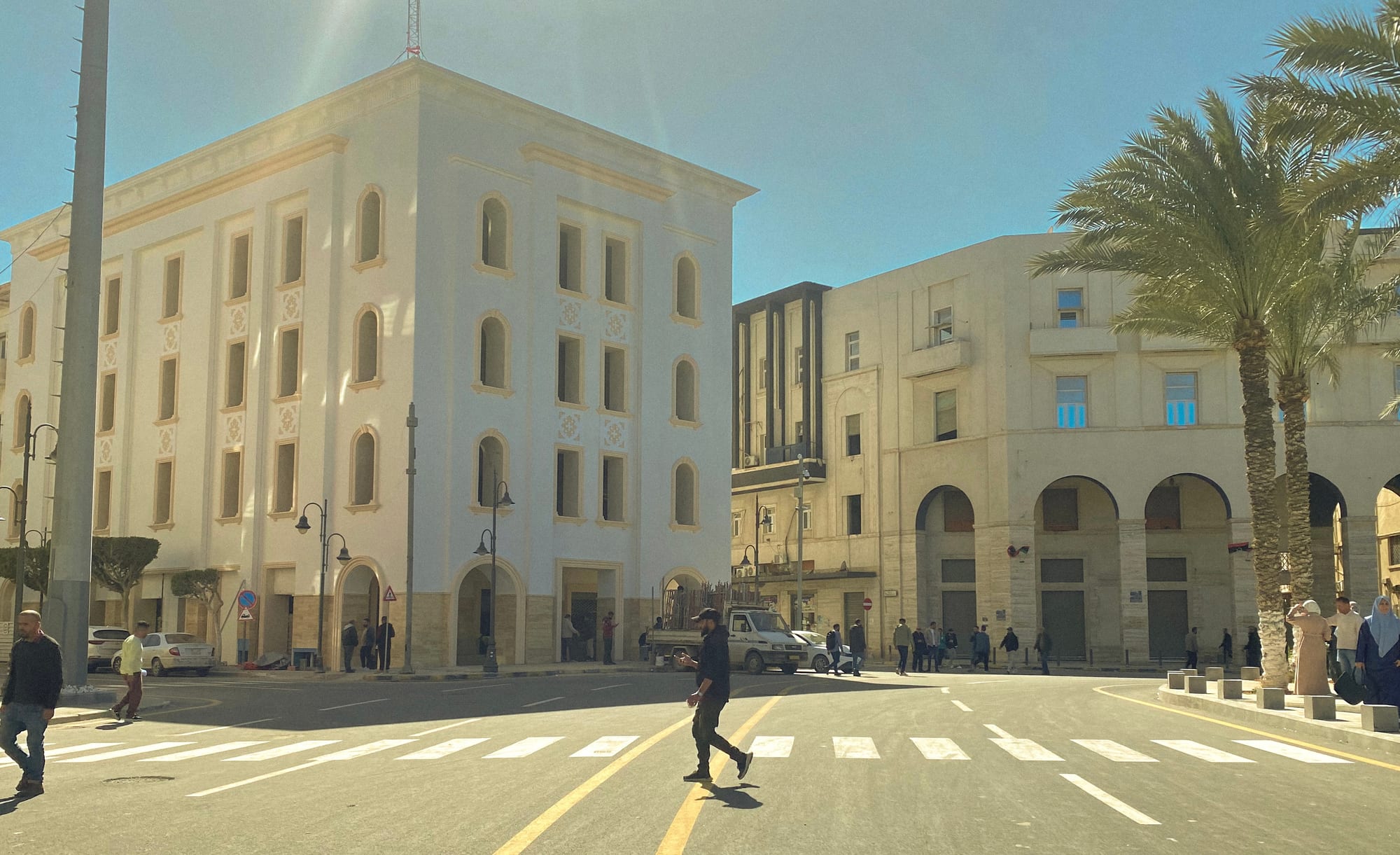
Pale Italian-era buildings with arcades and arched windows around a wide street lined with palm trees

Tripoli & Tripolitania, Libya

Tripoli

Buildings around Martyrs' Square in central Tripoli. (Lojain HB / Wikimedia Commons · CC BY-SA 4.0)

Libya's capital and largest city, on a rocky point of the Mediterranean coast, founded by Phoenicians in the seventh century BC and layered with Roman, Ottoman and Italian building. A walled medina of mosques, courtyard houses and covered souks sits beside the Red Castle and a modern city of ministries and towers. This page is written to explain the city, not to encourage travel.

Neighbourhoods

  • The medina
    • Historic district
    • Markets
    • Architecture

    The walled old city beside the harbour, entered from Martyrs' Square, with narrow lanes, Ottoman mosques, courtyard houses, covered souks for copper, cloth and gold, and the Arch of Marcus Aurelius standing among them. Parts are restored and parts are decayed, and it is small enough to cross on foot.

    Open in Maps
  • Martyrs' Square and the Italian-era centre
    • First-time visitors
    • Architecture
    • Cafés

    The square on the seaward edge of the medina, below the walls of the Red Castle, opening onto the streets of arcaded 1920s and 1930s buildings put up under Italian rule. Ministries, banks, cafés and the older hotels are in these blocks.

    Open in Maps
  • The corniche and the port
    • Waterfront
    • Views
    • Walks

    The seafront road runs from the harbour past the castle and out along the bay, with palms, fishing boats and views back to the old city. It is where people drive and walk in the evening, and the commercial and passenger ports lie at its eastern end.

    Open in Maps
  • Gargaresh and Hay al-Andalus
    • Best for food
    • Shopping
    • Modern city

    The western coastal suburbs, where much of the city's middle class lives. Gargaresh Road is lined with shops, malls, patisseries and restaurants, and the district runs down to beaches and the villas of the shore.

    Open in Maps
  • Souq al-Jumaa and the eastern districts
    • Local life
    • Everyday markets
    • Quiet and residential

    Dense residential districts east of the centre towards Mitiga, named for an old Friday market, with street markets, workshops and family housing rather than sights.

    Open in Maps
  • Tajura
    • Beaches
    • Quiet and residential
    • Day out from the centre

    A coastal town absorbed into the eastern edge of the city, about 23 km east of the centre, with sandy beaches, palm gardens and an old mosque, long used by Tripoli families as a place to escape the city at weekends.

    Open in Maps

Things to do

The old city

  • Red Castlelandmark

    Assai al-Hamra, the fortress above the harbour, rebuilt in layers from Roman times through Spanish, Knights of St John and Ottoman occupations, and home to a museum established in 1919 that was closed from 2011 and reopened in December 2025 as the National Museum of Libya.

    Open in Maps
  • Arch of Marcus Aureliuslandmark

    A four-way Roman arch raised entirely in marble in 165 AD to mark the victories of Lucius Verus over the Parthians, and the chief monument of ancient Oea still standing in the medina.

    Open in Maps
  • Gurgi Mosquelandmark

    An Ottoman mosque built in 1834 for the naval captain Mustafa Gurgi, near the arch, known for its tiled walls, carved marble and painted woodwork.

    Open in Maps
  • Ahmed Pasha Karamanli Mosquelandmark

    An 18th-century mosque begun in 1736 by Ahmed Karamanli, founder of the dynasty, part of a complex that includes a madrasa and the tombs of the Karamanli family.

    Open in Maps
  • The medina souksmarket

    The covered market streets inside the walls, several of them attached to the mosque complexes, where copper, brass, cloth, gold and spices are sold from small shops.

    Open in Maps

Squares and the modern city

  • Martyrs' Squarelandmark

    The city's central square by the sea, built by the Italian colonial administration on the site of the old bread market and renamed several times — Piazza Italia, Independence Square, then Green Square under Gaddafi, and Martyrs' Square after rebel fighters took it in August 2011.

    Open in Maps
  • That El Emad Towerslandmark

    Five towers of eighteen floors each, begun in 1984 and opened in 1990, that dominate the skyline of the modern centre.

    Open in Maps
  • Mitiga International Airporttransit hub

    The city's working airport about 9 km east of the centre, built by the Italian air force in 1923, later the American Wheelus Air Base, civilian since 1995 and since 2018 the only international airport serving Tripoli.

    Open in Maps

Short trips from the city

  • Leptis Magnalandmark

    A UNESCO World Heritage Site since 1982, about 120 km east within present-day Al-Khums — the Roman city enlarged by the emperor Septimius Severus, with its arch, forum, basilica, market and theatre by the sea.

    Open in Maps
  • Sabrathalandmark

    A UNESCO World Heritage Site since 1982, about 65 km west, founded as the Phoenician trading post of Tsabratan and later a Roman port, its theatre keeping a three-storey stage building facing the Mediterranean.

    Open in Maps
  • Tarhunaattraction

    A town about 65 km south-east in the hills above the Jafara plain, a leading producer of olive oil, cereals, figs and grapes.

    Open in Maps

Seasonal events

  • Ramadanthe ninth month of the Islamic calendar, moving through the year

    The month reshapes the city — offices work short hours, the medina and the markets come alive after sunset, and families visit late into the night.

  • Eid al-Fitr and Eid al-Adhaafter Ramadan, and about two months later

    The two main religious holidays, marked by morning prayers, new clothes, family meals and, at Eid al-Adha, the sacrifice of a sheep.

  • Revolution Day17 February

    The anniversary of the start of the 2011 uprising, a public holiday marked with official ceremonies and gatherings.

  • Liberation Day23 October

    A national holiday marking the declaration of liberation at the end of the 2011 conflict.

Eat and drink

Long-standing places and food districts in Tripoli. Hours, ratings and directions come from your maps app, always current.

Tripoli classics

  • The medina's food stallsneighborhood

    Small counters and bakeries inside the walls sell bazin, couscous, lamb soup, sfinz fried dough and shay, the tea boiled to a foam and poured in rounds.

    Open in Maps
  • Gargaresh Road restaurants and patisseriesneighborhood

    The main strip of the western suburbs, lined with grills, pizza and pasta places, shawarma counters, juice bars and cake shops that reflect the city's Italian and Middle Eastern tastes.

    Open in Maps
  • The fish market and seafood grillsmarket

    The catch of the Mediterranean — grouper, bream, prawns and sardines — sold near the port and grilled on the spot in plain restaurants alongside.

    Open in Maps

Everyday food districts

  • Souq al-Jumaa marketsneighborhood

    An eastern district of street markets where vegetables, dates, olives, spices and bread are bought, with cheap kitchens serving rice and stew at lunchtime.

    Open in Maps

Experience Tripoli

History

Phoenician traders founded the city in the seventh century BC as Oyat; it became Oea under the Greek rulers of Cyrenaica, one of the three cities — with Sabratha and Leptis Magna — that gave Tripolitania its name, and the only one to survive antiquity. Under Rome it grew rich on the caravan trade and olive oil, and the marble arch of 165 AD, raised in the reign of Marcus Aurelius, is what remains above ground. Vandals and Byzantines followed, and the Arab conquest of the seventh century made it an Islamic port, its name shortened to Tarabulus.

Normans, Almohads and Hafsids held it before Spain seized the city in 1510; Charles V handed it to the Knights of St John in 1530, and they were driven out by the Ottomans in 1551. Ottoman rule, interrupted by the Karamanli dynasty that ran Tripoli as a near-independent state from 1711 to 1835, made it a corsair capital whose demands for tribute led to war with the United States at the start of the 19th century.

Italy invaded in 1911 and made Tripoli the capital of its colony, laying out arcaded avenues and squares beyond the walls. The city was taken by British forces in 1943 and became a capital of independent Libya in 1951. Oil money transformed it after 1959, and it was the centre of government under Muammar Gaddafi from 1969. In August 2011 it fell to the forces of the uprising and Gaddafi's rule ended. Since then it has been contested by armed groups, endured an assault by eastern-based forces in 2019 and 2020, and remains the seat of the internationally recognised government.

Culture & Customs

Tripoli has always faced the sea, and it shows in the mixture the city carries: Ottoman and Andalusian family names, a Maghrebi dialect close to Tunisian, the remains of a large Italian community that shaped the food and the streets, and long-standing Amazigh and Jewish presences, the second of which ended in the mid-20th century. The old merchant families of the medina still form a recognisable part of the city's identity.

Social life is centred on family and on hospitality. Visits are long, tea is poured in several rounds and the last is often served with peanuts or almonds, and weddings run for days with drumming, ululation and separate gatherings for men and women. Religious observance is mainstream, and Friday prayers and Ramadan set the rhythm of the week and the year. Public entertainment is limited: cafés, football, the beach and family visiting take the place of nightlife, and alcohol is illegal.

Craftwork survives in the souks, where coppersmiths, tailors, goldsmiths and makers of traditional dress still work inside the walls. Malouf, the Andalusian-rooted classical music of the Maghreb, and Libyan popular song are heard at weddings and on the radio. Loyalty to neighbourhood, town and family often counts for more than national politics, and residents speak carefully about the armed groups that operate in the city.

Daily Life

Tripoli had about 1.3 million people in the city at a 2021 estimate, and it dominates the country's administration and commerce. Ministries, the central bank, the national oil company and most large businesses are here, and public-sector salaries funded by oil revenue support a large share of households. Wealth is visible in the western suburbs and the coastal villas; damaged and neglected housing is visible elsewhere.

The day begins early, pauses in the afternoon heat and revives in the evening, when the corniche, the shopping streets of Gargaresh and the malls fill up. Families spend Fridays at the beaches east and west of the city. Traffic is heavy, and checkpoints run by different armed groups are part of ordinary journeys.

The recurring difficulties are power cuts, water interruptions, fuel queues, shortages of cash at the banks and the swings of the parallel exchange rate. Periodic clashes between armed groups close streets and schools for days at a time. The city has also absorbed people displaced from other parts of Libya since 2011, and it is a major point on the migration routes across the Mediterranean, with large migrant communities working in construction and services in difficult conditions.

Food

Tripoli's kitchen mixes Maghrebi, Ottoman and Italian habits. Bazin, a firm dome of unleavened barley dough eaten with a meat and tomato stew, is among the dishes most associated with Libyan home cooking. Couscous is steamed and served with lamb or chicken and vegetables, and shorba, a lamb and vegetable soup with mint and tomato paste, is the standard opening to the Ramadan iftar.

Pasta remains from the Italian period, cooked in a Libyan way: imbakbaka, pasta simmered in one pot with meat in a spiced tomato sauce, and rishta, homemade noodles cooked in a tomato sauce. Usban, made of guts stuffed with offal and herbs, is a festival dish, and grilled fish from the Mediterranean is the speciality of the restaurants near the port. Street food runs to shawarma, falafel and sfinz, a fried dough eaten with sugar or egg for breakfast.

Sweets are dense and sugary — maqrud, semolina pastries filled with dates; ghraiba, crumbling biscuits; and Italian-derived cakes from the patisseries of the western suburbs. Dates come from the desert oases, and olive oil from the groves of the Jafara plain and the Nafusa mountains. Tea is boiled until a thick foam forms, poured from a height and drunk in three rounds; coffee is Italian in style, and alcohol is not sold.

Planning tools

Budget

There is no tourist economy in Tripoli. The few foreigners in the city are on business, diplomatic or aid work, arrive with a local sponsor, and pay for secured hotels, drivers and security staff, which sets costs far above what the country itself is like to live in. Cash matters, because banks have repeatedly run short of it and street exchange rates have often differed from the official one.

Daily Budget Midrange
USD 200–400+ (secured hotel in Tripoli, driver, fixer; paid largely in cash)
Daily Budget Shoestring
USD 150+ (the lowest realistic cost through a sponsor, with a basic hotel and a driver; independent budget travel is not possible)

Any visit has to be arranged through a sponsor with security and logistics in place; there is no independent travel.

Best Time to Visit

In principle the mild months from October to April suit the city and the Roman sites along the coast, and spring is the pleasantest season before the summer humidity. In practice the security situation and official advice, not the season, decide whether any travel is possible.

Suggested Number of Days

The walled old city and the central squares can be seen in about two days at a slow pace. Four allow for the Roman sites along the coast on either side, which involve long drives and checkpoints. Movement, not distance, sets the pace.

First Visit
2 days
With Surroundings
4 days

Transportation

There is no metro, tram or passenger railway. The city runs on private cars, shared taxis and minibuses, and traffic on the main roads and the coastal highway is heavy. Foreign visitors travel with a driver arranged through their sponsor or security provider, and armed checkpoints are a normal part of moving around the city and between districts.

Plan every movement with trusted local contacts and a security provider, and expect routes to change at short notice.

Airport & Station Connections

A visa is required for most nationalities and is difficult to obtain. It is issued by a Libyan diplomatic mission or through the e-visa system introduced in 2024, normally on the basis of an invitation from a Libyan sponsor, company or licensed tour operator, and a short list of mainly Arab and African nationalities is exempt. Flights are limited and subject to sudden suspension, and they use Mitiga International Airport, about 9 km east of the centre; Tripoli International Airport, south of the city, was heavily damaged in fighting in 2014 and has not carried scheduled flights since. Overland arrival is by the coastal highway from the Tunisian border at Ras Ajdir, about 170 km west.

Walkability

The medina and the streets around Martyrs' Square are flat, compact and in themselves easily walked, and the corniche runs on from them along the sea. The rest of the city is spread out and built for cars, with wide roads and long distances between districts. In practice, where and whether a foreign visitor walks at all is decided by security advice rather than by the map.

Safety

Most governments advise against all travel to Libya, including Tripoli. The city is the seat of an internationally recognised government, but armed groups control much of the security on the ground, and fighting between them has broken out repeatedly in the capital and nearby towns. Risks include kidnapping, terrorism, crime, unexploded ordnance from past fighting, and arbitrary detention at checkpoints. There is little or no consular help available.

Globeway covers Libya so its history and its recent tragedy can be understood — not to suggest a visit. Anyone with an unavoidable reason to go must take professional security advice and read their government's current advisory in full. Check current official travel advice before travelling.

Climate

Mediterranean, with hot, dry, humid summers and mild winters that bring most of the year's modest rainfall. The ghibli, a hot dust-laden wind off the Sahara, can raise temperatures sharply in spring and autumn and fill the air with sand.

Summer
hot and humid, generally around 30–35°C by day from June to September, with warm nights and very little rain
Winter
mild and damp, roughly 9–18°C, with rain and wind between November and March

Local Customs

Libya is a conservative Muslim country and dress is expected to be modest: long trousers or skirts and covered shoulders, and a headscarf for women at mosques. Alcohol is illegal and there are severe penalties for it. Greetings are unhurried, hospitality is pressed on guests, and tea served in several rounds is the standard courtesy. Ramadan changes the working day, and eating or smoking in public during daylight causes offence.

Do not photograph people without permission, and never photograph checkpoints, military or government buildings, ports or airports; unmarried couples should not expect to share a hotel room, and tipping is modest and discretionary.

Common Payment Methods

The currency is the Libyan dinar. The banking system is strained, cards issued abroad are of little use, and there has at times been a wide gap between the official exchange rate and the parallel market. Payments are made in cash, and visitors bring US dollars in cash to change.