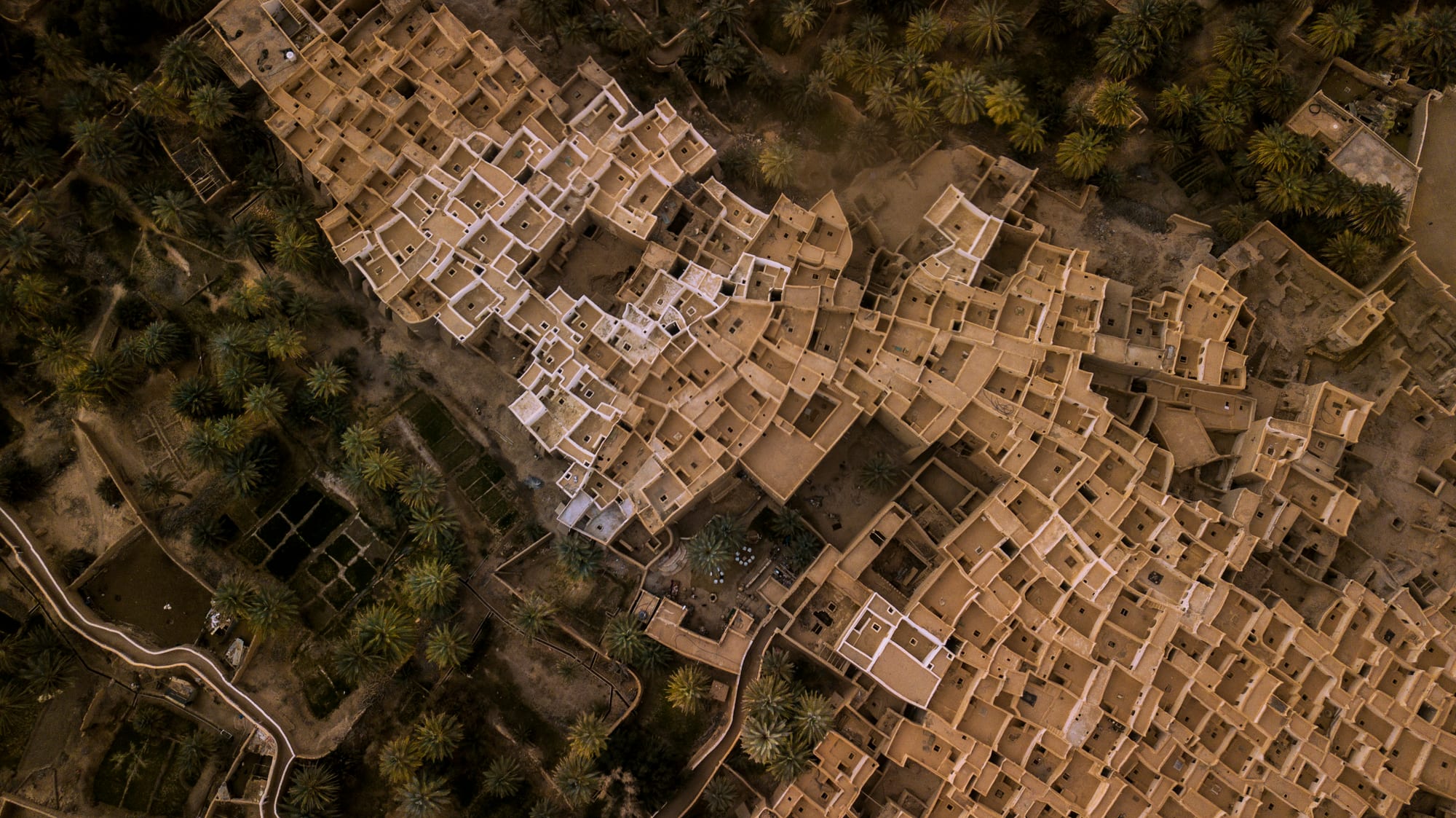
Aerial view of tightly packed pale mud-brick houses and rooftops beside dark green palm gardens

Libya

Tripoli & Tripolitania

The old town of Ghadames and its palm gardens from the air. (Mohamed alazrak / Wikimedia Commons · CC BY-SA 4.0)

Libya's populous northwest, from the capital Tripoli along the coast to Misrata and Sirte and inland to the Nafusa mountains and the oasis of Ghadames — the land of the Roman cities of Leptis Magna and Sabratha, and today the seat of a Tripoli-based government amid rival armed groups. This page is written to explain the region, not to encourage travel.

Explore Tripoli & Tripolitania

History

Phoenician traders founded three coastal towns here — Oea, which became Tripoli, Sabratha and Leptis Magna — and the Greek name Tripolis, "three cities", gave the region its name. After Carthage fell they passed to Numidian and then Roman rule, grew rich on olive oil and the Saharan trade, and Leptis reached its height under Septimius Severus, born there in 145, who lavished buildings on his home town. Ghadames, the Roman Cidamus, was the gateway for caravans heading south.

Arab armies arrived in the 640s, and the Amazigh of the Nafusa mountains became followers of Ibadi Islam, which some of their towns still keep. Spain seized Tripoli in 1510 and handed it to the Knights of St John, and the Ottomans took it in 1551. Under the Karamanli dynasty, which ruled from 1711 to 1835, Tripoli was a corsair port whose demands for tribute led to war with the United States in 1801.

Italy invaded in 1911, built a European new town in Tripoli and settled colonists on the coast. After independence Tripoli became the capital, and in 2011 the region was central to the uprising: Misrata held out through a long siege, the Nafusa mountains became a rebel stronghold, and Gaddafi was killed at Sirte, near his birthplace. The Islamic State group held Sirte in 2015–2016. In 2019–2020 eastern-based forces under Khalifa Haftar tried to take Tripoli before a ceasefire in October 2020, and since then control of the region's towns has been divided among local armed groups aligned, to varying degrees, with the rival authorities.

Culture & Customs

Tripolitania looks to the Mediterranean and to Tunisia, and its dialect is partly intelligible to Tunisians. Tripoli's old families, merchant clans and long-established Italian community, now gone, gave the capital a cosmopolitan past. Misrata has a strong identity as a city of traders and, since 2011, of a powerful local armed force and business class.

The Amazigh are the region's main minority, concentrated in the Nafusa mountain towns such as Yefren, Jadu, Kabaw and Nalut, and on the coast at Zuwara. Their language and culture, suppressed under Gaddafi, have been promoted openly since 2011. The people of Ghadames are also mainly Berber.

Weddings are grand, family affairs lasting several days, Ramadan evenings are spent visiting, and tea poured in several rounds is the ritual of hospitality. Loyalty to town and tribe often counts for more than national politics.

Daily Life

Tripoli has over a million people and dominates the region, with Misrata, Zawiya, Zliten, Khoms and Gharyan the other main towns; Sirte is smaller. Ministries, the central bank, the national oil company and most businesses are based in the capital, and the Mellitah gas complex west of Tripoli exports gas to Italy by pipeline.

Life goes on despite the politics: cafés and malls in Tripoli, fishing and farming on the coastal plain, olive groves and figs in the Nafusa. Public-sector salaries funded by oil pay a large share of families. Power cuts, fuel queues, cash shortages, and bouts of fighting between armed groups disrupt daily life.

Many families displaced since 2011 have returned, but some towns still show the damage of past battles.

Food

Tripoli's kitchen shows the city's past: Ottoman stews, Maghrebi couscous and an Italian taste for pasta. Imbakbaka is pasta cooked in one pot in a spiced tomato sauce with meat, and rishta is homemade pasta. Osban is guts stuffed with offal and herbs, and sharba is a lamb and vegetable soup with mint and tomato.

Bazin, a dome of barley dough in a sauce of lamb, potatoes and eggs, is one of the best-known Libyan dishes. Along the coast, fish is grilled or cooked in sauce, and the Nafusa mountains produce olive oil and figs. Ghadames and the desert oases supply dates.

Sweets include maqrud, semolina pastries filled with dates. Libyan tea, boiled to raise a foam, is served in rounds, the last sometimes with peanuts or almonds.

Attractions & Natural Wonders

Leptis Magna, a UNESCO World Heritage Site, lies on the shore near Khoms: the four-way Severan arch, the Severan forum and basilica, the market, the theatre and an amphitheatre. Sabratha, also a World Heritage Site, west of Tripoli, has its restored stage building with three storeys of columns, temples and mosaics.

Tripoli's medina holds the Gurgi and Karamanli mosques, Ottoman houses and the Arch of Marcus Aurelius, built in the 2nd century AD, while the Red Castle, Assaraya al-Hamra, rises beside Martyrs' Square and houses the national museum. Misrata has a long waterfront and a busy port.

Inland, the Nafusa mountains rise as an escarpment above the Jafara plain, with the granary of Qasr al-Haj, the fortified qasr of Nalut and the old towns of Kabaw and Yefren. The old town of Ghadames, a UNESCO World Heritage Site, has covered lanes, rooftop terraces once reserved for women, and palm gardens.

Cities in Tripoli & Tripolitania

Planning basics

Budget

There is no tourist economy. The few foreigners who come are on business, diplomatic or aid work, with a local sponsor, and pay for secured hotels in Tripoli, armoured transport and security staff. Cash matters, because banks have repeatedly run short of it, and exchange rates on the street have often differed from the official rate.

Daily Budget Midrange
USD 200–400+ (secured hotel in Tripoli, driver, fixer; paid largely in cash)
Daily Budget Shoestring
Not realistically applicable in the current security situation

Any visit has to be arranged through a sponsor with security and logistics in place; there is no independent travel.

Safety

Most governments advise against all travel to Libya, including Tripolitania. Tripoli is the seat of an internationally recognised government, but armed groups control much of the security on the ground, and fighting between them has broken out repeatedly in the capital and nearby towns. Risks include kidnapping, terrorism, crime, unexploded ordnance from past fighting, and arbitrary detention at checkpoints.

Globeway covers Libya so its history and its recent tragedy can be understood — not to suggest a visit. Do not travel without an unavoidable reason, professional security support and a full reading of official advisories. Check current official travel advice before travelling.

Climate

The coast from Zuwara to Misrata is Mediterranean: hot, humid summers and mild winters with most of the year's rain. The Nafusa mountains are cooler, while Ghadames and the interior are desert, with searing summer heat. Dust-laden winds from the Sahara can push coastal temperatures far above normal.

Summer
hot, around 30–35°C in Tripoli, far hotter inland and at Ghadames
Winter
mild and wet on the coast, around 9–18°C; cold nights in the mountains and the desert

Transportation

Tripoli's Mitiga airport and Misrata's airport handle the region's flights, which are limited and subject to sudden suspension. There is no passenger railway. The coastal highway links Zuwara, Tripoli, Misrata and Sirte, and roads climb to the Nafusa towns and run on to Ghadames, but armed checkpoints line the routes and clashes can close them without warning.

Plan every movement with trusted local contacts and a security provider, and expect routes to change at short notice.

Best Time to Visit

In principle, October to April suits the Roman sites and Ghadames, and spring is green in the Nafusa. In practice, the security situation and official advice, not the season, decide whether any travel is possible.