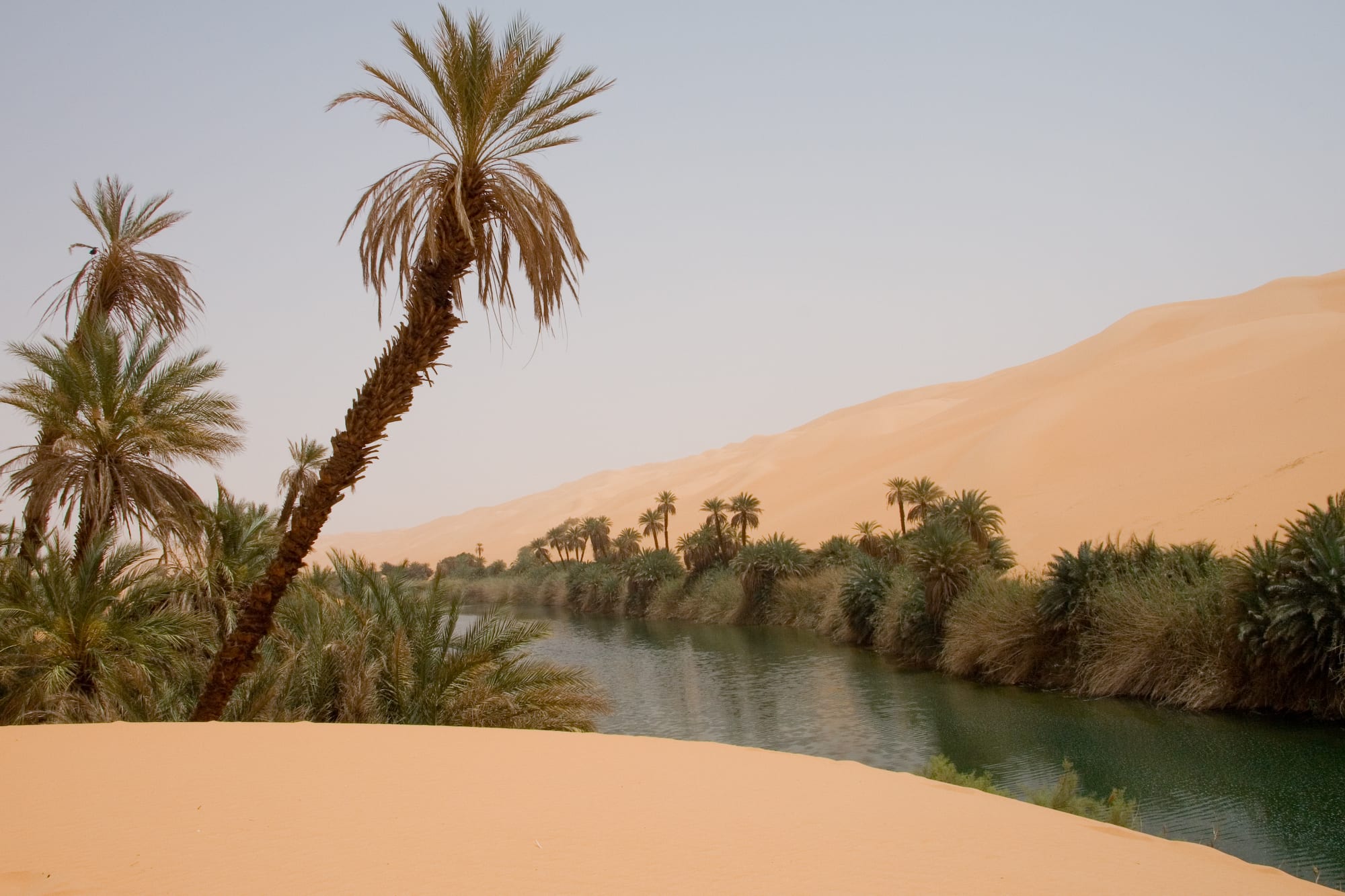
A green lake fringed with date palms and reeds beneath a tall orange sand dune in the Sahara

Libya

The Fezzan

A palm-fringed lake among the dunes of the Ubari sand sea in the Fezzan. (Luca Galuzzi (Lucag) / Wikimedia Commons · CC BY-SA 2.5)

Libya's desert southwest, a land of sand seas, oasis valleys and rock plateaus centred on the town of Sabha, home to the ancient Garamantes and today to Arab, Tuareg and Tebu communities, with the Ubari lakes, the rock art of the Acacus near Ghat, the Murzuq sand sea and the country's largest oilfield. This page is written to explain the region, not to encourage travel.

Explore The Fezzan

History

The Fezzan was green long before it was desert, and its rock paintings and engravings record elephants, giraffes and cattle herders from the wetter Sahara of thousands of years ago. Settled here by about 1000 BC, the Garamantes built a kingdom, with its capital at Garama, modern Germa, drawing water from underground channels called foggaras, farming the oases and trading across the desert. They clashed often with Rome, and in 203 Septimius Severus captured Garama before abandoning it.

The Fezzan became a staging post on trans-Saharan routes carrying slaves and other goods between the Mediterranean and Lake Chad. From the 16th century the Awlad Muhammad dynasty ruled from Murzuq, which became a caravan centre, until 1812, at times under Ottoman overlordship. European travellers such as James Richardson, who described Ghat in 1845–1846, crossed it in the 19th century.

Italy took the Fezzan from the Ottomans in 1912, but its hold long remained precarious. In the Second World War Free French forces advanced from Chad, and France administered the region until Libyan independence in 1951. Under Gaddafi, who went to school in Sabha, the Fezzan remained a stronghold of his support through much of the 2011 war. Since then local tribes have complained that they see little of the oil money, and the region has seen local clashes, protests that shut the Sharara oilfield, and rival national forces competing for influence.

Culture & Customs

The Fezzan is Libya's most mixed region. Arab tribes live in Sabha and the oasis valleys, the Tuareg in Ghat and around Ubari, and the Tebu in Murzuq, Qatrun and the far south. Each keeps its own language — Tamasheq for the Tuareg, Tedaga for the Tebu — along with its own dress and customs, and loyalty to tribe and community runs deep.

The Tuareg men's indigo or white veil, the tagelmust, silver jewellery and leatherwork belong to a culture shared with Algeria, Niger and Mali. Murzuq held Libya's first Toubou national festival in 2013. The Tebu have ties to Chad and Niger, and the region's trade and kinship networks cross the borders.

Hospitality is the desert's first rule. Guests are welcomed with tea poured in three rounds and offered dates, and in the oases gardens and palm groves are tended with care passed down between generations.

Daily Life

Sabha, the Fezzan's largest city, is the region's hub, with its university, markets and airport. Ubari, Ghat, Murzuq, Brak and Germa are small towns strung along the oasis valleys of Wadi al-Hayaa, Wadi al-Shatii and the Murzuq basin, with much of the land in between uninhabited.

The Sharara oilfield in the Murzuq Desert is Libya's largest, and the Great Man-Made River draws water from beneath the desert for the coast. Most local people live from public salaries, farming date palms and irrigated grain, trade and, for some, smuggling fuel, goods and people across the southern borders.

Fuel and cash shortages, long power cuts, poor services and insecurity weigh on daily life, and many residents feel forgotten by governments in the north. The Fezzan is also a main route for migrants travelling north from countries further south.

Food

Desert food is plain and filling. Bazin, a stiff barley dough with a meat or vegetable sauce, and couscous are staples, and camel and goat meat are eaten alongside lamb. The Tuareg bake taguella, a flat bread cooked in the hot sand under embers, which is broken up and eaten with a meat sauce.

Dates are the region's great harvest, eaten fresh, dried or pressed into date syrup, and the oasis gardens grow tomatoes, onions, peppers and grain under the palms. Dried meat and milk from camels and goats carry herders through the desert.

Tea is the centre of every gathering: among the Tuareg, as across the Maghreb, at least three glasses are usually served.

Attractions & Natural Wonders

The Ubari sand sea holds a string of lakes in the dunes between Ubari and Germa, including Gaberoun and Um el-Ma, surrounded by palms and reeds and fed by groundwater. Near Germa are the ruins of Garama and the tombs of the Garamantes, and to the south the Messak plateau is known for its large rock engravings of animals.

In the far southwest, the Tadrart Acacus mountains near Ghat, a UNESCO World Heritage Site, have dunes, arches, gorges and deep wadis with paintings and carvings of giraffes, elephants, ostriches and camels, and of people and horses. Ghat itself lies below the fortress the Italians built on Koukemen hill.

The Murzuq sand sea spreads south of the Messak, a vast field of high dunes, with the old caravan town of Murzuq on its edge. Sabha, at the region's centre, has Fort Elena, the Italian-built fort shown on the ten-dinar note, and the markets where desert traders met.

Cities in The Fezzan

Planning basics

Budget

Desert tourism, once organised from Sabha, Ubari and Ghat with 4x4 convoys and Tuareg guides, stopped after 2011. Today there is no tourist infrastructure, and the few outsiders who come are on oil, aid or research work with heavy security, at very high cost.

Daily Budget Midrange
Not realistically applicable; costs depend entirely on security arrangements
Daily Budget Shoestring
Not realistically applicable in the current security situation

There is no possibility of independent travel in the Fezzan.

Safety

Most governments advise against all travel to Libya, and the Fezzan is among its most dangerous areas. The state is thinly present; armed groups linked to local communities, tribes and the rival national authorities compete for control; kidnapping of foreigners, banditry, smuggling of fuel, weapons and people, and clashes between communities are all serious risks, as are the heat and the empty desert.

Globeway covers Libya so its history and its recent tragedy can be understood — not to suggest a visit. Do not travel to the Fezzan. Check current official travel advice before travelling.

Climate

Ubari lies in one of the sunniest and driest areas in the world. Summer days regularly reach 40°C in Sabha, which gets less than 10 mm of rain a year, and winter nights are cold.

Summer
extreme heat, commonly around 40°C and above
Winter
mild days around 19°C in January, cold nights around 5°C

Transportation

Sabha has an airport with occasional domestic flights. Long roads cross the desert from Sabha to Tripoli, to Ubari and Ghat, and south to Murzuq and Qatrun, but checkpoints are run by different armed groups, and the southern borders with Niger, Chad and Algeria are used by smugglers and armed groups. Travel to the dunes and the Acacus needs 4x4 vehicles and guides.

No journey in the region should be considered without professional security and an armed escort.

Best Time to Visit

Before 2011, desert trips ran from November to March, the only months when the heat is bearable. Today the security situation, not the season, rules out travel.